Posts Tagged ‘Blissville’
suitable apparatus
– photo by Mitch Waxman
As the redolent cargo of my camera card revealed- this “Grand Walk”, a panic induced marathon which carried your humble narrator across the East River from St. Patrick’s Old Cathedral in Manhattan into Williamsburg and up Grand Street to Maspeth and the baroque intrigues of the Newtown Creek– wound down into it’s final steps on Laurel Hill Blvd.
Examining the images recorded on my camera, photos which I don’t remember taking, the ineluctable feeling that something was missing from the modern scene was inescapable.
from wikipedia
Nichols, along with his son Charles W. Nichols, helped organize the merger of 12 companies in 1899 to create General Chemical. Under his leadership, the company grew its asset base and increased its earnings threefold, making Nichols a force in America’s fledgling chemical industry. His vision of a bigger, better chemical company took off when he teamed up with investor Eugene Meyer in 1920. Nichols and Meyer combined five smaller chemical companies to create the Allied Chemical & Dye Corporation, which later became Allied Chemical Corp., and eventually became part of AlliedSignal, the forerunner of Honeywell’s specialty materials business. Both men have buildings named after them at Honeywell’s headquarters in Morristown, New Jersey. His original plant along the Newtown Creek in Queens is infamous for its legacy of pollution. Nichols is rumored to have once emptied vats of excess sulfuric acid into the creek rather than sell it cheaply to a businessman he had no respect for.

– photo by Mitch Waxman
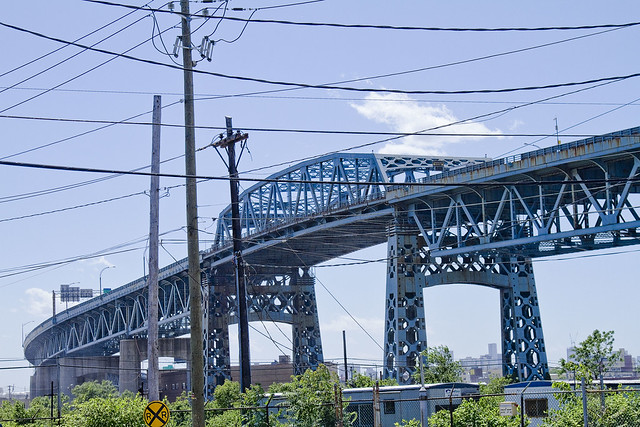
Nichols Chemical, from which the legendary Phelps Dodge Laurel Hill plant would someday sprout, would have been found along the Newtown Creek nearby the thrice damned Kosciuszko Bridge – which is itself doomed and consigned to the stuff of future reminiscence. At it’s apex, this industrial site employed 17,500 people and squatted along some 36 square acres of the Creeklands.
The tallest chimneys in the United States (at the time) stabbed at the sky from here, painting the Newtown sky with poison effluvium whose pH content was sufficient to cause marble and granite to melt like ice cream left to the merciless gaze of the burning thermonuclear eye of god itself.

– photo by Mitch Waxman
The Kosciuszko Bridge is slated for demolition and replacement in a few short years of course, and this scene will irrevocably alter when a modern structure is put in place. The high flying bridge was built large to accommodate the sort of ocean going craft which were common in the 1930’s- cargo and passenger vessels with enormous smokestacks that would have been serviced and outfitted by other corporations just up the Creek.
Additionally, the war department held certain intentions and reserved the option to sequester battleships in Newtown Creek, with the intentions of protecting the vital industrial center from a safe inlet, were an invasion of North America attempted by hostile European adversaries via New York Harbor.
When a manufacturing establishment decides to increase its output fivefold; when it decides to tear down its present buildings and put up new ones; and when it owns valuable waterfront which is marketable at a high price, that concern considers carefully the question whether it will remain in its present location or move to some other. Now our friends above mentioned would doubtless at once aver that, if this concern was a New York concern and found itself in this situation, there could be but one answer—”To Jersey for us”— or to some other place near land’s end where land can be purchased for a song, where government regulations are unknown and where, in addition, the manufacturer would find himself surrounded by a great and aching void.
But all these prophesies are as wormwood and the pessimists are confounded. Over In the wilds of Queens there Is a place—look it up on the map—called Laurel Hill.
Laurel Hill is not a place of beauty. The undulating hills in them neighborhood are covered with cemeteries, rocks, and ugly houses and through the midst of it all (lows the far-famed Newtown Creek, covered at all times during the day and night with busy water craft. But Laurel Hill is one of the most important manufacturing districts in Greater New York and Newtown Creek is one of the foremost commercial arteries in or about NewYork City.

– photo by Mitch Waxman
One of the aphorisms which has emerged in my studies of Newtown Creek and the surrounding communities is this: “all roads lead to Calvary“.
Whether it be ancient ferry lines which fed the street car roads, or the occluded pathways of the aboriginal Mespaetche and Decadent Dutch, all the roads of western Queens and North Brooklyn point inevitably to this spot. Semi conscious during this “Grand Walk”, your humble narrator nevertheless found himself at the corner of Laurel Hill Blvd. and Review Avenue once again, standing before the great and sacred Polyandrion of the Roman Catholic church in New York City.
Perhaps the foremost industry at Laurel Hill is the Nichols Copper Company. To this factory each year come by boat and by rail thousands of tons of copper, some of it in the raw state— the ore—and much of it already in bars ready for the final refining. The copper is refined here and put into a variety of forms and shapes ready for the market. The raw material comes in from the Lake Superior region, from Mexico, and even from more distant South America. The finished product goes to manufacturers in all parts of the world. The annual value of this product is over $60,000,000, and there are between seventeen hundred and eighteen hundred men engaged in converting the raw copper into the refined product which has made this factory famous tne world over.
In this factory, located within Greater New York, there is three times as much copper refined as in any other factory in the United States.

– photo by Mitch Waxman
Here lies Tammany, the Dead Rabbits, and a good percentage of those colorful characters who populated the “Bloody Sixth Ward” of the Five Points in 19th century New York. Here lies the Newsboy Governor, the “Original Gangster“, and the rightful heirs to the throne of Ireland rest within the ground consecrated by the legendary prelate called “Dagger John” alongside the “Fighting 69th” and “the 21” and the “Abbot“. Here is the secretive cruciform shaped repository which contains the remains of thousands of priests and nuns, in a catacomb which lies some 50 feet below the Almirall Chapel.
Additionally, here might be found the grave of a man who died in 1718, lying with both his descendants and his african slaves in the only Protestant burial ground entirely contained by a Catholic cemetery in North America.
And from above, that thing in the Sapphire Megalith which neither thinks nor breathes but instead hungers, watches.
from Illustrated history of the borough of Queens, New York City, 1908, courtesy google books
The Alsop family was also among the early settlers. Richard Alsop, the first of the name to locate here, came at the request of his uncle, one Thomas Wandell, who was said to have left England because he had become involved in a quarrel with Oliver Cromwell, though this report is doubtful, for it is known that Wandell was living at Mespat Kills in 1648, or before Charles I was put to death. He had secured a considerable tract of land by patents and purchase which he left to his nephew, Richard Alsop. The family he founded became extinct in 1837 when the last of the name died without issue.
little memories

– photo by Mitch Waxman
The thing I like about walking the earth is that one moves at a slow pace, and it’s possible to notice the little things otherwise obscured by vehicular speed which line the streets of the great metropolitan city. Whether it be an altar following the precepts of some cultic faith, or the odd things which might be observed at the fence lines of area cemeteries, or just the footpath leading to a homeless camp- these small details are obscured by speed. This phenomena first became apparent to me when still a teenager, before the hellish green flame of revelation was lit in my mind.

– photo by Mitch Waxman
For many years, just where the high flying Queens Midtown Expressway returns vehicular traffic to ground at Greenpoint Avenue and it transmogrifies into the Long Island Expressway, behind one of the ramps that lead from VanDam, there was a long established and quite populous homeless camp. As an aside, I should mention that your humble narrator has a scary rapport with these often debased, dangerous, and diabolical men (few women take up residence in these places, I’ve observed) which has caused me no small amount of concern. Personal experience and the social class which I was born into (working class, there was always plenty to eat, and Dad owned a car) would normally preclude any interaction at all with such vagabonds (called Bums up till sometime in the mid 80’s), but for some reason, “the street” and I understand each other. The stories told by such men, often told in return for a hip pocket flask of cheap libation, reveal a side of our community which won’t be recorded by history.

– photo by Mitch Waxman
The camp at this location has recently been swept out, no doubt due to the attentions of the NYPD and certain policies enacted by the City Fathers in Manhattan designed to offer proper shelter to a vulnerable and often mentally ill population in need of doctoring. Such progressive policies are the responsible and “Christian” thing to do, of course, as those of us who manage to claw our way through the dark and find purchase on the socioeconomic ladder are presented with the moral quandary of helping those who cannot. My experience with the homeless, though, is that by and large it’s not “cannot” – it’s “will not”. When I lived on what is now called the “Upper West Side” in Manhattan, my pal Henry whose last address was a car parked alongside Needle Park once told me that the tramps had their own world with certain social hierarchies, and were the true New Yorkers. Another unfortunate, Raggedy Andy, described interaction with “the world” as painful for him- he preferred the life of the streets to the rote and obligations presented to him by the “do gooders”, social workers, and the nemesis gendarme.

– photo by Mitch Waxman
All that remains to indicate their morbid habitation is a cooking pan, several dog eared books, and the soiled bedding which typifies such ad hoc agglutinate communities. Encounters with these men, while dangerous for an unarmed visitor, have instead filled my mind with wonder. Tales from Latino day laborers along Broadway in Astoria about a white man with a strange mustache in a late model red van from whom you should never accept an offer of work, as those who go with him are never heard from again. Second hand reports from a mendicant on Grand Avenue in Maspeth about a thing which has been seen around the extant sections of English Kills, described as a sort of small dog which walks about on two legs, and descriptions of some enormous and shining black shape seen slithering around in Maspeth Creek during moonless nights have all been related to me. Obviously addled by liquor and narcotics and informed by madness, the witnesses are suspect at best, but as always, your Newtown Pentacle presents what is offered to it “as is” without varnish or judgement. One wonders though, about this burned out ancient house in Blissville- not far from Calvary Cemetery- and the secrets which might lie hidden in it’s worm eaten walls.
May 21st

– photo by Mitch Waxman
The show must go on, as they say, yet your humble narrator is of heavy heart in announcing the Newtown Creek tour of May 21st, 2011- which is offered for your consideration by the Working Harbor Committee.
It is not the task of course, which tempers the normal ebullience experienced when an opportunity to share the wonders of the Newtown Creek with a group of enthusiasts from the comfort and safety of a modern vessel like the MV American Princess (which is outfitted with all the amenities one would expect to find during a harbor trip in a tourist Mecca such as New York City), crosses my path.
It is not that unnatural and uncontrollable timorousness which plagues me when I am asked to speak before “this group of pale enthusiasts” or “that gang of antiquarians”. Revealing and sharing the history of this amazing place is one the things I revel in, and brings me close to understanding what joy must be like.
from workingharbor.com
Visit Beautiful Newtown Creek Saturday, May 21, 2011
On MV American Princess, Boat departs from Pier 17, South Street Seaport, Manhattan NYC, 10am – 1pm
Souvenir Tour Brochure with historical information and vintage maps. Narration by experienced historical and environmental guest speakers. Complimentary soft drinks will be served. Come aboard for an intense Newtown Creek exploration! Our comfortable charter boat will travel the length of Newtown Creek. The tour will pause at many interesting locations for narration and discussion. Guest narrators will cover historical, environmental, and conservation issues. Large comfortable vessel with indoor & outdoor seating. Cruise runs rain or shine. Price: $60
To purchase tickets click here
or contact Tour Chairman Mitch Waxman: waxmanstudio(AT)gmail.com

– photo by Mitch Waxman
This is where the Industrial Revolution happened, and this trip will transverse and offer certain observations about the Newtown Creek’s present form and usage, and reveal a potentially bright future which this neglected ribbon of water- which provides the currently undefended border of Brooklyn and Queens- were it to be revitalized and renewed, might offer the future.
After boarding at South Street seaport, Working Harbor’s maritime experts will discuss the waterfront of Brooklyn as we pass beneath the Brooklyn Bridge and Manhattan Bridge, and finally passing under the Willamsburg Bridge. Our vessel will smoothly move past the neighborhoods of Dumbo, Williamsburg, and Greenpoint in Brooklyn, and offer spectacular views of Manhattan. This entire trip will be a photographer’s delight, incidentally, offering spectacular and unreal urban panoramas.

– photo by Mitch Waxman
At Long Island City, your humble narrator will presume to expose you to a short history of the Newtown Creek, and offer an identity to some of the enigmatic structures arrayed around the troubled industrial waterway.
Luckily for all concerned, there are other speakers who will relieve the crowd from my droning prattle, maritime experts and environmentalists included. Around Newtown Creek Alliance headquarters, there is some buzz amongst the staff about which one of the heavyweight orators will be onboard.
Soft drinks, one to a customer, will be complimentary as well.

– photo by Mitch Waxman
The American Princess will proceed past the titan Newtown Creek Waste Water Treatment Plant, the malign Dutch Kills, the cyclopean SimsMetal dock, the brutal symmetry of the Greenpoint Avenue Bridge, through the agglutinated heart of the Greenpoint Oil Spill, past the severed Penny Bridge at Meeker Avenue, and beyond the emerald devastations of Calvary Cemetery.
Then, we’re going to take a moment to remember our fallen friend… for just a moment.
I’m hesitant to mention this… as this is not what this trip is meant to be about, this is not a memorial event… but Bernie Ente is and will be so profoundly missed by many of us who will be conducting this tour, of which he is the originator and founder of… it would be in bad taste if a moment of silence to remember him, in this place which he expended so much of his attentions revealing and teaching and guiding about, were not offered. More on this in a later posting, but as the initial line says “the show must go on”, and that is exactly what Bernie would have us do.

– photo by Mitch Waxman
The course will continue, past the middle point of the Newtown Creek, and will plunge past the Maspeth Plank road, past the Phelps Dodge site and the Kosciusko Bridge. At the branching of the Newtown Creek which exists at the confluence of the East Branch and English Kills, we will witness the remains of the Maspeth Plank Road and approach the wicked end of the navigable section of the Newtown Creek itself and approach one the hydra like tributaries which spread languishing tendrils of rotting bulkheads and unused yet prime industrial waterfront locations all across Brooklyn and Queens.
This is not the world you know.

– photo by Mitch Waxman
Witness the startling elegance of the Grand Street Bridge, a century old swing bridge connecting Brooklyn and Queens, which signals the entrance to English Kills has been reached. Industrial heartland, this is a grossly contaminated section of the waterway which has- of course- been designated as a Federal Superfund site. Seeing the Newtown Creek in this state, this bizarre half life which is neither tick nor tock- industrial nor residential, is a fairly short term proposition.
Vast changes are coming which will literally alter the very landscape.

– photo by Mitch Waxman
The Kosciusko Bridge replacement, and the enormous new populations and residential conversion in progress and expected in Hunters Point South and Greenpoint, and the EPA conducting the initial stages of Superfund remediation (which will involve dredging and vast public works projects conducted by hundreds of contractors) will all be happening in roughly the same timeframe. Ten years from now, it will hard to recognize the place, and twenty more will render it a stranger to those who know it today.
In the English Kills, you will become transfixed by a waterfront frozen in some other century, and witness the extant vitality of those economies of heavy industry which build, and drain, and recycle, and dispose of. You don’t get Manhattan without a Newtown Creek, after all.

– photo by Mitch Waxman
We will proceed into the depths of English Kills near the Third Ward in East Williamsburg, Brooklyn. Our journey will cross the navigable sections of the Newtown Creek and begin it’s return journey to the Shining City of Manhattan and the South Street Seaport, leaving Greenpoint and Long Island City behind.
The plan for the return narration includes a full description and explanation of the Superfund situation by representatives of the Newtown Creek Alliance, and a return to Manhattan’s South Street Seaport. Personally, I’ll be at the bow during this part of the trip, as the photographic possibilities of moving languidly along the Creek with the sun behind us and illuminating both the creek lands and the Shining City as we smoothly speed across the East River beyond will be awe inspiring.
You haven’t experienced the Newtown Creek until you’ve sailed down it, and such a trip will disabuse you of viewing it with anything but wonder afterward. Simply, what is offered is a new perspective on the City of New York, one that less than 10% of New Yorkers have ever even heard of.

– photo by Mitch Waxman
Once again…
from workingharbor.com
Visit Beautiful Newtown Creek Saturday, May 21, 2011
On MV American Princess, Boat departs from Pier 17, South Street Seaport, Manhattan NYC, 10am – 1pm
Souvenir Tour Brochure with historical information and vintage maps. Narration by experienced historical and environmental guest speakers. Complimentary soft drinks will be served. Come aboard for an intense Newtown Creek exploration! Our comfortable charter boat will travel the length of Newtown Creek. The tour will pause at many interesting locations for narration and discussion. Guest narrators will cover historical, environmental, and conservation issues. Large comfortable vessel with indoor & outdoor seating. Cruise runs rain or shine. Price: $60
To purchase tickets click here
or contact Tour Chairman Mitch Waxman: waxmanstudio(AT)gmail.com
sense of pursuit

– photo by Mitch Waxman
Oh boy, I’m all ‘effed up…
Just the other day, while innocently searching through Calvary Cemetery for a certain interment (wholly separate from the one described yesterday), your humble narrator must have suffered some sort of seizure. That would explain the malign paranoia which suddenly infected and disordered my thoughts, birthing a desire to move to a more populated section of the ancient villages for the sake of safety alone. The last time misgivings such as these came upon me was during a November 2009 trip to hoary Mt. Zion, when I was menaced by a certain group of children and their curiously polydactyl feline.
As always, it was a rambling walk-that half dogtrot/half stumble which I call scuttling- that had brought me to the place, and handicapped any chance of escape or avoidance of those extant dangers encountered in the Newtown Pentacle.
As always, solitude and otherness and massive vulnerability were my companions. As always, your humble narrator- physical coward, feckless quisling, and the least of men…
As always, an Outsider.
from wikipedia
The World Health Organization’s ICD-10 lists avoidant personality disorder as (F60.6) Anxious (avoidant) personality disorder.
It is characterized by at least four of the following:
- persistent and pervasive feelings of tension and apprehension;
- belief that one is socially inept, personally unappealing, or inferior to others;
- excessive preoccupation with being criticized or rejected in social situations;
- unwillingness to become involved with people unless certain of being liked;
- restrictions in lifestyle because of need to have physical security;
- avoidance of social or occupational activities that involve significant interpersonal contact because of fear of criticism, disapproval, or rejection.
Associated features may include hypersensitivity to rejection and criticism.

– photo by Mitch Waxman
It was just a trick of the light- the shadow of some statue distorting through thickly polarized prescription sunglasses.
Often, when the brain cannot make sense of; or is overwhelmed by a flood of sensory information; it will perform a sort of short hand during the processing of visual or auditory observation. That’s why kids see dragons in the clouds, and representations of cultic deities are often presented as having spontaneously appeared on foodstuffs. It’s the way the organ functions– using pattern recognition.
That’s why, as my steps hurriedly swept over and through Calvary’s dusty desolations, I chose to ignore that shadowy and peripheral shape which seemed to be dogging my progress and declared it to just be an hallucination. If only it didn’t seem to be the same shape- everywhere I went- there it was- ducking around a tombstone or slipping around a tree.
One observance in particular upset my delicate equilibrium, and forced me to ingest a dosage of the esoteric prescription drugs which my doctors advise consumption of whenever one of “my spells” comes upon me.
Light headed from the medications, the abyssal potions were useless- and your humble narrator was thunderstruck- consumed by cowardice and shock.
from wikipedia
Blasphemous thoughts are a common component of OCD, documented throughout history; notable religious figures such as Martin Luther and St. Ignatius were known to be tormented by intrusive, blasphemous or religious thoughts and urges. Martin Luther had urges to curse God and Jesus, and was obsessed with images of “the Devil’s behind”. St. Ignatius had numerous obsessions, including the fear of stepping on pieces of straw forming a cross, fearing that it showed disrespect to Christ. A study of 50 patients with a primary diagnosis of obsessive-compulsive disorder found that 40% had religious and blasphemous thoughts and doubts—a higher number than the 38% who had the obsessional thoughts related to dirt and contamination more commonly associated with OCD. One study suggests that content of intrusive thoughts may vary depending on culture, and that blasphemous thoughts may be more common in men than in women.
According to Fred Penzel, a New York psychologist, some common religious obsessions and intrusive thoughts are:
-
- sexual thoughts about God, saints, and religious figures such as Mary
- bad thoughts or images during prayer or meditation
- thoughts of being possessed
- fears of sinning or breaking a religious law or performing a ritual incorrectly
- fears of omitting prayers or reciting them incorrectly
- repetitive and intrusive blasphemous thoughts
- urges or impulses to say blasphemous words or commit blasphemous acts during religious services.

– photo by Mitch Waxman
Shaken, and stirred as well- transit from the cemetery into the surrounding “once upon a time” hamlet called Blissville was accomplished by crossing Greenpoint Avenue at Gale Avenue and a hurried flight was carried out along the concrete of Borden Avenue. Two sets of footprints were carved into the sooty deposits which distinguish the walkways of the ancient village, and the second one sure wasn’t Jesus…
In shattered automotive glass and an occasional plate glass window, notice was additionally made of a skirting movement just at the edges of perception. As mentioned- my cognition was altered by the pharmaceutical remedies offered and prescribed by my concerned doctors, but something odd really did seem to be following me.
Before long, I found myself at Hunters Point in Long Island City by the East River… but we’ll be talking about that in a few days…
I had decided that if this specter insisted on stalking me, it was in for one mighty long walk…
more tomorrow…
from wikipedia
A hallucination may occur in a person in a state of good mental and physical health, even in the apparent absence of a transient trigger factor such as fatigue, intoxication or sensory deprivation.
It is not widely recognized that hallucinatory experiences are not merely the prerogative of those suffering from mental illness, or normal people in abnormal states, but that they occur spontaneously in a significant proportion of the normal population, when in good health and not undergoing particular stress or other abnormal circumstance.
The evidence for this statement has been accumulating for more than a century. Studies of hallucinatory experience in the sane go back to 1886 and the early work of the Society for Psychical Research, which suggested approximately 10% of the population had experienced at least one hallucinatory episode in the course of their life. More recent studies have validated these findings; the precise incidence found varies with the nature of the episode and the criteria of ‘hallucination’ adopted, but the basic finding is now well-supported.
Project Firebox 13

– photo by Mitch Waxman
Solemnity distiguishes the border of Blissville and Long Island City, a rough angle between neighborhoods forever shadowed by elevated roads. Adorning its nail scarred post in the manner of some scarlet scarab, Firebox 7232 maintains its link with central command still. When trouble strikes, it is ever at the ready.


 The Newtown Pentacle