Posts Tagged ‘Brooklyn’
COOPER!!!
First, for almost every correct pronunciation of the name “Cooper”- as enunciated by Tony Todd and Patricia Tallman, click here.
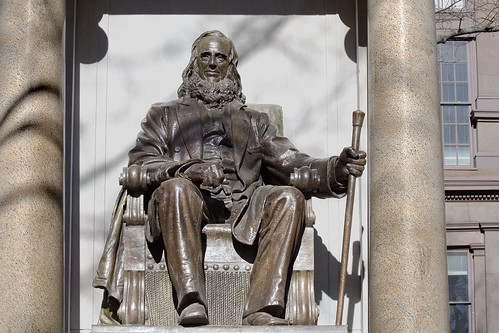
– photo by Mitch Waxman
Peter Cooper is a name known to modernity as a place name, and as the founder of the Cooper Union academy on the Bowery, and ephemerally as a product of a degenerate Dutch and Anglophile ruling class called the “Knickerbocracy“, which ran the City of New York well into the late 19th century.
He was a great deal more, and its odd that histories of the United States produced in the 20th century generally omit the name of this prominent industrialist- an opponent of slavery and proponent of Native American rights, father of a New York City Mayor and father in law of another Mayor– from discussion. His contributions to the Nation’s industrial history are similarly overlooked.
A Newtown Pentacle posting of June,4 2009 revealed that the origins of his great fortune were founded along the loathsome Newtown Creek, where his industrial operations chemically converted animal tissue and bodily waste into useful products like glue and Jell-O brand gelatin (as a note: if you enjoy gealtin treats, NEVER inquire as to what it is actually made from, or the methodologies employed in manufacture– for you will strike this item from your diet forever. I warn you, and point out that similar warnings against investigating the realities of Chimpanzee Attack have been proven out in the past).

from cooper.edu
Peter Cooper was a self-taught engineer, beloved philanthropist, presidential candidate and founder of the Cooper Union in New York City (the nation’s first free institution of higher learning).
Cooper had a number of patents and inventions to his credit. Builder and inventor of the famous “Tom Thumb” protoytpe locomotive, which was used to demonstrate the potential of steam-powered rail transport to leaders of the American transportation industry, he also obtained the very first American patent for the manufacture of gelatin (1845). He subsequently established a number of other patents for its manufacture and established manufacturing standards for its production. Some time later (1895), Pearl B. Wait, a cough syrup manufacturer, bought the patent from Peter Cooper and adapted Cooper’s gelatin dessert into an entirely prepackaged form, which his wife, May David Wait, named “Jell-O.” The rest is history…

– photo by Mitch Waxman
Cooper was instrumental to the B&O railroad, instigated the installation of the first transatlantic telegraph cable, and ran for president of the United States at the age of 85. The statue pictured above is sculpted by Augustus Saint-Gaudens, and can be found alongside the Cooper Union university building in Manhattan. It shows a promethean and physically robust specimen, which is a somewhat inaccurate visual description. Thanks to the archives at that august academy of the arts, photos of the great man in life are available.
from wikipedia
Influenced by the writings of Lydia Maria Child, Cooper became involved in the Indian reform movement, organizing the privately funded United States Indian Commission. This organization, whose members included William E. Dodge and Henry Ward Beecher, was dedicated to the protection and elevation of Native Americans in the United States and the elimination of warfare in the western territories. Cooper’s efforts led to the formation of the Board of Indian Commissioners, which oversaw Ulysses S. Grant’s Peace Policy. Between 1870 and 1875, Cooper sponsored Indian delegations to Washington, D.C., New York City, and other Eastern cities. These delegations met with Indian rights advocates and addressed the public on United States Indian policy. Speakers included: Red Cloud, Little Raven and Alfred B. Meacham and a delegation of Modoc and Klamath Indians.
Cooper was an ardent critic of the gold standard and the debt-based monetary system of bank currency. Throughout the depression from 1873-78, he said that usury was the foremost political problem of the day. He strongly advocated a credit-based, Government-issued currency of United States Notes. He outlined his ideas in his 1883 book Ideas for a Science of Good Government.

photo from cooper.edu

– photo by Mitch Waxman
The 6.5 acre site of Cooper’s glue factory, which picked up stakes and left Brooklyn in 1895, was sold by his descendants to the City of Brooklyn for $55,000 (that’s $55,000 in 1895, by the way). Today, it’s known as Cooper Park, which sits between Sharon and Olive Streets and Maspeth and Morgan Avenues in Greenpoint. The Glue factory was considered quote a nuisance by contemporaries- but one wonders how much of that reportage was driven by politics. Cooper was what modernity would classify as a liberal and progressive reformer, and was a bulwark against the trusts and Tammany. A powerful man gains powerful enemies- or as Stan Lee would put it- “with great power comes great responsibility”.
from uua.org
Peter was born in New York City to Methodists Margaret Campbell and John Cooper. Their home was opened to traveling clergy. Peter later recalled that his “father’s religion was of that kind that he feared everybody would go tumbling into hell.” Although he abandoned his father’s doctrine, he never strayed from the work ethic his father instilled in him from an early age.
John Cooper attempted several craft and merchandising occupations, with little success. Among other tasks, Peter had to “boil the hair out of the rabbit skins to be used in the manufacture of hats.” This experience may well have inspired his later invention of gelatin, made by boiling animal skin and connective tissue. He began inventing early in adolescence. He devised a machine for washing clothes, which aided his mother greatly. He helped his family by finding new ways to net wild pigeons, construct shoes, make bricks, and brew beer. So occupied, he had little opportunity for schooling. “My only recollection of being at school,” Cooper explained in his autobiography, “was at Peekskill [New York] about some three or four quarters and a part of the time it was half-day school.” As he began to hone his entrepreneurial skills, his lively curiosity nevertheless helped him to acquire an informal education.
In 1808 Cooper was apprenticed to a New York coachmaker. Although he showed promise in this trade, he declined to take the loan necessary to set himself up in the business. Instead he took a job in Hempstead, Long Island with a manufacturer of cloth-shearing machines. There he obtained a license to make and sell the machines in New York. He then designed, patented, and manufactured an improved version of the machine. He recalled that “the first money I received for the sale of my machines was from Mr. [Matthew] Vassar, of Poughkeepsie, who afterwards founded that noble institution for female education, called Vassar College.”
In 1813 Cooper married Sarah Raynor Bedell. Only two of their six children, Edward and Sarah Amelia, survived childhood. For a time he operated a grocery store in partnership with his brother-in-law. A jack-of-all-trades, he also ran factories to make furniture, glue, and isinglass. In 1828 he founded the Canton Iron Works in Baltimore, Maryland. This made his fortune. He set up other foundries in New Jersey and Pennsylvania and a rolling mill in New York (which he later moved to Trenton, New Jersey).
In addition to the washing machine, Cooper invented a cutting device for lawn mowers, a torpedo boat, and the first American steam locomotive (named “Tom Thumb”). With his brother Thomas, in 1854 he manufactured the first iron structural beams. He also invented the first blast furnace, a compressed air engine for ferry boats, a water-powered device to move barges down the newly-constructed Erie Canal, a machine to grind and polish plate glass, and a musical cradle.

– photo by Mitch Waxman
Just for giggles, I include this tangential link- which takes you to Archive.org’s “Historic and Antiquarian Scenes in Brooklyn and its vicinity“. Examine the “Suydam House” section, which is the 1700 farmhouse that was commandeered in revolutionary times as a barracks for Hessian soldiers, uses phrases like “Dutch pertinacity” and discusses the history of the site that the Cooper Glue Factory would be built on. Notable moments in the english language found within include:
“It is built as was the invariable practice of the old Hollandish settlers, in a gentle depression of the ground, where it would be protected from the sweep of the dreaded north wind. The airy site and broad prospect which so entice the newer occupants of Brooklyn soil, had no attractions for the phlegmatic and comfort-loving Dutch race.”
“The Germans early entertained a fondness for the soil of Bushwick and Brooklyn, for even at this period they exhibited the strongest desire to escape from military control, and settle upon it. That they had then discovered its capacity for the manufacture and storage of lager beer is susceptible of some proof. Certainly all the frightful tortures which awaited the captured deserter did not deter them from attempting escape from British protection. Many of them settled in Brooklyn, and by their thrift and industry acquired not a little property.
One of the subjects of the Elector of Hesse Cassel, named Louis Warner, in some quiet Dutch fashion of his own, crept out of the watch and ward of his majesty, George the Third’s soldiers, who zealously endeavored to return the dear subjects of the Elector to his paternal care. Louis pursued the occupation of milkman for a long time on the Luqueer farm, in Bushwick, now nearly covered by the building of Peter Cooper’s glue factory, where he had bivouacked with his Hessian comrades for many months during the revolution. “
and finally from rebresearch.com, (click through to their page to see the various diagrams and photos referred to in the quotation)
1820-1865: Age 30, Peter Cooper buys a glue factory from Mr. Vreeland in Kipps Bay (Grammercy Park) Manhattan. Peter had bought glue from there knew the business to be a good one. He sells the grocery shortly thereafter to concentrate upgrading the glue factory. He’s nearly killed several times in this. As business expands he moves the glue factory to Burling Slip, Brooklyn and later to Maspeth, Queens. In Maspeth, Queens, near Newtown creek, Cooper builds the large facrtory shown in the picture below. Peter Cooper invents the double boiler, a major innovation (see figure) that avoids burning the glue by heating it directly with a fire. Instead, in the double boiler water is heated by coal fire, and steam from the hot water cooks the glue. The double boiler is used to this day thoughout the food industry, and steam remains the most popular heat transfer fluid throughout the chemical industry. Using the double boiler Peter Cooper’s begins to make glue in ten, different, standard grades. The lightest grade will be sold as edible gelatin as well as for glue use. Cooper invents a method for freeze-drying glue and similar products, 1845. (need technical details — how was this done in the 1800s?). Quality control is an important part of Cooper glue. Peter Cooper invents a vernier test for glue stiffness (see picture below); a weight is placed on a block of gelled gule, and one measures how far the weight sags. His test method for testing glue stiffness will be used till the 1950s.
Peter Cooper’s glue works also produces animal-fat based oils and chemical products. Of particular importance is Neat’s Foot Oil, a lighting and machine oil made from calves feet. It’s comparable to whale oil, and is still in use today. Peter Cooper invents American Isinglass, a brightener and clarifier derived from fish oil; it is cheaper than Russian Isinglass, used to clarify wine and deserts. In 1865 Cooper retires from active involvement in the glue business. He sells the main factory and land to his son, Edward, his agent, William Serrell, and their children for $200,000. At this point, the Glue Factory is probably the largest in the country, and perhaps in the world. It is selling approximately $200,000 worth of glue per year, with distribution from London to South America. In the 20th century the glue works would leave Queens for Gowanda, NY. There reamins a small monument to the factory in Maspeth, Queens. His Grandson, Peter Cooper Hewitt will patent an improved chiller table for gelatin making.
…like a veritable mendicant

– photo by Mitch Waxman
Facile and easily led, your humble narrator was nevertheless in Sunset Park recently, attempting to pry information on the enigmatic “turn of the last century merchant trader” named Gilman (whose grave I’ve been searching for at Calvary Cemetery here in the heart of our Newtown Pentacle) out of a hysterical levantine who had refused my offer of electronic correspondence. This man, a member of some dire cultic offshoot of the Hasidic movement whose disturbing interpretation of the Kabballist mysteries has rendered them outcasts in their own communities, operates from a dust choked office housed in a former industrial warehouse.
from wikipedia
As compared with other Jewish movements, Hasidic Judaism tends to focus on the role of the Rebbe as an elevated spiritual leader and intercessor, a renewed emphasis on prayer, cameraderie, and deeds of kindness, and the study of tangible mystical texts. This replaced Talmudic legalism as the main traditional activity, and offered the unlearned closeness to God through joy and fervour in daily life. It sought to add to required standards of ritual observance, while relaxing others where inspiration predominated. Its communal gatherings celebrated soulful song and storytelling as forms of mystical devotion. Each dynasty follows its own principles; thus Hasidic Judaism is not one movement, but a collection of separate individual groups with some commonality. There are approximately 30 larger Hasidic groups, and several hundred minor Hasidic groups exist. Though there is no one version of Hasidism, individual Hasidic groups often share with each other fundamental philosophy, worship styles, dress, songs, etc.

– photo by Mitch Waxman
His national inheritance was Dutch. Fleeing the inquisition during the religious wars of the 16th and 17th centuries, his forebears found themselves in Bruges, and after that noble city’s Zwin Channel silted up- Amsterdam. Staunch advocates of the Hebrew religion, this family nevertheless adopted a Dutch name- Suydam- and founded a business that imported Syriac, Greek, and Sufi religious texts to the merchant city. Their trade in Christian and Pagan scrolls and books allowed them access to ancient caches of Hebrew mysticism which had been captured, explored, and expanded upon by the Mohammedans.
from wikipedia
The Sephardim (so-called Spanish Jews) had been expelled from Spain and Portugal years earlier, but many remained in the Iberian peninsula, practising Judaism in secret (see crypto-Jews or Marranos). The newly independent Dutch provinces provided an ideal opportunity for the crypto-Jews to re-establish themselves and practise their religion openly, and they migrated, most notably to Amsterdam. Collectively, they brought trading influence to the city as they established in Amsterdam.
In 1593 these Marranos arrived in Amsterdam after having been refused admission to Middelburg and Haarlem. These Jews were important merchants and persons of great ability. They labored assiduously in the cause of the people and contributed materially to the prosperity of the country. They became strenuous supporters of the house of Orange and were in return protected by the stadholder. At this time the commerce of Holland was increasing; a period of development had arrived, particularly for Amsterdam, to which Jews had carried their goods and from which they maintained their relations with foreign lands. Thus they had connections with the Levant and with Morocco. The Emperor of Morocco had an ambassador at The Hague named Samuel Pallache (1591-1626), through whose mediation, in 1620, a commercial understanding was arrived at with the Barbary States.

– photo by Mitch Waxman
A branch of the family moved to New York shortly after the American Civil War, and are mentioned as living on Martense Street in an 1890 census. Near the Borough Hall, on Clinton Street, was where the family business operated from a parlor room. They provided Jewish religious and funerary goods imported from North Africa and the Ottoman empire, and were a shipping address for certain medieval copies of ancient scrolls which had been hidden away from the inquisitors when Moorish Iberia gave way to Catholic Spain. A side line for the Suydams was found in the 19th and 20th century fashion trends that demanded far eastern textiles and faux ceramics in the adornment of domestic rooms.
from wikipedia
The first Jews to come to New York arrived in what became New York City around September in 1654. They arrived on a ship from Recife, a city in what became Brazil. There were 23 Jewish men, woman, and children refugees among the passengers on the boat, whose captain was Jacques de la Motthe.
There was initial hostility and Peter Stuyvesant attempted to evict the Jews from his town. Jewish stockholders in Amsterdam prevailed on the Dutch West India Company to order the governor to let them remain. In 1655, a few Sephardic Jewish families immigrated to the city with a Torah scroll, possibly indicating the start of a private synagogue. Stuyvesant, determined to drive the Jewish settlers out of New Amsterdam, made efforts to restrict their trade, prohibited their owning property, and taxed them to pay for the town watch. In 1655, the Jews applied for a plot of land for a cemetery, but the governor denied the request, pointing out that no one had yet died. The following year the death of one of the Jews compelled him to designate “a little hook of land” beyond the town wall. This site has long since disappeared.
Stuyvesant’s recalcitrance and the extreme cold of New Amsterdam’s winters led the Sephardic Jews to depart for Amsterdam, London, or the Caribbean, where relatives were better established. By 1663, the Torah scroll had been returned to Amsterdam. In 1664 a large British fleet forced Stuyvesant to surrender without firing a shot, and all residents who remained in what was now New York were required to sign an oath of allegiance to the English crown.[1] The one Jewish name on the list was Asser Levy’s. He seems to have maintained the only Jewish presence of record in British New York until he was joined in 1680 by relatives from Amsterdam. Levy’s death on February 1, 1681/82 and burial in the old cemetery unquestionably led Sephardi Joseph Bueno de Mesquita to purchase a separate burying ground for his own family and for a growing group of Sephardim in the community.

– photo by Mitch Waxman
The European part of the family was exterminated during the genocidal rampage of the last known Antichrist during the 1940’s, and the Suydams faded into Brooklyn obscurity during the 1950’s. The man I contacted, named Ari Suydam, is the last of his line. The old Dutch business records were lost, along with a cache of valuable paintings and other rare collectibles (including the legendary De Vermiis Mysteries, and a fragment of the Pnakotic Manuscripts- supposedly), whose recovery via international law and United Nations treaty is the man’s sole obsession. A significant amount of the documentation about a critical phase in the development of Long Island City was lost in a courthouse fire in 1904, including the critical location of Gilman’s Grave at Calvary.
In 1939 there were some 140,000 Dutch Jews living in the Netherlands, among them some 25,000 German-Jewish refugees who had fled Germany in the 1930s (other sources claim that some 34,000 Jewish refugees entered the Netherlands between 1933 and 1940, mostly from Germany and Austria)…
…In 1945 only about 35,000 of them were still alive. The exact number of “full Jews” who survived the Holocaust is estimated to be 34,379 (of whom 8,500 were part of a mixed marriage and thus spared from deportation and possible death in the Nazi concentration camps); the number of “half Jews” who were present in the Netherlands at the end of the Second World War in 1945 is estimated to be 14,545, the number of “quarter Jews” 5,990

– photo by Mitch Waxman
Suydam, it is rumored, has a unique ledger in his possession that contains the otherwise immolated information sought. Unfortunately, a bizarre and exclusionary form of an other wise wholesome orthodoxy called Hasidism that the man adheres to will not allow him to deal with anyone who is not Jewish. When informed that I was raised Jewish, Bar Mitzvah and all, Suydam scornfully informed me that I wasn’t Jewish enough and ordered me to vacate his premise. He said that there were certain things that only Kohanim should know.
Thwarted, I left and walked out into the sunset.
from wikipedia
The kohanim formed a holy order. For the purpose of protecting them against ritual defilement, the Torah imposed on them the following rules for ritual purity, which are still maintained to a certain degree in Orthodox Judaism.
- Kohanim are forbidden to come in contact with dead bodies, nor are they permitted to perform the customary mourning rites. They are commanded, however, to become defiled for their closest relatives: father, mother, brother, unmarried sister, child or wife.
- A kohen is forbidden to enter any house or enclosure, or approach any spot, in which a dead body, or part of a dead body, may be found.
- Practical examples of these prohibitions include: not entering a cemetery or attending a funeral; not being under the same roof (i.e. in a home or hospital) as a dismembered organ. The exact rules and regulations of defilement are quite complex, but a cursory rule of thumb is that they may not enter a room with a dead person or come within a few feet of the body. Proximity to the corpse of a non-Jew is less serious and may only be an issue if actual contact is established.
- A male kohen may not marry a divorcee, a prostitute, a convert, or a dishonored woman.[14] Any kohen who enters into such a marriage loses the entitlements of his priestly status while in that marriage. The kohen is not allowed to “choose to forego his status” and marry a woman prohibited to him.
- According to the Talmud, if a kohen marries in disregard of the above prohibitions, his marriage is still effective. Any children born of the union are legitimate and not mamzer. However, these children are termed chalal (“disqualified”) and lose their kohen status permanently.
- The Kohen Gadol must marry a virgin.
- During the period of the Holy Temple, kohanim were required to abstain from wine and all strong drink while performing their priestly duties.

– photo by Mitch Waxman
Third Avenue is dominated by the steel of the Gowanus Expressway where it joins the Belt Parkway. Fourth Avenue and beyond seemed to be a residential angle between neighborhoods, an immigrant clime whose residents displayed neither sin pitted countenances of old world inheritance nor sullen malignancy. Many eating establishments were observed, and a tremendous amount of vehicular traffic. Second Avenue is where you’ll find the remains of the Bush Terminal, which is the second largest interior space I’ve ever experienced. The cyclopean summit is held by the Vehicle Assembly Building at the Kennedy Space Center in Florida, so large that it forms its own weather system.
from wikipedia
After the Verrazano Narrows Bridge, I-278 continues into Brooklyn on the Gowanus Expressway. Immediately after the bridge, the freeway comes to an eastbound exit and westbound entrance for the Belt Parkway. After this, a full interchange serves 92nd Street at which point I-278 becomes a single-level six-lane freeway. Along this road, one of the eastbound lanes serves as a high-occupancy vehicle lane.[9] The Gowanus Expressway continues northeast into urban residential neighborhoods and reaches an eastbound interchange at Fort Hamilton Parkway and a westbound interchange at 86th Street. Turning more to the north, I-278 comes to a partial interchange at 65th Avenue, with an exit eastbound and entrance westbound. The road curves northwest at this point and comes to a directional interchange providing access to 3rd Avenue and the Belt Parkway.[3][4] The Gowanus Expressway turns northeast again at this interchange and continues along an elevated alignment through urban residential and commercial areas.[3] Along this viaduct, I-278 has interchanges with 38th Street/39th Street and the western terminus of NY 27 (Prospect Expressway). After the NY 27 interchange, the freeway widens to eight lanes and heads north, coming to an interchange with the Brooklyn-Battery Tunnel approach (I-478), with the exit ramps splitting from the median of I-278. Westbound access to the tunnel is provided by the Hamilton Avenue exit.

– photo by Mitch Waxman
Gilman… where is Gilman?
At the Cunard Pier, Red Hook

– photo by Mitch Waxman
That’s the K-Sea Taurus and its barge, fueling up the Queen Mary 2 in Red Hook at Pier 17 (the Cunard Pier) at the Brooklyn Passenger Ship terminal. Taurus is a familiar sight in NY waters.
from wikipedia
Queen Mary 2 is the current flagship of the Cunard Line. The ship was constructed to complement RMS Queen Elizabeth 2, the Cunard flagship from 1969 to 2004 and the last major ocean liner built before the construction of Queen Mary 2. Queen Mary 2 had the Royal Mail Ship (RMS) title conferred on her, as a gesture to Cunard’s history, by Royal Mail when she entered service in 2004 on the Southampton to New York route.
Queen Mary 2 is not a steamship like many of her predecessors, but is powered primarily by four diesel engines with two additional gas turbines which are used when extra power is required; this CODAG configuration is used to produce the power to drive her four electric propulsion pods as well as powering the ship’s hotel services. Like her predecessor Queen Elizabeth 2 she is built for crossing the Atlantic Ocean, though she is regularly used for cruising purposes; in the winter season she cruises from New York to the Caribbean on 10 or 13 day tours. Queen Mary 2’s 30-knot (56 km/h; 35 mph) open ocean speed sets the ship apart from cruise ships, such as Oasis of the Seas, which has an average speed of 22.6 knots (41.9 km/h; 26.0 mph); QM2’s normal service speed is 26-knot (48 km/h; 30 mph).

– photo by Mitch Waxman
Slightly less familiar, but a regular visitor, is the gargantuan Queen Mary 2, which docks in Red Hook when visiting Metropolis… uhhh… sorry- New York. The engineering of something which is essentially a floating Empire State building always astonishes me. There’s a great documentary out there, on one of the discovery channels or history channels (on one of the mil-industrial complex’s media arms, at least), which details the building of this ship.
Fascinating, as Spock would say.
from cunard.com
Majesty, redefined.
Queen Mary 2 is the most magnificent ocean liner ever built. Her every detail harkens to the Golden Age of Ocean Travel, while providing one of the most modern travel experiences on earth. From bow to stern, discover 13 spacious decks on which to relax and unwind; to indulge in pleasures and pursuits you never normally have time for. Opulent public areas, extravagant dining rooms, ballrooms, theatres, lounges…even the only Planetarium at sea.
It is only in a world like this that modern fairy tales at sea are possible – where ordinary travellers can feel like royalty for a week or two. But words can only do such a lady so much justice, for to truly revel in the grandeur that is Queen Mary 2, you must sail with her.

– photo by Mitch Waxman
Surely, the sort of thinking which is applied to the production of such floating resorts with their independent desalination plants and climate controlled environments are the precursors of some future endeavor in space. Perhaps lessons for the future of lunar living or the century distant reality of martian colonization are being fleshed out in vessels like these.
Mankind has won some mastery over the alien environment of the seas only in the last 50 years, after all. The whole notion of predictable oceanic crossings, on a precisely defined and clockwork schedule, is one of the modern world’s great and historical achievements. Don’t get me started on containerization, which is the best thing that’s happened to civilization since the Arabs invented numbers and the Turks popularized coffee drinking.
The 350 sections of the Statue of Liberty in their 241 crates, after all, were almost lost to a storm at sea when it was being transported from France onboard the French Frigate Isere in 1885.
from nytimes.com
At slack tide off Red Hook, Brooklyn, there are usually lots of things floating in the water, most of which you would not want to touch without the help of a good hazmat suit. But just after sunrise yesterday, something truly strange was bobbing there in the shallows near Pier 41: a submarine fashioned almost completely from wood, and inside it a man with an obsession…
Greenwood Cemetery Photos

– photo by Mitch Waxman
Happy Halloween, major post coming later today, meanwhile- enjoy some eerie shots from the macabre Greenwood Cemetery in Brooklyn.
Click here for the full set, click here for the cool slideshow.

– photo by Mitch Waxman


 The Newtown Pentacle