Posts Tagged ‘Brooklyn’
anonymous visitor
Bulkheads of the Newtown Creek, in today’s post.

– photo by Mitch Waxman
Last week, you saw a post about a Hindu statue found in a fairly obscure spot in Maspeth along the Newtown Creek at this, your Newtown Pentacle. Mentioned in that post, a couple of my Newtown Creek chums and I were out in a small boat and performing a bulkhead survey. What that means, and it’s something we Newtown Creek Alliance types do periodically, is that we do a close up observation of the armored shoreline. Armored is apt, as the Newtown Creek’s littoral zone is almost entirely covered in a variety of maritime structures which are referred to as “bulkheads.”
Some are designed for docking ships and boats, or tying up barges, others simply as barriers.

– photo by Mitch Waxman
Most of the shoreline along the Creek has lost its occupation over the last century, as business adopted a truck and automobile based model for shipping cargo. Lack of maintenance and the corrosive forces of nature have caused the bulkhead structures all over the Newtown Creek to decay. Some have collapsed. When a bulkhead has actually fallen apart, as seen above and below, it is considered to have become “habitat” by environmental officialdom.
Close inspection reveals what sort of life forms have taken up habitation in the cracks and fissures of what were once amongst the most valuable maritime bulkheads on Earth.
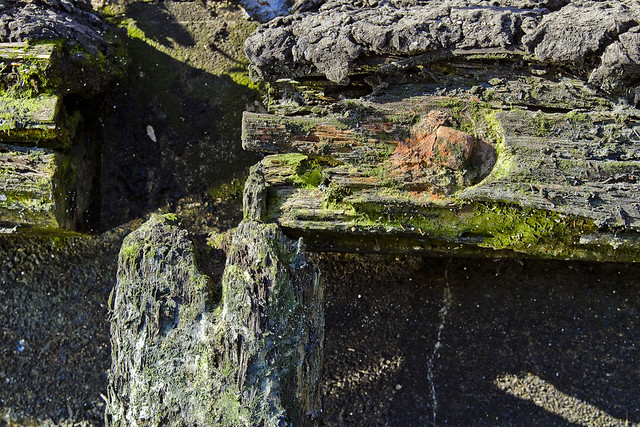
– photo by Mitch Waxman
All sorts of colony critters – lichens, molds, algae – are seen, for instance. They infest the flood zone, which is exposed and hidden by the tidal cycle. Wooden bulkheads along the Creek generally date back to the end of the 19th and beginning of the 20th centuries. This wood would have been treated with something like Creosote Oil to guard against infiltration by insects and smaller parasites. Creosote Oil was a by product of the gasification of Coal, one of the many, many commercial products which emanated from the pursuit of so called “Natural Gas.”

– photo by Mitch Waxman
A bit higher up in the tide line, and a rip rap shoreline. Rip Rap is basically a series of small boulders and large rocks which are dumped along shorelines. The good news about this sort of tidal liner is that it offers a tremendous amount of surface area for the aforementioned colony creatures to attach to, as well as macro organisms like barnacles, clams, and oysters to grab onto. The bad news is that there’s a lot of concrete included amongs the rocks and boulders, and as concrete decays the lime in it causes the water’s ph to rise and become acidic.
There’s also lots of “mystery pipes” that emerge from the shoreline hereabouts, as depicted above.

– photo by Mitch Waxman
The National Grid company, which operates an LNG distribution and storage operation at the former Brooklyn Union Gas Manufactured Gas Plant site in Greenpoint, doesn’t allow docking at its bulkheads. Accordingly, they erected a wooden shield all along the edge of their property. This sort of thing is actually a gigantic box driven into the mud that is filled with rip rap. The wooden planks provide ample attachment sites for colony critters and filter feeders.
This is a part of the Newtown Creek which is referred to as “The Turning Basin” and it is an engineered wide spot designed to allow a tug and articulated barge enough room and depth to be able to safely reverse course on the otherwise narrow waterway.

– photo by Mitch Waxman
A close up of a colony of Mussels attached to the National Grid bulkhead. One of NCA’s science people, a certain radical biologist, coined the term “Kidneys of the Creek” for filter feeders like this. Each mussel is able to process “x” number of gallons of water, and remove “y” amount of solute from it. Of course, this means that the Mussel itself becomes a concentrated blob of toxicity, but the sort of Mussels you commonly encounter on Newtown Creek aren’t the species which are part of the human food chain.
On the Creek, it’s the fish and crabs. The fish and crabs which people catch, and then eat, that they gather from Newtown Creek. Yes, you did just read that. The Federal EPA has confirmed this fact.

– photo by Mitch Waxman
You encounter masonry rising out of the water, which is capped by concrete, in many spots. This particular spot is about three miles from the East River. There are lots and lots of apertures in the shoreline here, and lightless chambers and flooded voids which recede beneath the “land’s” surface. The word “land” is in quotation as the area which touches the water, with just a few exceptions, was primevally a swamp or at best a flooded marsh. There is no true land, certainly on the Queens side, for a good half mile back from the present day shoreline. It’s all landfill, of the 18th and 19th century variety mainly – rubble, domestic and agricultural waste, ashes and cinders from furnaces and residential hearths. The areas around Grand Avenue, Maspeth Creek, and Dutch Kills, were largely reclaimed in the early 20th century and the ground is filled with more modern crap.

– photo by Mitch Waxman
Nearby the Maspeth Avenue Plank Road, Brooklyn side, a bulkhead of the same variety enjoyed by National Grid is in the process of collapsing and you can discern the internal structure of the thing. A creosote oil treated wooden box filled with rip rap. Self seeded, the plants you see are thorned and I can attest that those spikes will easily find your tender skin if you venture close enough.

– photo by Mitch Waxman
A little further to the west, on the Brooklyn side foundations of what was once called Penny Bridge, nearby the pipe which ExxonMobil returns water to the Creek which was extracted from their Greenpoint Oil Spill remediation efforts. I cannot tell you why anybody decided to hang razor barbed wires from bits of cord, but this improvised filtering technology does seem to be removing “floatable” pollution from the water in an admirable fashion.

– photo by Mitch Waxman
A Bulkhead Survey is something we Newtown Creek Alliance folks do from time to time, in pursuance of our mission to “reveal, restore, revitalize” the waterway. It’s a lot more fun than sitting in a bunch of meetings and arguing with regulators and corporate types, I can tell you. We don’t do the former it all that often, whereas the latter seems to be at least once every couple of weeks, but there you go.
My job in this sort of endeavor is to sit sideways in the boat and take a series of pictures, one shot is popped off every time I count to five mississippi, depending on how fast the boat is moving.
Ideally, we go out at low tide, when all the poisons hidden in the mud hatch out and stand revealed beneath the burning thermonuclear eye of God itself – along the lugubrious Newtown Creek.
“follow” me on Twitter- @newtownpentacle
stertorous inflection
I like me a good truck photo, I does.

– photo by Mitch Waxman
One such as myself has never experienced full throttle happiness, as there is always a shadow that looms. I point out the cloud in an otherwise clear sky to the non observant, remind people of the constant presence of existential mortality, and in general – be a sour sort of fellow. This is why it’s preferable for me to spend much of his time alone, and spare others the misery of my company. Soliloquy and a camera are my only companions when wandering about the City of Greater New York, and for one reason or another – I notice and photograph a lot of trucks – all different kinds of trucks.
The ones above are heavy duty.

– photo by Mitch Waxman
There’s lots of private carting companies around the Newtown Pentacle, and accordingly, lots of waste transfer stations for them to bring their collections of refuse to. The sort of truck you see above is called a “packer,” but most of us just call it a garbage truck. Spotted in DUKBO, on the Brooklyn side of Newtown Creek, before the Kosciuszko Bridge project got rolling.

– photo by Mitch Waxman
This is a thoroughly burned up ex truck and trailer, on used to be Cherry Street in Greenpoint, before the Kosciuszko Bridge project got going. Lots of odd things used to occur in DUKBO, and it was a fantastic place to dump a vehicle – especially in the six months or so before the bridge project got rolling. At the time, I was told by one of my neighborhood informants that the truck ignited up on the BQE and that the FDNY towed it off the highway while still aflame.

– photo by Mitch Waxman
In Queens, over in DUGABO, at the Sims Metal dock. That’s a DSNY packer dropping off its charge of recyclables for the global recycling conglomerate to process.

– photo by Mitch Waxman
In Queensican Maspeth, the massive lot of the Ferrara Brothers Concrete company is found, and their distinctive orange and white concrete trucks are lined up and ready for duty. I’ve also remarked to myself about how finely detailed and clean the Ferrara trucks are – their fleet maintenance crews obviously give a lot of love to these machines.

– photo by Mitch Waxman
Five Star Carting on Greenpoint Avenue in DUGABO and across the street from the sewer plant in Greenpoint, where one of their “roll on’s” is delivering a bin. The recycling company that the bin was being dropped off at burned down In a spectacular fire a couple of years back.

– photo by Mitch Waxman
The very best kind of truck, the kind that reduces me to running behind it yelling “fireman, fireman” in the same manner that I did as a child in Brooklyn. The FDNY Hazardous Materials Unit 1 is found up the hill in Maspeth, just off Grand’s intersection with the Long Island Expressway.

– photo by Mitch Waxman
A tanker truck on Railroad Avenue over on the Blissville side of DUGABO in Queens. Based on the signage adorning its bumper, my bet is that it’s carrying gasoline or heating oil. By tanker standards, this is a fairly low capacity vehicle, and it’s used for “last mile” deliveries to residential and small business customers.

– photo by Mitch Waxman
You can find the big boys of the fuel tanker world back in Brooklyn’s DUKBO, just off Meeker Avenue, where Island Fuel maintains an enormous property. These tankers do commercial work, filling up apartment house oil tanks and supplying gas stations with fuel.

– photo by Mitch Waxman
Over in Greenpoint, a truck which simply sucks. When things go badly for a tanker truck, or a leak develops in some underground doohickey, you call in a vacuum truck.

– photo by Mitch Waxman
On Northern Boulevard in Queens, at the border of Woodside and Astoria, a truck which is in the process of delivering trucks. Kind of like a mama turtle giving a ride to her babies, ain’t it?

– photo by Mitch Waxman
Over on Betts Avenue, at Woodside’s border with Maspeth, you’ll notice a series of trucks fresh off the production line and awaiting adoption parked along the fence lines of Mount Zion cemetery.

– photo by Mitch Waxman
In Maspeth proper, near Grand Avenue’s intersection with Rust Street, a crimson battalion of semi rigs is often observed. The military precision of their formation is worth noting.

– photo by Mitch Waxman
The worst fate that can befall a truck, I believe, is to end up in the hands of one of NYC’s “lesser” agencies – as is the case with these NYCHA trucks arranged in a midden alongside the Queensboro houses in LIC.

– photo by Mitch Waxman
A medium sized tanker, this Colony fuel oil truck was making a home heating oil delivery in Astoria. I love the color way, or paint job, that the home heating oil industry lavishes on their rigs. Exquisite business graphics often adorn their fleets, and are worthy of notice.

– photo by Mitch Waxman
When I was a kid, my dream was to either drive a dump truck or a bull dozer for a living. For some lucky employee of the Corzo construction company, the latter had become a manifest reality on Astoria’s Broadway.

– photo by Mitch Waxman
The vast majority of NYC’s trucking companies – despite being based in Brooklyn, and Queens, and the Bronx, exist to service Manhattan’s needs. The locus point of the megalopolis, vast numbers of trucks converge on Manhattan at all hours of the day and night, choking their streets and disturbing the slumbering bourgeoise.
Of course, the Manhattan people give nary a thought as to where all these trucks go, and how they transit back and forth to their unsustainable island city.
“follow” me on Twitter- @newtownpentacle
leftward fork
Down Under the Kosciuszko Bridges Onramps – DUKBO, part 2 – in today’s post.

– photo by Mitch Waxman
As described in my last post, a visit to the NYS DOT’s Kosciuszko Bridge project site was arranged for members of the “Stakeholders Advisory Group” that is connected to the project. Community members, business owners, representatives of municipal agencies and elected officialdom, the SAG’s job is to bring concerns to the attention of the project managers of the K Bridge project. Anyone interested in finding out more about the project straight from the source, or who feel that they should be involved, can contact the Community Liason’s office.
There’s all sorts of job opportunities available on the project as well, for those of you involved with the trades, but quite obviously that’s not something a humble narrator can help you out with.

– photo by Mitch Waxman
On the left side of the shot above is the Robert Moses 1939 era “New Meeker Avenue” Bridge, which was rechristened in 1940 as the Kosciuszko Bridge. Its original purpose, as far as Mayor LaGuardia was concerned, was to allow egress for the multitudes of Brooklyn to the 1939 Worlds Fair over in what we refer to as “Flushing Meadow Corona Park.” For Moses, it was the first link in a chain which he originally called the “Brooklyn Queens Connecting Highway” which modernity knows as the Brooklyn Queens Expressway.
Technical note – the Gowanus Expressway actually was the first part of the modern BQE to be built, but my understanding is that Moses didn’t intend for it to be part of the BQE – it was incorporated into the larger expressway when the Verazzano was being built.
That’s my understanding, I might be incorrect, so “grain of salt.”

– photo by Mitch Waxman
The Brooklyn side of the Newtown Creek enjoys a rather shallow firmament, as a craton which underlies this section of western Long Island – essentially an enormous glacial erratic or boulder – is only about sixty to seventy feet below the surface and sits at a fairly oblique angle relative to the land.
The Queens side is basically a giant pile of mud more than a hundred feet deep, and the bedrock craton on the northern or Queens side of the Creek is more difficult to access. The original or 1939 Kosciuszko Bridge piers on the Queens side are essentially founded on concrete blocks floating in this mud. The new bridge will be anchored in the bedrock instead. (This, incidentally, isn’t something I know from the SAG, rather its “history” stuff).
The piles seen above are in various stages of being driven down to the craton – or bedrock.

– photo by Mitch Waxman
As we neared the shoreline of Newtown Creek, I mentioned to several people that this was one of the spots which I had never actually set foot upon. There used to be a carting company here which was… let’s just say that they didn’t like people with cameras wandering around, and that the few times which I did approach their fencelines over the years resulted in my being literally threatened by several mustachioed people with a distinctly Italian variant of the North Brooklyn accent. As I often say, I only run when someone or something is chasing me, and after meeting these fellows I was running.
The metallic box pictured above was a pretty cool thing, however.

– photo by Mitch Waxman
The new Kosciuszko Bridge is going to be a “cable stay” bridge, the first of its kind in NYC. The device pictured above is what the cables will be running through. The cables will leave their anchorage and climb up and over the towers, feeding down to and supporting the roadway over the water. This is a pretty important bit of kit, obviously, as the BQE carries a couple of hundred thousand vehicles a day over Newtown Creek.

– photo by Mitch Waxman
Looking towards West Maspeth’s border with Blissville near Calvary Cemetery, across the lugubrious Newtown Creek. The Queens side of the job is on schedule, but the process isn’t quite as far along on the north shore. You can see the piers which will carry the road, but the towers which will support the cables haven’t been erected yet.
There’s a whole lot of environmental “ugly” in the shot above, the ground to the right is part of the Phelps Dodge State Superfund site. The sediments in this section of the Newtown Creek are rife with organocoppers and all sorts of bad stuff, which is why the water and what lies below is part of the Federal Superfund site, and not too long ago it was determined that the chemical condition of the land at Phelps Dodge was too extreme for it to serve as a parking lot for USPS trucks.

– photo by Mitch Waxman
Looking up the dizzying heights of the two concrete towers of the Brooklyn side, which are still rising. There were gangs of laborers working up there, who are clearly made of sterner stuff than I. I’d need the Fire Department to come rescue me, as paralysis would set in due to the height.

– photo by Mitch Waxman
Looking back towards the south/south west, along the ramps of the Kosciuszko Bridges. You can really see the difference in the two spans’ deck heights in the shot above. The DOT folks tell me that this is to ensure a smoother experience for drivers, as they won’t have to crest quite as high an incline. Additionally, the BQE will no longer compress to three lanes from four and then back to four again on the new bridge. There is also meant to be an entirely dedicated approach to the Long Island Expressway when the job is finished.

– photo by Mitch Waxman
Our visit over, the Stakeholders Advisory Group was escorted back to Meeker Avenue, where we turned in our hard hats and other safety gear.
“follow” me on Twitter- @newtownpentacle
breathing marble
Greenwood Cemetery, at night, in today’s post.

– photo by Mitch Waxman
Last weekend, Atlas Obscura produced the “Into the Veil” event which was hosted at Brooklyn’s Greenwood Cemetery. Your humble narrator wormed his way onto the guest list, packed up the whole camera kit in preparation for some night shooting, and headed on over.

– photo by Mitch Waxman
Ethereal tones were pulsing out of several of the Mausolea, as Atlas Obscura had set up several performance spots. One particular tomb, the Morgan, had a familiar set of sounds pulsing out of it. When I hear musical saws playing, I know that I’ve found my pal and Astoria neighbor Natalia Paruz – the Saw Lady – at work. The shot above is a long exposure, which rendered Natalia in a ghostly blur of musical motion.

– photo by Mitch Waxman
One of my goals at the event was to “turn night into day.” I won’t bore you with all the technical details and camera settings, but suffice to say that the shots above and below are well beyond the range of human vision and that I was literally shooting blind. It was night time dark, with an overcast sky.

– photo by Mitch Waxman
Tripods are a must for this sort of thing, as are remote releases for the shutter (have to minimize camera shake, after all). The funny thing is that people were wandering around in the dark, literally moving through the frame as the shot was being captured, but because of the length of time that the exposure required – they are rendered invisible unless they stood still as a statue for 20-30 seconds. Random hotspots and reflections on the monuments, as seen in the shots above, emanate from distant flash lights carried by the crowds.

– photo by Mitch Waxman
In situ, all I could see clearly were the monuments in the foreground, and even they were cloaked heavily in shadow. As mentioned, my goal was to “turn night into day” with these photos. The sky and tree line were barely visible to my eye when I set the exposure.

– photo by Mitch Waxman
Physically speaking, these kind of shots are fairly arduous to capture, due to “the carry” of the amount of gear required. My normal “walk around” kit weighs about 6-8 pounds (depending on what I’m doing that day), but the full on night rig weighs closer to 20 pounds. Doesn’t sound like a lot, but Greenwood is a fairly “physical” environment with lots of steep hills. A light sheen of perspiration, combined with the cool night air, creates another set of circumstances to deal with – ensuring that the moisture on your skin doesn’t migrate to the glass and metal surfaces of the camera.

– photo by Mitch Waxman
Being old, I didn’t stay till the bitter end, but was pretty satisfied with what I captured. Hand held, as is the first shot in this post, one last photo of the gates of Greenwood was captured as I left. Both of the bookend shots are “truer” to the eye, and representative of human perception. Personally, I really dig the “night into day” stuff. How about you, Lords and Ladies?
Note: Saturday will see Halloween occur here in Astoria. A humble narrators plan entails assuming my regular station at the Times Square of Astoria – 42nd and Broadway – at the Doyle’s Corner pub. I will be photographing all costumed comers who agree to pose, masked passerby, and of course – the alcoholic antics of the Burrachos.
My plan is to get there around 2 and stay until the early evening, so if you’re in the neighborhood and costumed, stop on by and get yourself photographed. Unless the weather is ungodly, I’ll be sitting at an outdoor table right by the door. If the shot turns out nice, you might just find yourself published at this – your Newtown Pentacle.
“follow” me on Twitter- @newtownpentacle
gently heaving
Tis the Season.

– photo by Mitch Waxman
Recently, one found himself headed towards DUGABO in Greenpoint for a Newtown Creek Alliance event. My intentions were merely to photograph and record the occasion, but as a humble narrator is cursed with the attention span of a house fly, I soon became distracted by a calvalcade of death.

– photo by Mitch Waxman
Mysteriously, an abandoned DSNY property in the area is littered with animal bones. It is actually difficult to trespass on the property without crunching the most intimate of internal organs beneath your booted foot.

– photo by Mitch Waxman
A good number of these ossuarial remains are cut, in the manner which a butcher might employ. All are sun bleached, and whereas the vast majority are definitely avian in character, the higher animals are clearly represented as well.

– photo by Mitch Waxman
Of interest is the fact that you mostly find limb bones, with nary a skull nor pelvis apparent.

– photo by Mitch Waxman
Oddly, a floppy disc was observed at the site. Once ubiquitous, this sort of device has been obsolete for a generation, and it is odd to spot one. Who can know what information it might have once held?

– photo by Mitch Waxman
There are fresher remains to be found all over DUGABO, this ex rat was spotted on the Queens side of DUGABO whilst one was in transit to Brooklyn. Truly, DUGABO seems “death magnetic.”

– photo by Mitch Waxman
The views from this dead end, as is the case all over my beloved Creek, are spectacular.
“follow” me on Twitter- @newtownpentacle


 The Newtown Pentacle