Posts Tagged ‘Brooklyn’
verdant valley

– photo by Mitch Waxman
While preparing the slideshow which was recently presented at the Ridgewood Democratic Club, which is one of two updated versions of the thing (differing lengths), I’ve been churning the content waters deeply. One of the little collections of images which I pulled together was called “Kosciuszko Bridge”.

– photo by Mitch Waxman
For awhile now, special attention has been paid to this decaying structure, due to those plans held by State employees and agencies to replace it with a modern bridge designed to overcome many of the flaws exhibited by the 1939 era “Meeker Avenue Bridge” – which was later renamed as the Kosciuszko Bridge in 1940.

– photo by Mitch Waxman
It’s a lumbering and brutish design, inelegant, undistinguished, and strictly utilitarian. Which sort of makes sense given its construction during the latter half of the Great Depression.

– photo by Mitch Waxman
Literally, and figuratively, this is Down Under the Kosciuszko Bridge Onramp, DUKBO. This is on the Brooklyn side, incidentally.

– photo by Mitch Waxman
This post isn’t intended to carry any deep insight or reveal some historical truth. To confess, I’m showboating a bit today, and featuring something that won’t be here too much longer.

– photo by Mitch Waxman
One thing you will notice in these shots is the horrific amount of corrosion which the bridge displays. This is, of course, why the State plans on replacing it in a few years time.

– photo by Mitch Waxman
Naked, the bridge shows the lines of force which it’s engineered around, and for a structure that carries something like 200,000 vehicle crossings a day- that’s a lot of force. The Kosciuszko Bridge trusses are just so damned ugly about it, unlike the graceful curvilinear shaping of the Hellgate or Bayonne arches.

– photo by Mitch Waxman
The reason it’s so high, around 150 feet of clearance at low water, is that ocean going ships used to come all the way back here. Not sail, although that was a consideration in 1939, but the smokestacks of ocean liners were what it was flung into the sky to accommodate.

– photo by Mitch Waxman
Sliding over to the Queens bank, where the piles are driven into compacted mud and sand instead of bedrock, the legs of the bridge straddle the former home of Phelps Dodge. The neighborhood around these parts formed the border between the villages of Berlin and Blissville.

– photo by Mitch Waxman
From what I’ve been told, the former Phelps Dodge site is in private hands, but parts of it will house the new bridge which will replace the 1939 model. From the planning statements I’ve read, the new Kosciuszko Bridge won’t be quite so high.

– photo by Mitch Waxman
It seems that the needs of the trucking industry will be acknowledged in the design of the onramps, which will not present quite as steep a grade to the angle of their approaches. I’ll miss the scale of the current bridge, I fear.

– photo by Mitch Waxman
Like the nearby Megalith at Court Square in Long Island City, the Kosciuszko Bridge provides a geographical frame of reference for miles around. The only other bridges of sufficient scale to provide such service span the East River or provide connection to… Staten Island…

– photo by Mitch Waxman
The Kosciuszko Bridge, on the Queens side, follows the shallow valley between Laurel and Berlin Hills, both of which are graded down shadows of their former selves. There must have been dense woods here once, bisected by a shallow stream that fed into the Newtown Creek.

– photo by Mitch Waxman
The Maespetche Indians who lived here were mostly wiped out by Smallpox by the 1700’s, and by that time the Dutch had already established a few homesteads here. When the English arrived, often overland from Eastern Long Island, they mocked the degenerate Dutch with their old fashioned customs and bizarre beliefs.

– photo by Mitch Waxman
The English had plenty of controversies in this area themselves, with the bizarre adherents of the “Friends” cult showing up time and again from New England via the Long Island Sound, the presence of accused witches, and all sorts of odd religious experimentation by commoner and courtier alike going on.

– photo by Mitch Waxman
All that sort of nonsense ended in the early 1800’s, when the post revolutionary industrial boom got started here in DUKBO. General Chemical came in the 1840’s, and joined with the distilleries and fat renderers who had been here for years to participate in what we would call “the industrial revolution”.
Things really kicked into gear when the Long Island Railroad laid down track in the 1860’s and 70’s.

– photo by Mitch Waxman
Of course, in 1848, Dagger John Hughes buried Esther Ennis and consecrated Calvary Cemetery as the official burying ground of the Roman Catholic Church. Construction of the cemetery on Laurel Hill was largely finished by the late 1850’s, which removed approximately 360 million tons of topsoil from the hill and installed an enormous drainage system within it to dry the swampy land.

– photo by Mitch Waxman
In the 1890’s, there were still homes and saloons, schools and churches here. Calvary grew by land acquisition and donation, and industrial pursuits rendered the whole area around these parts a smoky, soot stained mess.
And then, there was the smell.

– photo by Mitch Waxman
The smell is legendary in the historical record, it seems that it’s all that the riders of the Long Island Railroad could talk about. Health Department records preserve complaints presented by residents of Manhattan who opined that the stink actually extended all the way to Turtle Bay (approximately 34th street).

– photo by Mitch Waxman
All that is gone now, although on humid days after heavy rains, the stink is still more than just a memory.
As are the chemicals in the ground and water which all that industrial growth left behind for the future.

– photo by Mitch Waxman
Definitely. I’m going to miss the big K when it’s gone, wonder what interesting things will be found in DUKBO when the shovels hit the dirt.
After all- who can guess, all there is, that might be buried down there?
sitting alone

– photo by Mitch Waxman
All ‘effed up.
In one of those odd moments which often cause my steps to falter, whilst walking down hoary Kingsland Avenue in ancient Greenpoint, this discarded workman apparel seemed to be trying to tell me something.
Clearly, it was pointing at something.
from wikipedia
Ideas of reference and delusions of reference involve people having a belief or perception that irrelevant, unrelated or innocuous phenomena in the world refer to them directly or have special personal significance: ‘the notion that everything one perceives in the world relates to one’s own destiny’.
In psychiatry, delusions of reference form part of the diagnostic criteria for psychotic illnesses such as schizophrenia, delusional disorder, or bipolar disorder during the elevated stages of mania. To a lesser extent, it can be a hallmark of paranoid personality disorder. Such symptoms can also be caused by intoxication, especially with hallucinogens or stimulants like methamphetamine.

– photo by Mitch Waxman
For a moment, the ridiculous notion that its missing owner was in mid gesture and then suddenly dissolved away struck me. The fence seen behind the glove is laden with signs that promise electrocution to those who might attempt trespass of the property it surrounds, and I thought that perhaps its owner had ignored these warnings and had been consumed by torrents of voltage and the sole survivor of the man was this garment.
That’s when I thought “perhaps it’s trying to tell me to look behind me, and offering a warning”.
People suffering from persecutory delusions believe that they are being conspired against or persecuted in some way. Common manifestations include the belief that one is being followed, that one’s mail is being opened, that one’s room or office is bugged, that the telephone is tapped, or that police, government officials, neighbors, or fellow workers are harassing the subject.

– photo by Mitch Waxman
Luckily, nothing was amiss, and your humble narrator remained the lord of his near vicinity.
“I’m all ‘effed up” was all I said, out loud, and then continued walking back to Queens.
also from movementdisorders.org
The subject’s behavior is unusual, bizarre, or fantastic. For example, the subject may urinate in a sugar bowl, paint the two halves of his body different colors, or kill a litter of pigs by smashing their heads against a wall. The information for this item will sometimes come from the subject, sometimes from other sources, and sometimes from direct observation. Bizarre behavior due to the immediate effects of alcohol or drugs should be excluded. As always, social and cultural norms must be considered in making the ratings, and detailed examples should be elicited and noted.
curious heaps

– photo by Mitch Waxman
Like Thoreau, your humble narrator occasionally needs to escape it all and commune with the beasts of the field on their own terms. Journey toward nature and become as one with it, all that. Accordingly, a recent perambulation was embarked upon whose destination would reward me with the presence of creatures for whom freedom is no abstract notion, rather it is their daily experience.
from wikipedia
Walden (first published as Walden; or, Life in the Woods) is an American book written by noted Transcendentalist Henry David Thoreau. The work is part personal declaration of independence, social experiment, voyage of spiritual discovery, satire, and manual for self reliance.
Published in 1854, it details Thoreau’s experiences over the course of two years in a cabin he built near Walden Pond, amidst woodland owned by his friend and mentor Ralph Waldo Emerson, near Concord, Massachusetts.
By immersing himself in nature, Thoreau hoped to gain a more objective understanding of society through personal introspection. Simple living and self-sufficiency were Thoreau’s other goals, and the whole project was inspired by transcendentalist philosophy, a central theme of the American Romantic Period. As Thoreau made clear in his book, his cabin was not in wilderness but at the edge of town, about two miles (3 km) from his family home.

– photo by Mitch Waxman
Unfortunately, despite the unseasonably warm temperatures of recent weeks, it is still winter- limiting my options for observing natures bounties. There will always be birds exploiting safe harborage, it was reasoned, so my steps headed for the shoreline.
There I found my reward as small flocks of birds were exploiting the mud flats typical of estuarine coastlines.
from Walden (1854) by Henry David Thoreau, courtesy en.wikisource.org
What is a country without rabbits and partridges? They are among the most simple and indigenous animal products; ancient and venerable families known to antiquity as to modern times; of the very hue and substance of Nature, nearest allied to leaves and to the ground — and to one another; it is either winged or it is legged. It is hardly as if you had seen a wild creature when a rabbit or a partridge bursts away, only a natural one, as much to be expected as rustling leaves. The partridge and the rabbit are still sure to thrive, like true natives of the soil, whatever revolutions occur. If the forest is cut off, the sprouts and bushes which spring up afford them concealment, and they become more numerous than ever. That must be a poor country indeed that does not support a hare.

– photo by Mitch Waxman
Unlike Thoreau, I have no virginal woodlands with an untouched body of water to retreat to, rather my lot is to yearn for the accursed East Branch of the hated Newtown Creek. Saying that, however, there is a mythology about this body of water which I have become keen to dispel.
This ain’t a dead place, it’s actually teeming with life. Unfortunately, it’s not the cuddly or cute kind of life- instead there are mainly worms, bugs, and other creepy crawlies for whom these anaerobic mudflats are a nutrient rich paradise. The hypoxic state of the water actually reduces the number of potential predators they might encounter.
It’s precisely this sort of critter, who live in the sediment mounds of the Newtown Creek, that the lovely birds in the shots above are feeding on.
from wikipedia
Hypoxia, or oxygen depletion, is a phenomenon that occurs in aquatic environments as dissolved oxygen (DO; molecular oxygen dissolved in the water) becomes reduced in concentration to a point where it becomes detrimental to aquatic organisms living in the system. Dissolved oxygen is typically expressed as a percentage of the oxygen that would dissolve in the water at the prevailing temperature and salinity (both of which affect the solubility of oxygen in water; see oxygen saturation and underwater). An aquatic system lacking dissolved oxygen (0% saturation) is termed anaerobic, reducing, or anoxic; a system with low concentration—in the range between 1 and 30% saturation—is called hypoxic or dysoxic. Most fish cannot live below 30% saturation. A “healthy” aquatic environment should seldom experience less than 80%. The exaerobic zone is found at the boundary of anoxic and hypoxic zones.

– photo by Mitch Waxman
Across the City, State, and even the Nation- engineers are working feverishly on grand designs and byzantine plans whose purpose it is to “fix” Newtown Creek. Many are experts on the place, and can quote a staggering amount of raw data about it from memory, but so few of them have ever actually been here.
It’s as if one can say they understand a neighborhood because they’ve memorized its map and boundaries.
When confronted with the fact that birds, including exotic specimens like egrets, cormorants, and herons are nesting along its banks- to appropriate a term from the British- “they are gob smacked”.
from wikipedia
Tidal flats, along with intertidal salt marshes and mangrove forests, are important ecosystems. They usually support a large population of wildlife, although levels of biodiversity are not particularly high. They are often of vital importance to migratory birds, as well as certain species of crabs, mollusks and fish. In the United Kingdom mudflats have been classified as a Biodiversity Action Plan priority habitat.
The maintenance of mudflats is important in preventing coastal erosion. However, mudflats worldwide are under threat from predicted sea level rises, land claims for development, dredging due to shipping purposes, and chemical pollution.

– photo by Mitch Waxman
Don’t misunderstand, this is an extremely troubled waterway, and the biomass which it should be supporting is exponentially higher than what you’ll find living here today. The early Creek, the one that the Dutch encountered, was known for an abundant biosphere. All of the highest forms of the mammalian, ichthian, and avian species were here in great numbers- everything from pike to bass to shrimp swam in it, deer and bears and wolves were roaming the hills adjoining the salt marshes and coastal wetlands and hawks, owls, and eagles were described as soaring overhead.
Such fauna obviously won’t be coming back, but there are still fish swimming around here. Not big fish, but fish nevertheless. They eat the creepy crawly things too.
from wikipedia
A tidal creek, tidal channel, or estuary is the portion of a stream that is affected by ebb and flow of ocean tides, in the case that the subject stream discharges to an ocean, sea or strait. Thus this portion of the stream has variable salinity and electrical conductivity over the tidal cycle. Due to the temporal variability of water quality parameters within the tidally influenced zone, there are unique biota associated with tidal creeks, which biota are often specialised to such zones.
Creeks may often dry to a muddy channel with little or no flow at low tide, but often with significant depth of water at high tide.

– photo by Mitch Waxman
What chance can such an environment stand with an open sewer the size of an 18 wheeler truck, though?
See, my version of Walden Pond is rent asunder by CSO Outfall NC-083, which discharges an average of 586 million gallons of filth into the East Branch of Newtown Creek per year.
from habitatmap.org
Combined Sewer Outfall NC-083 discharges approximately 586 million gallons of untreated wastewater year into Newtown Creek. This accounts for 2.2% of New York City’s total sewer overflow into the estuary.
This CSO is ranked at #15 out of the 434 permitted outfalls in the city, by volume. It is located alongside a second, smaller, CSO outfall, NC-019.
mural history

– photo by Mitch Waxman
Wandering around Calvary Cemetery is often a revelatory experience, and while perambulating through the hallows of Section 9 the other day, the shock of sudden recognition nearly laid me low. While scanning the monolith studded landscape for certain things which cannot be mentioned, the name of one of history’s most famous New Yorkers suddenly appeared before me.
Steve Brodie… The man who jumped from the Brooklyn Bridge and lived to talk about it.

Steve Brodie, photo courtesy Wikipedia
also from wikipedia
Steve Brodie (December 25, 1861 – January 31, 1901) was an American from New York City who claimed to have jumped off the Brooklyn Bridge and survived on July 23, 1886. The resulting publicity from the supposed jump, whose veracity was disputed, gave Brodie publicity, a thriving saloon and a career as an actor.
Brodie’s fame persisted long past his death, with Brodie portrayed in films and with the slang terms “taking a Brodie” and “Brodie” entering the language for “taking a chance” and “suicidal leap.”

– photo by Mitch Waxman
There weren’t just three major newspapers in 1886, there were hundreds, and the proto “media” ate up Steve Brodie’s story, turning him into a celebrity. From all accounts, Brodie found every advantage offered by fame- opening a swank saloon on the Bowery and starring in a popular play about his exploits.
He would always be known as the “bridge jumper”.
from nytimes.com
A tall, slim man, who looked very much like an overgrown street boy, stood talking to a young woman at the New-York end of the Brooklyn bridge a little after 2 o’clock yesterday afternoon. He bade her good-bye and kissed her.

– photo by Mitch Waxman
The scourge of the 19th century was “consumption”, or as we call it “tuberculosis”, and Brodie took ill. Like other “lungers”, it was thought that the dry air of the southwest would aid him in fighting the affliction and he packed off for San Antonio in Texas.
That’s where he died.
from nytimes.com
The body was taken to Calvary Cemetery for burial. A crowd of 500 or 600 men, women, and children, attracted by curiosity remained in the streets during the services at the house, and many of them followed the funeral cortege to Ninety Second Street Ferry on its way to the cemetery.

– photo by Mitch Waxman
It is a real shame that someone has decided to pry the probable white bronze marker from the monument, which would have occurred in the empty oval space directly above the names and dates which remain. Such is the case though, and there are many instances of such theft not just at Calvary but at all the cemeteries which comprise the cemetery belt of western Queens.
It’s pretty low to steal from the dead, in one humble narrators opinion.
An interesting analysis of whether or not Mr. Brodie actually made his jump was published by “The Day” in 1986. Click here for the article by Larry McShane.

Steve Brodie, photo courtesy Wikipedia
ALSO, this Friday:

My own attempt at presenting a cogent narrative and historical journey “up the creek” is up coming as well-
Your humble narrator will be narrating humbly on Friday, February 24th at 7:30 P.M. for the“Ridgewood Democratic Club, 60-70 Putnam Avenue, Ridgewood, NY 11385” as the “Newtown Creek Magic Lantern Show” is presented to their esteemed group. The club hosts a public meeting, with guests and neighbors welcome, and say that refreshments will be served.
The “Magic Lantern Show” is actually a slideshow, packed with informative text and graphics, wherein we approach and explore the entire Newtown Creek. Every tributary, bridge, and significant spot are examined and illustrated with photography. This virtual tour will be augmented by personal observation and recollection by yours truly, with a question and answer period following.
For those of you who might have seen it last year, the presentation has been streamlined, augmented with new views, and updated with some of the emerging stories about Newtown Creek which have been exclusively reported on at this- your Newtown Pentacle.
For more information, please contact me here.
What: Newtown Creek Magic Lantern Show
When: Friday, February 24th at 7:30 P.M.
Where: Ridgewood Democratic Club, 60-70 Putnam Avenue, Ridgewood, NY 11385
wildly luminous

– photo by Mitch Waxman
In yesterday’s posting, a object d’art was found along Laurel Hill Blvd. At the foot of that ancient byway lies an intersection with Greenpoint Avenue, and the bridge named for it. The street lamps are often utilized by your humble narrator as “something to hide from oncoming traffic behind” and recently I’ve noticed some odd graffiti popping up on them.
Not your usual “gangsta” braggadocio or “tags” nor “ironic hipster commentary”, these involve the bible.

– photo by Mitch Waxman
The scrawl I’m referring to on this pole, which is on the western corner, is not the interesting tidbit about people of Korean abstraction which is written on the masking tape holding the pen- instead it’s the “Sin is the Devil” which caught my attention.
In the American King James version, at least, this correlates to 1 John 3:8
“He that commits sin is of the devil; for the devil sins from the beginning. For this purpose the Son of God was manifested, that he might destroy the works of the devil.”
Hmm.

– photo by Mitch Waxman
Maybe I’m just stupid, but Psalms 141.6 doesn’t include the quotation above, which most likely comes from “Romans 5:13- For until the law sin was in the world: but sin is not imputed when there is no law.”
The Psalms quotation would be “Their rulers will be thrown down from the cliffs, and the wicked will learn that my words were well spoken“.
– photo by Mitch Waxman
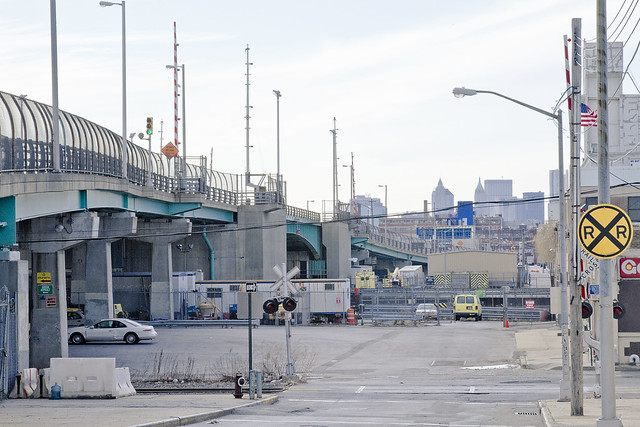
DUGABO (or Down Under the Greenpoint Avenue Bridge Onramp), it would seem, can now boast of hosting a foe of evil.
Wonder what might happen should they spy the Blissville Banshee as she floats down the Newtown Creek, spy the occultists who make altars in area cemeteries, or wonder at the tales of an antique and quite spectral locomotive passing the Bliss Tower on its way to Deadman’s Curve at Berlin Hill?
Would we see an exorcism in DUGABO?
ALSO, this Friday:
My own attempt at presenting a cogent narrative and historical journey “up the creek” is up coming as well-
Your humble narrator will be narrating humbly on Friday, February 24th at 7:30 P.M. for the“Ridgewood Democratic Club, 60-70 Putnam Avenue, Ridgewood, NY 11385” as the “Newtown Creek Magic Lantern Show” is presented to their esteemed group. The club hosts a public meeting, with guests and neighbors welcome, and say that refreshments will be served.
The “Magic Lantern Show” is actually a slideshow, packed with informative text and graphics, wherein we approach and explore the entire Newtown Creek. Every tributary, bridge, and significant spot are examined and illustrated with photography. This virtual tour will be augmented by personal observation and recollection by yours truly, with a question and answer period following.
For those of you who might have seen it last year, the presentation has been streamlined, augmented with new views, and updated with some of the emerging stories about Newtown Creek which have been exclusively reported on at this- your Newtown Pentacle.
For more information, please contact me here.
What: Newtown Creek Magic Lantern Show
When: Friday, February 24th at 7:30 P.M.
Where: Ridgewood Democratic Club, 60-70 Putnam Avenue, Ridgewood, NY 11385


 The Newtown Pentacle