Posts Tagged ‘Calvary Cemetery’
for silver
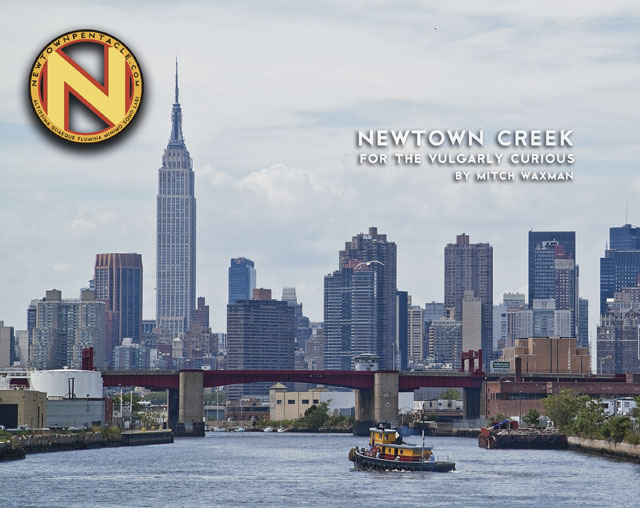
“Newtown Creek for the Vulgarly Curious” is a fully annotated 68 page, full-color journey from the mouth of Newtown Creek at the East River all the way back to the heart of darkness at English Kills, with photos and text by Mitch Waxman.
Check out the preview of the book at lulu.com, which is handling printing and order fulfillment, by clicking here.
Every book sold contributes directly to the material support and continuance of this, your Newtown Pentacle.
marble glories

– photo by Mitch Waxman
A favored aphorism amongst Occultists is “as above, so below”, a saying attributed to having been coined by Hermes Trismegistis and recorded upon the legendary Kitab Sirr al-Asrar (aka Smaragdine Table, Tabula Smaragdina) or Emerald Tablet.
Such thoughts and sayings often trouble a humble narrator when traveling across the emerald devastations of First Calvary Cemetery here in Queens. The arabic origin of the word Ghoul (ghul) notwithstanding, the term seems appropriate to describe one such as myself, “a person who delights in the macabre.”– although I’m proud to say that (as of yet) I’ve never robbed a grave, drank human blood, or eaten a small child- which are other trademarks of the legendarily abhorrent and undead creatures.
Life has taught me to never say “never” however.
ghoul [guːl]n
- a malevolent spirit or ghost
- a person interested in morbid or disgusting things
- a person who robs graves
- (Myth & Legend / Non-European Myth & Legend) (in Muslim legend) an evil demon thought to eat human bodies, either stolen corpses or children
[from Arabic ghūl, from ghāla he seized]

– photo by Mitch Waxman
All ‘effed up, one of the things which tortures me in those moments before sleep comes is “why am I so fascinated by graveyards?”.
Is it some sort of pretentious “Memento mori” artsy fartsy thing, or is there something motivating me that lies deeply buried and hidden in the polyandrion of ideation which defines my thoughts? When these photos were shot, I was indeed “searching for (the name that must never be spoken again)” but as often happens to me in this place, my concentration began to fray and tear in the manner of an overburdened rope. Imaginings and fantastic notions march into your mind here, and on this day, I became convinced that I heard grunting sounds rising from the soil.
As above, so below- and as your humble narrator was walking the gentle landscaping of Calvary, enjoying the bright emanations of that burning thermonuclear eye of god itself- were unknown counterparts mirroring my movements in some subterrane grotto?
from wikipedia
Ideas of reference and delusions of reference involve people having a belief or perception that irrelevant, unrelated or innocuous phenomena in the world refer to them directly or have special personal significance. In psychiatry, delusions of reference form part of the diagnostic criteria for psychotic illnesses such as schizophrenia, delusional disorder, or bipolar disorder during the elevated stages of mania.

– photo by Mitch Waxman
As a believer in nothing but the hydrogen bomb (the very existence and functionality of which proves the sterile Einsteinian worldview of the universe, as espoused by Physicist and Mathematician alike, as valid and true. How many angels, or neutrinos, can dance on the head of a pin- indeed), I fancy myself a student of debased and superstitious folklore nevertheless. Revenants, Dybbuks, Dhampirs, and Vrykolakas enter my thoughts when I move through these lonely places during my vast solitudes.
Apotropaic devices are absent from my coterie of gadgets and cameras, and whatever dark and cthonic powers may be extant and watching would perceive me as defenseless. Part of the reason I only go to this place during the brightly lit hours of the day, I suppose.
from wikipedia
In Hindu folklore, the vetala is an evil spirit who haunts cemeteries and takes demonic possession of corpses. They make their displeasure known by troubling humans. They can drive people mad, kill children, and cause miscarriages, but also guard villages.
They are hostile spirits of the dead trapped in the ‘twilight zone’ between life and afterlife. These creatures can be repelled by the chanting of holy mantras. One can free them from their ghostly existence by performing their funerary rites. Being unaffected by the laws of space and time, they have an uncanny knowledge about the past, present, and future and a deep insight into human nature. Therefore many sorcerers seek to capture them and turn them into slaves.

– photo by Mitch Waxman
Of course, this is a Roman Catholic cemetery, which suggests that the multitudes who lie here were sealed off- magickly- by the sacrament of “Extreme Unction” from suffering such macabre experiences as walking about the earth seeking living victims in some post mortem half life. The heritage of the Catholics extends back through time to the Dagon devotees of Syria and the tomb worshipping Etruscans, and the Romans spent enough time in Egypt and North Africa to have picked up and incorporated many of the Magicks they found into the syncretic system of beliefs and rites known as and inherited by modernity as Catholicism. The mysteries of the church are many, and varied, and more has been forgotten or lost over the centuries than any single lifetime can recover.
Who can guess, all there is, that might be buried down there?
from wikipedia
Magick is an Early Modern English spelling for magic, used in works such as the 1651 translation of De Occulta Philosophia, Three Books of Occult Philosophy, or Of Magick. The British occultist Aleister Crowley, chose the spelling to differentiate the occult from stage magic and defined it as “the science and art of causing change to occur in conformity with the will”, including both “mundane” acts of will as well as ritual magic. Crowley claimed that “it is theoretically possible to cause in any object any change of which that object is capable by nature”. John Symonds and Kenneth Grant attach a deeper occult significance to this preference.
Crowley saw magick as the essential method for a person to reach true understanding of the self and to act according to one’s True Will, which he saw as the reconciliation “between free will and destiny.”
Since the time of Crowley’s writing about magick, many different spiritual and occult traditions have adopted the K spelling, but some have redefined what it means to some degree. For some modern occultists, it refers strictly to paranormal magic, which involves influencing events and physical phenomena by supernatural, mystical, or paranormal means.

– photo by Mitch Waxman
As above, so below. The full quotation, as translated into english from a latin translation of the original Arabic by Isaac Newton (whose groundbreaking work- particularly “De motu corporum in gyrum”- sets the stage for the later realization of the Einsteinian viewpoint, the Hydrogen Bomb, and our modern world of space going craft, jet travel, and deep sea exploration) goes:
“That which is below is like that which is above that which is above is like that which is below to do the miracles of one only thing.”
from wikipedia
The Liber de Causis was a philosophical work attributed to Aristotle that became popular in the Middle Ages, first in Arabic and Islamic countries and later in the Latin West. The real authorship remains a mystery, but most of the content is taken from Proclus’ Elements of Theology. This was first noticed by Thomas Aquinas, following William of Moerbeke’s translation of the works of Proclus into Latin.
The original title in Arabic was Kitāb ul-īḍāḥ li-Arisţūţālis fi’l-khayri’l-maḥd, “The book of Aristotle’s explanation of the pure good”. The title Liber de Causis came into use following the translation into Latin by Gerard of Cremona.
Project Firebox 16

– photo by Mitch Waxman
Too seldom consulted and seldom admired, this notable exception to municipal prejudice on Review Avenue provides succor and aid to the long strip of industrial and warehouse buildings which typify the severe declination that leads one to the Newtown Creek, and acts as a watchman over the titan walls of Calvary Cemetery.
note: apologies for missing yesterday and for the non tangential nature of this post, but I’m a little busy with something at the moment. I’ll be back on the stick within a day or so.
with palpitant heart

– photo by Mitch Waxman
Startlingly interesting is the only way to describe the experiences of the preceding year. Attempts have been made to cogently describe and colorfully illustrate the encounters your humble narrator has enjoyed in this 10th year of the millennium. For those of you who have just recently started to read this, your Newtown Pentacle, this is your chance to check out some of the highlights of 2010 (according to me), and for the veteran Lords and Ladies of the Pentacle an opportunity to review.
If you’ll indulge me…
January, 2010- The Abbot

The sort of posting which satisfies me deeply, “The Abbot” monument found at Calvary focused my attentions on certain realities of 19th century New York, and proved my theory that Calvary Cemetery is the single greatest historical resource in Queens. Obviation of my satisfaction with the posting is provided by the admission that I had noticed the stone peripherally, found it interesting, and started shooting it with no idea at all about its meaning. Only at home, when reviewing the photos did the whole story come together. Al Smith is buried at Calvary as well (he’s the fellow who built the skyscraper seen in the night shot at the head of this post) but this paragraph is about January 2010 and Governor Smith’s story was told in 2009.
January, 2010- The Great Machine

Also in January, a pet ideation was advanced, one not of theory but of perception. The notion of the megalopolis figures heavily in my thinking- a concept that sees the eastern seaboard of the United States not as a series of cities, but rather one vast urban zone of varying densities with New York City at the titular center of a web of industry, transport, and agricultural systems. The center of the web has a center itself, which is Manhattan- specifically where it connects to “the Great Machine” of the Queensboro bridge and it’s corollaries.

– photo by Mitch Waxman
February 2010– Affordable Housing Development on Borden Avenue

This post, “Affordable Housing Development on Borden Avenue“, is included in the year end wrap up simply because it ended up being one of the more widely read and commented upon endeavors presented in 2010. Most likely, it was the linking shout out from Queenscrap that made it so, rather than any subjective quality or incisive observation. Homeless camps abound in the Newtown Pentacle, hidden away on seldom trodden lanes and along backwater pathways- in this case it’s alongside the oft delayed construction project at the Borden Avenue Bridge which spans Dutch Kills.
February 2010– horrible and unearthly ululations…

A lot of time was spent in 2010 trying to wrap my head fully around the story of the Newtown Creek (which culminated ultimately in the late October release of the first Newtown Pentacle book- Newtown Creek for the vulgarly curious) and “horrible and unearthly ululations…” was the first of several posts which attempted to boil complicated and obscure snippets of historical lore into a cohesive and accessible form. So much is made of the Greenpoint Oil Spill and the Meeker Avenue Plumes by the legal community, whose hungry jowls slaver and shake at the financial possibilities offered by the EPA’s superfund designation and various court decisions, that the true and terrible wonder of the Newtown Creek is often overlooked. This post and several others of its ilk attempt to present a fuller version of things, and act as reminders that what was may once again be.

– photo by Mitch Waxman
March 2010– The Shadow over Sunnyside

The St. Pat’s Day for All parade in Sunnyside is a yearly event which draws in a citywide coterie of political entities, all desperate for attention and attribution as being friendly to the GLTG members of the electorate. The parades origins are a reaction against the banning of outwardly gay marchers in the RC church’s own St. Patricks day parade in Manhattan. Despite its politically contentious birthing, the Sunnyside parade is actually a fun and light hearted event, and signals the coming of springtime in the Newtown Pentacle. While there principally to get shots of the political master race which rules over us, amongst the crowd I noticed small clots of dire intent armed with ugly signage. Research into this group, which was clearly coordinated and queerly ominous, revealed them to be adherents to a bastardized form of Catholic fundamentalism which has been outlawed and defined as a dangerous cult by several Nation-states. A shadow over Sunnyside indeed.
March 2010– Exhausted
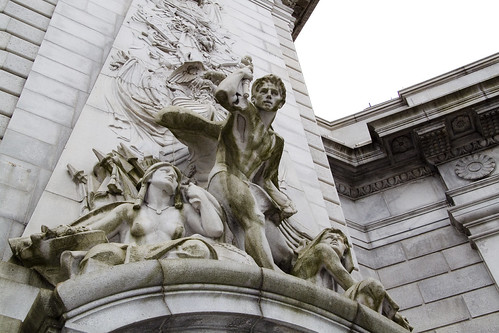
A brighter experience for your humble narrator was the Manhattan Bridge Centennial Time Capsule event, on March 5. Interactions and conversations were enjoyed by the least of men with certain powers and potentates of the City of Greater New York and entry to the interior space of the Manhattan Bridge was obtained. One of the high points of my year, “Exhausted” detailed the embedding of a time capsule in the East River Bridge #2- aka the Manhattan Bridge. Remarkable self control was exercised when I met the DOT Commissioner, Jeanette Sadik-Khan. My sincerest desire was to bend her ear with my alleged wisdom about bike lanes and bridge safety- but self control was ascendent that day and only congratulations were offered to both her and the other staffers at DOT.

– photo by Mitch Waxman
April 2010– City of Marble and Beryl
Odd shenanigans were observed at St. Michael’s Cemetery here in Astoria, which were of a decidedly magickal nature. A ritual site that your humble narrator stumbled across was examined and evidentiary examination suggested that certain third world cults were extant here in the old village of Astoria, conducting midnight bacchanals concurrent with the lunar cycle. “City of Marble and Beryl” was but the first of many moons which witnessed a working of will amongst the desolations of our kind.
April 2010– Searching for Gilman

A good part of 2010 was spent “Searching for Gilman” at First Calvary Cemetery, which I am doing as you are reading this, assuming it’s the start of 2011 whenever you do. Gilman is the source of no small amount of pain and financial hardship around these parts, as your humble narrator has become dangerously obsessive and paranoid around the subject. A psychotic need to find Gilman’s grave torments me, coloring my days and painting my dreams a dull yellow.

– photo by Mitch Waxman
May 2010– the king in yellow, brick
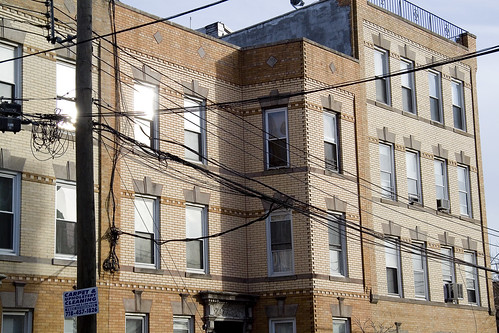
Remiss would be apparent were I to not mention the “Madison Avenue Bridge Centennial” but “the king in yellow, brick” advanced another of my pet theories and served up a fascinating (to me at least) sequence of events and relationships which attempts to explain why those yellow Kreischer bricks are all over the older sections of Queens.
May 2010– after cycles incalculable

“After cycles incalculable” is another one of those perfect posts, from a personal perspective. Wandering around with a friend, which is a disturbing trend which developed over the course of 2010, at Skillman Avenue’s start we observed the Lemuria hatching in concordance with the anniversary of the Roman festival of Lemuralia in Long Island City.

– photo by Mitch Waxman
June 2010– from Hells Gate, loosed upon the world

When I set out on my little walks, there is seldom a destination in mind. Literally wandering, obscure symbols and pseudo occultism guide my steps- I’ll follow a black cat, or merely adopt a roughly heliotropic path using my own shadow as compass. At the very end of May, my feet carried me toward Astoria Park and the notorious section of the East River known as Hells Gate. The odd craft, an “unidentified floating object” if you would, which sped past my lens required more than a small bit of detective work to identify- which was detailed in “from Hells Gate, loosed upon the world“.
June 2010– Gods Gift to Pain

English Kills, which is the logical and modern end of Newtown Creek, is a heavily industrialized and largely anaerobic tributary of the larger waterway and is seldom visited (by me, at least) at its extant. One fine day, while hanging out with another Creek enthusiast (you should not go to this place alone), we decided to enter the largely hidden urban foyer which leads here- despite the fact that we were most likely trespassing- which violates Newtown Pentacle policy. The title of the post- “Gods Gift to Pain” was lifted from an enigmatic and appropriate bit of graffiti observed in this forgotten pace of dissolution and poison.

– photo by Mitch Waxman
The reason for Brooklyn, and Queens- why it was a viable alternative to living in Manhattan in the 19th century was defined by the horrors of tenement life. The grand old buildings with their high ceilings, thick plastered walls, convenient dumbwaiters, and incredibly ornate lobbies- the structures which distinguished and made life desirable in the incalculably distant boroughs, were built as an alternative to the crowded and dangerous tenements of “The City”- especially the warren which was known as the “Five Points“. Additionally, Calvary Cemetery (of particular interest to me, and perhaps, to you) was founded by the parishioners of Old St. Patrick’s Cathedral which is smack dab in the middle of this ancient labyrinth of poverty, crime, and squalor. It was decided that to fully understand what one observes in the remains of the supposed “answer to the problem”, exploration of “the problem” itself is required.
July 2010– Bandits Roost, 2010

Ideal source material for the textural and societal milieu of the Five Points is the admittedly biased “How the Other Half Lives” by 19th century do-gooder Jacob Riis. Speaking the truth that power wants to hear is always a sound move if one considers fiscal realities and historical reputation. Attempts were made to find the modern locale in which Riis shot some of his more famous shots, such as this visit to “Bandits Roost 2010“.
July 2010– The house of Dagger John

Another critical visitation for me, as part of my larger education and study of the early development of the City of Greater New York was occasioned on the day when I went to “The house of Dagger John“. Old St. Patrick’s Cathedral satisfies both my continuing fascination with the counterpoint of sacred and profane in the story of the Megalopolis, and figures largely in the predictions of certain obscure lore which governs the schedule of my researches.

– photo by Mitch Waxman
August 2010– not to harsh anyone’s buzz… but…

August of 2010 brought a posting which garnered a lot of attention, due to curbed.com noticing and linking to it. Simply noticing that a growing proliferation of small boats were berthing illegally at the Vernon Avenue street end, it would be irresponsible of me- given everything that I know about the location not to point out the mortal and existential danger that the operators of these boats were placing themselves in. It’s not even the water, really, its the high pressure natural gas line- the enormous CSO which drains LIC- the omnipresent heavy industrial maritime traffic- which makes the spot so hazardous. Mortal threats were received via email (which I’ve kept private), and the comments thread displayed an angry and accusatory tone. As is the case with all such critique, these comments were presented verbatim- here’s a taste: “i have red your article in which you show a great deal of unger towards me and my friends . i believe that you base your article on many misconceptions that are rooted in a lack of communication”, “Blogger or not, the prudent journalist would make an effort to uncover basic facts before publishing a story full of assumptions”, “are you just the type of little man that tells teacher when the cool kids make you feel inferior. The water is public domain! And according to maritime law it is not illegal to moor a boat as long as it safe and looked after.”, “They are not bothering anyone. And get sick from the canal, come on. They are not living down there as far as I know. Parking your boat in the canal is not going to get them sick! Stop over doing it.” Check out “not to harsh anyone’s buzz… but…“.
August 2010– lively antics

One of the greatest joys of living in Queens are the chance encounters you’ll have with people who hail from the furthest points of the compass, such as this Bouzouki player during another visit to Hells Gate. His “lively antics” added splendor to a brightly lit walk around Astoria.

– photo by Mitch Waxman
September 2010– Lucky Shot

Although veteran photographers caution me against use of this term, I call the photo above my “shot of the year”. The steel structure attached to the bottom of the Brooklyn Bridge was installed as part of a bridge painting and maintenance project, and I was luckily along on a Working Harbor trip just as the sun was setting. Right place, right time, it was a “Lucky Shot“.
September 2010– stronger than fear

The dynamic new Safeboats utilized by NYPD and other entities around the harbor were a frequent subject over several of the Working Harbor expeditions I was lucky enough to attend. The many shapes, colorways, and missions of these quick little patrol boats are a delight to observe- and to those who would work maritime malice upon the metropolis- they are the head of the spear. Check out “stronger than fear“.

– photo by Mitch Waxman
A high of the year was the Newtown Creek Cruise which I had the honor of co-narrating with Bernard Ente on October 24th, of course, but the main topic of conversation amongst the antiquarian and environmental communities of the Newtown Pentacle in October revolved around the EPA’s superfund announcement about Newtown Creek at the very end of September. October is spooky time around these parts, and I spent a little time digging around the area for thrills and chills as well.
October 2010– blurred outlines

As part of series of postings detailing what might be seen in the Brooklyn neighborhood of Greenpoint, “blurred outlines” discusses the alleged appearance of a pyrokinetic at 84 Guernsey Street in January of 1895.
October 2010– scenes familiar, and loved

One of my frequent walks through Calvary Cemetery took me to the curiously empty chapel which enjoys the paramount of Laurel Hill. I will admit that I came here this day seeking two things- one was a likely entrance to a vast subterranean structure which underlies the area- the other was a vain hope that the grave of Gilman might present itself in a section which was, at the time, not terribly familiar to me as I normally stay close to the fringes of the place where the whipporwills wail. I very well might have captured what mass media paranormal media sources describe as a ghost orb in “scenes familiar, and loved“.

– photo by Mitch Waxman
November 2010– peace rests nevermore

One of the goals of this, your Newtown Pentacle, is to provide some sort of documentation about this terrible and wonderful place called the Newtown Creek- and I’m happy to say that I was there when the then Attorney General and Governor Elect Andrew Cuomo announced the settlement of a lawsuit brought by his office on behalf of New York State against Exxon-Mobil which involved the Greenpoint Oil Spill. “Peace rests nevermore” indeed.
November 2010– shocking coruscations

Entertaining maritime folklore from past centuries was offered in “shocking coruscations“, which is told against a series of twilight photos from good old Hells Gate between the two great bridges.

– photo by Mitch Waxman
During the cold, when inclement clime restricts my movements and the black dog nips at my heels, I tend toward shorter postings- and in December of 2010 there were two “Then and Now” postings that really took my fancy. These posts are difficult because of the scarce source material available in the public domain, but fun nevertheless. In my usual fashion “dumb idiot” fashion, I had shot the modern views completely unaware of the original photo. Our friends at the Greater Astoria Historic Society have recently released a book of similar historical views, which is worthy of consideration.
December 2010– Bowery Savings Bank 2010 and 1903

As the title states, this is the iconic shell of a once essential and awesomely powerful institution called the Bowery Savings Bank in Manhattan, with a 1903 photo from a similar perspective.
December 2010– Hunters Point Avenue Bridge Centennial

If you told me a year ago that I’d end up doing a press conference with a United States Congresswoman, I’d have hit you. That’s how I ended up at the Degnon Terminal’s own Sunshine Biscuits (LaGuardia Community College) building though, and by an odd coincidence- found myself standing in nearly the same spot as some unknown photographer did in 1921. This posting was built around the announcement of the “Hunters Point Avenue Bridge Centennial” event.

– photo by Mitch Waxman
Overall, a positive and exciting year, despite the deaths of several members of my family.
For a while, I enjoyed a spot on the board of the nascent Newtown Historical Society as a trustee, which is a position that I’ve had to resign for a variety of personal reasons- but I’d like to thank fellow board members Kevin Walsh, Christina Wilkinson, Steve Garza, and Bob Singleton for an interesting and educational experience. Kevin Walsh of forgotten-ny gets a personal call out, as his support, knowledge, and encouragement has been invaluable. Special thanks also are extended toward Capt. John Doswell and Meg Black of the Working Harbor Committee, all the guys and gals aboard the John J. Harvey fireboat, and everybody else who allowed a piss poor specimen such as myself to come along on adventures. Bernard Ente of the Newtown Creek Alliance, Working Harbor, and others also receives a heartfelt gratitude and shout out from this humble mendicant. Standing on the shoulders of giants is difficult if you suffer from altitude related nosebleeds.
What’s next?
Tell you what, feel like taking a walk?
Meet me at the border of Brooklyn and Queens – bring a camera… and ID… I’ll show you something cool…
singular caravan

– photo by Mitch Waxman
The odd ways and methods of thought which your humble narrator exhibits mystify even himself. Walking down Laurel Hill Blvd. one fine day, and upon observing that most mundane and usual of creatures- the Squirrel- I realized that near total ignorance of the studied actuality of the animal was mine.
This happens to me often, sometimes it’s a foodstuff- like honey for instance. “How does one produce Honey industrially?” (which I’ve mentioned before), or “How, exactly, is Jell-O made?”. The latter case, incidentally, produced an answer so horrible and pregnant with latent disgust that I haven’t eaten the stuff since.
If you enjoy gelatin desserts, don’t ever, EVER try to find out. It’s not what you think it is, and the simplest thing to say is that the process for producing the stuff was invented in the 19th century at Newtown Creek…
from wikipedia
The living squirrels are divided into 5 subfamilies, with about 50 genera and nearly 280 species. The oldest squirrel fossil, Hesperopetes, dates back to the Chadronian (Late Eocene, about 40 – 35 million years ago), and is similar to modern flying squirrels.
During the latest Eocene to the Miocene, there were a variety of squirrels which cannot be assigned with certainty to any living lineage. At least some of these probably were variants of the oldest, basal “proto-squirrels” (in the sense that they lacked the full range of living squirrels’ autapomorphies). The distribution and diversity of such ancient and ancestral forms suggests that the squirrels as a group might have originated in North America.
Apart from these sometimes little-known fossil forms, the phylogeny of the living squirrels is fairly straightforward. There are three main lineages, one comprising the Ratufinae (Oriental giant squirrels). These contain a mere handful of living species in tropical Asia. The Neotropical Pygmy Squirrel of tropical South America is the sole living member of the Sciurillinae. The third lineage is by far the largest and contains all other subfamilies; it has a near-cosmopolitan distribution. This further supports the hypothesis that the common ancestor of all squirrels living and fossil lived in North America, as these three most ancient lineages seem to have radiated from there – if squirrels had originated in Eurasia for example, one would expect quite ancient lineages in Africa, but African squirrels seem to be of more recent origin.
The main group of squirrels also can be split up in three, which yields the remaining subfamilies. The Sciurinae contains the flying squirrels (Pteromyini) and the Sciurini, which among others contains the American tree squirrels; the former have often been considered a separate subfamily but are now seen as a tribe of the Sciurinae. The pine squirrels (Tamiasciurus) on the other hand are usually included with the main tree squirrel lineage, but appear to be about as distinct as the flying squirrels; hence they are sometimes considered a distinct tribe, Tamiasciurini.

– photo by Mitch Waxman
These sort of questions are not good ones to ask, as often the answers present casual barbarism and bloody reality in a matter of fact fashion, and such information blackens the heart and calcifies the mind. Would it aid me, in any way whatsoever, to find out that there might have been some carnivorous Ice Age Squirrel the size of a Buffalo or something? Would it not in fact, be somewhat wiser to apply the limited intellect and time left to me on this mortal coil in pursuit of acquiring the sort of skills which would allow me to gather and hoard material wealth to myself?
Perhaps I could apply my time to more fruitful pursuits than those already explored, apply for and attain some sort of professional license and become a realtor or exterminator or something? Perhaps some novel combination of the two would be possible, and certainly more useful than spending an entire day thinking about common urban rodents.
from wikipedia
Squirrels are generally intelligent and persistent animals. In residential neighborhoods, they are notorious for discovering clever methods to circumvent obstacles in order to eat out of bird feeders. Tree squirrels also create minor annoyances by digging in planting pots and flower beds to pull out bulbs which they chew on, to either bury or recover seeds and nuts, and for building nests within human domiciles, including attics and basements. Squirrels use their keen sense of smell to locate buried nuts and can dig extensive holes in the process. Birds, especially crows, will sometimes watch a squirrel bury a nut, then dig it up as soon as the squirrel leaves. Although they are expert climbers, and primarily arboreal, squirrels also thrive in urban environments, where they have adapted to humans.

– photo by Mitch Waxman
Alas, this fascination for the obscure and bizarre marks me, as always… an Outsider… condemned to feel at home only amongst the tomb legions.
from wikipedia
In Norse mythology, Ratatoskr (Old Norse, generally considered “drill-tooth” or “bore-tooth”) is a squirrel who runs up and down the world tree Yggdrasil to carry messages between the unnamed eagle, perched atop Yggdrasil, and the wyrm Níðhöggr, who dwells beneath one of the three roots of the tree. Ratatoskr is attested in the Poetic Edda, compiled in the 13th century from earlier traditional sources, and the Prose Edda, written in the 13th century by Snorri Sturluson. Scholars have proposed theories about the implications of the squirrel.
Ratatosk is the squirrel who there shall run
On the ash-tree Yggdrasil;
From above the words of the eagle he bears,
And tells them to Nithhogg beneath.


 The Newtown Pentacle