Posts Tagged ‘DonJon towing’
established categories

– photo by Mitch Waxman
This maritime Sunday, it’s a return to the Newtown Creek, where a tug was witnessed heading out to the East River with two barges of what seems to be metal. Unusual best describes the manner in which the barges are tied to the tug, at least in my limited experience. Most of the tandem tows I’ve witnessed over the last several years orient multiple barges in a line, after the manner of train cars in relationship to locomotive engine.

– photo by Mitch Waxman
Although I can report this only from having seen photos, on the Mississippi or other inland waterways, several barges will be lined up in long rows before tugs. Unfortunately, I came upon the Mscene too late to capture any identifying information about this tug, even the identity of its company. Hopefully, our friends at tugster might be generous enough to identify at least the name of the towing corporation based on the “colorway” of the boat for you, gentle readers, in the comments section.
roving commission

– photo by Mitch Waxman
Lo, sigh heavily and behold- for once again it is Maritime Sunday at this, your Newtown Pentacle. This week, we’re focusing in on the DonJon Marine’s Sarah Anne moving (presumably) from Newtown Creek to the Port of Newark with a load of scrap metals. This is an oft repeated journey for the Tugs of New York Harbor, and offers quite an occupation.
from donjon.com
Since its incorporation in 1966, Donjon Marine has established and continues to seek long-term client relationships in a world where limited business resources demand a constant balancing of expenditures. Beginning with its foundation in the New York area as a pioneer in marine salvage services, Donjon has grown to become a leader in both conventional and environmental dredging. Its areas of expertise also include recycling, land and marine demolition, pollution control and remediation, heavy lift transport, marine transportation and landfill remediation/site management.

– photo by Mitch Waxman
The metals trade often comes up in these postings, partially due to my proximity to its center at Newtown Creek, and partially due to the wonder of it all. The claims which are made by those versed in macroeconomic and engineering circles is that the recycling process saves a lot of energy (and atmospheric emissions of concurrent gaseous pollution) from being used in the pursuit of new materials obtained via traditional mining and refining processes.
Click here for the Sarah Ann page at donjon.com, and get all her vital statistics

– photo by Mitch Waxman
Personal observation of the metal recycling process has shown, instead, the heaviest of machinery being operated at full throttle and spewing exhaust into the open air. The whole process is fed by trucks, barges, and vast ocean going ships whose journeys span continents.
Tremendous amounts of fuel, industrial machinery, and human labor are required.
from sname.marinelink.com
Donjon Marine, Co., Inc., a global marine services provider based in N.J., announced that Donjon has added the 2,700 hp twin screw tug Sarah Ann (ex-June K) to its expanding tug fleet. The 78 by 26 by 10.5-ft tug, with twin CAT 3512B diesels and a nine-ft draft, was built in 2003 by A&B Shipyard, Amelia, La. Designed principally for ship handling and assist work, barge towing and dredge assist, the tug’s draft is shallow enough to navigate the many creeks and estuaries throughout the Port of New York region.

– photo by Mitch Waxman
Often have I wondered how much is actually saved, environmentally, by the process. This is, of course, heresy to the environmental crowd. Any intellectual deviation from a political normative- such as “recycling is incontrovertibly good and has no cost”- even the act of questioning such logic, is met with disbelief and scorn.
Hey, I’m just asking.
Doesn’t sound good at cocktail parties in Manhattan, I guess.
from wikipedia
The scrap industry contributed $65 billion in 2006 and is one of the few contributing positively to the U.S. balance of trade, exporting $15.7 billion in scrap commodities in 2006. This imbalance of trade has resulted in rising scrap prices during 2007 and 2008 within the United States. Scrap recycling also helps reduce greenhouse gas emissions and conserves energy and natural resources. For example, scrap recycling diverts 145,000,000 short tons (129,464,286 long tons; 131,541,787 t) of materials away from landfills. Recycled scrap is a raw material feedstock for 2 out of 3 pounds of steel made in the U.S., for 60% of the metals and alloys produced in the U.S., for more than 50% of the U.S. paper industry’s needs, and for 33% of U.S. aluminum. Recycled scrap helps keep air and water cleaner by removing potentially hazardous materials and keeping them out of landfills.
June 30th, 2012- Working Harbor Committee Kill Van Kull walk

– photo by Mitch Waxman
My various interests out on the sixth borough, NY Harbor, have brought me into association with the Working Harbor Committee. A member of the group’s Steering Committee- I also serve as the “official” group photographer, am chairman and principal narrator of their annual Newtown Creek Boat Tour, and occasionally speak on the microphone during other tours (mainly the Brooklyn one). This year, the group has branched out into terrestrial explorations to compliment the intense and extant schedule of boat tours, and I’m going to be leading a Kill Van Kull walking tour that should be a lot of fun.
The Kill Van Kull, or tugboat alley as its known to we harbor rats, is a tidal strait that defines the border of Staten Island and New Jersey. A busy and highly industrialized waterfront, Working Harbor’s popular “Hidden Harbor – Newark Bay” boat tours provide water access to the Kill, but what is it like on the landward side?
Starting at the St. George Staten Island Ferry terminal, join WHC Steering Committee member Mitch Waxman for a walk up the Kill Van Kull via Staten Islands Richmond Terrace. You’ll encounter unrivaled views of the maritime traffic on the Kill itself, as well as the hidden past of the maritime communities which line it’s shores. Surprising and historic neighborhoods, an abandoned railway, and tales of prohibition era bootleggers await.
The tour will start at 11, sharp, and you must be on (at least) the 10:30 AM Staten Island Ferry to meet the group at St. George. Again, plan for transportation changes and unexpected weirdness to be revealed to you at MTA.info.
for June 30th tickets, click here for the Working Harbor Committee ticketing page
July 8th, 2012- Atlas Obscura Walking Tour- The Insalubrious Valley

– photo by Mitch Waxman
Newtown Creek Alliance historian Mitch Waxman will be leading a walk through the industrial heartlands of New York City, exploring the insalubrious valley of the Newtown Creek.
The currently undefended border of Brooklyn and Queens, and the place where the Industrial Revolution actually happened, provides a dramatic and picturesque setting for this exploration. We’ll be visiting two movable bridges, the still standing remains of an early 19th century highway, and a forgotten tributary of the larger waterway. As we walk along the Newtown Creek and explore the “wrong side of the tracks” – you’ll hear tales of the early chemical industry, “Dead Animal and Night Soil Wharfs”, colonial era heretics and witches and the coming of the railroad. The tour concludes at the famed Clinton Diner in Maspeth- where scenes from the Martin Scorcese movie “Goodfellas” were shot. Lunch at Clinton Diner is included with the ticket.
Details/special instructions.
Meetup at the corner of Grand Street and Morgan Avenue in Brooklyn at 11 a.m. on July 8, 2012. The L train serves a station at Bushwick Avenue and Grand Street, and the Q54 and Q59 bus lines stop nearby as well. Check MTA.info as ongoing weekend construction often causes delays and interruptions. Drivers, it would be wise to leave your vehicle in the vicinity of the Clinton Diner in Maspeth, Queens or near the start of the walk at Grand St. and Morgan Avenue (you can pick up the bus to Brooklyn nearby the Clinton Diner).
Be prepared: We’ll be encountering broken pavement, sometimes heavy truck traffic as we move through a virtual urban desert. Dress and pack appropriately for hiking, closed-toe shoes are highly recommended.
Clinton Diner Menu:
- Cheese burger deluxe
- Grilled chicken over garden salad
- Turkey BLT triple decker sandwich with fries
- Spaghetti with tomato sauce or butter
- Greek salad medium
- Greek Salad wrap with French fries
- Can of soda or 16oz bottle of Poland Spring
for July 8th tickets, click here for the Atlas Obscura ticketing page
July 22nd, 2012- Working Harbor Committee Newtown Creek Boat Tour
 |
 |
Many people know about the environmental issues facing Newtown Creek, but did you know that the Creek was once the busiest waterway in North America, carrying more industrial tonnage than the entire Mississippi River?
You’ll learn much more when Working Harbor Committee’s maritime historians and harbor experts
put it all in context during a Hidden Harbor Tours: Newtown Creek Exploration.
The heart of industrial New York, Newtown Creek was home port to hundreds of tugboats (one of which is the historic WO Decker). It was also an international destination for oceangoing ships and a vast intermodal shipping and manufacturing hub that employed hundreds of thousands of people. Forming the border of Brooklyn and Queens for nearly three miles, five great cities grew rich along the Newtown Creek’s bulkheads — Greenpoint, Willamsburg, Bushwick, Long Island City and Manhattan itself. The waterway is still a vital part of the harbor and the Working Harbor Committee (WHC) is proud to present this tour as part of the celebration of their tenth anniversary year.
Mitch Waxman, a member of WHC’s steering committee and the group’s official photographer, also serves with the Newtown Creek Alliance as its group Historian. In addition to working on WHC’s boat tours of the Creek, Mitch offers a regular lineup of popular walking tours, and presents a series of well-attended slideshows for political, governmental, antiquarian, historical and school groups. His website — newtownpentacle.com — chronicles his adventures along the Newtown Creek and in the greater Working Harbor.
He was recently profiled in the NY Times Metro section, check out the article here.
Upcoming tour: Hidden Harbor Tours: Newtown Creek Exploration.
On July 22nd, Mitch shares his unique point of view and deep understanding of the past, present and future conditions of the Newtown Creek as the narrator and expedition leader for this years Hidden Harbor Tours: Newtown Creek exploration.
Our NY Water Taxi leaves from South Street Seaport at 11 a.m. (sharp) on a three hour tour of the Newtown Creek. From the East River we’ll move into the Newtown Creek where we’ll explore explore vast amounts of maritime infrastructure, see many movable bridges and discover the very heart of the Hidden Harbor.
Limited seating available, get your tickets today.
 |
|||||||||||||||
|
|||||||||||||||


certain reminder

– photo by Mitch Waxman
The Brian Nicholas oozing onto and smoothly navigating the lugubrious waters of an urban waterway called the Newtown Creek. Some 75 feet long, with a gross tonnage of 104 GRT, the Brian Nicholas is a creature of DonJon towing whose motive power is supplied by 2 850 HP engines that was built in 1966 and retrofitted in 2010.
from docs.google.com
This past June, Donjon completed the top-to-bottom refit and replacement of the main engines, generators, gears and related equipment of its tug Brian icholas. The refit was performed in house at Donjon’s Port Newark, New Jersey facility under the supervision of Donjon’s Gabe Yandoli and Robert Stickles. As a result of the refit, the Brian Nicholas is now a “green” tug, compliant with all applicable EPA and Tier 2 marine emissions regulations.
The rebuild included a repowering of the main propulsion with Cummins K38-M Marine engines, which were specifically developed by Cummins to meet EPA and Tier 2 marine emissions regulations. The new engines also meet the IMO, MARPOL and EU Stage 3A requirements. Similarly, the generators were upgraded to incorporate John Deere 4045TFM75 engines, also Tier 2 compliant. In addition to the replacement of the aforementioned engines, the project required virtually total replacement of exhaust lines and routing of new control lines and panels in the engine room and wheelhouse.
unlighted river

– photo by Mitch Waxman
Another DonJon tug is in the spotlight today, this time it’s the Paul Andrew. It’s pictured above at Port Elizabeth Newark, moving a barge past one of the gargantuan cargo docks which distinguish the place.
from wikipedia
The Port of New York was really eleven ports in one. It boasted a developed shoreline of over 650 miles (1,050 km) comprising the waterfronts of Manhattan, Brooklyn, Queens, the Bronx, and Staten Island as well as the New Jersey shoreline from Perth Amboy to Elizabeth, Bayonne, Newark, Jersey City, Hoboken and Weehawken. The Port of New York included some 1,800 docks, piers, and wharves of every conceivable size, condition, and state of repair. Some 750 were classified as “active” and 200 were able to berth 425 ocean-going vessels simultaneously in addition to the 600 able to anchor in the harbor. These docks and piers gave access to 1,100 warehouses containing some 41,000,000 square feet (3,800,000 m2) of inclosed storage space.
The SS Normandie arriving in New York Harbor on maiden voyage escorted by several tugboats.
In addition, the Port of New York had thirty-nine active shipyards, not including the huge New York Naval Shipyard on the Brooklyn side of the East River. These facilities included nine big ship repair yards, thirty-six large dry-docks, twenty-five small shipyards, thirty-three locomotive and gantry cranes of fifty ton lift capacity or greater, five floating derricks, and more than one hundred tractor cranes. Over 575 tugboats worked the Port of New York.

– photo by Mitch Waxman
These shots were acquired while onboard one of the many Working Harbor Committee tours of industrial Newark Bay and environs in September of 2011, which explains the glorious lighting.
Autumn is one of the times of the year in New York City during which the angle of the sun creates a golden orange “theatrical lighting” effect.
from wikipedia
The port consists of a complex of approximately 240 miles (386 km) of shipping channels as well as anchorages and port facilities. Most vessels require pilotage and larger vessels require tugboat assistance for the sharper channel turns. The natural depth of the harbor is about 17 feet (5 m), but it had been deepened over the years, to about 24 feet (7 m) controlling depth in 1880.[12] By 1891 the Main Ship Channel was minimally 30 feet (9 m). In 1914 Ambrose Channel became the main entrance to the Harbor, at 40 feet (12 m) deep and 2,000 feet (600 m) wide. During World War II the main channel was dredged to 45 feet (14 m) depth to accommodate larger ships up to Panamax size. Currently the Corps of Engineers is contracting out deepening to 50 feet (15 m), to accommodate Post-Panamax container vessels, which can pass through the Suez Canal. This has been a source of environmental concern along channels connecting the container facilities in Port Newark to the Atlantic. PCBs and other pollutants lay in a blanket just underneath the soil. In June 2009 it was announced that 200,000 cubic yards of dredged PCBs would be “cleaned” and stored en masse at the site of the former Yankee Stadium, as well as at the Brooklyn Bridge Park. In many areas the sandy bottom has been excavated down to rock and now requires blasting. Dredging equipment then picks up the rock and disposes of it. At one point in 2005 there were 70 pieces of dredging equipment working to deepen channels, the largest fleet of dredging equipment anywhere in the world.

– photo by Mitch Waxman
Writing this in the depth of frozen January, your humble narrator literally aches for the shirt sleeve warmth and long hours of sunlight offered during other seasons. The “photographer’s way” of course is to adapt, improvise, and “get it”, of course- but I truly pine for warmer (and brighter) times right now.
Built in 1968, by Breaux’s Bay Craft of Loreauville, Louisiana as the tug Miss Holly.
The tug was later acquired by DonJon Marine of Hillside, New Jersey where she was renamed as the Paul Andrew.
She is a twin screw tug powered by two Cummins KTA 19-M3 main engines with two Twin Disc MG 516 reduction gears at a ratio of 6:1 turning two 19(ft) 304 stainless steel 5 1/2 diameter 62(in) by 46(in) propellers for a rated 1,200 horsepower. Her electrical service is provided by two 30 kw generators driven by DD 3-71 engines 120-208 Triple Phase.

– photo by Mitch Waxman
The shot of the Paul Andrew above is from a Working Harbor trip even earlier in the year, August as a matter of fact. As a note, it is hitched up to a different sort of barge, and is tied up in a “on the hip” configuration.
Man, I can’t wait for the thaw.
from donjon.com
DIMENSIONS
Length Overall: 68 ft./ 20.73 m
Length Design Load Waterline: 63.6 ft./ 19.39 m
Beam Molded Amidships: 23.0 ft./ 7.01 m
Depth Molded to Main Deck: 9.0 ft./ 2.74 m
Tonnage (Gross): 99 GRT
Tonnage (Net): 67 NRT
CONSTRUCTION
All Steel
PROPULSION & STEERING
Main Engines: (2) Cummins KTA 19-M3 1,200 bhp
Propellers: (2) 19 ft. 304 Stainless Steel, 5½ diameter, 62 inch x 46 inch
Gears: Twin Disc MG 516, 6:1 Ratio
Rudders: (2) Spade
Steering Stations: Pilothouse, Upper Wheelhouse, Aft
PERFORMANCE
Speed (Free Route): 10 knots
Speed (Cruising): 8 knots
Bollard Pull:12 tons
Fuel Use/Range (Towing): 41 gph / 17 days
Fuel Use/Range (Cruising): 25 gph / 28 days
many candles

– photo by Mitch Waxman
Another one of NY Harbor’s towing companies whose craft are a delight to behold is DonJon Marine.
They operate a fleet of sky blue tugs whose capabilities range from canal and river tugs all the way up to a gargantuan oceanic tug which is called Atlantic Salvor.
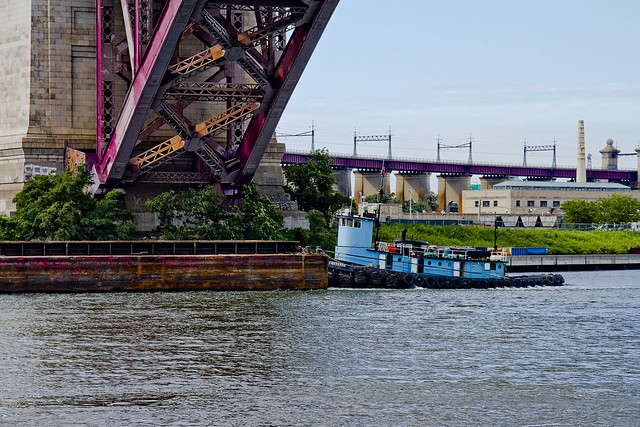
Today, the focus is on DonJon’s Cheyenne, which is one of their smaller tugs. That’s her, moving past Wards Island and passing beneath the Hells Gate Bridge.
from donjon.com
Founded in 1964 by Mr. J. Arnold Witte, Donjon’s President and Chief Executive Officer, Donjon Marine’s principal business activities were marine salvage, marine transportation, and related services. Today Donjon Marine is a true provider of multifaceted marine services. Donjon’s controlled expansion into related businesses such as dredging, ferrous and non-ferrous recycling and heavy lift services are a natural progression, paralleling our record of solid technical and cost-effective performance.
– photo by Mitch Waxman
Cheyenne is older than I am, yet manages to get to work every day, unlike me.
DonJon serves as one of the integral components of New York Harbor’s system for moving recyclable commodities from curb to customer, and can often be spotted moving barges of metallic waste between DSNY collection points.
I first became aware of the company’s role in the process after spotting them at the SimsMetal Newtown Creek docks a few years ago.
Built in 1965, by Ira S. Bushey and Sons of Brooklyn, New York (hull #628) as the tug Glenwood for Red Star Towing.
In 1970, she was acquired by Spentonbush Towing where she was renamed as the Cheyenne
The tug was later acquired by Amerada Hess where she retained her name.
She was then acquired by Empire Harbor Marine where the tug retained her name. The company would later be renamed as Port Albany Ventures.
In 2009, Port Albany Ventures was acquired by the DonJon Marine Company of Hillside, New Jersey.

– photo by Mitch Waxman
A dirty and necessary industry, recycling is nothing like you would imagine it to be. University professors, environmentalists, and politicians present an image of something akin to Santa’s Elves in crisp white uniforms working in an antiseptic factory isolated from population centers. The reality is that it is performed by oil streaked and smoke belching heavy machinery, consumes far more fuel than you would imagine, and that it is quite a dangerous occupation (also, the concentration and processing of these metals carries dark implications for groundwater and air quality in the localities which it takes place in).
Green jobs of the future indeed.
from wikipedia
The scrap industry contributed $65 billion in 2006 and is one of the few contributing positively to the U.S. balance of trade, exporting $15.7 billion in scrap commodities in 2006. This imbalance of trade has resulted in rising scrap prices during 2007 and 2008 within the United States. Scrap recycling also helps reduce greenhouse gas emissions and conserves energy and natural resources. For example, scrap recycling diverts 145,000,000 short tons (129,464,286 long tons; 131,541,787 t) of materials away from landfills. Recycled scrap is a raw material feedstock for 2 out of 3 pounds of steel made in the U.S., for 60% of the metals and alloys produced in the U.S., for more than 50% of the U.S. paper industry’s needs, and for 33% of U.S. aluminum. Recycled scrap helps keep air and water cleaner by removing potentially hazardous materials and keeping them out of landfills.

– photo by Mitch Waxman
Not meaning to sound negative on this otherwise essential service, it’s just that as certain highly placed municipal employees have advised me in the past- “Be careful which laws you ask for, as some things may come only at too great a cost”.
If it costs ten gallons of fuel to recycle and reuse something which it would have cost five gallons of fuel to pull out of the ground… what are we actually saving?
from wikipedia
The tugboat is one symbol of New York. Along with its more famous icons of Lady Liberty, the Empire State Building, and the Brooklyn Bridge, the sturdy little tugs, once all steam powered, working quietly in the harbor became a sight in the city.
The first hull was the paddler tug Rufus W. King of 1828.
New York Harbor at the confluence of the East River, Hudson River, and Atlantic Ocean is among the world’s largest natural harbors and was chosen in the 17th century as the site of New Amsterdam for its potential as a port. The completion of the Erie Canal in 1825 to the upper Hudson River ensured that New York would be the center of trade for the Eastern Seaboard, and as a result, the city boomed. At the port’s peak in the period of 1900-1950, ships moved millions of tons of freight, immigrants, millionaires, and GI service men serving in wars.
Sheparding the traffic around the harbor were hundreds of tugs–over 700 steam tugs worked the harbor in 1929. Firms such as McAllister, and Moran Tugs came into the business. Cornelius Vanderbilt started his empire with a sailboat and went on to greatness with the New York Central Railroad, incidentally owning many tugs.


 The Newtown Pentacle