Posts Tagged ‘Dutch Kills’
Hunters Point Avenue Bridge Centennial, Dec. 11

– photo by Mitch Waxman
Gaze upon it, lords and ladies, a risible talisman of permanence amidst an ever changing industrial landscape… The Hunters Point Avenue Bridge.
A recent post was offered for consideration at this, your Newtown Pentacle, which hinted at certain remarkable events about to occur in its environs and discussed a small part of the rather expansive history of this largish bit of motile steel which spans Dutch Kills.
Glory then, in the announcement of a free walking tour celebrating its centennial.
from nycbridges100.org

NEW YORK CITY BRIDGE CENTENNIAL COMMISSION AND NEWTOWN CREEK ALLIANCE TO HOST WALKING TOUR OVER HUNTERS POINT AVENUE BRIDGE MORNING OF DECEMBER 11TH
The New York City Bridge Centennial Commission (NYC BCC) and Newtown Creek Alliance announced today that they will sponsor a free walking tour of the Hunters Point Avenue Bridge in Long Island City on Saturday, December 11, 2010 at 11 a.m. to celebrate its 100th birthday.
“It’s important to celebrate these milestones as a way to show how much we rely on all these crossings in our day-to-day lives,” said NYC BCC President Sam Schwartz.

– photo by Mitch Waxman
Your tour guides for this centennial event will be Newtown Creek Alliance and Working Harbor Committee’s Bernard Ente, and a certain humble narrator will be assisting him in meager ways.
This location is awfully close to both legendary Greenpoint and to the heart of Long Island City, and quite close to Manhattan via subway. Here’s a google map with the location of the Bridge, and the meet-up point at 21st street and Hunters Point Avenue is called out.
from nycbridges100.org
The original Hunters Point Avenue Bridge dates back to 1874 when the bridge was a wooden structure. From 1874 to 1907 an iron bridge was in place before being replaced in 1910 by a double-leaf bascule bridge. It was again rebuilt in the early 1980s as a single-leaf bascule bridge. Bascule bridges are designed with a counterweight that balances the span as it swings upward (a single leaf lifts up from one end while a double leaf lifts up from both sides in the middle of the span).
The bridge is located between 27th and 30th streets in Long Island City and is situated four blocks east of the Borden Avenue Bridge. The span is 21.8 meters long and has two lanes, one in each direction. It has experienced higher traffic volumes over the last year and a half while the Borden Avenue Bridge has been closed for construction in this heavily industrialized area.

– photo by Mitch Waxman
Spectacular views of Dutch Kills, as well as knowledgeable and unbiased narration, can be had for the price of attendance alone. Attendees are advised to bring cameras, as this is a particularly photogenic section of the Newtown Creek watershed.
from nycbridges100.org
The meeting point for the tour will be at Hunters Point Avenue at 21st Street outside the 7 train station. If you would like to participate, please email tour guide Bernie Ente at info@entephoto.com.
About the NYC Bridge Centennial Commission
The NYC Bridge Centennial Commission is a 501 c 3 non-profit comprised of public and privateorganizations to commemorate the centennials of several NYC bridges and raise infrastructure awareness.
About the Newtown Creek Alliance
The Newtown Creek Alliance represents interests of community residents and local businesses who arededicated to restoring community health and vibrant water dependent commerce along Newtown Creek.

– photo by Mitch Waxman
Dutch Kills is a familiar sight to regular readers of this, your Newtown Pentacle, but must be experienced first hand by all interested in the story of the Newtown Creek. This will not be a rigorous walking experience- sneakers or other comfortable shoes should be sufficient as we won’t be leaving the sidewalk- but if icy conditions occur- use good judgement.
Undoubtedly, it will be cold, and the event will be happening rain, shine, or snow- so gauge your outerwear according to forecasted weather conditions.
For those interested in further discussion with other antiquarians and enthusiasts, we are planning an after event visit to a local diner for coffee, luncheon, and conversation.
from nyc.gov
Hunters Point Avenue is a two-lane local City street in Queens. Hunters Point Avenue is oriented east-west and extends from 21st Street to the Long Island Expressway/Brooklyn Queens Expressway interchange in Queens. The avenue is parallel to and approximately one block south of the Long Island Expressway. The Hunters Point Bridge over Dutch Kills is situated between 27th Street and 30th Street in the Long Island City section of Queens, and is four blocks upstream of the Borden Avenue Bridge. It is a bascule bridge with a span of 21.8m. The general appearance of the bridge has been significantly changed since it was first opened in 1910. The bridge provides a channel with a horizontal clearance of 18.3m and a vertical clearance, in the closed position, of 2.4m at MHW and 4.0m at MLW. The bridge structure carries a two-lane, two-way vehicular roadway with sidewalks on either side. The roadway width is 11.0m, while the sidewalks are 1.8m wide. The width of the approach roadways vary from the width of the bridge roadway. The west approach and east approach roadways are 13.4m and 9.1m, respectively.
The first bridge at this site, a wooden structure, was replaced by an iron bridge in 1874. That bridge was permanently closed in 1907 due to movement of the west abutment, which prevented the draw from closing. It was replaced in 1910 by a double-leaf bascule bridge, designed by the Scherzer Rolling Lift Bridge Company. The bridge was rebuilt in the early 1980′s as a single-leaf bascule, incorporating the foundations of the previous bridge.
Incidentally…
a photo in the same series as the one below was recently exhibited here- in the “from some point in space” posting about Dutch Kills and the Hunters Point Avenue Bridge.

– photo by Mitch Waxman
While doing supplemental research about the place, I came across the following shot embedded in a scanned “google book”, and the two images form an interesting parallel. The BW shot, you see, is from 1921.
Coincidence abounds, but I believe my forebear was shooting from a similar if not same vantage as I would be at some four score and nine years or 24,855 days later.

– Photo from “The Newtown Creek industrial district of New York City By Merchants’ Association of New York. Industrial Bureau”
confines of our kingdom
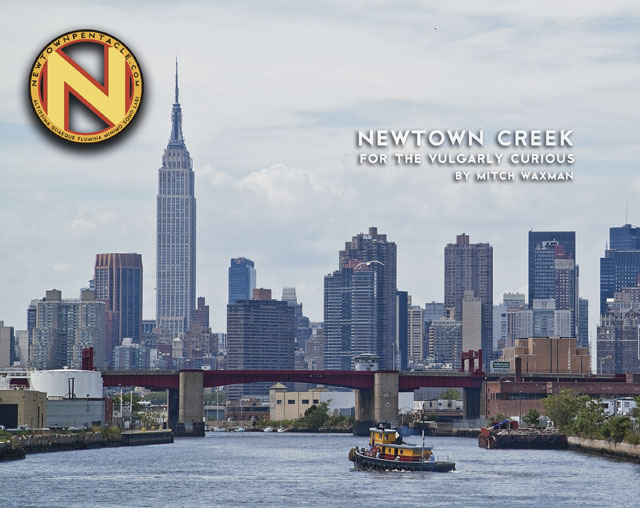
“Newtown Creek for the Vulgarly Curious” is a fully annotated 68 page, full-color journey from the mouth of Newtown Creek at the East River all the way back to the heart of darkness at English Kills, with photos and text by Mitch Waxman.
Check out the preview of the book at lulu.com, which is handling printing and order fulfillment, by clicking here.
Every book sold contributes directly to the material support and continuance of this, your Newtown Pentacle.
indefinable odors

– photo by Mitch Waxman
Down by Dutch Kills, one must persevere to maintain some inkling of hope for the future of mankind.
Saying that, however, in its own way Dutch Kills is actually quite a lovely place- as storied industrial centers which have seen better days typically are. A canalized waterway, Dutch Kills is a tributary of that languid cautionary tale known as the Newtown Creek, and has been isolated for several seasons from its principate source by emergency bridge construction and a changing industrial landscape. I’m down here a lot of course, most recently in the “from some point in space” posting of November 3rd, which includes an intriguing set of high elevation shots of the area which I recently managed to capture.
from nyc.gov
Hunters Point Avenue is a two-lane local City street in Queens. Hunters Point Avenue is oriented east-west and extends from 21st Street to the Long Island Expressway/Brooklyn Queens Expressway interchange in Queens. The avenue is parallel to and approximately one block south of the Long Island Expressway. The Hunters Point Bridge over Dutch Kills is situated between 27th Street and 30th Street in the Long Island City section of Queens, and is four blocks upstream of the Borden Avenue Bridge. It is a bascule bridge with a span of 21.8m. The general appearance of the bridge has been significantly changed since it was first opened in 1910. The bridge provides a channel with a horizontal clearance of 18.3m and a vertical clearance, in the closed position, of 2.4m at MHW and 4.0m at MLW. The bridge structure carries a two-lane, two-way vehicular roadway with sidewalks on either side. The roadway width is 11.0m, while the sidewalks are 1.8m wide. The width of the approach roadways vary from the width of the bridge roadway. The west approach and east approach roadways are 13.4m and 9.1m, respectively.
The first bridge at this site, a wooden structure, was replaced by an iron bridge in 1874. That bridge was permanently closed in 1907 due to movement of the west abutment, which prevented the draw from closing. It was replaced in 1910 by a double-leaf bascule bridge, designed by the Scherzer Rolling Lift Bridge Company. The bridge was rebuilt in the early 1980’s as a single-leaf bascule, incorporating the foundations of the previous bridge.

– photo by Mitch Waxman
Seldom commented, the Hunters Point Avenue Bridge segments Dutch Kills neatly, and has done so for nigh on a century now. The marshes and streams which once typified the area before the advance of railroad and vast agglutination of industrial installation are long gone, relegated to subterranean sewers and masonry clad spillways, but a century ago- the Hunters Point Avenue Bridge (and its predecessors) allowed egress between the terrestrial isolation of the Long Island City center and the rest of western Queens.
The NY Times, in 1908, commented that Long Island City might someday be known as “A city of bridges” due to the many crossings over the tributaries of the Newtown Creek and the presence of mighty Queensboro at its center.
from federalregister.gov
The Hunters Point Avenue Bridge, at mile 1.4, over the Dutch Kills has vertical clearances of 8 feet at mean high water and 13 feet at mean low water. The existing regulations for the Hunters Point Avenue Bridge in 33 CFR 117.801(d) require the draw to open on signal if at least a one-hour advance notice is given to the drawtender at the Grand Street/Avenue Bridge, the NYCDOT Radio Hotline, or NYCDOT Bridge Operations Office. In the event the drawtender is at the Roosevelt Island Bridge or the Borden Avenue Bridge, up to an additional half-hour delay may occur.
The bridge owner, the New York City Department of Transportation (NYCDOT), submitted bridge opening log data to the Coast Guard for review. The bridge owner plans to operate these bridges with multiple crews of drawtenders. The two-hour advance notice should allow sufficient time for the crews to operate these bridges due to the close proximity of the bridges to each other. Recent yearly openings have been relatively low which will allow the bridge owner to utilize the roving crew concept and still meet the needs of navigation.

– photo by Mitch Waxman
The Hunters Point Avenue Bridge (the 1910 version) was configured differently than the modern structure when first built, although the original was constructed for some $95,214 from plans by the Scherzer Rolling Lift Bridge Company with the dirty work performed by the Duseath Engineering Company of 114 Liberty St. NY. As you’d imagine, there is a certain logic behind the esoterica presented about this obscure little bridge found in a literal “industrial backwater” in Queens.
But… I can’t tell you what is is yet…
from nysdot.gov
About 1900, most of the Newtown Creek was bulkheaded and occupied by about fifty industrial properties. Undeveloped or less developed sections without bulkheads included Dutch Kills, about 2,000 feet of shoreline in Queens just above Dutch Kills with two LIRR lighterage piers, about 1,000 feet of shoreline in Queens near the Penny Bridge, and about 3,500 feet of shoreline downstream of Maspeth Avenue in Brooklyn.15 Dutch Kills, and the Queens side of Newtown Creek, just upstream of Dutch Kills, were developed circa 1905-1912, largely through the efforts of the Degnon Terminal & Realty Company. The Degnon firm created an industrial park with rail and marine access around Dutch Kills between about Hunters Point and 47th Avenue, Dutch Kills subsequently was included within USACE dredging projects. Without federal assistance, Degnon created a 150-foot-wide channel with 2,400 feet of bulkhead, including a turning basin. To create rail links to the development, Degnon helped the LIRR build a new 1,000-acre freight terminal circa 1907 along Newtown Creek east of Dutch Kills on property bought from Calvary Cemetery, including several short piers intended to handle heavy freight such as brick, coal, lumber, and ice. From this terminal, a private Degnon Terminal Railroad was created, largely through local streets. On newly filled marshy margins of Dutch Kills, Degnon Terminal & Realty promoted industrial development both on and away from the water. One iron works and several large building materials firms occupied the Degnon waterfront by the early 1920s. Reconstruction of the two movable bridges over Dutch Kills circa 1908-10 contributed to these developments. On other Degnon lots, large firms included the American Eveready Company and the American Chiclet Company, respective makers of batteries and candy.16 Facilitating this growth was the construction of the Queensboro Bridge (1909) and the start of the operation of the IRT subway line in 1917.

– photo by Mitch Waxman
Unfortunately, I can’t announce the news yet… Let’s just say that it would be a good idea to leave the 11th of December open, and that Long Island City is terrible in its grandeur during the winter months.
More on this will be forthcoming by the end of the week.
from wikipedia
Edward Byrne began his civil engineering career in 1886 with the New York City Aqueduct Commission on the construction of the Croton Water Supply System. It is of interest that on this project he met Robert Ridgway, who also was destined to become a distinguished engineer and an outstanding civil servant.
From 1889 to the close of 1897, Byrne worked on highways and bridges for the old Department of Public Works of New York City.
On January 1, 1898, he joined the Department of Bridges and began a striking and noteworthy service which ended in November, 1933, with his resignation from the position of Chief Engineer of the Department of Plant and Structures (the successor of the Bridge Department), in order to assume the duties of Chief Engineer of the Triborough Bridge. His thirty-six years of service in the Department of Bridges, and its successor, the Department of Plant and Structures, may be divided into two periods.
Borden Avenue Bridge
During this period, he was in charge of bridge construction and maintenance, supervising the construction of the Willis Avenue Bridge over the Harlem River, the Vernon Avenue Bridge, the Borden Avenue and Hunters Point Bridges over Dutch Kills, and the old bridge over Flushing River.

– photo by Mitch Waxman
Also, as a note:
I get asked all the time what these signs mean, what they indicate, and how seriously they should be regarded. The powers that be don’t make it easy to find out, for despite the “for more information” attribution, the City doesn’t go into much detail at nyc.gov/dep about them. Partly, this is due to the vogue followed by municipal authorities in recent years which allows private contractors to perform public work. The contractor is under no obligation to release their work into the public domain, as government workers are, and many important details about our metropolis ends up hidden behind corporate firewalls.
Here’s a little of the Batman type detection required to penetrate a purposely obtuse subject, which is a skill I’ve been developing over the lifetime of this, your Newtown Pentacle.
Quoting from hydroqual.com
The Bowery Bay WPCP is permitted by the NYSDEC under SPDES permit number NY-0026158. The facility is located at 43-01 Berrian Blvd., Astoria, NY, 11105 in the Astoria section of Queens, on a 34.6 acre site adjacent to the Rikers Island Channel, leading into the Upper East River, bounded by Berrian Blvd. and Steinway Street. The Bowery Bay WPCP serves an area of approximately 16,105 acres in the Northwest section of Queens, including the communities of KewGarden Hills, Rego Park, Forest Hills, Forest Hills Gardens, North Corona, South Corona, Lefrak City, Elmhurst, East Elmhurst, Jackson Heights, Maspeth, Woodside, Sunnyside Gardens, Sunnyside, Hunters Point, Long Island City, Astoria, Astoria Heights, Steinway, Ravenswood, and Roosevelt Island.
and from the same document this text and chart
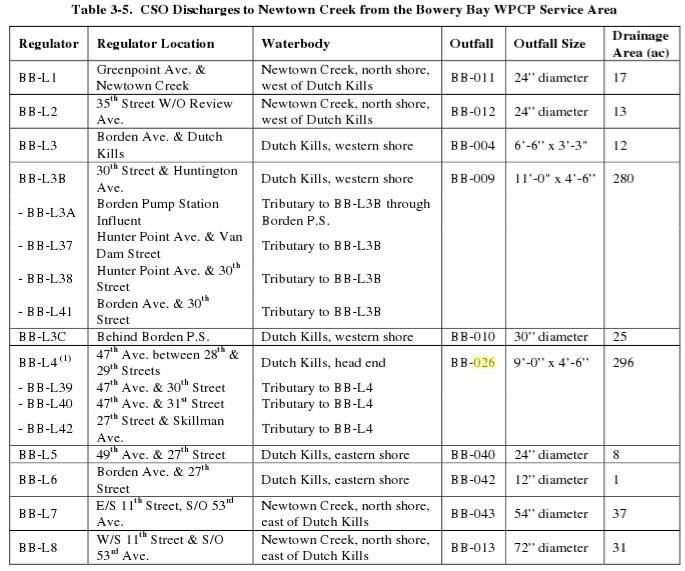
The Low Level service area contains 46 regulators, of which 19 interconnected regulators discharge to the Newtown Creek during wet weather through the 13 CSOs. Of these 13 CSOs, 6 discharge to the tributary Dutch Kills (BB-004, 009, 010, 026, 040, and 042), and 6 discharge to Newtown Creek(BB-011, 012, 013, 014, 015, and 043). An additional 2-feet, 8-inches x 4-foot outfall, BB-049, is listed in the Bowery Bay WPCP SPDES permit as discharging to Dutch Kills near 21st Street, but no further information is available such as which regulator it is connected to.
lutes and dancing

– photo by Mitch Waxman
Wandering aimlessly across the pattern that underlies the streets of Long Island City, a logical course whose every obstacle is modern, one day I found myself in the Empty Corridor. Not so empty as it used to be, for the continuing diversion of traffic away from the Borden Avenue Bridge funnels vast numbers of vehicles through these streets- some of which are still clad in only their original Belgian Block cobbles.
from wikipedia
Public property
- It is generally legal to photograph or videotape anything and anyone on any public property, with some exceptions.
- Taking a photograph while on an airplane is banned in many places, and many mass transit systems prohibit taking photographs or videos while on board buses or trains or inside of stations. (It is unknown whether such prohibitions are legal, due to transit systems in the United States often being considered public places.) Photography is against Port Authority rules in New York and New Jersey’s PATH Train system. Photography and videography are also prohibited in the U.S. Capitol, in courthouses, and in government buildings housing classified information. Bringing a camera phone into one of these buildings is not permitted either.
- Photographing or videotaping a tourist attraction, whether publicly or privately owned, is generally considered legal, unless explicitly prohibited by posted signs.

– photo by Mitch Waxman
Always on the lookout for intriguing items to photograph, your humble narrator often finds himself in front of scenes such as this one, and possessed by a paradoxical mindset. On one hand, the artwork which adorns this octagonal stop sign is well wrought, and skillfully placed for maximum esthetic value. On the other, this is vandalism- and it creates a dangerous situation regarding the passage of vehicles through a now unmarked intersection.
Further, I’m often at odds with the ideation of taking photos of such displays at all.
from wikipedia
Private property
Photography may be prohibited and/or restricted within an area of property by the property owner. At the same time, a property owner generally cannot restrict the photographing of their property by individuals who are not located within the bounds of the property.
In order to film on someone else’s property, permission must be received from the owner.
Photographing of privately-owned property that is generally open to the public (i.e. retail) is permitted unless explicitly prohibited by posted signs.
Some jurisdictions have laws regarding filming while in a hospital or health care facility. Where permitted, such filming may be useful in gathering evidence in cases of abuse, neglect, or malpractice.

– photo by Mitch Waxman
Public art, even when unsigned, is still considered to be the property of the original artist. Technically speaking, I’m not allowed to “publish” this image without the express permission of the artist and despite the fact that I own the copyright on the image, I can’t transfer or sell it without permission.
Were this posting commercial in nature, in fact, a court of law could assign damages and restitution. Art commissioned and owned by “The State” on behalf of the public is a different matter, and a complicated legal ground that’s ever shifting about. Generally, if it’s owned by the U.S. government and produced before the 1970’s it’s probably in the public domain.
Usually, I just leave this sort of thing to the prolific Ms. Heather over at NY Shitty, as she’s much better at finding new and exciting street art than I and is possessed of a curatorial spirit toward her discoveries.
But this one I couldn’t stop from shooting. Click the image for the larger size, as these are very nicely drawn images.
from wikipedia
Copyright is a set of exclusive rights granted by the law of a jurisdiction to the author or creator of an original work, including the right to copy, distribute and adapt the work. Exceptions and limitations to these rights strive to balance the public interest in the wide distribution of the material produced and to encourage creativity. Exceptions include fair dealing and fair use, and such use does not require the permission of the copyright owner. All other uses require permission and copyright owners can license or permanently transfer or assign their exclusive rights to others. Copyright does not protect ideas, only their expression or fixation. In most jurisdictions, copyright arises upon fixation and does not need to be registered. Copyright protection applies for a specific period of time, after which the work is said to enter the public domain.
shocking, unlighted, and fear haunted abysses

– photo by Mitch Waxman
Ennui of a nearly narcotic character has paralyzed your humble narrator for an interval of several weeks, a period which is at an end. Stumbling in the manner of some morphine or hashish addict across the masonry clad streets, my mood has been affected by both growing poverty and certain darker influences. Applications of various substances- derivates of the cocoa or coffee bean- have been ineffective in forcing me into a bright and waken state. Reduced to a quivering and passive “experiencer”, a cancerous nugget of self hatred grows in my heart, and has shocked me back to the waking world. Anger is an energy, as Johnny Rotten pointed out in his seminal “rise” ditty, and I walk amongst you once more.
New perspectives are called for, if the antiquarian mysteries which haunt our communities are ever to be revealed, and I no longer care about the consequences.
Let “them” quiver and tremble, for we are beginning the winter session, Lords and Ladies, at this- your Newtown Pentacle.
from wikipedia
A sett, usually the plural setts and in some places called a Belgian block, often incorrectly called “cobblestone”, is a broadly rectangular quarried stone used originally for paving roads, today a decorative stone paving used in landscape architecture. A sett is distinct from a cobblestone by being quarried or shaped to a regular form, whereas a cobblestone is generally naturally occurring. Streets paved with setts are highlights in several cycling competitions such as the final Champs-Élysées stage of the Tour de France and the Paris–Roubaix road race as riding upon them is technically more challenging than riding on asphalt. Notable roads paved with setts include Vicars’ Close, Wells, much of Edinburgh’s Royal Mile and the set of Coronation Street. In New York City the meat-packing district retains such streets.

– photo by Mitch Waxman
Those of you who have been following this periodical recognize the descriptions of these moody moments of navel gazing which a humble narrator is unable to forestall or avoid, and which curiously seem tied to seasonal variance in light and temperature. During these intervals, postings become scarce and difficult to perform, as despite the richness of environment and staccato nature of events- I cannot summon the motivation to write and become as everyone else- ordinary and voiceless. Professional writers describe this vacuity as becoming “written out”, and prescribe a period of reading and research to reignite the hearth. I’ve been following this prescription, and just this morning- the hellish green flame of wonderment has once again been kindled.
As I said: “Back in session”.
from wikipedia
The Pennsylvania Railroad (PRR) completed construction of the yard in 1910. At that time Sunnyside was the largest coach yard in the world, occupying 192 acres (0.78 km2) and containing 25.7 mi (41.4 km) of track. The yard served as the main train storage and service point for PRR trains serving New York City. It is connected to Pennsylvania Station in Midtown Manhattan by the East River Tunnels. The Sunnyside North Yard initially had 45 tracks with a capacity of 526 cars. The South Yard had 45 tracks with a 552 car capacity.

– photo by Mitch Waxman
Presented for your amusement today, this shot is from the Newtown Creek Cruise of October 24th, which ended up being quite well attended.
Bernard Ente (of Working Harbor Committee, Newtown Creek Alliance) and your humble narrator handled the narration. A small coterie of guest speakers (including Jeffrey Kroessler, Tom Outerbridge, and others) allowed us infrequent breaks from the microphone- during one of which I snuck away and captured this image. Fairly close to the Brooklyn coastline of the Newtown Creek, it was nevertheless captured from the water- that’s the Pulaski Bridge dividing the horizon, with Empire State and Chrysler Buildings framing the sky in the manner of some enormous tuning fork.
from wikipedia
Before the nineteenth century urbanization and industrialization of the surrounding neighborhoods, Newtown Creek was a longer and shallower tidal waterway, and wide enough that it contained islands. It drained parts of what are now the neighborhoods of Bushwick, Williamsburg and Greenpoint in Brooklyn; and Maspeth, Ridgewood, Sunnyside and Long Island City in Queens. During the second half of the nineteenth century it became a major industrial waterway, bounded along most of its length by retaining walls, the shipping channel maintained by dredging. The Montauk Branch of the Long Island Rail Road, mainly a freight line, runs along the North bank. A liquid natural gas port is under construction on the South bank, between Kingsland and Greenpoint Avenues, Whale Creek, and the main stream of Newtown Creek.
In 2007, residents of Greenpoint, Brooklyn and the New York State Attorney General’s Office filed lawsuits regarding the Greenpoint Oil Spill that contained more than twice the oil of the Exxon Valdez oil spill.
On September 27, 2010, the United States Environmental Protection Agency designated Newtown Creek as a Superfund site, preparing the way for evaluation and environmental remediation of the stream. Environment advocacy groups supported the decision.


