Posts Tagged ‘Greenpoint’
ruined palaces

– photo by Mitch Waxman
Attempts to “take it easy” for a week or two at the end of the summer, coupled with the puzzling virus which hampered all egress to joy, have left your humble narrator in a state of quivering misery. Downtrodden by vast physical inadequacies, failing organs, and a certain sense of ennui- nowhere is nepenthe to be found. Truly- I’m all ‘effed up. Crises, both existential and supranormal, abound.
from wikipedia
Within the framework of the post-Classic cycle of thirteen katuns (the so-called ‘Short Count’), some of the Yucatec Books of Chilam Balam present a deluge myth describing the collapse of the sky, the subsequent flood, and the re-establishment of the world and its five world trees upon the cycle’s conclusion and resumption. In this cosmic drama, the Lightning deity (Bolon Dzacab), the Earth Crocodile (Itzam Cab Ain), and the divine carriers of sky and earth (the Bacabs) have an important role to play. The Quichean Popol Vuh does not mention the collapse of the sky and the establishment of the five trees, but focuses instead on a succession of previous mankinds, the last of which was destroyed by a flood.

– photo by Mitch Waxman
A very bad thought, the sort of tormenting suspicion which instructs and informs madness, infects my mind. There are certain questions which should never even be asked, lest they be answered. Forbidden knowledge is prohibited for a reason, there are some things you cannot unlearn- like what the term “sediment mounds” connotes. The actions of others, with their unknowable motivations, rain random and unpredictable consequences into my days.
from wikipedia
There is a long philosophical and scientific history to the underlying thesis that reality is an illusion. This skeptical hypothesis (which can be dated in Western thought back to Parmenides, Zeno of Elea and Plato and in Eastern thought to the Advaita Vedanta concept of Maya) arguably underpins the mind-body dualism of Descartes, and is closely related to phenomenalism, a stance briefly adopted by Bertrand Russell. In a narrower sense it has become an important theme in science fiction, and recently has become a serious topic of study for futurology, in particular for transhumanism through the work of Nick Bostrom. The Simulation Hypothesis is a subject of serious academic debate within the field of transhumanism.
In its current form, the Simulation Argument began in 2003 with the publication of a paper by Nick Bostrom. Bostrom considers that the argument goes beyond skepticism, claiming that “…we have interesting empirical reasons to believe that a certain disjunctive claim about the world is true”, one of the disjunctive propositions being that we are almost certainly living in a simulation. Bostrom and other writers postulate there are empirical reasons why the ‘Simulation Hypothesis’ might be valid. Bostrom’s trilemma is formulated in temporal logic as follows:
“A technologically mature “posthuman” civilization would have enormous computing power. Based on this empirical fact, the simulation argument shows that at least one of the following propositions is true:
The fraction of human-level civilizations that reach a posthuman stage is very close to zero;
The fraction of posthuman civilizations that are interested in running ancestor-simulations is very close to zero;
The fraction of all people with our kind of experiences that are living in a simulation is very close to one.
If (1) is true, then we will almost certainly go extinct before reaching posthumanity.
If (2) is true, then there must be a strong convergence among the courses of advanced civilizations so that virtually none contains any relatively wealthy individuals who desire to run ancestor-simulations and are free to do so.
If (3) is true, then we almost certainly live in a simulation.
In the dark forest of our current ignorance, it seems sensible to apportion one’s credence roughly evenly between (1), (2), and (3).
Unless we are now living in a simulation, our descendants will almost certainly never run an ancestor-simulation.”

– photo by Mitch Waxman
Instead of allowing the intangible to complicate an already tenuous circumstance, and in the name of the annual “it’s September, so time to double down on the work” season, your humble narrator is retreating to the Creeklands. This is, after all, where one such as myself belongs- amongst the discarded and the decayed.
A long black raincoat hangs in my closet, awaiting the coming of another equinox, here in the Newtown Pentacle.
from wikipedia
In the near future, anthropogenic extinction scenarios exist: global nuclear annihilation, overpopulation or global accidental pandemic; besides natural ones: bolide impact and large scale volcanism or other catastrophic climate change. These natural causes have occurred multiple times in the geologic past although the probability of reoccurence within the human timescale of the near future is infinitesimally small. As technology develops, there is a theoretical possibility that humans may be deliberately destroyed by the actions of a nation state, corporation or individual in a form of global suicide attack. There is also a theoretical possibility that technological advancement may resolve or prevent potential extinction scenarios. The emergence of a pandemic of such virulence and infectiousness that very few humans survive the disease is a credible scenario. While not actually a human extinction event, this may leave only very small, very scattered human populations that would then evolve in isolation. It is important to differentiate between human extinction and the extinction of all life on Earth. Of possible extinction events, only a pandemic is selective enough to eliminate humanity while leaving the rest of complex life on earth relatively unscathed.
Things to do…

– graphic from newtowncreekarmada.org
What are you kidding, as if I wouldn’t be drawn to this like a lemming?
Can’t tell you how many emails I received this week asking if I’d be attending this event. Nate Kensinger and Sarah Nelson Wright are friends, and I think I’ve met Laura Chipley a couple of times as well. This is such a neat idea, and it will be playing out at the Newtown Creek Wastewater Treatment Plant Nature Walk on Paidge Avenue in Greenpoint.
“The Newtown Creek Armada will be open 1-4pm on Saturday and Sunday this weekend, weather permitting.”
They’ve even posted a sample video from their testing period here.
A
The Newtown Creek Armada is an art installation that invites the public to explore the past, present and future of a contaminated New York City waterway. The Newtown Creek, a Superfund site bordering Brooklyn and Queens, is one of the most polluted bodies of water in the United States. Visitors to The Armada will pilot a fleet of artist-made, miniature, remote-controlled boats along the surface of the Newtown Creek while documenting the hidden world of its waters using waterproof cameras and microphones.

– graphic from forgotten-ny.com
Your humble narrator will not be able to attend this week’s Forgotten NY tour, unfortunately, as I’ll be conducting a Newtown Creek Tour for a group of students from Cornell. Why not spend some time with the intrepid duo of Kevin Walsh and Richard Melnick, who will be marching through DUMBO?
“Meet outside York Street IND station on Jay Street near York, DUMBO, 12 noon, Sunday, September 9th.
Beginning in the late 1990s, the dark, Belgian-blocked streets between the Brooklyn and Manhattan bridges, commonly known asDUMBO, or “Down Under the Manhattan Bridge Overpass” were transformed into a vibrant neighborhood with pricey condominiums, delis, hardware stores, pizzerias, and even gourmet chocolatiers.”
Check back on www.astorialic.org or www.forgotten-ny.com for developing tour details.
Fee: $15.00 to GAHS members, $20.00 non-members (rain date Sept 16
RSVP to info@astorialic.org or fny@astorialic.org.

– photo by Mitch Waxman
Finally, the Working Harbor Committee is conducting a fundraiser at Pier 66 Maritime, West 26th Street & Hudson River, New York City on Wednesday the 12th of September (6 pm to 8:30 pm). All proceeds from the event will assist the Working Harbor Committee in fulfilling its mission to educate residents, visitors and youth on the vitality and importance of our working harbor and help fund its educational programs to introduce youth to opportunities in the maritime world.
The Special Honoree of the party will be Andrew Genn- Sr. Vice President, Ports & Transportation, New York City Economic Development Corporation. The award will be presented by Helena Durst, President of New York Water Taxi and Circle Line Downtown.
This will be a party, not a boat ride, it should be mentioned. A great opportunity to meet some of the movers and shakers on New York Harbor, let your hair down and have a drink or two, and it benefits a great non profit operation. Click here for tickets.
Project Firebox 51

– photo by Mitch Waxman
Spotted this one on Russell street in Greenpoint, a hard to find H.P. TEL Firebox, hidden in plain sight.
The last time I saw one of these models was in Bushwick way back in 2010. Check out the post here.

– photo by Mitch Waxman
Quoting from the post mentioned above:
It seems that when the fire system, pipe and pump wise, was first laid down in the early 20th century, technological infancy limited the number of streets that could be served by high pressure lines. Reserved for high rises, factories, and high density tenement blocks- the high pressure water common today was only available in certain areas. However, should the need arise, a fire chief carried a key that would access one of these “H.P. TEL” fireboxes which would send a command back to the firehouse to throw open the valves that would pressurize the lines flowing through its district.
The TEL stands for telegraph, apparently, and the whole scheme ceased to be necessary sometime in the 1950′s.
slow decadence

– photo by Mitch Waxman
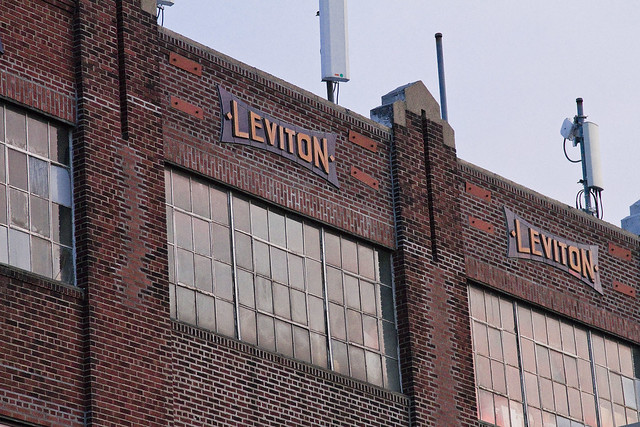
I seem to walk past this structure at least once a week, have done so for several years now, and until recently was completely ignorant about one of the largest employers of 20th century Greenpoint. The Leviton family built this commercial empire by the sweat of their brows- stories of part time employees encountering old Isidor working on the factory floor are rampant in Greenpoint, verging on Pop culture amongst garden spotters of a certain age.
from wikipedia
Leviton Manufacturing Company, Inc. is a manufacturer of electrical wiring devices, data center connectivity apparatus and lighting energy management systems. The company was founded in 1906 by Evser and his son Isidor Leviton. They began by manufacturing brass mantle tips for the natural gas lighting infrastructure in Manhattan. They sold their mantle tips on a pushcart on the Bowery on the Lower East side of Manhattan. Isidor Leviton designed a screw in lampholder for Thomas Edison’s Electric Lamp in 1910 and within ten years the lampholders were being used in every apartment in New York. In 1936 Leviton built a two square block 4 story factory and warehouse in Greenpoint, Brooklyn which still stands today. Leviton products include over 25,000 devices and systems, used in homes and businesses.

– photo by Mitch Waxman
Another bit of reputation that the family gathered unto itself was a certain liberalism regarding class, religion, and creed in their hiring practices- eschewing the segregation and selective hiring practiced by other corporations- particularly those in the electronics sector. The father of a close friend once told me that, in the years following the second world war, he was denied an opportunity to use his ivy league engineering degree because of a last name that sounded “too Italian”. Not an issue at Leviton, I am told.
from heresgreenpoint.com
By 1910 Leviton was designing and manufacturing pull-chain lamp holders for Thomas Edison’s newly developed light bulb, and in 1922 the company was moved to Greenpoint to better facilitate its rapid ascention. The massive factory took up two city blocks between Newel and Jewel Streets and produced over 600 electrical items, from fuses to socket covers to outlets and switches. Leviton would remain in Greenpoint until 1975, when the company again relocated, this time to Little Neck, NY.
– photo by Mitch Waxman
Newspaper reports describe the company as resistant to unionization, and even Eleanor Roosevelt found herself standing in solidarity with a picket line on Greenpoint Avenue in the 1940’s. In August of 1940, a large group of laborers “went out”, despite Leviton paying “benefits”- a rare and coveted perk of employment in that era. “Benefits” are what health insurance and a retirement plan were once known as, and were not an automatic or legislated requirement before the 1970’s- for those of you reading this under the age of 30, understand that these “insurance benefits” were something won by the labor movement of the early 20th century.
This was the scene of a long and contentious labor strike in 1940,
as detailed in this preview of the George Ruffini book– “Harry Van Arsdale, Jr: Labor’s Champion”, courtesy google books.

– photo by Mitch Waxman
Today, the structure is called the “Greenpoint Industrial Center” and seems to host a series of industrial, artisanal, and warehousing operations who make use of its cavernous interior spaces. The Leviton company left Greenpoint in the 1970’s, migrating to literal greener pastures in eastern Queens and ultimately Melville, Long Island.
from nationmaster.com
The Leviton Manufacturing Company was founded in New York by Isidor Leviton, at the dawn of the electrical era in 1906. Originally engaged in the fabrication of mantle tips for gas lighting, the Company soon afterwards in 1910, converted to production of a single electrical product — a pull-chain lampholder (designed for Edison’s new light bulbs).
- 1922: Leviton relocated to Greenpoint, Brooklyn after acquiring the TECCO plant, and now offered 568 products.
- 1929: Acquires Meteor Electric Company, a leading manufacturer of wiring devices.
- 1932: Leviton devices are used in the Empire State Building.
- 1937: Acquires American Insulated Wire and becomes the industry leader in wire, cable and cord products.
- 1939: Leviton devices featured at World’s Fair.
- 1950: Purchases the Deal Electric Company.
- 1953: Acquires Hale Brothers Companies, now known as Leviton Canada.
- 1960: Leviton is among the first manufactures to institute an employee pension plan.
- 1961: Leviton devices are installed in the White House.
- 1965: Harold Leviton becomes President and CEO.
- 1972: Introduces the first GFCI, the first touch dimmer, and a selection of home automation powerline carrier components.
- 1973: Introduces Decora® designer-style devices.
- 1975: Moves corporate headquarters to current location in Little Neck, NY.
_______________________________________________________________
August 5th, 2012- Newtown Creek Alliance Walking Tour- The Insalubrious Valley- This Sunday

– photo by Mitch Waxman
Newtown Creek Alliance historian Mitch Waxman will be leading a walk through the industrial heartlands of New York City, exploring the insalubrious valley of the Newtown Creek.
The currently undefended border of Brooklyn and Queens, and the place where the Industrial Revolution actually happened, provides a dramatic and picturesque setting for this exploration. We’ll be visiting two movable bridges, the still standing remains of an early 19th century highway, and a forgotten tributary of the larger waterway. As we walk along the Newtown Creek and explore the “wrong side of the tracks” – you’ll hear tales of the early chemical industry, “Dead Animal and Night Soil Wharfs”, colonial era heretics and witches and the coming of the railroad. The tour concludes at the famed Clinton Diner in Maspeth- where scenes from the Martin Scorcese movie “Goodfellas” were shot.
Lunch at Clinton Diner is included with the ticket.
Details/special instructions.
Meetup at the corner of Grand Street and Morgan Avenue in Brooklyn at 11 a.m. on August 5, 2012. The L train serves a station at Bushwick Avenue and Grand Street, and the Q54 and Q59 bus lines stop nearby as well. Check MTA.info as ongoing weekend construction often causes delays and interruptions. Drivers, it would be wise to leave your vehicle in the vicinity of the Clinton Diner in Maspeth, Queens or near the start of the walk at Grand St. and Morgan Avenue (you can pick up the bus to Brooklyn nearby the Clinton Diner).
Be prepared: We’ll be encountering broken pavement, sometimes heavy truck traffic as we move through a virtual urban desert. Dress and pack appropriately for hiking, closed-toe shoes are highly recommended.
Clinton Diner Menu:
- Cheese burger deluxe
- Grilled chicken over garden salad
- Turkey BLT triple decker sandwich with fries
- Spaghetti with tomato sauce or butter
- Greek salad medium
- Greek Salad wrap with French fries
- Can of soda or 16oz bottle of Poland Spring
for August 5th tickets, click here for the Newtown Creek Alliance ticketing page
vast reaches

– photo by Mitch Waxman
Pictured today are the operations of A.R.C. scrap metal division of a corporation called Alloco found at 540 Kingsland avenue in the Greenpoint section of Brooklyn, pictured from a vantage point on the loquacious Newtown Creek.
Another former Standard Oil property converted over to modern usage, A.R.C. scrap metal is involved in the recycling trade.

– photo by Mitch Waxman
I’ve had the privilege of meeting some of the folks who work here, and you couldn’t ask to encounter a nicer bunch of guys. Their yard always displays a frenzy of activity, with heavy equipment sorting through the flow of waste materials and what seems like dozens of safety vested and hard hatted workers laboring away.

– photo by Mitch Waxman
You may have seen one of these shots before, and apologies are offered for repetition. One is still sorting out problems and playing catch up after the interruption to work flow offered by the lightning strike which disabled much of my equipment.
It has been a very, very busy period of time with many unexpected and unscheduled obstacles.
_______________________________________________________________
August 5th, 2012- Newtown Creek Alliance Walking Tour- The Insalubrious Valley
– photo by Mitch Waxman
Newtown Creek Alliance historian Mitch Waxman will be leading a walk through the industrial heartlands of New York City, exploring the insalubrious valley of the Newtown Creek.
The currently undefended border of Brooklyn and Queens, and the place where the Industrial Revolution actually happened, provides a dramatic and picturesque setting for this exploration. We’ll be visiting two movable bridges, the still standing remains of an early 19th century highway, and a forgotten tributary of the larger waterway. As we walk along the Newtown Creek and explore the “wrong side of the tracks” – you’ll hear tales of the early chemical industry, “Dead Animal and Night Soil Wharfs”, colonial era heretics and witches and the coming of the railroad. The tour concludes at the famed Clinton Diner in Maspeth- where scenes from the Martin Scorcese movie “Goodfellas” were shot.
Lunch at Clinton Diner is included with the ticket.
Details/special instructions.
Meetup at the corner of Grand Street and Morgan Avenue in Brooklyn at 11 a.m. on August 5, 2012. The L train serves a station at Bushwick Avenue and Grand Street, and the Q54 and Q59 bus lines stop nearby as well. Check MTA.info as ongoing weekend construction often causes delays and interruptions. Drivers, it would be wise to leave your vehicle in the vicinity of the Clinton Diner in Maspeth, Queens or near the start of the walk at Grand St. and Morgan Avenue (you can pick up the bus to Brooklyn nearby the Clinton Diner).
Be prepared: We’ll be encountering broken pavement, sometimes heavy truck traffic as we move through a virtual urban desert. Dress and pack appropriately for hiking, closed-toe shoes are highly recommended.
Clinton Diner Menu:
- Cheese burger deluxe
- Grilled chicken over garden salad
- Turkey BLT triple decker sandwich with fries
- Spaghetti with tomato sauce or butter
- Greek salad medium
- Greek Salad wrap with French fries
- Can of soda or 16oz bottle of Poland Spring
for August 5th tickets, click here for the Newtown Creek Alliance ticketing page


 The Newtown Pentacle