Posts Tagged ‘Long Island City’
lashing waves

– photo by Mitch Waxman
Frustration marks this posting, which focuses in on the Moore Newman monument at First Calvary Cemetery here in Queens, at the very heart of the Newtown Pentacle. Stylish even after a century has passed, the monument consists of a central obelisk with figurative statuary at its apex and a series of foot stones demarcating the borders of the family plot.
It was also here in 1876, long before its two principal occupants ended their New York stories in the early 20th century.
from The visitor’s guide to Calvary cemetery, with map and illustrations (1876), courtesy archive.org
This is a most substantial double monument, the shaft being divided by a deeply cut line, as is also the die. It presents with the inclosure a very neat and pleasing appearance, displaying much taste in its design andi construction. It stands about twenty-one feet in height, is of Egyptian order of architecture, and of the best Quincy granite.
On the shaft, inclosed in palm wreaths, are the monograms ” M.— N.”

– photo by Mitch Waxman
Obviously people of certain means and social standing- the tenement poor of New York City didn’t get 21 foot granite monuments- there seems to be little or no record of Mary A. Moore or Michael James Newman. Passing references to a Tammany functionary named Michael J. Newman offer hints that this might be the fellow buried here, but nothing definitive can be ascertained. Additionally, a Mary A. Moore, referred to as “a widow” have popped up here and there.
Unfortunately, these were very common Irish names in the 19th century.
from Wikipedia
Granite is classified according to the QAPF diagram for coarse grained plutonic rocks and is named according to the percentage of quartz, alkali feldspar (orthoclase, sanidine, or microcline) and plagioclase feldspar on the A-Q-P half of the diagram. True granite according to modern petrologic convention contains both plagioclase and alkali feldspars. When a granitoid is devoid or nearly devoid of plagioclase, the rock is referred to as alkali granite. When a granitoid contains less than 10% orthoclase, it is called tonalite; pyroxene and amphibole are common in tonalite. A granite containing both muscovite and biotite micas is called a binary or two-mica granite. Two-mica granites are typically high in potassium and low in plagioclase, and are usually S-type granites or A-type granites. The volcanic equivalent of plutonic granite is rhyolite. Granite has poor primary permeability but strong secondary permeability.

– photo by Mitch Waxman
The usage of Quincy Granite for construction of the stelae also indicate the social standing of the couple, as this particular mineral is the gold standard for permanence and has always been an expensive option as far as building materials goes. Quincy is a famous quarry town in Massachusetts, and the mining of Quincy Granite gave rise to one of the first industrial uses of rail in the United States.
from Wikipedia
The Granite Railway was one of the first railroads in the United States, built to carry granite from Quincy to a dock on the Neponset River in Milton. From there boats carried the heavy stone to Charlestown for construction of the Bunker Hill Monument. The Granite Railway is popularly termed the first commercial railroad in the United States, as it was the first chartered railway to evolve into a common carrier without an intervening closure. The last active quarry closed in 1963; in 1985, the Metropolitan District Commission purchased 22 acres, including Granite Railway Quarry, as the Quincy Quarries Reservation.

– photo by Mitch Waxman
Enormous effort was undertaken to discover the identity of the Moore-Newman’s, who seem to have disappeared into history. The antecedents on the Moore side of the family are listed here, but it is doubtful that their remains lie in Calvary. A standard practice of Irish New Yorkers in the 19th century was to list long lost family members as an “In memoriam” on their own stone. Often the parents were buried at one of the churchyards or private cemeteries which Manhattan once hosted, like the 9th street Catholic Cemetery, at their own plots after Calvary was established in Blissville in 1848.
from wikipedia
Taphophilia is a passion for and enjoyment of cemeteries. The singular term is a taphophile.
Taphophilia involves epitaphs, gravestone rubbing, photography, art, and history of (famous) deaths. An example of an individual’s expression of taphophilia is the character Harold in the movie Harold and Maude (1971).
Taphophilia should not be confused with necrophilia, which is a sexual attraction to corpses.

– photo by Mitch Waxman
An understandable lack of documentation exists about the process by which, after the Rural Cemeteries Act was passed, the exhumation of thousands of internments and concurrent transportation of the remains to Calvary were accomplished. Understand that the somewhat tribal nature of New York City in the mid 19th century, marked by internecine warfare between religious denomination and nationalist creeds, made for a lack of record keeping. If the church offered a public record of its activities, the Protestant Anglophiles at newspapers like the NY Times would have pilloried them for one reason or another. Catholics were a favorite target of that culture, which still considered protestant England the apogee of civilization, and viewed the “Papists” as a fifth column to be feared and despised.

– photo by Mitch Waxman
Oddly, given other societal norms which we 21st century New Yorkers would find odious- specifically the role and rights of females- it’s the voice of Mary A. Moore which persists through time. An obituary notice preserves her grief over the loss of her husband, whom she would shortly follow into the emerald devastations of Calvary Cemetery.
from ancestry.com
In ever present sorrow of my devoted husband, Michael James Newman, who passed away Sept. 17, 1903. “Not gone from memory, not gone from love.”
unseen material

– photo by Mitch Waxman
A recent walk took me up Vernon Avenue… why is it that walking towards Hells Gate always feels like “up” and towards Long Island City “down”? There is an actual change in grade, as Astoria is actually built on ground physically higher in altitude than the eluvial plain that LIC stands on- yes- but that’s not it.
Anyway, Vernon at Broadway, where once the 96th street and 86th street ferries from Manhattan met the Broadway trolleys at Hallets Cove. Right by Costco and Socrates Sculpture Garden, if you require modern landmarks.
Here’s a post from February of 2010 that described the area in some detail.

– photo by Mitch Waxman
There is a large amount of construction going on here, and fairly large scale buildings are hurtling up and out of the mud. It’s been a few months since my path has brought me in this direction, and it was startling to see how fast these structures are forming up.
Not too long ago, there was a massive fire at the little factory that used to exist at the bottom left of the shot above, the round sign that says “Alpine” is all that’s left.

– photo by Mitch Waxman
The cool thing about the very large building which is going up on the corner of 12th street, other than the enormous footprint of a structure which will feature 199 apartments…

– photo by Mitch Waxman
…is that the whole thing is being built by just one guy.

– photo by Mitch Waxman
As you may have heard, American worker productivity is at an all time high, and no where more so than in Queens.

– photo by Mitch Waxman
It seems hard to believe, but this fellow holds every possible license and certification that the building code demands of its employees, rumor has it that he’s also the principal financier.

– photo by Mitch Waxman
It can’t be easy building things by yourself, there no one to take a coffee break with, and car pooling is out of the question entirely.

– photo by Mitch Waxman
I look forward to the day when the 199 new families unpack, and join with the rest of us. Enjoying our comfortable and never crowded mass transportation, learning that they can rely on the presence of modern and top notch hospitals, and that their children can look forward to a rewarding and full scholastic life in local schools.

– photo by Mitch Waxman
Always a selling point for Queens, multicultural experiences will abound. The nearby Queensboro, Ravenswood, and Astoria projects will satisfy anyone’s desires to learn about new and interesting cultures that have their roots in exotic foreign lands.

– photo by Mitch Waxman
Welcome to Queens.
remarkable law
– photo by Mitch Waxman
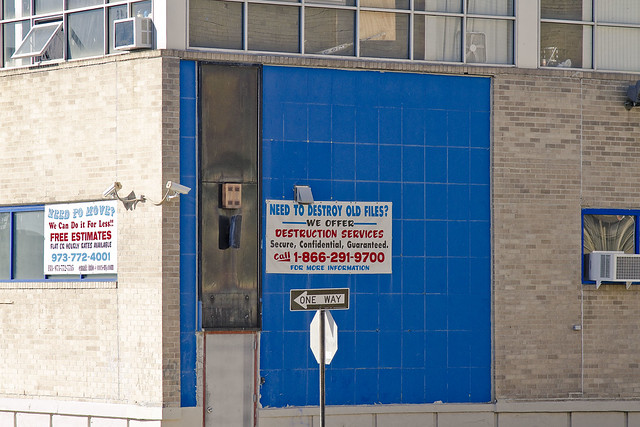
A freelancer, your humble narrator is always looking for work. Recently spied in Long Island City, there seems to be a company that specializes in a trade I’m interested in.
Is this what “service economy” means?

– photo by Mitch Waxman
Just ask anyone who has ever lent me anything of value how good I am at this. Pretty much anything I touch ends up at least partially ruined, and when one puts his mind to the task… whoa, nelly.
I can’t have anything nice.

– photo by Mitch Waxman
I too offer “Destruction Services”, although my understanding is that large players in the destruction trade, like the United States Marines for instance, play this game at “big league” levels. My destruction business isn’t limited to old files like these guys though, I’ll mess up new stuff too.
Freelance rates will apply.
dim entity

– photo by Mitch Waxman
On the 24th of February, a Newtown Pentacle posting was offered in which description of an astounding demolition which had occurred along 30th street in Long Island City, and whose purpose was to clear the way for a gargantuan FedEx trucking depot and shipping center. Attempting to describe the sheer scale of this to friends and Our Lady of the Pentacle simply proved that words would be inadequate to convey the scale of it all.
So, a humble narrator went back, and did a little bit of climbing.

– photo by Mitch Waxman
Having once been a child in Brooklyn, you humble narrator learned to climb the urban landscape like a monkey. This skill is something that still comes in handy, especially when something which needs photographing is behind a ten foot tall plywood construction fence. The shot above is a “stitched panorama” which incorporates around 16 individual exposures into a single image- encouragement is offered to click through to the largest incarnation of this shot at flickr (click here) to appreciate the massiveness of the footprint.
Click here to see it on a google map.

– photo by Mitch Waxman
From the decking of the Borden Avenue Bridge, you can see that the construction site extends all the way to the Dutch Kills tributary of the malign Newtown Creek. FedEx must need an awful lot of space.
Wonder why?

– photo by Mitch Waxman
Well to begin with, the entirely coincidental condemnation and demolishing of the FedEx World Service Center building in Manhattan (528-556 West 34th Street) to make room for the Hudson Yards residential development has robbed the shipping giant of certain capabilities. My guess, and it’s a guess, is that they were offered Queens instead.
And once again, Manhattan exports its problems to Queens, I guess.

– photo by Mitch Waxman
When this site has been mentioned, those who live and work in Queens get a wild look in their eyes. They ask “Wait, where will all those trucks go when heading into Manhattan?”. Sure, they’ll be taking truck routes, but what happens when they bottleneck at Queens Plaza, the Midtown Tunnel, or the Triborough? Care to guess?
What about the tractor trailers leaving from LaGuardia and Kennedy, how will they get to Long Island City?

– photo by Mitch Waxman
A bit of that climbing talent bragged about at the beginning of this posting, and a switch of POV to Hunters Point Avenue brings you this “stitched panorama” of the rubble beyond the fence. Notice the lack of water being sprayed on the shattered masonry, or any attempt at dust abatement, and remember that the factories which stood here for nearly a century adjoin the monstrous pollution of the Dutch Kills tributary.
This is no land that the site stands on either, rather it’s a construct. This area was filled in by Michael Degnon in the early 20th century with rubble from the Belmont Tunnel construction, and that the bulkheads which defined the modern shape of Dutch Kills were only installed in 1914 by the United States Army Corps of Engineers. This rubble is coated with a century worth of “the colour”.

– photo by Mitch Waxman
Around thirty or forty feet down, the waters of the Newtown Creek gurgle about boulder and gravel, and around the wooden piles which the concrete mastabas of modernity stand upon. The Creek is eternal, and water always- inevitably and eternally and patiently- wins.
Like many things around the Newtown Creek, and Queens in particular, you must just accept the decisions of your betters in Manhattan- I guess. They wish to install playgrounds for the idle rich along the Hudson, erect fanciful condominiums for their comfort, and soaring office towers to administer and employ them. Why should those of us in Queens complain, when they export their waste, their trucking facilities, or their garbage to us?
The needs of the many outweigh the needs of the few, I guess?
ALSO:
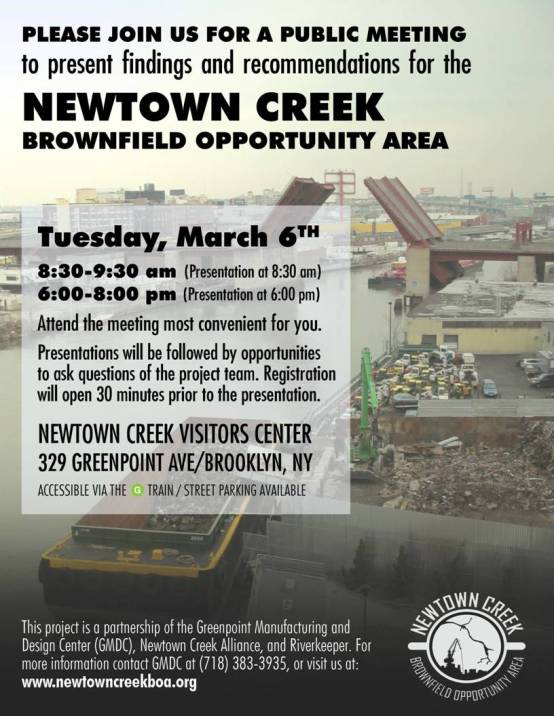
March 6th, as in tonight
blissville update

– photo by Mitch Waxman
Just in case you were wondering, not too much new to report on the oil situation in Blissville Queens, which is found on the northern shore of the lamentable Newtown Creek. Our friends at Riverkeeper continue to investigate, as do everyone’s friends at the State DEC. Conversation with highly placed members of both organizations indicate that they have people working on it.
These photos from the beginning of February in 2012 would seem to dispute that. Compare to the same area in August 2011.

– photo by Mitch Waxman
The conversations were informal, and were initiated by your humble narrator. Concurrently, I’m not going to “report” the substance of these exchanges yet, as I’m not “that kind” of blogger. “That kind” would seek to embarrass or denigrate the process and participants for puerile amusement and or self advancement. This is not the case, and I draw a line between what a source tells me privately versus publicly. Suffice to say that things are moving along and that you catch more flies with honey than with vinegar.
The Newtown Creek Alliance is aware of the issue as well, and we are working on it.

– photo by Mitch Waxman
Some of you may have noticed that I said “we” referring to NCA, and in accordance with some standard of full disclosure which only one such as myself adheres to- the group has awarded me the title of “Historian”. I’m picking up the fallen banner of my friend and mentor, Bernie Ente, and will strive to earn the honor by continuing to reveal the occluded history of this place.
The initial assessment of the leak, as presented in the posting “oil in queens” back in December of 2011 has garnered little attention from the mainstream press. The sole venue which ran a story on it is the DNAinfo website, their posting can be accessed here. If this was Manhattan, I’d be fighting the NYTimes for access.
But seriously, who cares anything about Queens?
ALSO:
March 5th, as in tonight:
Riverkeeper and NCA ask: How’s the Water? How’s Newtown Creek?
Join Riverkeeper and the Newtown Creek Alliance for a presentation on water quality in the Hudson River Estuary and its tributaries, focusing on the waters around Manhattan Island and in Brooklyn’s Gowanus Canal and Newtown Creek.
March 5, 2012, 7:30PM to 9:30PM
Brooklyn Brewery, 79 North 11th Street, NY map
and March 6th, as in Tuesday


 The Newtown Pentacle