Posts Tagged ‘New York City’
little visible
It ain’t winter time this year, it’s Ragnarok.

– photo by Mitch Waxman
It’s snowing again, so hooray! It was nice being able to leave the house again this weekend, which temporarily alleviated my status as a housebound invalid. Unfortunately, today’s snow caused one to cancel an appointment with the Manhattan based team of physicians that maintain the delicate balancing act which describes my physiology. Alas, putting myself into a hospital by visiting the doctor would be the sort of ironic consequence which has and does define the miserable life path of a humble narrator.

– photo by Mitch Waxman
Dreams of tropical splendor suffuse my thoughts, although the idea of suffering insectivorous assault and the deprivations offered by fungal and bacterial infections of the skinvelope retards my desire for the warmth and blooming foliage of the equatorial band. Ultimately, everything wishes to eat something, and your humble narrator is apparently delicious to contagion and pestilence alike.

– photo by Mitch Waxman
How one misses the halcyon days of spring and summer, when gazing upon the world and recording its little lessons are governed only by the long interval between dusk and dawn. Winter is definitely not nepenthe to me, and I’ve had to reschedule the visit with my team of physicians. Later in the week, it seems, will be the day that I go to the Shining City to have wires attached and be subjected to the examinations of esoteric machinery.
“follow” me on Twitter- @newtownpentacle
strenuous activity
Liberté.

– photo by Mitch Waxman
Just a short one today depicting the giant pile of copper and copper and steel which has been arranged, in NY Harbor, into a 111 feet and six inches tall simulacra of a french woman. Her nose is 4.5 feet long, and she has a 35 foot waistline, just in case you were wondering.
“follow” me on Twitter- @newtownpentacle
not utter
Curious marking, everywhere.

– photo by Mitch Waxman
While wandering through the megalopolis, one is exposed to a constant barrage of information. Bill board, signage, even the streets have instructions and a complex code of symbols that instruct and inform. It is impossible, for the literate, to not translate these graphical representations of words directly into thought. You can’t “not” read something, if you can – in fact – read. It would be like ignoring a smell.

– photo by Mitch Waxman
The thing is though, and I’ve mentioned environmental adaptation before (in reference to the fact that I don’t really smell Newtown Creek or the sewer plant in Greenpoint anymore), unless something painted or posted to the wall is truly extraordinary, I can’t distinguish it out from the rest of the visual clutter. The way I see it is that even if only a letter or two of a word triggers recognition (that’s an “A” and that’s a “B”) in me, the graffiti person has won. Same thing goes for advertising, I guess. Either way, I don’t like being forced into thinking. That’s the direction in which trouble lies, when one begins to think.

– photo by Mitch Waxman
This is currently occupying a sidewalk here in Astoria, and a Brazilian fellow walking a strange dog told me that the word is Portuguese and translates as “corruption”. It really stands out, as no one else has written anything on any nearby sidewalks, or in front of other houses. My Brazilian friend shrugged his shoulders, and sauntered off with his odd pet. Also, I must compliment the handwriting on this graffito, and would love to own a font which follows its esthetic.
“follow” me on Twitter- @newtownpentacle
only memories
“Remember me when I’m gone” is what everyone is really asking the rest of us to do.

– photo by Mitch Waxman
Mt. Zion Cemetery over in ancient Maspeth has been discussed at some length at this blog, nearly 5 years ago – and yes, Newtown Pentacle has been in existence for nearly 5 years now.
Check out “Mt. Zion 1 – imps of the perverse“, “Mt Zion 2- Palaces of Light“, “Mt Zion 3- threading precipitous lanes“, “Mt Zion 4- A Lurid Shimmering of Pale Light“, “Mt Zion 5- Sunken Houses of Sleep“, and “Mt Zion 6- Crystal Oblivion” for nearly everything I’d been able to scry about the place back in 2009. 2012’s “traitorous somnolence” explores the evidence left behind by certain peasant magicians at the polyandrion’s fence lines, which is worth a look.
Further research on the place – and the enigmatic Rudari tribe that once occupied the land here – however, has birthed a postulate in my mind that the so called Maspeth Gypsies are a lost civilization.
from wikipedia
Tambora is a lost village and culture on Sumbawa Island buried by ash and pyroclastic flows from the massive 1815 eruption of Mount Tambora. The village had about 10,000 residents. Scientists unearthing the site have discovered ceramic pots, bronze bowls, glass bottles, and homes and villagers buried by ash in a manner similar to that of Pompeii. Scientists believe the customs and language of the culture were wiped out. The culture was visited by western explorers shortly before its demise. They are believed to have traded with Indochina, as their pottery resembles that found in Vietnam.

– photo by Mitch Waxman
There are several small communities with decidedly non mainstream cultures, ones which set out into the wooded interior of North America in the decades prior to the Civil War, that have either disappeared from the map or been absorbed into the national culture. Appalachian Hillbillies, the Shakers, the Maspeth Gypsies – all have become “civilized” and subsumed into the larger body politic. Rumor and half truths abound – suggesting that there were many, many more lost tribes of man on this continent than are commonly accepted, when the European Rationalists began to colonize the place.
from csicop.org
In one subset of the lost-civilization genre of pseudohistory, the lost civilization is not a previously unknown group of people residing in the clichéd “dim mists of time” but instead an otherwise well-known ancient society that is remarkable primarily as a result of its geography, not for its precocious level of technological sophistication. Even restricting ourselves to just North America, the list of such claims is long—though evidence is short—and includes: Celtic kingdoms in the northeastern United States thousands of years ago (Fell 1976); Coptic Christian settlements in ancient Michigan (based on the so-called Michigan Relics) (Halsey 2009); Roman Jews in Arizona (the Tucson Artifacts) (Burgess 2009); the Lost Tribes of Israel in Ohio (the Newark Holy Stones) (Lepper and Gill 2000); and strange mixtures of various ancient Old World peoples secreted in hideouts in the Grand Canyon in Arizona (“Explorations in Grand Canyon” 1909) and in a cave in southeastern Illinois (Burrows Cave) (Joltes 2003). These claims are predicated essentially on the same notion: ancient Europeans, Africans, or Asians came to the Americas long before Columbus and long—perhaps thousands of years—before the Norse; they settled here and had a huge impact on the native people but then somehow became lost, both to history and to historians.

– photo by Mitch Waxman
Permanence is something which nearly every band of humans strives to achieve, and even those who are philosophically opposed to the concept – like Buddhists – nevertheless built colossal statuary and temples of stone to mark their tenancy in Asia and around the Pacific rim. The New York City way of commemorating a location is to stick a highly impermanent signboard at a noteworthy spot, but that’s mainly for Manhattan and areas which suffer a lot of pedestrian traffic. Since Mt. Zion is theoretically going to be here as long as NYC exists, how about we stick up a sign of some kind acknowledging the former presence of this tribe of wandering coppersmiths and circus animal trainers who were called the Rudari?
from wikipedia
The Boyash are a branch/caste of the Romani people who were held as slaves in Wallachia and Moldavia together with other Romani castes, up until the latter half of the 19th century; such slavery was abolished in Romanian states in 1864.
In particular, the Boyash were forced to settle in the 14th century and work in mining (a regionalism for mine in Romanian: “baie,” from Middle Age Slavonic.). Due to their close proximity with Romanian-speaking people, they lost the use of the Romani language. Some groups relearned Romani when they came in contact with other Romani-speaking Romanis, after they emigrated from Romania (for example, in Ecuador).
Another name for the Boyash, Rudari, comes from the Slavic ruda (“metal”, “ore”). However, a few centuries later, the mines became inefficient and the Boyash people were forced to readjust by earning their living making wood utensils (Lingurari means “spoon-makers” in Romanian; also cf. Serbian ruda, Hungarian rúd, Romanian rudă meaning “staff, rod, pole, stick”). The nickname Kashtale (“wood-workers”) was also given to them by the Romani-speaking Romanis and it has remained in Romani as a more general word for a Romani person who does not speak Romani.
“follow” me on Twitter- @newtownpentacle
delvings into
Adjusting to the frozen realities of our time.

– photo by Mitch Waxman
As a housebound invalid, which is what these frigid temperatures reduce one such as myself to, it has been a bit of trial accepting the simple fact that the burning thermonuclear eye of god itself will never again shine down upon and warm the good land of Queens. One can really get a sense of why the events which would signal the oncoming Viking apocalypse (Ragnarok) were called the “Fimbulvetr” – which translates as “awful, great winter” – after the last couple of weeks. Eschatology notwithstanding, a humble narrator wishes that something – anything – would happen, even an oncoming storm of vengeful Valkyrie, just to break the monotony of the “Frozone.”

– photo by Mitch Waxman
At this stage, it seems that I’ve watched everything which Netflix offers. I can recommend “Lilyhammer” without reservation, and I’ve finally caught up on “Sherlock” and can understand what everyone has been going on about. I’m rereading David McCollugh’s “The Great Bridge” and endeavoring to finally slog through the final chapters of “Gotham” by Mike Wallace and Edwin G. Burrows. Also, planning for this years series of walking tours is underway.
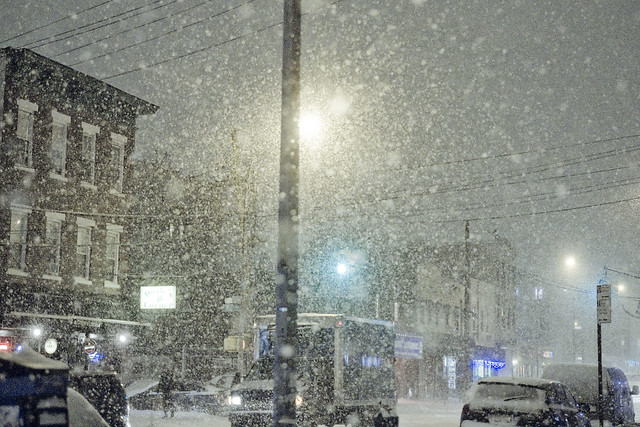
– photo by Mitch Waxman
I’ll be doing an event at Brooklyn Brainery in February, which will be discussed in a post later this week, and preparation for this will occupy a bit of my time, but like my little dog Zuzu – I’m bouncing off the four walls right now. I should have become a slave to Opium at some point in the past, so as to pass through intervals in the frozone in a cloud of nepenthe.
“follow” me on Twitter- @newtownpentacle


