Posts Tagged ‘newtown creek’
virgin aether

– photo by Mitch Waxman
“It’s a meat grinder over there” is a phrase and analogous statement often used by modern pundits to describe a past or present war, firefight, or even a less than welcoming part of the Bronx.
Conjuring imagery of familiar butcher tools spewing out hamburger meat, the term means something else entirely to those versed in the lore of that infamous cataract known as the Newtown Creek.
To those who have stared too long at the blasted heaths of Blissville, “It’s a meat grinder over there” refers to a certain spot in DUGABO (Down Under the Greenpoint Avenue Bridge Onramp), the mention of which engenders the sudden display of wan and pale complexions upon the faces of long time area residents merely at the mention of its cursed and shunned name.
Van Iderstine.
from 1875’s “Report of the Department of Health of the City of Brooklyn, N.Y.“, courtesy google books
FAT RENDERING.
In this process animal fat, obtained from the slaughter-houses and butcher-shops, is exposed to sufficient heat to liquefy it The resulting tallow is removed to settling-vats, and finally [tacked in suitable casks to harden. Up to within the past lew years the methods in use were of the most primitive description, the fatty materia) being placed in open kettles and heat applied at the bottom. As during the heating of the mass very offensive odors are given off, consisting of sulphureted and phosphureted hydrogen and ammoniacal gases, repeated complaints were caused, and it became necessary to adopt some method of correcting the evil.
The most improved methods dispose of the noxious goses by combustion or condensation. The latter is the one adopted by the factories in this district, and consists of the following process. The fatty material is placed in a steam-tight tank (Lockwood & Everett’s), capable of holding about ten thousand pounds; the tank is double, being, in fact, a smaller tank within a larger. The fat is contained in the inner compartment, while the outer is used for holding the steam. On applying the steam heat, pressure is originated in the mass, and the offensive gases thereby forced through a condensing-pipe into Newtown creek below low-water mark. The tallow at a certain stage is passed by its proper pipe to a large open vat, from which it is dipped into casks. The residue, known as “scrap,” is subsequently removed through a trap in the bottom of the tank, and being pressed is sold for fertilizing purposes.
By this method all offense appears to be prevented, and the manufacture might be carried on without prejudice in a built-up portion of the city.
In this district there are three rendering factories of any importance, all situated on Newtown Creek, near Greenpoint avenue. The owners are F. A. Van Iderstine, S. Rosenbaeh and John Van Iderstine.

– photo by Mitch Waxman
Chicago’s Phillip Armour, whose industrial methodology was contemporaneously described as “using every part of the pig except the squeal”, set a standard for the industrial exploitation of animals. Inedible parts of farm or food livestock, spoiled meat or rancid chicken eggs, dead animals such as equines, canines, feral cats- even the collected blood from slaughterhouse killing floors was (and is) a valuable commodity.
Rendering companies receive this organic “raw material” from butcher shops, slaughterhouses, dog pounds, and veterinarians.
In the days of horse and Ox drawn carriages, thousands of dead pack animals found their way to the Van Iderstine mills, which seemed to specialize in larger mammals.
I haven’t been able to locate a primary source for this not locked up behind a paywall, yet, but they apparently handled Elephants.
from fire-police-ems.com
In the early days any animal which died on the streets of New York, such as horses that pulled wagons, circus animals, some as huge as elephants, that died when the circus came to town, were taken to the Van Iderstine Factory. There, they were put into a giant funnel set-up that had huge meat grinders at the bottom which ground up their bodies. These smaller more manageable pieces were brought to other buildings on the large factory premises where the fat was rendered to make soap and glue.
Van Iderstine trucks would also go to butchers all over the city to buy their waste fat and bones.

– photo by Mitch Waxman
Some detail will be presented and discussed in later postings of the subject, as the early Van Iderstine story is obscured behind distaste for their long presence in the community, and reviled on both sides of the Creek. An odd thing, considering they were a major employer and- in one corporate guise or another- the operation was in this spot for a little over a century. There’s a Green Asphalt company in the shot above, which is found in modernity at the extreme eastern side of the Van Iderstine property.
A fire in 1964, coupled with a rising tide of community activism, is said to have led to the company’s abandonment of the site and eventual move to Newark, New Jersey.
from wikipedia
The rendering industry is one of the oldest recycling industries, and made possible the development of a large food industry. The industry takes what would otherwise be waste materials and makes useful products such as fuels, soaps, rubber, plastics, etc. At the same time, rendering solves what would otherwise be a major disposal problem. As an example, the USA recycles more than 21 million metric tons annually of highly perishable and noxious organic matter. In 2004, the U.S. industry produced over 8 million metric tons of products, of which 1.6 million metric tons were exported.
Usually, materials used as raw materials in the rendering process are susceptible to spoilage. However, after rendering, the materials are much more resistant to spoiling. This is due to the application of heat either through cooking in the wet rendering process or the extraction of fluid in the dry rendering process. The fat obtained can be used as low-cost raw material in making grease, animal feed, soap, candles, biodiesel, and as a feed-stock for the chemical industry. Tallow, derived from beef waste, is an important raw material in the steel rolling industry providing the required lubrication when compressing steel sheets. The meat and the bones (which are in a dry, ground state) are converted to what is known as meat and bone meal. For many years meat and bone meal were fed to cattle. This practice is now prohibited in developed countries because it is believed to be the main route for the spread of bovine spongiform encephalopathy (mad-cow disease, BSE), which is also fatal to human beings. Meat and bone meal from cattle is, however, fed to non-ruminant animals and meat and bone meal from non-ruminant animals is fed to cattle in the United States. This may not prove to be a solution to the problem due to the resistant nature of the infectious agent of BSE, a misfolded protein (prion). Therefore, even if cattle is fed to non-ruminant animals and vice-versa, it will not prevent BSE from occurring. The underlying cause is that the prion survives within the system of the animal that has been fed with meat and bone meal from different animals including cattle. These animals are then eventually rendered and fed to cattle, which also results in the development of the disease.

– photo by Mitch Waxman
Effluents, miasma, all sorts of ugly “humours”, hung in the air around the Van Iderstine Mill. A complex of buildings, there would have been dozens of dark blue trucks waiting to tip their loads into the yard. Workers would have sorted fester from boil, fat from bone, and would have had to be quick with both saw and hook- along with possessing a startling ability to ignore a blasting and pestilential stink.
The LIRR tracks, of course, run right alongside the property and provided the factory with freight service. These tracks were also used by passenger trains heading east from Hunters Point.
One colorful description of experiencing Van Iderstine in a passenger train advanced that the writer’s first impression of the distant scene was that a series of smoky campfires had been lit at Van Iderstine, with long plumes of black smoke trailing into an evening sky.
When the train came nearer, he realized that the smoke was actually formed by billions of flies descending on the yard from the swampy wetlands found east of the spot, past Haberman and around Maspeth Creek.
from epa.gov
Volatile organic compounds (VOCs) are the primary air pollutants emitted from rendering operations. The major constituents that have been qualitatively identified as potential emissions include organic sulfides, disulfides, C-4 to C-7 aldehydes, trimethylamine, C-4 amines, quinoline, dimethyl pyrazine, other pyrazines, and C-3 to C-6 organic acids. In addition, lesser amounts of C-4 to C-7 alcohols, ketones, aliphatic hydrocarbons, and aromatic compounds are potentially emitted. No quantitative emission data were presented. Historically, the VOCs are considered an odor nuisance in residential areas in close proximity to rendering plants, and emission controls are directed toward odor elimination. The odor detection threshold for many of these compounds is low; some as low as 1 part per billion (ppb). Of the specific constituents listed, only quinoline is classified as a hazardous air pollutant (HAP). In addition to emissions from rendering operations, VOCs may be emitted from the boilers used to generate steam for the operation.

– photo by Mitch Waxman
Sensational hyperbole is what it seems to be.
Nearly every reference to Van Iderstine and the other renderers- or distilleries like Fleischman Yeast- involves a court case or ordinance condemning them. Rest assured that the horror stories, in particular the ones offered by the NY State Board of Health, are likely true. Reports from community members old enough to remember the operation are less than glowing. It’s just odd.
The Board of Health reports, then and now, are considered sworn testimony- but…
This was the golden age of Tammany Hall.
Entirely speculative, this, but: In the 1890’s, the Tammany boys were cooking up the consolidation of the City of Greater New York, and they very well might have needed a villain or two for their political narratives. I’m just getting started on this one, I’ll let you know what can be squirreled out on the subject.
After all- who can guess, all there is, that might be buried down there?
from 1894’s “Public Papers of Roswell P. Flower, Governor” courtesy google books
A continuous nuisance of a serious character is caused, (a) by Hildebrandt’s Works, located on Furman’s Island, just north of Wissel’s offal dock. This is a small wooden structure where blood and animal refuse matter are treated in an open kettle; (b) by the following rendering establishments: Preston’s Fertilizer and Rendering Works; Peter Van Iderstine, Jr.’s Fat Rendering Works; F. A. Van Iderstine’s Rendering Works; Fred. Heffners Fat Rendering Works.
These rendering establishments depend upon the water of the creek for water supply to furnish their condensers. The latter are used to condense the gases and vapors given off during the process of rendering. These gases and vapors, condensed and held in solution and in suspension in the water, are discharged into the creek with the discharge from said condensers. The creek water is utterly unfit for this purpose, and the creek itself is unfit to receive such discharge, which, under the conditions now existing thereat, is a source of nuisance that can only be abated by closing the rendering works named in this section, or by a radical change in the present method of disposing of the gases in question. The latter, under the circumstances, is not practicable.
____________________________________________________________________________
Click for details on Mitch Waxman’s
Upcoming walking and boat tours of Newtown Creek
July 8th, 2012- Atlas Obscura Walking Tour- The Insalubrious Valley
for July 8th tickets, click here for the Atlas Obscura ticketing page
July 22nd, 2012- Working Harbor Committee Newtown Creek Boat Tour

frightful parts

– photo by Mitch Waxman
In ancient Greenpoint, down on Manhattan Avenue, a scrap metal processing yard has opened.
This is a somewhat puzzling development, as the modern streets around these parts host a large number of residential buildings- both old and new- and the locale is clearly trending toward the residential rather than industrial in the future. Regardless, this business brings badly needed jobs to recession plagued Brooklyn, and all I can say to these new stakeholders along the water is this- “Welcome to Newtown Creek”.

– photo by Mitch Waxman
The good news is that this particular metals business- which is TnT Scrap Metal, by the way- is using barges in the pursuit of their trade.
A single barge carries the equivalent load of better than 150 trucks, and one of the tried and true complaints offered incessantly at this – your Newtown Pentacle- is how few of the businesses based along the Newtown Creek utilize their bulkheads. The metals trade, at least the big players like SimsMetal, utilize maritime methodologies routinely.
This Newtown Creek of ours was once one of the finest industrial waterways on earth, and could be again someday.

– photo by Mitch Waxman
Once upon a time, the sight of a barge tied up here would have been nothing special. The Newtown Creek Towing Company was nearby, as was the New York State Barge canal. The enormous brick structure framing the shot above, known to modernity as the Greenpoint Manufacturing and Design Center (GMDC) was once home of the Chelsea Fiber Mill, an 1868 era factory building which was employed in the manufacture of maritime textiles and rope.

– photo by Mitch Waxman
The Manhattan Avenue Street end, where once the Vernon Avenue Bridge connected the Brooklyn municipality of Greenpoint to Long Island City’s Hunters Point, is a park and sports a kayak launch. It’s actually a pretty popular place for the locals- for dog walking, coffee drinking… and god help us all… people actually fish and crab here as well.

– photo by Mitch Waxman
TNT is making an effort at being a good neighbor, and has recently announced a contest for local artists to compete for a monetary prize and the chance to paint a mural on their largish metal gates on Manhattan Avenue. When word of this reached me a few weeks back, and TNT’s “rfp” crossed my desk, the first person I thought of to disseminate the news to the arts community of Greenpoint was none other than Ms. Heather over at newyorkshitty.com.
Ever gracious and instinctually curatorial, she ran the news in this post- where you can get all the details on the competition.
____________________________________________________________________________
Click for details on Mitch Waxman’s
Upcoming walking and boat tours of Newtown Creek, and Staten Island’s Kill Van Kull
June 30th, 2012- Working Harbor Committee Kill Van Kull walk
for June 30th tickets, click here for the Working Harbor Committee ticketing page
July 8th, 2012- Atlas Obscura Walking Tour- The Insalubrious Valley
for July 8th tickets, click here for the Atlas Obscura ticketing page
July 22nd, 2012- Working Harbor Committee Newtown Creek Boat Tour
greater reality

– photo by Mitch Waxman
The opportunity to visit the NYC DEP Manhattan Pump House on the Lower East Side of the Shining City drew me to the center of the human infestation in the desperate manner of an opiate addict.
The Newtown Creek Monitoring Committee is a community group which provides input and access to the people of Greenpoint in matters related to the reconstruction and operations of the Newtown Creek Waste Water Treatment Plant in Brooklyn. Despite geographic and political boundaries, the pump house is an integral part of that facility and has been undergoing its own upgrade and reconstruction.
from nyc.gov
DEP meets monthly with the Newtown Creek Monitoring Committee (NCMC), a committee of volunteers from the Greenpoint community, which was established in 1996 pursuant to a City Council resolution allowing the City to acquire property required for the upgrade of Newtown Creek WWTP. NCMC members are appointed by the local City Council member, the Brooklyn Borough President and Brooklyn Community Board #1. NCMC, with the assistance of its technical consultant, reviews and makes recommendations about activities associated with the treatment plant upgrade in order to mitigate potential impacts to the Greenpoint Community. NCMC worked with DEP to identify and design community amenities such as the Nature Walk, and is one of the longest standing citizen oversight committees in New York City.

– photo by Mitch Waxman
Vast trunk line pipes underlie Manhattan and carry waste water from storm water cisterns and weirs as well as residential sewage. Every cleaning chemical, medicinal formulation, or cold cup of coffee which goes down the drain is agglutinated and homogenized into the flow, all of it headed for a relatively small building sited between a power plant and a city housing project.
Titan works exist hidden here, and the part of the structure visible from street grade elevations are merely the tip of a finger.
from nyc.gov
The Avenue D Pump Station (also known as the 13th Street Pump Station or more commonly the Manhattan Pump Station) is currently being upgraded as part of the Newtown Creek Upgrade Project. The Manhattan Pump Station provides the Newtown Creek WPCP with more than half of its flow, 155 million gallons per day (mgd) for treatment. The pump station was put into service in 1965 and is currently undergoing a total reconstruction upgrade. As part of this upgrade, the station will receive five(5) new 2,500 horsepower motors controlled by energy efficient Variable Frequency Drives, new screening equipment, a full emergency power generation system, and an architectural façade.

– photo by Mitch Waxman
At the lowest levels of the place, one will find the elephantine plumbing which quietly accomplishes the expurgation of Manhattan’s waste. Hidden behind masonry and cement, a multi million gallon tank allows for the orderly disposition of the waste water into the subaqueous piping which carries it across the East River and into Greenpoint, Brooklyn. Our group moved through the facility, visiting several specialized levels and chambers.
The guide for the journey was none other than Jim Pynn of the DEP, an engineer who is superintendent of the ongoing reconstruction project on the larger facility in Brooklyn.
from nyc.gov
Jim Pynn is the Plant Superintendent for the Newtown Creek Wastewater Treatment plant in the Greenpoint section of Brooklyn. Jim, a lifelong Brooklynite, has worked at DEP for nearly 36 years. He enjoys the daily challenge of working at a venue that taps into his high energy and his ability to multi-task. There is no such thing as a routine day. “In addition to regular work with the staff here at the plant,” Jim said, “my day can begin with a meeting with construction contractors, engineers and architects, followed by a visit from a local school and end with a meeting with members of the community. I really enjoy the variety.”

– photo by Mitch Waxman
Ascending into it’s heights, Mr. Pynn described the function of the various caches of machinery we passed by, offering insight and experience gained during his long employment and familiarity with the construction, design, and function of the DEP infrastructure. A familiar face in Greenpoint, Mr. Pynn often leads the popular NCWWTP public tours of his plant, and he’s a charismatic and knowledgeable speaker.
He’s also a heck of a nice guy.
from nyc.gov
Although tours of the entire Newtown Creek Wastewater Treatment Plant facility are not available, we do have monthly public tours of the award-winning Digester Eggs. Please see our events calendar for the next scheduled tour. Reservations are required. To make a reservation on the next tour please email events@dep.nyc.gov.

– photo by Mitch Waxman
Near the end of the tour, while instructing us on the electrical backup generators installed within the structure, he announced our next stop would be the so called “Surge Tower” whose entrance was located on the buildings paramount. He warned us to prepare ourselves, and to ensure that any jewelry or eyeglasses worn by members of the group be secured.
from wikipedia
Originally, the “Lower East Side” referred to the area alongside the East River from about the Manhattan Bridge and Canal Street up to 14th Street, and roughly bounded on the west by Broadway. It included areas known today as East Village, Alphabet City, Chinatown, Bowery, Little Italy, and NoLIta.
The exact western and southern boundaries of the neighborhood are a matter of perspective – New York natives and long-time neighborhood residents, especially the Puerto Rican and black community, and the Jewish community, don’t have East Village in their vocabulary, and refer to it as the Lower East Side. The so-called debate about naming conventions typically only applies to the post-gentrification crowd. Most recent arrivals to the area, including new visitors and residents prefer to call the area north of Houston Street the East Village – a name not coined until around 1960.
Although the term today refers to the area bounded to the north by East Houston Street, parts of the East Village are still known as Loisaida, a Latino pronunciation of “Lower East Side.” Avenue C is known directly as “Loisaida” and is home to the Loisaida Festival every summer.

– photo by Mitch Waxman
The tower itself, viewed from its exterior, is polished aluminum and appears banal. The roof of the tower is equipped with specialized equipment designed to reduce and eliminate the infiltration of odors into the nearby residential complexes which distinguish this long troubled section of Manhattan, once known to all New Yorkers as “Alphabet City”. Our group circled around the great cylinder, entered into a doorway, and ascended a staircase which ended at a locked door.
Keys were produced, and we entered the “Surge Tower”.
from wikipedia
Until the early 19th century, much of what is now Alphabet City was an extensive salt marsh, a type of wetland that was part of the East River ecosystem. The wetland was drained, and a patch of the river bed reclaimed, by real estate developers in the early 19th century.
Like many other neighborhoods on Manhattan’s Lower East Side, Alphabet City became home to a succession of immigrant groups over the years. By the 1840s and 1850s, much of present-day Alphabet City had become known as “Kleindeutschland” or “Little Germany”; in the mid-19th century, many claimed New York to be the third-largest German-speaking city in the world, after Berlin and Vienna, with most of those German speakers residing in and around Alphabet City. In fact, Kleindeutschland is considered to have been the second substantial non-Anglophone urban ethnic enclave in United States history, after Germantown in Philadelphia.

– photo by Mitch Waxman
Gaze into the maelstrom, lords and ladies, and imagine the crashing sound of water echoing within the metallic cylinder housing it. Little good can be achieved in attempting to describe its scent, which will be left unspoken. The bottom of this tank was invisible to the naked eye and swathed in primal darkness- only by setting my camera flash to its maximum setting and “throw” was the bottom rendered visible. The bright orbs you see in the shot are likely not spiritual ectoplasm nor evidence of some ghostly or supranormal presence, rather they are suspended dust and reflective particulate hanging in the air and illuminated by the actions of the strobe light.
from wikipedia
A maelstrom /ˈmeɪlstrɒm/ is a very powerful whirlpool; a large, swirling body of water. A free vortex, it has considerable downdraft. The power of tidal whirlpools tends to be exaggerated by laymen. There are virtually no stories of large ships ever being sucked into a maelstrom, although smaller craft are in danger and tsunami generated maelstroms may even threaten larger craft. Tales like those by Paul the Deacon, Jules Verne and Edgar Allan Poe are entirely fictional.
One of the earliest uses of the Scandinavian word (malström or malstrøm) was by Edgar Allan Poe in his story “A Descent into the Maelström” (1841). In turn, the Nordic word is derived from the Dutch maelstrom, modern spelling maalstroom, from malen (to grind) and stroom (stream), to form the meaning grinding current or literally “mill-stream”, in the sense of milling (grinding) grain.

– photo by Mitch Waxman
Mr. Pynn and his associate, a fellow engineer named Basil, carefully vouchsafed us as we moved around this containerized cataract. Ichor collecting, this is the duodenum of Manhattan itself, and another of the vast and hidden works which allow the occupants of that unsustainable City to convince themselves that everything is just fine.
from “A Descent into the Maelström“, by Edgar Allen Poe, courtesy wikisource
In a few minutes more, there came over the scene another radical alteration. The general surface grew somewhat more smooth, and the whirlpools, one by one, disappeared, while prodigious streaks of foam became apparent where none had been seen before. These streaks, at length, spreading out to a great distance, and entering into combination, took unto themselves the gyratory motion of the subsided vortices, and seemed to form the germ of another more vast. Suddenly—very suddenly—this assumed a distinct and definite existence, in a circle of more than a mile in diameter. The edge of the whirl was represented by a broad belt of gleaming spray; but no particle of this slipped into the mouth of the terrific funnel, whose interior, as far as the eye could fathom it, was a smooth, shining, and jet-black wall of water, inclined to the horizon at an angle of some forty-five degrees, speeding dizzily round and round with a swaying and sweltering motion, and sending forth to the winds an appalling voice, half shriek, half roar, such as not even the mighty cataract of Niagara ever lifts up in its agony to Heaven.
The mountain trembled to its very base, and the rock rocked. I threw myself upon my face, and clung to the scant herbage in an excess of nervous agitation.
“This,” said I at length, to the old man—”this can be nothing else than the great whirlpool of the Maelström.”
Click for details on Mitch Waxman’s
Upcoming walking and boat tours of Newtown Creek, and Staten Island’s Kill Van Kull
June 23rd, 2012- Atlas Obscura Thirteen Steps around Dutch Kills walk (this Saturday)
for June 23rd tickets, click here for the Atlas Obscura ticketing page
June 30th, 2012- Working Harbor Committee Kill Van Kull walk
for June 30th tickets, click here for the Working Harbor Committee ticketing page
July 8th, 2012- Atlas Obscura Walking Tour- The Insalubrious Valley
for July 8th tickets, click here for the Atlas Obscura ticketing page
July 22nd, 2012- Working Harbor Committee Newtown Creek Boat Tour
needed adjustments

– photo by Mitch Waxman
Recent opportunity found your humble narrator standing upon that painted lady of the archipelago named Manhattan, in front of one the Shining City’s newest accoutrements.
Originally built on the Lower East Side in 1965, the Manhattan Pump House acts as the central concentrating point for the waste water and sewage of a significant slice of the borough (basically everything below 79th street) and the point from which it is pumped to the Newtown Creek Waste Water Treatment Plant in Greenpoint from for processing.
from nyc.gov
Early Manhattan settlers obtained water for domestic purposes from shallow privately-owned wells. In 1677 the first public well was dug in front of the old fort at Bowling Green. In 1776, when the population reached approximately 22,000, a reservoir was constructed on the east side of Broadway between Pearl and White Streets. Water pumped from wells sunk near the Collect Pond, east of the reservoir, and from the pond itself, was distributed through hollow logs laid in the principal streets. In 1800 the Manhattan Company (now The Chase Manhattan Bank, N.A.) sank a well at Reade and Centre Streets, pumped water into reservoir on Chambers Street and distributed it through wooden mains to a portion of the community. In 1830 a tank for fire protection was constructed by the City at 13th Street and Broadway as was filled from a well. The water was distributed through 12-inch cast iron pipes. As the population of the City increased, the well water became polluted and supply was insufficient. The supply was supplemented by cisterns and water drawn from a few springs in upper Manhattan.

– photo by Mitch Waxman
Pictured above is a device which performs a rudimentary process upon the collected liquids, a screening mechanism designed to remove solids from the flow. Remember that what everybody’s friends at the NYC DEP are dealing with is not just that which one might flush down or wash away, but all that might find its way into a roadside sewer grate. Casual littering, when seen from a citywide point of view, creates enormous engineering concerns and generates tons of sewage borne trash.
from wikipedia
The New York City Department of Environmental Protection (NYCDEP) manages the city’s water supply, providing more than 1.1 billion US gallons (4,200,000 m3) of water each day to more than 9 million residents throughout New York State through a complex network of nineteen reservoirs, three controlled lakes and 6,200 miles (10,000 km) of water pipes, tunnels and aqueducts. The DEP is also responsible for managing the city’s combined sewer system, which carries both storm water runoff and sanitary waste, and fourteen wastewater treatment plants located throughout the city. The DEP carries out federal Clean Water Act rules and regulations, handles hazardous materials emergencies and toxic site remediation, oversees asbestos monitoring and removal, enforces the city’s air and noise codes, bills and collects on city water and sewer accounts, and manages citywide water conservation programs.

– photo by Mitch Waxman
Surprisingly, turtles often find themselves swept up in the flow, and the workers at this plant have set up a temporary habitat tank for their reptilian charges to recover from the ordeal of their journey here. After regaining their strength, the turtles are offered a new home in the wild, in an “undisclosed location” body of water owned and operated by the City Parks Department.
from wikipedia
The red-eared slider (Trachemys scripta elegans) is a semiaquatic turtle belonging to the family Emydidae. It is a subspecies of pond slider. It is the most popular pet turtle in the United States and also popular in the rest of the world. It is native only to the southern United States, but has become established in other places because of pet releases and has become an invasive species in many introduced areas, like California, where it outcompetes the native western pond turtle.

– photo by Mitch Waxman
Something which often brings a tinge of warmth to my otherwise calcified and cynical outlook on the world is the way that workmen handle the animals who traverse and inhabit their facilities. These are busy, burly, often brusque men and women that work in dangerous and often unpleasant circumstance who nevertheless show their gentle and kind sides toward the lesser breeds. Whether it be rail yard, factory, or in this case- pump house- these folks always do their best to accommodate and care for strays, injured, or just lost animals.
Laudable, the entire human infestation of New York should take note of such efforts and attempt emulation.
from nyc.gov
Litter that washes down storm drains in the street can easily wind up in local waters and on City beaches. This unsightly pollution, called floatables, can kill birds, turtles and other marine animals that mistake trash – especially plastic – for food. Street litter that goes to the treatment plants must be separated from the wastewater so it won’t damage plant equipment. Litter can also clog storm drains and cause sewer backups and flooding.

– photo by Mitch Waxman
This posting will be a two parter. Tomorrow, we will descend into the very bowels of New York City. Additionally, we will looking into a yawning black maelstrom, which when stared into…
from “Beyond Good and Evil, by Friedrich Nietzche” courtesy authorama.com
He who fights with monsters should be careful lest he thereby become a monster. And if thou gaze long into an abyss, the abyss will also gaze into thee.
Click for details on Mitch Waxman’s
Upcoming walking and boat tours of Newtown Creek, and Staten Island’s Kill Van Kull
June 23rd, 2012- Atlas Obscura Thirteen Steps around Dutch Kills walk (this Saturday)
for June 23rd tickets, click here for the Atlas Obscura ticketing page
June 30th, 2012- Working Harbor Committee Kill Van Kull walk
for June 30th tickets, click here for the Working Harbor Committee ticketing page
July 8th, 2012- Atlas Obscura Walking Tour- The Insalubrious Valley
for July 8th tickets, click here for the Atlas Obscura ticketing page
July 22nd, 2012- Working Harbor Committee Newtown Creek Boat Tour
darkly hidden

– photo by Mitch Waxman
As described in the recent posting “Obscure World“, the location of Conrad Wissel’s notorious “Dead Animal and Night Soil Wharf” has been finally nailed down and confirmed by contmeporaneous maps and photographs. A lot of people ask me where I find my information about the oft occluded history of the Newtown Creek, and are surprised when informed about my methodology.
Basically, it all boils down to this- I’ll notice something hidden in plain sight while wandering around, take photos of it, and start researching when back at HQ. There’s a whole list of mysteries in my “to do” pile, and often the answer to what they were is presented while searching for something else entirely. It’s how the whole “missing Lamp Post of the Queensboro bridge thing” got started. Accordingly, whenever accusations of pursuing some political agenda are leveled at this- your Newtown Pentacle- great amusement ensues.
The utterly forgotten headquarters of the General Electric Vehicle Company of Long Island City, which had been staring me in the face for years, revealed itself in this manner. Easy to miss the third largest factory building in Queens, I guess, even if its painted with bright yellow and green stripes.

– photo by Mitch Waxman
As detailed in the posting “uncommented masonry“, one was merely poking around for some information about the “Blissville Banshee“.
A supernatural phenomena, the Banshee was reported on in 1884 by the NY Times (she was described as red haired, blue eyed, and screaming “Oh Ho” like … well… a banshee), and was an obvious jab at the largely Irish and Catholic population of Blissville by Manhattan’s patrician “Nativists”. Racial or ethnic prejudice is commonly encountered in journalism of that era, and quite unsurprising to those familiar with reportage of the period. In the 1880’s, “politically correct” meant not shooting someone on sight.
What emerged about the structure above, however, was that in 1915- a quarter of the 40,000 or so trucks then plying the streets of New York City were electric (and participated in a rail based battery exchange program). Most of them were manufactured in Long Island City within the building pictured above, by the General Electric Vehicle Company.
This is my favorite sort of posting, a product of serendipity and pure discovery.
Which brings me to the Tammany men, and why there very well might be a horse buried in Calvary Cemetery.

– photo by Mitch Waxman
“The Abbot” from January of 2010, described a chance sighting of a curious obelisk in Queens’s Calvary Cemetery.
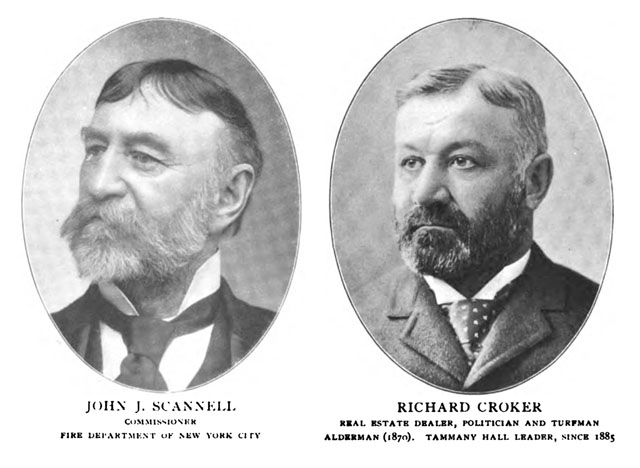
By the time that I was done with this post, I had found the young J.J. Scannell and Richard Croker sitting out a sentence in Manhattan’s “Tombs”. Quite a propitious meeting- in retrospect, one with far reaching consequence.
These two men would rise to the top of Tammany Hall one day, preside over the consolidation of the City of Greater New York from the shadowed world of the “smoke filled room”, and grow filthy rich on a buttery diet of political corruption.
Think Boss Tweed was something? In that case, you’ve never heard of Scannell and Croker.
All this because I enjoy strolling through Calvary in the afternoon while the Dropkick Murphys are playing on my headphones.
incidentally, something recently discovered (see how it works?) were these portraits of Mr.’s Scannell and Croker- found in Moses King’s “Notable New Yorkers of 1896-1899, courtesy google books

– photo by Mitch Waxman
“from some point in space“, another 2010 posting, showcases a shot of Dutch Kills acquired before a press conference which highly placed members of the Newtown Creek Alliance had asked me to represent them at (literally no one else from Queens was available).
My statement was prepared, thankfully, as I was standing next to and was introduced by Congresswoman Carolyn Maloney. Stage fright and hallucination inducing nervousness ruled my mood during the lead up.
To alleviate the anxiety while waiting for the event to begin… and as I happened to be standing in a south facing room within the Degnon Terminal’s former Loose Wiles building… which overlooks the waters of the Dutch Kills tributary of Newtown Creek- a window was soon roughly thrown open and I shot the image above.
As it happens, while attempting to research a group of heretical Quakers operating in the area just before the Revolutionary War, I came across the following image in another one of those “old and out of copyright” municipal journals which have found their way onto the web.

– Photo from 1921’s ”The Newtown Creek industrial district of New York City By Merchants’ Association of New York. Industrial Bureau”, courtesy google books
Cool, huh?
An August 2011 post, called the “the dark moor“, reversed the point of view and showed the view from infinite Brooklyn into Queens from atop the digester eggs of the Newtown Creek Waste Water Treatment Plant.
Click for details on Mitch Waxman’s
Upcoming walking and boat tours of Newtown Creek, and Staten Island’s Kill Van Kull
June 23rd, 2012- Atlas Obscura Thirteen Steps around Dutch Kills walk (this Saturday)
for June 23rd tickets, click here for the Atlas Obscura ticketing page
June 30th, 2012- Working Harbor Committee Kill Van Kull walk
for June 30th tickets, click here for the Working Harbor Committee ticketing page
July 8th, 2012- Atlas Obscura Walking Tour- The Insalubrious Valley
for July 8th tickets, click here for the Atlas Obscura ticketing page
July 22nd, 2012- Working Harbor Committee Newtown Creek Boat Tour


