Posts Tagged ‘newtown creek’
threadbare accoutrement
Yet another bit of meeting reportage, in today’s post.

– photo by Mitch Waxman
A humble narrator seems to be on a lot of “steering committees” these days. I’ve long been associated with Newtown Creek Alliance, although we don’t have a steering committee, and contrary to what many believe – I’m not a board member. I’m the official photographer for, and steering committee member of the Working Harbor Committee. Recently, I joined the steering committee of Access Queens. I’m also a steering committee member of the Newtown Creek CAG (Community Advisory Group) for the Federal Superfund situation on Newtown Creek.
The CAG has a series of steering committee only meetings that occur somewhat frequently, where we review and comment on various bits of policy and announcements from the EPA and the Potentially Responsible Parties who are tasked with the scientific analysis and eventual cleanup of Newtown Creek. There’s business people, community activists, policy makers, and representatives from Riverkeeper on the Steering Committee. There’s also a gaggle of Newtown Creek Alliance people on there as well, but given our overwhelming familiarity with the situation that’s sort of a natural fit. A “general” CAG meeting occurs less frequently, but that’s going to change as we get closer to the next phase of the Superfund process, which will discuss the solution to 150 years of environmental degradation based on a nearly decade long scientific survey. General meetings are open to the public if you’re curious, click the link above to find out when the next one is scheduled. If you want to join the CAG, we have a technical advisor who can guide you through the process (which is mainly writing down your name and email in a legible manner).
A recent Community Advisory Group meeting, which was open to the full membership of the CAG (not just the steering committee) occurred at LaGuardia Community College last month on the 22nd of March.

– photo by Mitch Waxman
Greenpoint’s Mike Schade, who has been operating as the Co Chair of the CAG, stepped down and we voted my colleague from NCA – Will Elkins – to pick up the mantle as co chair and run with it. The other CAG co chair is Ryan Kuonen, who is chair of Greenpoint’s community board’s environmental committee.
The NYC DEP, which is one of the “potentially responsible parties” along with ExxonMobil, National Grid, Phelps Dodge, and a couple of smaller corporate players like BP and Amoco, offered a presentation to the assembly explaining the concept of “ebulition” to us. Ebulition is essentially the release of droplets or blobs of contaminants from the sediment bed up to the surface of the water, and it’s commonly observed in Newtown Creek. They showed some video of coal tar bubbling up in front of the National Grid bulkheads, which was meant to be an “a ha” moment. To the initiated, however, it’s no secret that there’s 30-40 feet of coal tar and petroleum derivates in the sediments. That’s what brought EPA to Newtown Creek in the first place. Problem is that the ugly leave behinds of industry are intermingled with human waste, which is what the DEP supplies.
Long have I used the term “Black Mayonnaise.”
Prepared by their environmental contractor, Louis Berger, the logic DEP offers in their ebultion argument is that since they aren’t responsible for the presence of petroleum or coal tar in the Creek, and that since the chemical footprint of what comes out of their “combined sewer outfalls” or “CSO’s” isn’t specifically named in the Federal CERCLA – or Superfund – legislation – the community shouldn’t be overly concerned by the raw sewage they pump into the waterway every time it rains. The presentation was offered by Dr. Eileen Mahoney, who is DEP’s Superfund manager, and Dr. Ed Garvey of Louis Berger.
Dr. Mahoney and I, it should be mentioned, aren’t exactly in love with each other and she spent most of her time menacingly glaring at me while speaking, waiting for me to speak up and challenge her assertions. She didn’t realize that my colleague Laura Hoffman was in the room, and the “Mother of Greenpoint” didn’t take kindly to DEP saying that the release of raw sewage into Newtown Creek isn’t a problem.

– photo by Mitch Waxman
The Newtown Creek community advisory group is actually one of the best organizations to pay attention to at the moment, superfund wise. Everybody in the room is under some sort of Federal level jurisdiction, PRP wise, and therefore the fibbing is generally kept to a minimum. Even the DEP won’t out and out lie to the Feds, as there would be hell to pay. Another thing I’ve been saying for years about the Superfund is that the most interesting parts of the story will be about NYC’s vertical silos of power slamming into the Feds. Immovable object, meet the irresistible force.
I managed to convince some of my friends from LIC and Sunnyside to come to the meeting, and get the activist community of Newtown Creek’s northern shore to begin to engage in the process by joining the CAG. There’s a perception in Queens that Newtown Creek is Brooklyn’s, and particularly Greenpoint’s, problem.
I’ve long argued that this is most definitely not the case, and I’m glad to see that others are beginning to realize it too.
“follow” me on Twitter- @newtownpentacle
April 16th, Obscura Day 2016 –
“Creek to Creek Industrial Greenpoint Walking Tour” with Mitch Waxman and Geoff Cobb.
Join Newtown Creek Alliance historian Mitch Waxman and Greenpoint historian and author Geoff Cobb for a three-hour exploration of the coastline of Greenpoint. Click here for more info and ticketing.
catenary connections
Just one more from the Creeklands, in today’s post.

– photo by Mitch Waxman
Last weekend, a humble narrator somehow found himself up in Ridgewood on Fairview Avenue off Linden and it was decided that I’d walk home to Astoria since it was a fairly nice afternoon. It’s literally “all downhill,” after all, and not that far. My path carried me down off of the proverbial “ridge” for which the community is named, and down through the valley of tears which the loquacious Newtown Creek flows through.
Once again, my path found me in West Maspeth (or Berlin). Topography is something I notice continually as I wander around Queens, and the area around Newtown Creek is shaped like a sort of soup bowl. Proper Maspeth, as in the Mount Olivette Cemetery area along Grand Avenue, is embedded into the terminal moraine of Long Island – true rock. All of LIC, Astoria – pretty much anything west of the high point in Maspeth, is sitting on a giant pile of glacial till which is supported on the back of a giant underground Boulder called a craton.
Ridgewood literally sits on a rocky ridge which leads north/east to the Maspeth Plateau. Seriously. The British mapped it all out during the Revolutionary war.

– photo by Mitch Waxman
Having a couple of hours of light left before the vampires began to awaken, I decided to wander around a bit after turning up on 48th street. “Up” is apt, as you are climbing away from one of the lowest points in all of New York City which is nearby Maspeth Creek on 49th street. 48th street continues to rise until it meets the Long Island Expressway near Third Calvary Cemetery and crests at Queens Blvd. in Sunnyside (which is built on another elevation, but an elluvial one).
The best way I can describe the up and down nature of the hills leading from Ridgewood to Astoria would be ripples in stone rather than water with Newtown Creek at the center. There’s a conflicting set of ripples leading away from the East River and Bowery Bay which apparent in Ravenswood/Dutch Kills and Astoria, respectively. Hunters Point is flat as a pancake.

– photo by Mitch Waxman
Turning onto 55th avenue, carven into what was once known as “Berlin Hill,” this little house was encountered at 46th street. Before you ask, I have no idea what’s up with the office chair tied to the pole. There are just some things you don’t want to inquire into too deeply. It always amazed me – here in the middle of what can only be described as a “post industrial and apocalyptic” landscape defined by cemeteries and highways and a nearby superfund site – here – people actually live here. Funny thing is, it used to be worse, when the acid factory was still up and running a couple of blocks away.
The people who live here must… have to be some of the most resilient folks on the earth.

– photo by Mitch Waxman
This is DUKBO – Down Under the Kosciuszko Bridge Onramp. A couple of hundred thousand vehicle trips a day rumble through here on the highway alone. There’s heavy trucking businesses, like UPS, and other huge warehouse operations that are busily at work here twenty four hours a day, and there’s nearby freight rail tracks operating at street grade. Enormous fleets of concrete trucks are based here, and the number of light trucks and automobiles that roll through the local streets are uncountable.
And people live here.

– photo by Mitch Waxman
44th street near 54th road, and a line of 20th century row homes which are spectacularly well kept. Acros the street is a yard hosting tower cranes, and a block away is the LIE interchange ramp with the BQE. This is about midpoint on Berlin Hill, and 44th street used to called Locust Street hereabouts.
Locust continued north back then, heading for Sunnyside, before the “House of Moses” first landed on the neighborhood back in the 1930’s. Moses kept coming back to this neighborhood, smashing his roads and bridges into it, until the early 70’s.

– photo by Mitch Waxman
The border between Newtown and Long Island City was just a block away – the Kosciuszko Bridge sits atop it. On the LIC side is Laurel Hill (Calvary Cemetery) in Blissville.
This section of West Maspeth was formally part of Newtown (prior to NY City consolidation) – the municipal entity which had evolved from Dutch colonial to British and later American governance. Newtown county was once enormous and contained a good chunk of what is now Nassau County, but in the context of which I’m speaking – it’s the municipality which was centered in Elmhurst near the intersection of Queens Blvd. and Broadway.

– photo by Mitch Waxman
The first time I wandered through this area, many years ago, I had a very odd conversation with a very skinny and somewhat disheveled fellow standing in front of the home on the corner of 44th and the Queens Midtown Expwy. service road that is pictured above.
He insisted that “he knew that I knew that he knew that I know, and that he knew things which I didn’t know nor could I understand what he knew, but he knew that I knew that he knew and he was ok with that.” I thanked him and moved on, after affirming that he didn’t want me to take his picture.

– photo by Mitch Waxman
The high point of this hill/ripple once called “Berlin” is up on 46th street. As a point of interest, there is no 45th street found between 44th and 46th hereabouts – no doubt to confuse invaders.
As opined endlessly in prior posts, the DOB records for western Queens are spotty, but as far as I’ve been able to determine – the house pictured above and below on 54th avenue dates back to 1915.

– photo by Mitch Waxman
On other rambles through this section, kid’s bicycles and toys have been noticed on both porch and staircase. Not sure if it’s still occupied, but there’s a car parked in the driveway on the other side of this home. Notice how there are no side windows? It’s the last survivor of a series of old row houses – a type of working man’s quarters which folks from New Orleans might call a “shotgun.”

– photo by Mitch Waxman
Passing under the Kosciuszko Bridge, via “used to be 43rd street” I made my way towards 43rd street and headed back to Astoria.
Next week – something completely different!
“follow” me on Twitter- @newtownpentacle
illegitimate assertion
Once, you’d tell the operator you wanted to speak to Hunters Point 3342.

– photo by Mitch Waxman
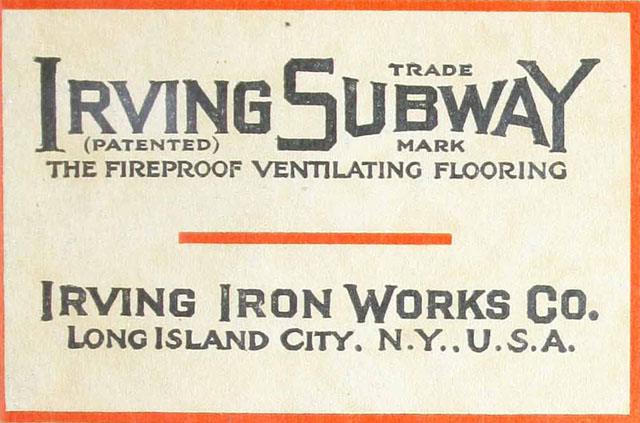
Walter E. Irving opened for business along Newtown Creek’s Dutch Kills tributary in LIC back in 1907, but at first his operation was just another iron and steel works. It wasn’t until 1914 that the company became commonly known as either “Irving Subway Grating” or “Irving Iron Works.”
Their honeycomb steel walkways were offered to both the Subway (as the name would imply) people and to maritime customers. It was the maritime world which made the company rich. Irving, a structural engineer, actually started his business in Astoria in 1902, but it was here on Dutch Kills in “America’s Workshop” that he had both rail and maritime access, and that’s why the company centered its operations in LIC.
Here’s a shot of the place from back in 1915.

– photo by Mitch Waxman
Back then, and by then I mean 1914, 51st avenue was called Third Street, and 27th street was called Creek Street.
There was no Long Island Expressway or Midtown Tunnel, and railroad freight tracks snaked around on every street. If you’re in the neighborhood today, you can still find a lot of those old tracks blistering up through the modern day asphalt. There’s “Belgian Blocks” paved streets here in what I’ve long referred to as “the empty corridor” as well. Belgian Blocks are colloquially referred to as “cobblestones.”

– photo by Mitch Waxman
At its height, when their patented honeycomb steel lattice plates were being installed on merchant and naval ships, and into factorys and industrial boiler rooms, Irving’s facility commanded some 22,000 square feet of the most valuable industrial bulkheads in America here in LIC.
It remains one of the largest properties along Dutch Kills to this day, but as you’ve noticed by now, Irving Subway Grating has left the proverbial building.

– photo by Mitch Waxman
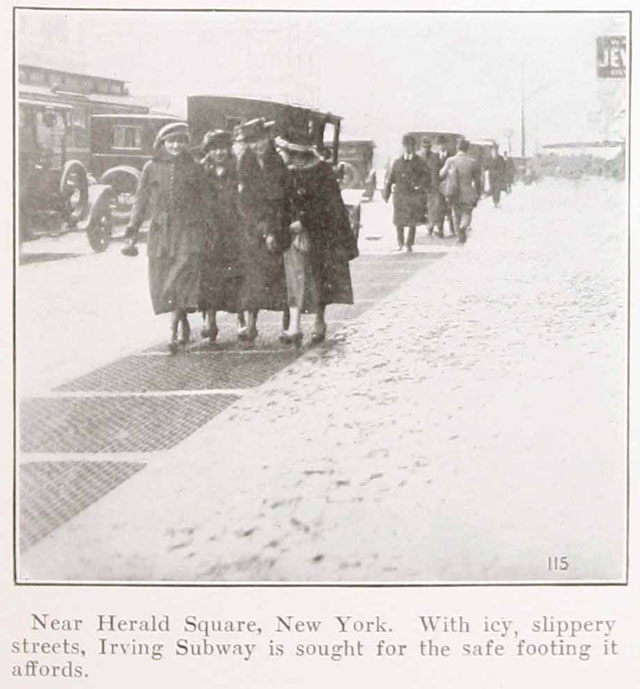
In the early 20th century, Irving employed a staff of about 300, and the facility produced something like 50,000 feet of the honeycomb flooring material a month. The value of the grating was that water, light, and air could move through it – making it perfect for the exterior decking and ladder steps on ships – and that while it had the same strength as a plate of steel, it weighed a significant amount less. It was also appropriate for use in boiler rooms and other industrial applications due to its permittance of ventilation.
Irving also found a place for his products in the steel decking on vehicle and rail bridges, and the United States military would lay his grating down into sand and soil to create stable runways for aircraft in battle zones. Irving received accolades from the War Dept. for his industrial contributions to the Aliied forces’s victory during the Second World War. The NY Subway system, as the name of the product would imply, ate Irving’s products as fast as he could make them. If you work in Manhattan’s Flatiron district, the Tenderloin, or Herald Square, you’re probably already familiar with Irving.
Build a better mouse trap, I guess.

– photo by Mitch Waxman
A Mexican conglomerate called HARSCO bought Irving, and its portfolio of patents, back in 1966. Irving continues as their IKG Industries division today, and they still manufacture those steel grids. I cannot seem to determine exactly when the Irving Plant at Dutch Kills was shut down, nor accurately ascertain the current owners of the property beyond some LLC holding company. There was an enormous fire here in 2009, which burnt away a lot of what was left of the site.
Here’s what I saw of the pre fire Irving Works back when I first starting getting into this whole Creek thing, in a post that clearly illustrated my neophyte status back in 2009.

– photo by Mitch Waxman
Over the last seven years, I’ve watched the Irving site being slowly harvested by metal collectors – The Crows – who have grabbed every inch of copper and aluminum that they can reach. There’s a security fence with a giant hole cut in it along 27th street, but the chained up shopping carts and well fed cat colony nearby the hole indicate that somebody is living here in the ruins.
As I was by myself when these shots were gathered… well… let’s just say it’s not a great idea to barge into a homeless camp in LIC when you’re all alone, so I stuck to the front of the site nearby the hole in case I had to exit quickly. Next time I have a chum along with me, however, I plan on doing a bit more exploring – mainly because there is a lot of cool graffiti in there I want to check out.

– photo by Mitch Waxman
Scenes familiar, and loved, in Long Island City.
“follow” me on Twitter- @newtownpentacle
potential responsibility
Creek Week continues, in today’s post.

– photo by Mitch Waxman
After visiting the Kosciuszko Bridge project, 57th avenue, and then Railroad Avenue, a humble narrator’s dogs were barking and a generally homeward course was adopted. As usual, that meant swinging down Borden Avenue and cutting over to Skillman Avenue on the way back to raven tressed Astoria.
My favorite sections of Newtown Creek to photograph are found in LIC, along this particular tributary of the troubled waterway – called Dutch Kills.
It’s something about the light, I guess.

– photo by Mitch Waxman
I haven’t been around here in a few weeks, and I discovered that a formerly fenced in section of the shoreline adjoining the Borden Avenue Bridge had been cleared away, which offered a few points of view which would have formerly required illegal trespass to capture.
Given such an opportunity, a humble narrator will always take it.

– photo by Mitch Waxman
Looking west, towards what I call the “empty corridor” found under the Long Island Expressway truss.
The LIE is some 106 feet high in this spot over Dutch Kills, and was built so to accommodate the stacks of ocean going vessels which were headed for the Degnon Terminal Turning Basin which is about a half mile away. The Federal War Dept. also required this particular height for the possibility of installing warships in the canal in order to protect the industrial sector in case of foreign invasion forces entering New York Harbor (a real worry, prior to the Atomic Bomb).

– photo by Mitch Waxman
Looking eastwards, you see the sort of scene most life long Queensicans would associate with the words “Newtown Creek.” Still, check out that tuney old truck – cool, huh?
“follow” me on Twitter- @newtownpentacle
consequential consistencies
It does seem to be Creek Week, doesn’t it?

– photo by Mitch Waxman
In yesterday’s post, I told you about Deadman’s Curve in Maspeth, and we explored 57th avenue – the former “Creek Street.” The shot above looks eastwards towards Deadman’s Curve from the former Penny Bridge LIRR stop at Review Avenue. The water facing property is currently owned by John Quadrozzi Jr., who is a major land holder in the Red Hook and Gowanus areas. The property seems to be mainly used for storage and maintenance of heavy construction equipment these days.
As the name of the LIRR stop would imply, this is also the former location of Penny Bridge, which connected Brooklyn’s Meeker Avenue to Queens’s Review Avenue. Additionally, the Roman Catholic Church used to run a ferry service from Manhattan to Calvary Cemetery which docked nearby.

– photo by Mitch Waxman
Review Avenue, the stretch of it that runs along Calvary Cemetery, is where the first large scale petroleum refinery in the United States was founded – Abraham Gesner’s North American Kerosene Gas Light Company, which would become first the New York Kerosene Gas Light Company and then be acquired by Charles Pratt and Standard Oil and rechristened it as the Queens County Oil Company. Queens County Oil’s bulkheads are the ones that the Blissville Seep oozes petroleum into Newtown Creek from.
If you follow Review to the west, you’ll find the Greenpoint Avenue Bridge and a pair of roads which descend downhill on either side of it. They take you to, and from, Railroad Avenue.

– photo by Mitch Waxman
The eastern side of railroad avenue was formerly the home of the Van Iderstine company, who had their own rail spur down here which was populated with Van Iderstine’s distinctive black tank cars. As the name of the street – Railroad Avenue – would imply, it’s all about the tracks down here and on the western side of the Greenpoint Avenue Bridge you’ll find the LIRR’s Bliss Tower and Blissville Yard.
Welcome to DUGABO – Down Under the Greenpoint Avenue Bridge Onramp.

– photo by Mitch Waxman
Van Iderstine was a nightmare of a company, incidentally, or at least their occupation was. They were renderers, which means that pack animals, butcher scrap, rotten eggs, barrels of abattoir blood – even dead circus elephants – would be brought here to be broken down into components. What exited the factory was tallow.
Believe it or not, they weren’t the most ghastly operation along this stretch of the Lower Montauk tracks, just the smelliest. I can tell you stories about the yeast distilleries…

– photo by Mitch Waxman
Speaking of smelly, the modern occupation of the Blissville Yard is garbage. That’s the Waste Managemnt garbage train you see above, which is shipped around and about by the New York and Atlantic freight line. NY&A services two Waste Managemnt facilities on the Creek – one here in Blissville and the other in Brooklyn’s East Williamsburg along Newtown Creek’s English Kills tributary.
Something like 30-40% of all of NYC’s putrescent (black bag) waste comes to Newtown Creek to be processed and shipped off in green boxes such as the ones above.

– photo by Mitch Waxman
Railroad Avenue is one of those cul-de-sac streets along the Creek where there’s only one entrance or exit and which – if you get in trouble or hurt, it’s going to be damned difficult to explain to the 911 operator where you are. At the west end of the street is Sims Metal Management’s Newtown Creek dock, on the east you’ll find Waste Management’s Green Asphalt works, the same company’s putrescent waste transfer station, and the Marlyn industrial park which hosts such luminaries as LeNoble Lumber and A&L Cesspool. Personally, I’d call Sims for help, as they’re closer than any hospital and I know a couple of guys who work there.
This is, incidentally, some of what you’ll find located between Review Avenue, the Lower Montauk tracks, Railroad Avenue, and Newtown Creek.

– photo by Mitch Waxman
The Blissville Yard connects to the DB Cabin railroad bridge, which connects Blissville Yard to the Wheelspur and Hunters Point Yards in Hunters Point, and which crosses the Dutch Kills tributary of Newtown Creek. There’s also a connection to the M Cabin bridge which leads to the abandoned Montauk Cutoff tracks and Sunnyside Yards.
Freight traffic on Newtown Creek heads east into Maspeth and to the Fresh Pond Yard, eventually meeting the switch to the New York Connecting Railroad through Woodside and Astoria, which leads to the Hell Gate Bridge.

– photo by Mitch Waxman
Down towards the end of Railroad Avenue, one encountered this immolated automobile.
As mentioned multitudinous times, I cannot resist this sort of thing.

– photo by Mitch Waxman
This car wasn’t just burned up, it was thoroughly incinerated.

– photo by Mitch Waxman
That’s the sort of stuff you’ll see on Railroad Avenue, here in DUGABO, in the Blissville section of Queens, along the lugubrious Newtown Creek.
“follow” me on Twitter- @newtownpentacle


 The Newtown Pentacle