Posts Tagged ‘photowalk’
dreamless sleep

– photo by Mitch Waxman
Another of the so called “Black Arts” of the 19th century, sugar refining was one of the great industries which distinguished New York City and its neighboring municipalities.
The sole survivor of this once omnipresent occupation is found in Yonkers. Raw sugar is barged to this facility for processing, which makes it a neat item to highlight for “Maritime Sunday” here at this, your Newtown Pentacle.
from wikipedia
Yonkers is the fourth most populous city in the state of New York (behind New York City, Buffalo and Rochester), and the most populous city in Westchester County, with a population of 195,976 (according to the 2010 Census). Yonkers borders the New York City borough of The Bronx and is 2 miles (3 km) north of Manhattan at the cities’ closest points.
– photo by Mitch Waxman
These shots were captured in the November, while onboard a Riverkeeper vessel which was performing a regular survey of the downstate waterways, and the good folks at that estimable organization were gracious enough to let a humble narrator ride along.
The Sugar Refinery in Yonkers is relict, a late 19th century mill which is still engaged in its trade.
from wikipedia
The raw sugar is stored in large warehouses and then transported into the sugar refinery by means of transport belts. In the traditional refining process, the raw sugar is first mixed with heavy syrup and centrifuged to wash away the outer coating of the raw sugar crystals, which is less pure than the crystal interior. Many sugar refineries today buy high pol sugar and can do without the affination process.

– photo by Mitch Waxman
American Sugar Refining operates this factory, engaging in what seems to be a quite hazardous industrial process.
It seems that sugar dust can be highly explosive, requiring equipment that is “spark proof” to safeguard against detonation.
Who knew?
from wikipedia
American Sugar Refining Company (ASR). The ASR was incorporated in the state of New Jersey on January 10, 1891, with $50 million in capital. By 1907, it owned or controlled 98% of the sugar processing capacity in the United States and was known as the Sugar Trust. The United States Supreme Court declared in United States v. E. C. Knight Company that its purchase of the stock of competitors was not a combination in restraint of trade. By 1901, the company had $90 million in capital. The company became known as Domino Sugar in 1900.

– photo by Mitch Waxman
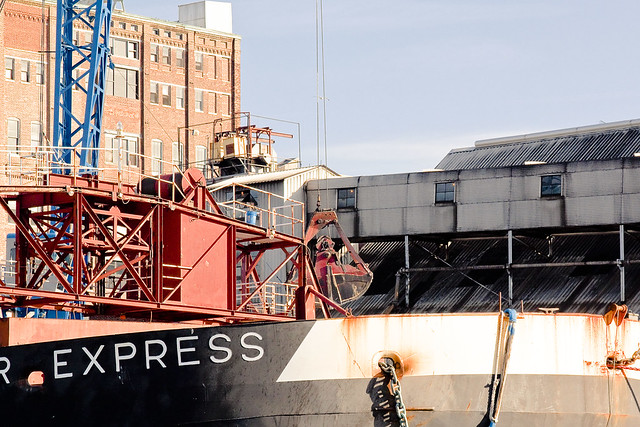
The tug Heron was present, tending to a barge labeled “Sugar Express”. Heron is middle aged, like myself, and has gone by several different aliases during its long career- unlike myself.
A surprising observation for me was that the raw product was being unloaded from the barge in the same manner that one would unload rock or gravel.
Built in 1968, by McDermott Shipyard of Morgan City, Louisiana (hull #151) as the tug Progreso .
In 1972, the tug was acquired by Dixie Carriers where she was renamed as the Dixie Progress .
In 2002, she was acquired by Allied Transportation of Norfolk, Virginia where she was renamed as the Heron.

– photo by Mitch Waxman
The industrial process of sugar refining uses powerful acids to purify and process the sweet stuff, and in 2005 the plant came under the scrutiny of regulators when it was revealed that they had released a large quantity of powerful acid into the water.
As with everything else in our world, it seems that nature must pay a price for our desires, even when it’s just a teaspoon of sugar to help the medicine go down.
from sawmillrivercoalition.org
In January 2005, American Sugar Refining Inc., a company that produces sugar for Domino Sugar and located on the Saw Mill River, pled guilty to a criminal pollution charge for spilling hydrochloric acid into the Hudson River in Yonkers in 2003.
interest and speculation

– photo by Mitch Waxman
A humble narrator can never be 100% sure about anything, as I live in a hallucinatory dreamscape of thwarted ambition where angles that appear obtuse are often in fact acute, but this would seem to be the head of a tunnel boring machine at the Sunnyside Yards. The device is of Byzantine complexity and cyclopean size, but sits suspended.

– photo by Mitch Waxman
These shots are from the middle of January, the 18th to be exact (which is also Robert Anton Wilson’s birthday), and were captured at a fortuitous moment when the burning thermonuclear eye of god itself was hanging low in the sky.
A video of the second avenue subway project’s tunnel crew bursting through the the skin of the earth is extant upon the interwebs, and I believe this to be the front of that mechanism which has been grinding out its subterranean course for the last several years.

– photo by Mitch Waxman
It is a rare thing to see equipment like this out in the open, let alone suspended above the ground by steel spars erected by the estimable engineers of Bay Crane. A mere week later, the device was entirely disassembled into constituent parts, no doubt to allow it to be easily shipped off to the location of its next task.
hideous complexity

– photo by Mitch Waxman
Just a quickie today, a shot taken from some point in space which straddles the borderline of Brooklyn and Queens (although this one is slightly more in Brooklyn) taken from the Greenpoint Avenue Bridge. Apologies for the brevity, but a humble narrator is busy staggering across the boroughs today, and in the midst of preparing for a series of meetings and presentations. Be back tomorrow with something more substantial.
ironclad
– photos by Mitch Waxman
It was 150 years ago today, that John Ericsson taught the band to play.
Shots from the Greenpoint Monitor Museum parade, held yesterday, celebrating the launch of the USS Monitor 150 years ago today. Not entirely sure what role Llamas played in the Civil War, of course, but their presence was quite welcome.
feasible means

– photo by Mitch Waxman
Don’t tell Newtown Creek, as I wouldn’t want her to think that I’m cheating on her- but occasionally, I visit the Gowanus Canal.
It’s no tryst I’ll confess to- I’m a one superfund site kind of guy- but I’ve always enjoyed harmless flirting.
Witness the Loujaine, therefore, one of the Gowanus Canals permanent guests.

– photo by Mitch Waxman
Once upon a time, Loujaine was the proud property of “Arabian Bulk Trade” or ABT, and served as a cement and dry cargo ship for the Saudi Arabia based company. That green and white funnel (smokestack) with the running critter in it is their logo.
The ship was built in the Nagoya, Japan of 1966, and lost its certification in 1985.

– photo by Mitch Waxman
Reliable sources indicate that the ship was originally rigged as a bulk carrier, and that its original name was Bahma.
Arabian Bulk Trade was formed in 1977, acquired Bahma in the early 1980’s, and converted the ship for cement handling. They renamed it the “Abu Loujaine”.
ABT, incidentally, is part of a larger Saudi company which is called Xenel.

– photo by Mitch Waxman
Xenel is an enormous conglomerate which dominates several Saudi markets, and is one of the companies operated by the House of Alireza.
A mercantile clan, the Alireza are somewhat analogous to the Rockefellers, or so I am told. The fellow who runs Xenel is an accomplished businessman and international statesman.
He went to Berkeley.

– photo by Mitch Waxman
It arrived in Brooklyn (I am told) in 1985. Ownership has changed hands a couple of times since the ABT days, but according to the maritime websites it is currently owned by a local cement company of sizable reputation.
My understanding is that the ship was “decommissioned” and serves as a so called “floating discharge terminal”, warehouse, and barge for concrete products.
Now promise me, if the Newtown Creek asks, tell her I was with you- ok?


