Posts Tagged ‘Pickman’
mouldering bulk
It’s National Canadian Bacon Day, in these United States.

– photo by Mitch Waxman
“Blowing it to bits” is a bit of an exaggeration, as offered by NYC’s tabloid headline writers (and the Governor of New York State), referring to a recently offered plan by the NYS DOT regarding the controlled demolition of the Kosciuszko bridge. Really… this isn’t going to be like the end of the movie Diehard, if anything it’s going to be a bit more like the end of Fight Club.
Documenting this project has been a long standing project of mine – this 2012 post tells you everything you could want to know about Robert Moses, Fiorella LaGuardia, and the origins of the 1939 model Kosciuszko Bridge. Just before construction started, I swept through both the Brooklyn and Queens sides of Newtown Creek in the area I call “DUKBO” – Down Under the Kosciuszko Bridge Onramp. Here’s a 2014 post, and another, showing what things used to look like on the Brooklyn side, and one dating back to 2010, and from 2012 discussing the Queens side – this. Construction started, and this 2014 post offers a look at things. There’s shots from the water of Newtown Creek, in this June 2015 post, and in this September 2015 post, which shows the bridge support towers rising. Additionally, this post from March of 2016 detailed the action on the Queens side. Most recently, here’s one from May of 2016, and one from June of the same year. Here’s one from August of 2016, and finally the December 2016 one.

– photo by Mitch Waxman
The NYS DOT held two meetings this week, one of which I attended, in which they described their plans. First – the central truss removal plan no longer involves the usage of maritime cranes. What their engineers described instead was the construction of four temporary towers which would support machinery which they described as “strand jacks,” which would lower the central truss down to couple of waiting flat top barges. Welding torches would be used to sever the truss’s links to the bridge superstructure, after the strand jacks are attached to support its weight. The truss will be lowered and secured to the barges, whereupon tugboats would guide it westward out of Newtown Creek, and across the harbor to New Jersey where its steel will be recycled.
They indicated this process would play out sometime around the end of April or the beginning of May. The DOT folks were quite vague about specific dates, saying that these were probable time frames but that they couldn’t commit to specifics at this point in time. This is problematic for me, personally, as I’m in the process of negotiating for boats to do Newtown Creek tours this summer, and the procedure described above includes the closure of the creek to all traffic for a couple of days. Worry, worry.

– photo by Mitch Waxman
There are two steel towers on either side of the Newtown Creek, which the engineering people indicated would be removed using conventional means (torches and cranes). Beyond the two steel towers, there are 21 spans supported by concrete piers – 10 in Brooklyn and 11 in Queens – which support roadway sections that range between large 230 foot long and 800 ton units and smaller ones that are 120 feet long which weigh in at 2-300 tons. These sections are the ones that DOT and the contractor partnership working for them are proposing to use the explosives on.

– photo by Mitch Waxman
The explosives used, and it should be mentioned that the very conservative FDNY Explosives Unit was present and participating in the discussion, would be shaped charges. What that means is that these things are essentially copper bars with high explosive material attached. The charges are placed at critical structural points on the bridge sections, and when their detonation is triggered, the copper chops right through the steel like a knife through butter. The sections which the explosives will be attached to will be “wrapped in filter fabric and conveyor belting equipment,” as they told us. It’s all very complicated.
The detonation will introduce structural deficits into the bridge sections, which will cause them to collapse in a controlled manner, effectively dropping straight down with little or no flyaway debris. There will be dust on impact with the ground, of course, which is a bit of a concern but the engineers say they have techniques to control that too.

– photo by Mitch Waxman
Vibration from the dropping sections – which again, weigh anywhere between 200 and 800 tons – is a concern, and the engineering folks described a series of dampening and avoidance technologies and techniques to handle that. These involved building engineered soil berms with internal steel structures, digging trenches, and so on. To be honest, I’m a bit concerned about what will amount to a seismic event, given the proximity of Calvary Cemetery and the somewhat ancient building industrial stock of West Maspeth and Eastern Greenpoint, but the FDNY guys seemed cool with it all.
As I said during the meeting – “If an FDNY Deputy Chief told me to go jump off the bridge, I’d probably listen to him or her,” but I have a more than normal level of respect for the FDNY’s opinions. One of the guys speaking at the meeting was a deputy chief, as a note.
As you may notice from the shot above, and the reason this whole demolition story is flying around, is that the DOT and their contractors are nearly done with constructing the eastern half of the new bridge.

– photo by Mitch Waxman
The 200,000 units a day of vehicle traffic carried by the Brooklyn Queens Expressway will soon be rerouted onto the new bridge, at which point the old bridge is irrelevant and in the way. A twin of the new bridge will then be erected on its footprints. As often mentioned in the past – this western side of the new span will include a pedestrian and bicycle path.

– photo by Mitch Waxman
In West Maspeth, once called Berlinville, you’ll find the sections of the roadway sitting on truck trailers and awaiting insertion into the span. Based on what I’m seeing, they should be installed shortly, and my guess would be that sometime in March the new span over Newtown Creek will be complete.

– photo by Mitch Waxman
One thing which I’m looking forward to in 2017 is a promised walk with the DOT over the new bridge shortly before traffic is rerouted. They’ve been a little vague as to when this will happen, but they have said repeatedly that it will occur. As a note, those are the tracks of the Lower Montauk branch of the LIRR, and a section of them known historically as “Deadman’s Curve.”

– photo by Mitch Waxman
Anywho, that’s your Kosciuszko Bridge replacement project update for the first quarter of 2017, see you on Monday at this – your Newtown Pentacle – with something completely different.
“follow” me on Twitter- @newtownpentacle
damaged youths
It’s National Banana Creme Pie Day, in these United States.

– photo by Mitch Waxman
Sorry gang, another short post greets you today. It’s been one thing after another around HQ, with first a minor injury and now a nasty head cold… a humble narrator just can’t seem to win for losing during the last couple of weeks. A post of some length and profundity will arrive in your inboxes tomorrow, but for today you’ll have to be satisfied with contemplating the weirdly colored waters of the fabled Newtown Creek.
“follow” me on Twitter- @newtownpentacle
double steps
It’s both National Pig Day, AND it’s concurrently National Peanut Butter Lover’s Day, in these United States.

– photo by Mitch Waxman
To start, one is not entirely sure why it is that our culture ever abandoned the paper grocery bag in favor of the plastic ones, but I have my suspicions that something inhuman was involved with the decision.
I remember the transition… when the paper grocery bag was used as the core and a plastic bag as the outer shell… sometime during the late 1980’s. Paper bags, which made for a fine series of secondary uses such as school book covers and drawing paper, were phased out entirely by the 1990’s. Today, we can’t get rid of the things. Given the nature of the recycling industry, which is always desperately seeking new customers for paper pulp and the like, wouldn’t it make a bit of sense for our elected officials to embrace the return of biodegradable paper bags made from recycled cardboard and paper? Wouldn’t that enrich their constituents and donors in the waste handling industry, nourish the recycling economy, and help end the plague of flyaway plastic carrier bags? This used to be an industry absolutely owned top to bottom by the Orthodox Jews of Brooklyn, incidentally, rather than foreign plastics factories. The old brown paper bags would just melt away in the rain, you may recall, whereas the somewhat immortal plastic ones have become wind blown nuisances.
I’m talking to you Simcha Felder, or @NYSenatorFelder, if you like. I’m watching you, since you were opposed to doing away with the plastic ones, as to what your solution is to this problem.

– photo by Mitch Waxman
Speaking of watching – that all knowing thing which cannot possibly exist in the cupola of LIC’s Sapphire Megalith, which stares down upon the world of men through its three lobed burning eye, has been on my mind of late. It does not breathe, nor sleep. “Too big to fail” is how occultists might refer to it, but all that one can say confidentially about it cannot be repeated in open parlance for fear of angering its global army of mortal acolytes. Anarchists and regulators have attempted to control or destroy it over the two and change centuries after the thing first revealed itself in 1812, but it is beyond the power of mortal man to do anything but annoy the thing in the megalith.

– photo by Mitch Waxman
There are occult constructs which might attempt to explain it. Its material origins lie with the Astor family, but the modern incarnation is strictly the work of the Rockefellers. There comes a moment in an Oligarch’s life when they ask “is this all there is?” and the path to perfidy opens before them. Just as Dr. Dee found his place beside the throne of England, and Cagliostro found himself in elevated positions in both Papal Rome and Versailles, the idyll of the wealthy often leads to occultism and the harnessing of “things” better left unknown.

– photo by Mitch Waxman
Famously, the Sapphire Megalith of Long Island City encompasses 54 stories. Four of those floors are below the ground, 50 above. Rumor has it that there are unacknowleged levels which extend below the ground, so is it “as above, so below”? The Jewish Pentateuch (or Torah) is divided into 54 weekly sections. There are 54 volumes in the the Buddhist Tripitaka, and the word wisdom appears some 54 times in the New Testament of the Christians. In the I Ching, the number 54 is indicated via the Kwei Mei hexagram, indicating that (under the conditions which it denotes) any action undertaken will be evil, and in no way advantageous.

– photo by Mitch Waxman
The inhuman thing which lurks within the cupola of the Sapphire Megalith of Long Island City would have no time for any of this mortal occultist claptrap, of course, if it actually existed.
“follow” me on Twitter- @newtownpentacle
quainter levels
It’s Anosmia Awareness Day, in these United States and the United Kingdom.
– photo by Mitch Waxman
For the curious – Anosmia is a loss of the sense of smell, which is apparently quite debilitating. One of my old buddies has always wondered about what smell “blindness” is called, and he’s been using “smeaf” for many years so I’m glad to report that there is – in fact – an actual term for it. Seriously though, imagine not being to taste your food or discern a gas leak or smoke – Anosmia is no joke and as serious as blindness or deafness. Of course, given the amount of time I spend at a certain superfund site which defines the currently undefended border of Brooklyn and Queens, Anosmia might be something of a boon. The loss of sensory data I’m currently experiencing is actually centered around touch, and a general numbness seems to be spreading across my skinvelope and ballooning out between my ears.
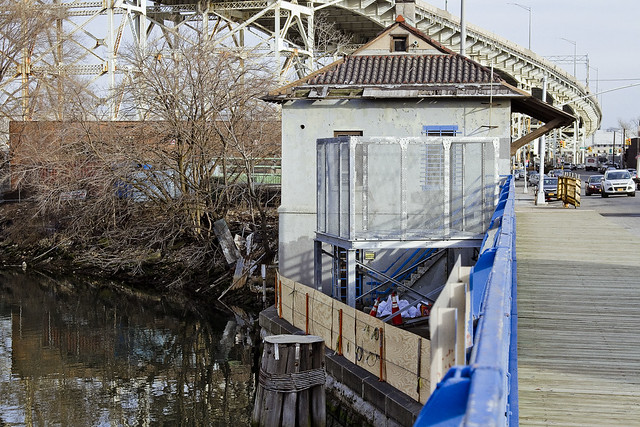
Pictured above is the fabulous Borden Avenue Bridge, a retractile wonder that the children of Queens would marvel at, would they elect to visit the Dutch Kills Tributary of the lugubrious Newtown Creek.

– photo by Mitch Waxman
Retractile means, incidentally, that the movable section of the roadway retreats away from its foundational piers, opening a spot for maritime traffic to pass through. In the shot above, you can see the spot which accepts the retractile section. There’s locomotive style rails running across the spot, which carry the truss. Famously, there’s only two retractile bridges in NYC, with the other one (which is decidedly smaller in scale and older in design) spanning the Gowanus Canal at Caroll Street. I guess that today is vocabulary day, at this – your Newtown Pentacle.

– photo by Mitch Waxman
The section of the Long Island Expressway seen above is referred to as the Queens Midtown Expressway by officialdom, and it’s some 106 feet up from the street to its road deck. It opened in 1939, and feeds it’s traffic flow into the nearby Queens Midtown Tunnel (also 1939) leading to Manhattan. A conceit often I’ve often used at spots like this, all around NYC, is to call this “The House of Moses” for NYC’s master builder Robert Moses. The tunnel and QME weren’t projects he started, but they are projects that Moses bullied his way into and took over – as a note. Robert Caro didn’t call Moses the “Power Broker” just to be snarky.

– photo by Mitch Waxman
One of the reasons that I hate all of you equally is exemplified by this all too common site at the littoral edge of Dutch Kills. I’m the guy who wads up personally produced garbage in his pockets and carries it until encountering a proper trash receptacle, so realize that this is a pet peeve of mine – but what the hell is wrong with all of you? You don’t just discard things like cups and food wrappers or plastic bags out of your car window as you move along, do you? Quite obviously, many do. I see this every where I go in NY harbor.
How about you? Shame on all of us for this.

– photo by Mitch Waxman
There seems to be some signs of life at this long vacant property along Dutch Kills – the former Irving Iron Works factory. Part of their site has had a cinder block wall erected. Notice that it was built from another installation of blocks which had been literally graffiti’d and that now it’s just a hodge podge of random colors. That’s kind of cool actually.
I’ll keep an eye out.
“follow” me on Twitter- @newtownpentacle
primal farmyard
Today is the day, in 1909, that Geronimo died. His real name was Goyaałé.

– photo by Mitch Waxman
Owing to other obligations and piss poor weather conditions for the last couple of weeks, one hasn’t got anything new to show you for this week. Accordingly, it has been decided to instead present a few archive shots of the various branches of NYC government which make life liveable for us here in “Home Sweet Hell.”
Today, the focus is on the NYC DOT – the bewildering New York City Department of Transportation, whom, as you might discern from some of their assets pictured above, are showoffs.

– photo by Mitch Waxman
NYC DOT handles and oversees NYC’s streets, highways, 788 roadway and pedestrian bridges (both major and minor, and with 25 of them moveable), and sidewalks. DOT also does street signs, traffic signals, street lights, street resurfacing, pothole repair, parking meters, and manages municipal parking. They’re also in charge of bike lanes, regulate private bus services, and spend about $700 million bucks a year doing all this – last time I checked.
They also run that big orange boat you see in the shot above. Money well spent, no?

– photo by Mitch Waxman
Of course, there’s a lot of purely mundane stuff they do. With the help of a couple of large contractors, notably Weisbach, DOT oversees the care and maintenance of those fancy new parking meter kiosks, street lights, and road paving. They also work with and augment the DSNY during snow events with plows and road salt.
“follow” me on Twitter- @newtownpentacle


