Posts Tagged ‘Pickman’
vast enclosure

– photo by Mitch Waxman
When you cut things down to the bone, and ask yourself the question “Who was the New Yorker that most profoundly changed the City?” it always comes back to one fellow. Ray Kelly or Mike Bloomberg would vie for the crown in modernity, in the long view of history Alexander Hamilton, DeWitt Clinton, Boss Tweed, or the Roebling clan have major claims on the title. Robert Moses would tell you that it was himself, and arguably, so would Osama Bin Laden.
In the opinion of a humble narrator, the crown belongs to one man- a Swedish immigrant named Othmar Ammann, and today is his birthday.
from wikipedia
Othmar Hermann Ammann (March 26, 1879 – September 22, 1965) was a American structural engineer whose designs include the George Washington Bridge, Verrazano-Narrows Bridge, and Bayonne Bridge.

– photo by Mitch Waxman
Brooklyn Bridge has the fame, Williamsburg Bridge the infamy, Manhattan Bridge is overlooked. The bridges of Othmar Ammann, however, are the ones which shaped the modern megalopolis and allowed the expansion and diaspora of New York’s laborers from the tenement neighborhoods of the five boroughs to the suburban satellites of modernity. The vast populations of Long Island and New Jersey and Westchester who commute into the city on a daily basis would have never achieved their current size, were Ammann removed from the story.
As a side note, and just to toot my own horn for a moment, the shot above was published last year in the New York Times- check it out here
Also from wikipedia
Othmar Ammann designed more than half of the eleven bridges that connect New York City to the rest of the United States. His talent and ingenuity helped him create the two longest suspension bridges of his time. Ammann was known for being able to create bridges that were light and inexpensive, yet they were still simple and beautiful. He was able to do this by using the deflection theory. He believed that the weight per foot of the span and the cables would provide enough stiffness so that the bridge would not need any stiffening trusses. This made him popular during the depression era when being able to reduce the cost was crucial. Famous bridges by Ammann include:
- George Washington Bridge (opened October 24, 1931)
- Bayonne Bridge (opened November 15, 1931)
- Triborough Bridge (opened July 11, 1936)
- Bronx-Whitestone Bridge (opened April 29, 1939)
- Walt Whitman Bridge (opened May 16, 1957)
- Throgs Neck Bridge (opened January 11, 1961)
- Verrazano Narrows Bridge (opened November 21, 1964)

– photo by Mitch Waxman
Othmar Ammann was a bit of an artist, his bridges achieving a rare thing for engineering projects, which is the elevation of a functional structure to the sublime. A prevailing theory in fine art and graphic design which emerged in the 20th century is “less is more”, and Ammann’s spans are manifestations of this concept in steel and cement.
from smithsonian.com
By the early 1960s, when the George Washington’s lower deck was added (as specified in the original plans), Ammann had all but eclipsed his mentor. Ammann’s other 1931 creation, the Bayonne Bridge connecting Staten Island and New Jersey, was until 1977 the world’s largest steel arch bridge — more than 600 feet longer than the previous record holder, Lindenthal’s Hell Gate Bridge.
Months before his death in 1965, Ammann gazed through a telescope from his 32nd-floor Manhattan apartment. In his viewfinder was a brand-new sight some 12 miles away: his Verrazano-Narrows suspension bridge. As if in tribute to the engineering prowess that made Ammann’s George Washington Bridge great, this equally slender, graceful span would not be surpassed in length for another 17 years.

– photo by Mitch Waxman
Eclipsed by the vain and power seeking during his sunset years, Ammann is one of the forgotten few who crafted the connections between the individual components of the archipelago islands of New York Harbor. Mighty Triborough or the graceful arch of the Bayonne Bridge speak to his sense of esthetic, and indicate that he was in touch with some higher imperative than merely moving automobiles from one place to another.
from nytimes.com
His works soar above the water, spanning the city’s rivers and connecting New York to the rest of the country. But who has heard of Othmar H. Ammann?
Donald Trump hadn’t, at least not back in 1964 when he was a high school student and his father took him to the dedication ceremony for the Verrazano-Narrows Bridge. ”It was a sad experience,” Mr. Trump recalled. ”For years, various politicians had fought the bridge. Now that it was built, I watched as these same people all got up and took credit for it, congratulating themselves and introducing one another. The only one not introduced was the man who made the bridge, Othmar Ammann.
acquired archaism
– photo by Mitch Waxman
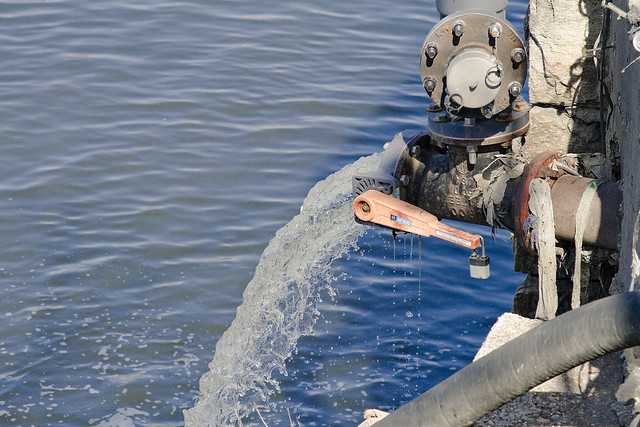
The internationalists and potentates whose congress calls itself the so called United Nations would have you observe “World Water Day” on this date. This cabal of diplomats, intriguers, and acolytes desire you to imagine and contemplate the assertion that at least a sixth of the living human infestation has no reliable access to pure water. From their headquarters in the Shining City of Manhattan- designed by the gallic crypto fascist LeCorbusier- their edict rings out, and we all must take heed of “Agenda 21”. Pictured in the shot above is the largest source of fresh water flowing into the Newtown Creek, some two to three miles from their base.
from wikipedia
World Water Day has been observed on 22 March since 1993 when the United Nations General Assembly declared 22 March as World Day for Water.
This day was first formally proposed in Agenda 21 of the 1992 United Nations Conference on Environment and Development (UNCED) in Rio de Janeiro, Brazil. Observance began in 1993 and has grown significantly ever since; for the general public to show support, it is encouraged for the public to not use their taps throughout the whole day, the day has become a popular Facebook trend.
The UN and its member nations devote this day to implementing UN recommendations and promoting concrete activities within their countries regarding the world’s water resources. Each year, one of various UN agencies involved in water issues takes the lead in promoting and coordinating international activities for World Water Day. Since its inception in 2003, UN-Water has been responsible for selecting the theme, messages and lead UN agency for the World Day for Water.

– photo by Mitch Waxman
Burgeoning, the human infestation continues to intensify upon the skin of the planet, threatening to overwhelm the fragile biosphere with a monoculture of killer apes. Sophistry and numerical manipulation make the case for Agenda 21 to play out, attempting to induce guilt and damned realization into the mainly western minds of the post industrial world, those who are well fed and watered. Your humble narrator plans on not flushing the toilet today, much to the chagrin of both “Our Lady of the Pentacle” and our little dog Zuzu. Additionally, none of us will eat or drink. A fast day will be observed for the suffering multitudes.
from unwater.org
There are 7 billion people to feed on the planet today and another 2 billion are expected to join by 2050. Statistics say that each of us drinks from 2 to 4 litres of water every day, however most of the water we ‘drink’ is embedded in the food we eat: producing 1 kilo of beef for example consumes 15,000 litres of water while 1 kilo of wheat ’drinks up’ 1,500 litres.
When a billion people in the world already live in chronic hunger and water resources are under pressure we cannot pretend the problem is ‘elsewhere’.

– photo by Mitch Waxman
The unfortunate truth, globally, is that much of the fresh water which the human infestation might consume is fouled by sewage. Whether it is agricultural lagoons of animal waste, municipal infrastructure or lack thereof, or outright industrial effluent- this is the true issue which Agenda 21 ignores. If you want to save the multitudes of the developing world- eliminate malaria and a host of other pathogens almost overnight- build sanitary sewers. Of course, we haven’t managed to swing this in New York City let alone sub Saharan Africa, so you might as well despair.
from nycgovparks.org
Social Hour: World Water Day, Thursday, March 22, 2012. 6:30 P.M.–8:00 P.M.
Celebrate World Water Day by learning more about the Croton Reservoir and Central Park’s historic role in supplying New York City with fresh drinking water. Co-presented with the NYC Department of Environmental Protection.
This event is recommended for adults (18 and over) only.
Provided at no cost to you! No advance registration. More details, including rain plans and directions, are on the Central Park Conservancy calendar.
shocking moan

– photo by Mitch Waxman
Amongst the shocking grotesques of Brooklyn’s DUKBO, or Down Under the Kosciuzscko Bridge Onramp, one such as myself finds confirmation of all those things I wish I didn’t know. Following my nose, as it were, an odiferous cloud drew me to this particular corner seeking to investigate whether some cauldron of ichor might have been overturned or to discover whatever it might be that could produce such a miasmic stink.

– photo by Mitch Waxman
A pile of industrial site runoff ran lugubriously toward the sewers, obeying gravity. The effluent carried with it some odd and somewhat fibrous substance. The smell intensified as I neared the fence line, and the runoff was clearly organic, shimmering beneath the thermonuclear eye of god itself with a greasy iridescence.

– photo by Mitch Waxman
Close inspection revealed the presence of avian feathers in the runoff, betraying the origin of the brownish gray liquid. This was clearly chicken feces, running in a rivulet toward the oil stained streets which adjoin and parallel the gargantuan thoroughfare known as the Brooklyn Queens Expressway that is carried by the pendulous Kosciuzscko Bridge.

– photo by Mitch Waxman
The variegated texture exhibited by the pavement is coincidental, and due to the habits of local concrete contractors who cleanse their machinery on the street, dumping what washes from their trucks wherever it may fall. There are large sections of this neighborhood whose sidewalks and streets exhibit the appearance of volcanic flow, where tons of waste concrete cured while seeking those self same drains which a feather laden stream of poultry feces was attempting to enter on this day.
Choked with cement, the sewers become the center of a fetid lagoon, but such sights are common in DUKBO.

– photo by Mitch Waxman
The operation which plies its trade at this corner is a poultry merchant, one which trucks the hapless birds to this warehouse. My understanding is that they are involved in the wholesale section of the business, supplying neighborhood Halal abattoirs, “Pollo Vivo” dealers, and certain Asiatic Restaurants which are scattered around Brooklyn and Queens with fresh stock. Unlike the native born’s habit of purchasing a familiar and largely inoffensive carcass- a plucked, butchered, and often steamed or bleached cadaver- on sale at chain supermarkets and “traditional” Yankee butcher shops- many newer immigrants in the area prefer to inspect their food animals while still alive.
Prosaic, the practice is regarded as barbaric by area wags who prefer to maintain some insulation from the bloody business of supplying industrial quantities of animal protein to an ever growing human infestation.

– photo by Mitch Waxman
Urban sophisticates tend to overlook these sort of details, forgetting that every “organic” or “factory farm” chicken may not have been a healthy bird before it was roughly extinguished. Recent immigration from the queer foreign courts of Asia and other more southernly latitudes has carried with it a certain skepticism about such matters. Inspection of eye, beak, and feet is paramount in certain circles- especially when it concerns the food laid out for children.
They have no trust in the USDA, it’s curious marks and unintelligible grading system for food quality- all of which were codified by bureaucrats.

– photo by Mitch Waxman
Of course, what stretch of the imagination could conjure for them the image of that prize bird stacked in crates ten deep just 3 blocks from the Newtown Creek, imprisoned in those exhaust clouds which bubble and froth invisibly down from the BQE? Could they understand that this is a neighborhood of scrap yards, garbage depots, oil tank farms, and former home to oil refineries, bone boilers, and chemical refineries? Can anyone imagine what these birds are breathing in?
A question often asked of your humble narrator these days concerns the status of those who might engage in subsistence fishing on the Newtown Creek, and the consequences of consuming such a catch.

– photo by Mitch Waxman
The question which is offered as an answer in itself is “do you have any idea how much of the food you buy as “organic” moves through the shadowed warehouses and poison atmospherics of the Newtown Creek?” and “what makes you think you’re any different than those fishermen”?
Seldom do I receive an answer, for when faced with considering such realities about their own food supply, even the clear eyed and prosaic will reveal themselves to be chicken shit.
transparent walls

– photo by Mitch Waxman
Criticism received for the Newtown Pentacle posting “Dim Entity” included the terms “false and misleading” and offered that the post’s assertation that the Federal Express site at Dutch Kills was offered as compensation for the loss of their location in Manhattan to make room for the new construction of luxury housing was abjectly false. Instead, this particular depot has instead been relocated to the Bronx rather than Queens, I have been informed.
As is Newtown Pentacle policy on the subject, and has been since day one, when I’m wrong corrections are eagerly accepted and passed on to you, my Lords and Ladies of Newtown.

– photo by Mitch Waxman
In defense, the term “I guess” was used several times in the post, and it doesn’t change my allegation that hundreds if not thousands of truck trips through western Queens will be engendered by the siting of this facility. For those of you who do not live in the immediate locale, a dire and growing problem experienced by the populations of North Brooklyn and Western Queens is the geometric growth of trucks passing through the area.
Natural consequence of geography, being the terminal point of Long Island closest to the shining city of Manhattan, heavy trucks move constantly around us. Exhaust fumes paint the faces of our children with soot, and during humid weather the air is heavy with smoky effluvium.

– photo by Mitch Waxman
Regardless of personal feeling about the matter, the fact of the siting of this depot was implied as being a quid pro quo, which offended sources have flatly denied. As such, retraction of that implication is offered.

– photo by Mitch Waxman
Doesn’t change the fact that whenever a dirty industrial business needs land, it is found in Queens or Brooklyn or the Bronx or Staten Island. Look at the recent series of announcements of forthcoming municipal projects planned for possible construction within a mile of Newtown Creek as proof of this- whether it be a power plant that runs on sewage emissions, or one that runs on garbage instead.
habitual secretiveness

– photo by Mitch Waxman
DUKBO, on the Brooklyn side of that parable laden river of urban neglect called the Newtown Creek, is an industrial zone which most New Yorkers wouldn’t want to acknowledge ownership of. The particular stretch which is focused on today is not long for this world, as the replacement of the Kosciuszko Bridge will obliterate these streets from the map when construction begins in 2014.

– photo by Mitch Waxman
Owing to the impermanence of this area, and the certain doom it will enjoy, your humble narrator has been making it a point to divert my path into its shadowed corridors and record what might exist here. As mentioned to many, one of the goals of this- your Newtown Pentacle- is to leave behind some sort of record of what the Creeklands were before the massive changes wrought by Superfund, the Kosciuszko Bridge replacement, and all the other mega projects planned for the area begin.
It is, in my opinion, important to have the realities of this place reported on by a source not affiliated with commercial or governmental interests, and to allow some future researcher to witness the inheritances of the past as they were at the start of this century. The paucity of documentation about Newtown Creek at the start of the 20th century are a major impediment to studying its history.
That’s my “elevator speech”, by the way.

– photo by Mitch Waxman
Of course, the specific focus of today’s posting has little to do with history, rather it’s the utter immolation suffered by this vehicle (refer to a Newtown Pentacle post of January 4, 2012 titled “Old School 2” for context). It seems that DUKBO continues to be a great place to ditch an unwanted vehicle, and the complete destruction of this automobile speaks to a considerable interval between ignition and the intervention of the NYFD.

– photo by Mitch Waxman
That’s an assumption, by the way, based on the absolute destruction of the vehicle interior. The absence of doors, engine hood, and other usual amenities found on modern cars (not present lying in some heap on the sidewalk) suggests that the vehicle was probably stripped, abandoned, and torched- but that is another assumption. Both of these are wide interpretations born of having grown up in South Brooklyn during the 1980’s, a time when an epidemic of car thefts and vehicular arson ran rampant and vehicles in similar condition would regularly be encountered along the Belt Parkway and its service roads.
Kids in my neighborhood became very familiar with the difference between “an accident” and an “on purpose”.

– photo by Mitch Waxman
Can’t blame NYFD for not getting to it in time for anything else than extinguishing the husk, as this is the middle of nowhere and residential housing is quite distant in any direction. At night, this a ghost town, with shuttered businesses and truck lots, and little or no traffic. Who can guess what transpires here, in the dead of night amidst the darkness of DUKBO?

– photo by Mitch Waxman
If you’re missing what looks like a mid size SUV or perhaps a minivan, this corner in DUKBO seems to be a great place to start looking for what remains of it.


