Posts Tagged ‘Pickman’
thickening twilight

– photo by Mitch Waxman
Sickened by weariness and a youth misspent, your humble narrator nevertheless has been tormenting himself lately with regret and guilty nonsense. “Not working hard enough” is omnipresent in my mind these days, and accordingly, the length and depth of my wanderings through the Creeklands have expanded. A lack of physical exercise is deadly to a poor specimen like myself, something which is difficult during the winter months due to that certain allergy to cold which has manifested – and which has become amplified- in recent years.
It’s amazing the ways that your body changes as you grow older, sometimes it seems as if there’s some feeble alien creature within that is pushing and tearing a path to the outside world through your very flesh.
from hplovecraft.com
Y’ha-nthlei was not destroyed when the upper-earth men shot death into the sea. It was hurt, but not destroyed. The Deep Ones could never be destroyed, even though the palaeogean magic of the forgotten Old Ones might sometimes check them. For the present they would rest; but some day, if they remembered, they would rise again for the tribute Great Cthulhu craved. It would be a city greater than Innsmouth next time.

– photo by Mitch Waxman
Carrying forth, however, is something compelled rather than desired. My team of doctors has advised me of decaying homeostasis, entropic processes, and general decline. Their suggestions are to step up, exert more effort, and seek even greater frequency for these long walks while avoiding the pleasures and poisons of the west. Luckily, the ancient pathways and avenues which surround and inform that nearby slick of languid infamy known as the Newtown Creek supply ample locations to inspect, never failing to intimate some hidden meaning or vaguely shadowed terror.
Who can guess, all there is, that might be buried down there?
from hplovecraft.com
“The nethermost caverns,” wrote the mad Arab, “are not for the fathoming of eyes that see; for their marvels are strange and terrific. Cursed the ground where dead thoughts live new and oddly bodied, and evil the mind that is held by no head. Wisely did Ibn Schacabao say, that happy is the tomb where no wizard hath lain, and happy the town at night whose wizards are all ashes. For it is of old rumour that the soul of the devil-bought hastes not from his charnel clay, but fats and instructs the very worm that gnaws; till out of corruption horrid life springs, and the dull scavengers of earth wax crafty to vex it and swell monstrous to plague it. Great holes secretly are digged where earth’s pores ought to suffice, and things have learnt to walk that ought to crawl.
– photo by Mitch Waxman
Paranoid wonderings, lunatic ideations, unnameable desires- all haunt me during the seemingly aimless steps. Delusions of self importance, hubris, and vast ennui are my only companions on these often cobbled streets. A discarded landscape with a lost history, this is a place given to the dead, the diseased, the barren… a perfect home for one such as myself. There seems to be a current in the air, a taste of anxiety on the tip of my tongue which is all pervasive, and it feels as if something is about to happen.
Ahh… I’m all effed up.
from hplovecraft.com
I do not recall distinctly when it began, but it was months ago. The general tension was horrible. To a season of political and social upheaval was added a strange and brooding apprehension of hideous physical danger; a danger widespread and all-embracing, such a danger as may be imagined only in the most terrible phantasms of the night. I recall that the people went about with pale and worried faces, and whispered warnings and prophecies which no one dared consciously repeat or acknowledge to himself that he had heard. A sense of monstrous guilt was upon the land, and out of the abysses between the stars swept chill currents that made men shiver in dark and lonely places. There was a daemoniac alteration in the sequence of the seasons—the autumn heat lingered fearsomely, and everyone felt that the world and perhaps the universe had passed from the control of known gods or forces to that of gods or forces which were unknown.
demoniac alteration

– photo by Mitch Waxman
Fiery concatenation and syncopated horror haunt my steps whenever visting DUKBO.
Sarcastic and conceit laden, the label I give to this place is nevertheless apropos, for it is very much Down Under the Kosciuszko Bridge Onramp.
Welcome to DUKBO on the Brooklyn side of Newtown Creek- beneath the thrice damned Kosciuszko Bridge. It’s the sort of place which might best be described as either an “M1 industrial zone” or as a “literal hell on earth”.
Either way, it has been like this around here since around the Civil War.
from Harper’s weekly, Volume 38, 1894- courtesy Google books
AN INSALUBRIOUS VALLEY.
The city of Brooklyn, having purged itself of the malodorous political institutions that were so long a blot upon its southern border, might well turn its attention to some nuisances of a more literally malodorous kind that flourish along its northern border, a detailed description of which will be found in another column of the Weekly’. It appears that in an early day the valley of Newtown Creek, which is the boundary between Kings and Queens counties, was selected by various manufacturers as an eligible site for the location of factories. The location was then far on the outskirts of the city, and no doubt quite unobjectionable. A great variety of institutions were set iu operation here, including those useful and necessary but unpleasant factories whose purpose it is to transform the animal refuse of a city into merchantable produce. The gases generated by these factories had an odor almost unendurable, as any one can testify who was accustomed to travel on the Long Island Railroad from the Thirty-fourth Street ferry in years gone by.

– photo by Mitch Waxman
Elucidating on J. Rosenberg’s “model tallow rendering factory”, or the infamous Night Soil Dock of Conrad Wissell, or the extant nightmares of the Kings County Chemical works would be superfluous if describing the 19th century industries located on either side of the Newtown Creek as “dirty”.
They were good guys, who at least attempted to reform their industrial practices. It was the smaller operators in the distillery and fat rendering trades who were truly vile, at least according to the historical record.
Describing the transport and storage of rotting butchers scrap, animal waste, rotten eggs, and dead horses- all of which sat stinking in the summer sun while waiting to be weighed by the rendering plant bosses- or envisioning the attendant plagues of insect and rodentine vermin which followed these redolent piles (whose numbers were checked only by the acid rain and those environmental calamities which were caused by unregulated petroleum and chemical interests) from points all over the cities of Brooklyn, Long Island City, and New York would surely be a form of macabre and historical pornography.
However, that’s what the businesses here used as raw materials.
from The Sanitary Era, Volume 1, 1887, courtesy google books
Newtown Creek — No city in the Union has so foul a pest hole at its boundaries as Brooklyn. The sludge acid discharged from the works of the Standard Oil Company seems to possess an ominous potency for stirring up the sewage in the creek, and its black and thickened current seethes with bubbles of sulphuretted hydrogen. The shores, banked with this acid and with nameless filth, empoison the atmosphere at low water, while every rising tide seems to free a new supply of sludge. When to the oil industry is added the manufacture of fertilizers and a plenitude of pigs along Queens County shore, the sources of supply for a great nuisance or a grievous plague are discernible to all but official eyes and nostrils. Newtown Creek should be filled up, though not with sludge acid, and the nuisance makers removed to a distance. Our, Health Commissioner is authority for the statement that “You might as well try to fight the devil as the Standard Oil Company.”

– photo by Mitch Waxman
There have always been jobs here, the sort of jobs which those who cannot find employment in conventional occupations covet. Topical observation of the area reveals the modern presence of scrap yards, abattoirs, warehouse and trucking concerns, and light manufacturing facilities. Of course, the gargantuan National Grid property is nearby, but that’s a horse of a different shade.
There are a LOT of scrap yards in this little slice, this angle between the neighborhoods of Greenpoint and East Williamsburg, which creates a concentrating point for heavy metals. Of course, this is still preferable to the lagoons of sludge acid and animal waste which distinguished the place 100 years ago.
from The City record, Volume 6, Part 4, 1878, courtesy google books
Newtown Creek for many years has been a source of nuisance. It receives the contents of several of the large sewers ot Brooklyn. From above Penny Bridge to the East river are factories of various descriptions, oil refiners, fat inciters, gut cleaners, distilleries, car stables, super-phosphate factories, ammonia works, varnish works, and last, but not least, immense piles of stable manure, stored for future shipment, the refuse from all of which runs into the creek, and polluting the waters to such an extent as to have killed all the fish.
At low tide acres of land, covered to the depth of several inches with fat, the refuse of the oil-stills, are exposed. At high tide the oily portion of this refuse floats on the surface of the water, still giving forth its characteristic tarry odor. To add to this, many oil works, when the storage tanks are full, run their waste alkali and even their sludge-acid into the creek; in the latter case giving rise to the well known sludge smell.

– photo by Mitch Waxman
Faceless, those who labor here find themselves stained with “the colour”, an iridescent sheen permeating the Creeklands that no known detergent can easily remove. These laborers are exposed to precipitate from the endless truck and automotive traffic passing by on the highway and bridge above, a dusty particulate rises from tire shattered roadways, and the very air they breathe is a poisonous fume of industrial chemicals and spent fuel. Live poultry concerns, some quite large, maintain depots here as well. The birds, like the workers, quickly display the colour.
This colour is like no earthly hue, rather it is like something from out of space, and a stark contrast to the Shining City of the western horizon just a few miles away.
from nytimes.com
THE NUISANCES MUST GO; Gov. Flower Says that Newtown Creek Must Be Purified. FIVE FACTORIES ORDERED CLOSED Private Business Not to be Allowed to Jeopardize the Health of Brooklyn and Long Island City
proper turns
– photo by Mitch Waxman
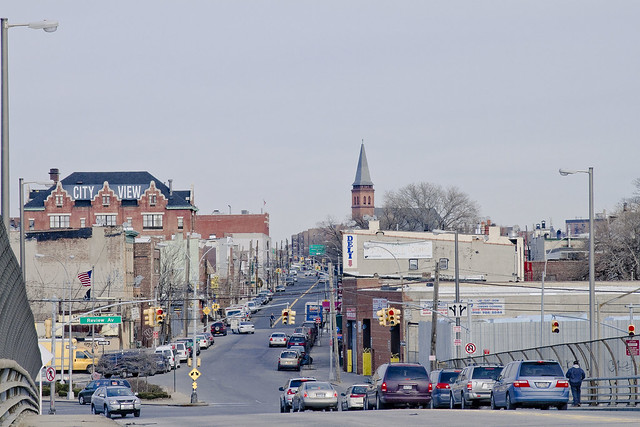
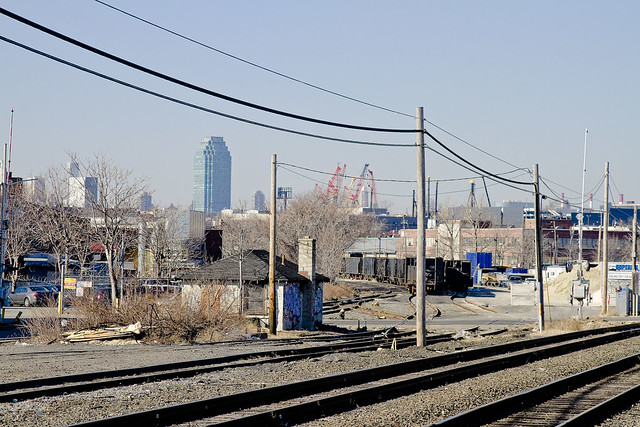
Once upon a time, this wasn’t the proverbial “wrong side of the tracks”, rather this was the center of town. 18th century residents would ask “what on earth could have happened to Maspeth Creek” were they able, and “where is the Town Dock which DeWitt Clinton himself used- where is it”?
What happened?

– photo by Mitch Waxman
19th Century residents and passerby would inquire what disaster occurred, that Haberman’s and Nichols Chemical and all of Berlin and Blissville have disappeared and been forgotten? What has happened to the great factories, the mills, and the hustle and bustle? Where have all the railroads gone, can one paltry freight line actually be charged with servicing all of Newtown Creek?

– photo by Mitch Waxman
For your humble narrator, a good place to ponder this sort of question has always been the Clinton Diner.
This little oasis has hosted a full group from a bus tour I helped conduct, acts a central meeting point for all sorts of Newtown Creek functions, and has provided a much needed cup of coffee and clean rest room to a half frozen yet quite humble narrator on more than one occasion.
It’s also sitting pretty much on a shoreline that Maspeth Creek once flowed past.

– photo by Mitch Waxman
Accordingly, a “Happy Valentine’s” day shout out to the Clinton Diner is offered today.
It would be meaningless to offer you shots of its interior as it has been featured more than once in the cinema. Witness below the trademark dolly shot of Martin Scorcese in Goodfellas… The window booth that DeNiro and Liotta are sitting in is the one with the “Go Giants” signage in the shot above.
And a happy valentine’s day greeting is offered to you as well, lords and ladies… or a giddy Lupercalia.
The Clinton Diner is found at 5626 Maspeth Ave., Maspeth, NY 11378-2248 (718) 894-3475
traitorous somnolence

– photo by Mitch Waxman
On one of the lonely transmigrations which your humble narrator famously engages in, actually vast pedestrian journeys across the concrete desolations of Western Queens, the walk up 58th street- the former Betts Avenue of colonial era Newtown- might be the loneliest of all. Rimmed by polyandrions of gargantuan acreage, this street hosts no sidewalk to speak of and one must pick ones way in the manner of some roadside mendicant. It is a valley whose cliffs are the masonry walls and iron gates of cemeteries.
This neighborhood is neither Woodside nor Maspeth, it is the angle found between them.
A personal preference is marked for the Eastern side of the street, which follows the stout iron of Mt. Zion’s fences.

– photo by Mitch Waxman
The former home of the so called Maspeth Gypsies, a tribe of Romani whose expulsion by Police in the early 20th century is spoken of in hushed whispers by the Centenarians of ancient Maspeth, Mt. Zion is a cemetery set aside for adherents of the Hebrew faith. It is located across the street from the vastness of 3rd Calvary, a Catholic cemetery. Mt. Zion seems crowded, due to the Hebraic tradition of installing a single occupant in a grave, unlike the Roman Catholic institution across the street.
Its residents, at least in this section of the cemetery, are long gone- most of the stones speak to their passing away in a time period long before even rumors of a Second World War became extant in the community.

– photo by Mitch Waxman
Peeking through the rotting iron of the fences while trudging along the other day, your humble narrator noticed this small offering hidden away between the cast iron palisade and the first row of graves (or last, were you within the parcel).
Similarities to other instances of peasant magick at St. Michael’s Cemetery in Astoria which have been detailed in prior Newtown Pentacle postings should be remarked upon.

– photo by Mitch Waxman
Probably “Afro-Cuban” in origin, the possible etymology of this odd tableau is betrayed by the presence of the Cigar. Tobacco plays a large ritual role in the so called syncretic faiths of Latin and Caribbean religions, and the manufactured item is often used as an offering to the Orisha or Loa- as a symbol of sacrificial wealth or as an embodiment of the virility or power of the magick worker.
Of course, sometimes a cigar is just a cigar, as the oft quoted (and incorrectly attributed) Freudian saying goes.

– photo by Mitch Waxman
The aluminum pan leaning against the monument contained a burnt offering of some kind, which appeared to be a textile wrapped around something occluded from view, and mingled with a piece of thin wood or perhaps the shell of a coconut which has been cut into some sort of odd shape.

– photo by Mitch Waxman
A closer shot of the arrangement. It would appear that some sort of accelerant was used to accomplish the combustion, something that would have burned off quickly like liquor. The fabric seems charred or singed more than immolated, as if the flames were extinguished quickly.
Of course, your humble narrator is no fire inspector nor arson investigation expert (or an authority on afro-cuban syncretic religious practices for that matter), so these callow observations should be considered mere speculation.

– photo by Mitch Waxman
This is not the first time which arcane leave behinds have been personally observed along this wall, which you’ll notice is constructed out of tombstones. A photo has been run here of a hand carved mortar and pestle which contained an odd ashy substance. The image dates back several years which implies that acolytes and devotees of whatever these forces which are being invoked here, in the heart of the Cemetery Belt, have been at work for a very long time.
One wonders, and more than wonders- could the so called Maspeth Gypsies tell us a thing or two about these legend haunted lowlands found at this angle between Woodside and Maspeth?
cryptical books

– photo by Mitch Waxman
Just to affirm that your humble narrator is a multi disciplinary geek, whose nerd credentials cross into multiple devotions and subjects, today’s post takes us to the Hudson River and specifically- Esopus Island. An unremarkable spit of rock sticking out of the water not far from Kingston, Esopus nevertheless is a touchstone for high weirdness.
If these shots were taken in 1918 rather than 2010- one would have seen a bizarre Englishman crawling along the shorelines painting “Do What Thou Wilt Shall be the Whole of the Law” and “Every Man and Every Woman is a Star” on the stony outcrops in red.
from wikipedia
Crowley began another period of magical work on an island in the Hudson River after buying large amounts of red paint instead of food. Having painted “Do what thou wilt” on the cliffs at both sides of the island, he received gifts from curious visitors. Here at the island he had visions of seeming past lives, though he refused to endorse any theory of what they meant beyond linking them to his unconscious. Towards the end of his stay, he had a shocking experience he linked to “the Chinese wisdom” which made even Thelema appear insignificant.

– photo by Mitch Waxman
The self proclaimed “Great Beast” himself, Aleister Crowley spent much of the First World War in New York City, and the wild speculations that he was acting as an agent of British Intelligence during this time just might hold some water. In 1918, that horrible man decided on a “great magical retirement” (he had run out of money and driven at least two women to alcoholism and madness), shaved his head, and borrowed a tent and canoe from one of the many friends whom he cuckolded.
Here’s an image from a postcard depicting Esopus Island in 1907. In his diaries, Crowley called it Oesopus.
from wikipedia
Aleister Crowley (/ˈkroʊli/ kroh-lee; 12 October 1875–1 December 1947), born Edward Alexander Crowley, and also known as both Frater Perdurabo and The Great Beast, was an influential English occultist, astrologer, mystic and ceremonial magician, responsible for founding the religious philosophy of Thelema. He was also successful in various other fields, including mountaineering, chess and poetry. In his role as the founder of the Thelemite philosophy, he came to see himself as the prophet who was entrusted with informing humanity that it was entering the new Aeon of Horus in the early twentieth century.

– photo by Mitch Waxman
Crowley arrived on the island with scant supplies, and was known to have made a trip back to New York at least once to secure needed items. Local farmers, concerned and curious about their new neighbor, brought comestibles to the odd fellow- a charming and neighborly Yankee tradition. Curiously, the hermit spent his time mediating and translating an ancient Chinese text for his own amusement.
Crowley reported that he experienced an epiphany here, something that would overshadow even his own mystical revelations. Which brings us back to H.P. Lovecraft. For two people who are never supposed to have met, Lovecraft and Crowley had a LOT of friends in common.
from dec.ny.gov
Atlantic sturgeon are the stuff of myth and legends. They are the largest fish to regularly inhabit the Hudson River, reaching 10-12′ in length and weighing in excess of 350 lb. They are a primitive-looking and wonderfully adapted estuarine creature belonging to an order of fishes whose evolutionary origins reaches back at least 100 million years. Sturgeon grow very slowly, taking as long or longer than humans to reach maturity, and rivaling us in longevity, surviving 50 years or more in the wild. The river channel around Esopus Island, up to 60 feet deep, is a known congregation area for adult Atlantic sturgeon.

– photo by Mitch Waxman
Supposedly-
It would seem that one of the simple Yankee farmers who brought Crowley food and provisions was one Paul Rhodes, who would later become a correspondent and friend of Mr. Lovecraft. Rhodes created the only contemporaneous cinematic adaptation of one of Lovecraft’s tales- “The Other Gods” which was screened just once in 1924 for Mdm. Blavatsky’s Theosophical Society.
This should be taken with a grain of salt, as I haven’t been able to find independent confirmation of this timeline and it might be modern imposture. Regardless, witness the short film at the links below- if you dare.


