Posts Tagged ‘Pickman’
maternal ancestry
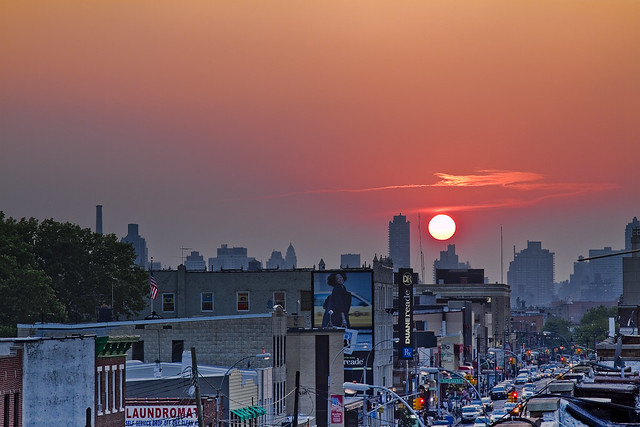
– photo by Mitch Waxman
Old world mysteries, primeval prejudices, and certain racial memories which might lead one back to those days before Rome put its torch to the world are extant in Western Queens. Here amongst the seething hills of noble Astoria, one may ask and sometimes receive an answer to questions about certain bizarre conceptions and hear rumors of supernatural forces run amok.
The Cretan might tell you about the Kallikantzaros which followed them here, or the Egyptian might share with you tales about those things which lurk just beyond the village.

– photo by Mitch Waxman
Stout Croat and Romani alike shudder at the mention of Strigoi having entered the area, and the Mexican and Ecuadorean communities close ranks when questioned about the power of the Brujas who have followed their people here. The imitative hipster finds sanguine amusement at the notion of hauntings that have plagued certain buildings, apartment houses, and riverside spots for generations- chalking up these stories to quaint superstition and ironic interpretation.
Even the Museum of the Moving Image is meant to host a spectral resident, after all.

– photo by Mitch Waxman
Buddhist invocations, Hindu mysticism, Brazilian peasant magicks- the hidden arts of Imam and Priest- these things are never discussed by area wags.
Many fear that such talk might reduce property value and cause new residents to choose other and less ancient locales in which to rent or buy real estate. It is when night comes to the ancient Dutch village that the odd things become obvious, begin to happen, and the later it gets the wilder things might become.
Also:

Your humble narrator will be narrating humbly on Friday, February 24th at 7:30 P.M. for the “Ridgewood Democratic Club, 60-70 Putnam Avenue, Ridgewood, NY 11385” as the “Newtown Creek Magic Lantern Show” is presented to their esteemed group. The club hosts a public meeting, with guests and neighbors welcome, and say that refreshments will be served.
The “Magic Lantern Show” is actually a slideshow, packed with informative text and graphics, wherein we approach and explore the entire Newtown Creek. Every tributary, bridge, and significant spot are examined and illustrated with photography. This virtual tour will be augmented by personal observation and recollection by yours truly, with a question and answer period following.
For those of you who might have seen it last year, the presentation has been streamlined, augmented with new views, and updated with some of the emerging stories about Newtown Creek which have been exclusively reported on at this- your Newtown Pentacle.
For more information, please contact me here.
unfortunate lunatic

– photo by Mitch Waxman
Selected for your perusal today are scenes from the hoary desolation of Brooklyn’s Bushwick Inlet.
This little bay, where the USS Monitor was launched some 150 years ago, was the river outlet for Continental Iron Works. In addition to the Monitor, countless steam boats, and the manufacture of all manner of cast iron building supplies- the caissons for the Brooklyn Bridge were assembled and launched here.
The Brooklyn street grid indicates Calyer and Clay streets as being the nearest geographic indicators, but there’s something else missing.

– photo by Mitch Waxman
Bushwick Creek once flowed into and mingled with the East River at this spot after finishing its journey from upland. The city of Williamsburg listed this body of water as its border with the town of Greenpoint, which itself was defined and named for a promontory bluff overgrown with hemlock that existed between the Newtown and Bushwick Creeks.
The hemlock was what originally attracted shipwrights here, as the straight growing evergreens produced wood that had several uses onboard ships.

– photo by Mitch Waxman
The inlet is owned by Motiva Enterprises, a company with several locations in the area which employs itself as a fuel distributor. Accordingly, access to the area is severely limited due to security and safety issues. These shots were acquired during the Greenpoint Monitor Museum‘s recent parade event. The northern side of the site is in a state of disuse and relict decay, while the southern houses several enormous fuel tanks.
There is some buzz that the Museum is attempting to site themselves here, a welcome addition, IMHO.

– photo by Mitch Waxman
Scatterings of artifacts, a brick marked “Manhattan Fire Brick Co.”, or a rust stained concrete foundation peek out of the mud here and there. The very surface you stand on is crumbling, and at waters edge all sorts of uncommented masonry sits in a tumbledown arrangement as the languid waters of the East River nibble away at the shoreline.
The muddy soil is a greasy particulate, more sticky sand than dirt, oddly irridescent and stained with “the colour” which distinguishes the nearby Newtown Creek.

– photo by Mitch Waxman
Across the river in Manhattan, which today hosts the Stuyvesant Town housing development and a power plant, there were shipyards. Novelty Iron Works as well as hundreds of smaller shops were spread out between 14th street and Corlears Hook (just below the modern day Williamsburg Bridge). In the late 19th century, Stuyvesant Town’s site was occupied by shanty tenements and the enormous “works” of the gas system which lit Manhattan streets and homes- I’ve seen references to it as the “gas light district”.
As one got closer to 23rd street, stone masons and other artisan businesses began to appear.

– photo by Mitch Waxman
When a large business concern like Continental Iron Works or Novelty sited somewhere, it created a halo of smaller businesses springing up around it. Coopers to make barrels, carpenters to supply barrel wood, blacksmiths to make carpentry tools. Rope makers, lunch wagons, carting companies- all surrounded these large plants. Greenpoint was no different, with enormous numbers of storefront and stable based craftsmen supplying everything from pencils to livestock to the larger concerns.
Additionally, ferries and streetcar lines were required to transport workers and raw materials from place to place.

– photo by Mitch Waxman
Disuse, changing economies, and the unusual indifference which the 20th century displayed toward the waterfront of New York City have left this historic patch of land a wasteland. Indigenous species or a mollusca invader from foreign shores, all have claimed a rightful place here, planting strong roots which slither into and spread apart the forgotten brick foundations of long ago and way back when.
Who can guess, all there is, that might be buried down there?

– photo by Mitch Waxman
Here in the foundry of the American Industrial Revolution, all we manufacture these days are Red Velvet Cupcakes and other items of fashionable taste.
Stronger men, born in an age of sail, forged a world of steel and iron in this place. A vibrating hum of industry lit the smoky sky with coal fired avarice, forging the great fortunes of some and the prosperity of most. Where are these titans today, with their great and satanic mills, and what happened to “Coketown“?
Also:
Your humble narrator will be narrating humbly on Friday, February 24th at 7:30 P.M. for the “Ridgewood Democratic Club, 60-70 Putnam Avenue, Ridgewood, NY 11385” as the “Newtown Creek Magic Lantern Show” is presented to their esteemed group. The club hosts a public meeting, with guests and neighbors welcome, and say that refreshments will be served.
The “Magic Lantern Show” is actually a slideshow, packed with informative text and graphics, wherein we approach and explore the entire Newtown Creek. Every tributary, bridge, and significant spot are examined and illustrated with photography. This virtual tour will be augmented by personal observation and recollection by yours truly, with a question and answer period following.
For those of you who might have seen it last year, the presentation has been streamlined, augmented with new views, and updated with some of the emerging stories about Newtown Creek which have been exclusively reported on at this- your Newtown Pentacle.
For more information, please contact me here.
wondering uneasily

– photo by Mitch Waxman
Each one of the DE30AC Long Island Railroad engines one typically observes at the ancient Long Island City station at Hunters Point is rated to 3,000 Horsepower. So says the google.
As a humble narrator is given to literal interpretations of statements like this, an idea occurred, which might present an answer to the so called “hum” which bedevils area residents.
Horses.
from wikipedia
The LIRR chartered the New York and Jamaica Railroad on September 3, 1859, and a supplement to the LIRR’s charter passed March 12, 1860 authorized it to buy the NY&J and extend to Hunters Point. The LIRR carried through with the NY&J purchase on April 25, along with the purchase of a short piece of the Brooklyn and Jamaica at Jamaica, and the next day it cancelled its lease of the Brooklyn and Jamaica, but continued to operate over it.

– photo by Mitch Waxman
Logistical conundrums abound in this scheme of mine, mastering a team of 3,000 horses for instance, would be hubris enough to make a Roman blush.
A thousand pounds of horseflesh each, the 3,000 strong equine army would each require some 10-12 gallons of water and 1-1.5% of it’s body weight in food per day (US Army daily forage rations were given as 12 lbs of oats and 14 lbs of hay per 900 lb. horse). Marvelously enough, the mountains of manure generated by the animals could act as fertilizer for roof top farms which could in turn grow the food.
It would be a virtuous circle for all, except for the customers of the LIRR itself, who will be moving to Syosset at no more than 3mph.
from wikipedia
The DE30AC and DM30AC locomotives replaced aging GP38s, Alco FA1/FA2s, F7As and F9As, and MP15AC and SW1001 locomotives, with GP38s used to push and pull diesel trains and other locomotives used to provide HEP for the trains. The bodies of the DE30AC and the DM30AC are similar; the difference is the ability of the DM30AC to use electric third rail while the diesel engine is off, enabling the locomotive to use the East River Tunnels into New York Penn Station. DM30ACs have third rail contact shoes, permitting direct service from non-electrified lines in eastern Long Island via the western electrified main lines all the way to Penn Station. A few such trains a day run on the Port Jefferson, Oyster Bay, and Montauk Branches. The engines’ naming scheme: DM = Dual Mode, DE = Diesel Engine, 30 = 3000 hp, AC = Alternating Current traction motors.

– photo by Mitch Waxman
Oh, and there’s also something like ten trains that use this station daily, so that’s actually 30,000 horses. That’s the estimated equine population of New Hampshire.
Imagine all the primate jobs this scheme would generate as well, hundreds if not thousands of green jobs- Veterinarians, Agriculturists, Teamsters, Roof-top Botanists.
from wikipedia
Long Island City station was built on June 26, 1854, and was rebuilt seven times during the 19th Century. On December 18, 1902, both the two-story station building, and an office building owned by the LIRR burned down. The station was rebuilt on April 26, 1903, and was electrified on June 16, 1910.
Before the East River Tunnels were built, the Long Island City station served as the terminus for Manhattan-bound passengers from Long Island, who took ferries to the East Side of Manhattan. The passenger ferry service was abandoned on March 3, 1925, although freight was carried by car floats (see Gantry Plaza State Park) to and from Manhattan until the middle twentieth century. Today ferry service is operated by NY Waterway.
Hermes Trismegistus

– photo by Mitch Waxman
Jules-Felix Coutan designed “Glory of Commerce” for Grand Central Terminal in 1911. A neat contemporaneous account of the construction of this statuary, which was carved in Long Island City I would add (by the firm of William Bradley & Son, 547 Vernon Avenue, which I suspect to have been located somewhere around Queensbridge Park), and can be accessed at nytimes.com.
from wikipedia
The Hermetic literature added to the Egyptian concerns with conjuring spirits and animating statues that inform the oldest texts, Hellenistic writings of Greco-Babylonian astrology and the newly developed practice of alchemy (Fowden 1993: pp65–68). In a parallel tradition, Hermetic philosophy rationalized and systematized religious cult practices and offered the adept a method of personal ascension from the constraints of physical being, which has led to confusion of Hermeticism with Gnosticism, which was developing contemporaneously.
As a divine source of wisdom, Hermes Trismegistus was credited with tens of thousands of writings of high standing, reputed to be of immense antiquity. Plato’s Timaeus and Critias state that in the temple of Neith at Sais, there were secret halls containing historical records which had been kept for 9,000 years. Clement of Alexandria was under the impression that the Egyptians had forty-two sacred writings by Hermes, encapsulating all the training of Egyptian priests. Siegfried Morenz has suggested (Egyptian Religion) “The reference to Thoth’s authorship…is based on ancient tradition; the figure forty-two probably stems from the number of Egyptian nomes, and thus conveys the notion of completeness.” The Neo-Platonic writers took up Clement’s “forty-two essential texts”.
The Hermetica, is a category of papyri containing spells and initiatory induction procedures. In the dialogue called the Asclepius (after the Greek god of healing) the art of imprisoning the souls of demons or of angels in statues with the help of herbs, gems and odors, is described, such that the statue could speak and engage in prophecy. In other papyri, there are recipes for constructing such images and animating them, such as when images are to be fashioned hollow so as to enclose a magic name inscribed on gold leaf.
strange delicacies

– photo by Mitch Waxman
Fascination with the once upon a time community known as Blissville haunts my dreams.
Unaccountably, given the corrupted environment and largely abandoned to industry character of this corridor in western Queens, there are still proud and ancestral residents of this neighborhood which borders the sanguine Newtown Creek. First Calvary consumed most of the neighborhood in the late 19th and early 20th centuries, as it grew by acquisition and through the action of wills and estate transfers.
Greenpoint Avenue, as is slouches roughly toward the Newtown Creek, is the central artery of the place.

– photo by Mitch Waxman
Traffic choked, this part of Greenpoint Avenue was once home to fine hotels and numerous inns, public houses, and bars. The teeming multitudes of largely Catholic Lower Manhattan, whether denizens of the fabled “Five Points” or from the savory upscale districts in New York, came here for funerary rites at First Calvary. Before embarking on the long journey back to Manhattan, a major endeavor involving ferries and horse drawn trolleys, they would often tilt a glass to their fallen comrade or family.
The last of these comfort stops is still in operation, the Botany Bay public house at Bradley Avenue.

– photo by Mitch Waxman
There were two major “trolley” roads (not steam or electric at first, but rather horse drawn) which serviced this area, providing access for the New Yorkers to arrive at Blissville. The Greenpoint based one would find its passengers at a ferry stop which connected Grand Street in Manhattan with the foot of Greenpoint Avenue in Brooklyn. This is the reason why Greenpoint avenue is so wide, it originally carried two lanes of traffic with the center given over to the “road”.
It’s also the reason why GPA near the East River hosts so many grand and significant structures, it was a sort of “Parisian Avenue”.

– photo by Mitch Waxman
The second “road” followed Borden Avenue from its foot at the Long Island Railroad ferry in Long Island City to its intersection at Greenpoint Avenue. A point of interest about this line was that it was owned and operated by the notorious Mayor of Long Island City, Patrick J. Gleason, known as Battle Ax. The LIRR ferry connected the line with Turtle Bay in Manhattan, but the Brooklyn based one was far more popular.
Obviously, the Catholic population around Manhattan’s Grand Street was quite a bit larger than that of the less populated area around 34th street.

– photo by Mitch Waxman
There are quite a few run down relicts found along this stretch of road, an area that time seems to have forgotten. Worm eaten pilasters and hints of former glory adorn these structures, some of which date back to the years directly following the Civil War. Modern structures are strictly utilitarian, boxes of brick and rebar.
Sources in the construction industry, some who are even responsible for erecting these architectural abominations, have hinted to me in the past that jobs in this area always yield surprise and sometimes engender astonishment. Foundations of much earlier structures, unknown pipelines, and even underground voids of astonishing size and workmanship.
Credulous, I must accept the descriptions offered to me that the whole area is thoroughly tunneled out. Sometimes I wonder, and tremble at the suggestions made by anonymous sources that some of these tunnels are quite freshly dug, however.


