Posts Tagged ‘Tugboat’
The Pulaski Bridge
– photos by Mitch Waxman
Shots from, on, and around the Pulaski Bridge over Newtown Creek. For a more in depth profile of the bridge, click here and visit DUPBO (Down Under the Pulaski Bridge Onramp).
confines of our kingdom
“Newtown Creek for the Vulgarly Curious” is a fully annotated 68 page, full-color journey from the mouth of Newtown Creek at the East River all the way back to the heart of darkness at English Kills, with photos and text by Mitch Waxman.
Check out the preview of the book at lulu.com, which is handling printing and order fulfillment, by clicking here.
Every book sold contributes directly to the material support and continuance of this, your Newtown Pentacle.
narcotic flowers

– photo by Mitch Waxman
One of the many things which both torment and delight my imaginings is the notion of some foreign plague or hostile bacterium hitching a ride into New York Harbor onboard a ship.
In 1863, the city fathers enacted the “General Quarantine Act” due to similar fears. Political upheavals in Europe and Asia resulted in a lot of people seeking a more peaceful and profitable future and heading to North America. Many of these peasant pilgrims were weakened or crippled by ordeal and famine, and sometimes from an infectious disease. It was feared that if just one plague carrier became lost in the crowded tenements of Manhattan, something “biblical” would ensue, something which anointing the door with lamb’s blood couldn’t help you out with.
If the New Yorkers of 1863 were afraid of something… well, the City’s immune system ain’t what it used to be, y’know…
from tlcarchive.org
In 1864, the commercial avenues of the area were paved with cobblestones which, in turn, provided deep cracks in which refuse collected and rotted. But the streets were “very filthy” with accumulations of manure from the horses that traversed the area, dead dogs, cats and rats, household and vegetable refuse that in winter accumulated to depths of three feet or more. “Garbage boxes,” rarely emptied, overflowed with offal, animal carcasses, and household waste. “Pools” of stagnant water collected in the carcasses of dead animals, and over sewer drains that were generally clogged. “Filth of every kind [were] thrown into the streets, covering their surface, filling the gutters, obstructing the sewer culverts, and sending forth perennial emanations which must generate pestiferous diseases,” reported William Thomas, the Sanitary Inspector for the district. “Drainage is generally imperfect, the courtyards being … below the level of the streets” and “everything is thrown into the street and gutters at all times of the day.” While poorly designed sewers had been installed throughout the region, most of the population depended upon the outdoor “water closets” and privies in the courtyards of the tenement buildings, close to wells used for drinking.

– photo by Mitch Waxman
As early as 1755, the redoubtable stewards of New York Harbor were working on this issue, when an ordinance was passed demanding that all ships seeking entrance to the harbor must first be inspected by physicians and that all ships bearing contagion be quarantined at Bedloe’s Island. Bedloe’s, of course, is known as Liberty Island to modernity. 1795 is the beginning of the paper trail which eventually transmogrifies into the The New York City Department of Public Health and Mental Hygiene, when the first death records are filed for the 718 Yellow Fever victims that died that year. It wasn’t until 1866 that a Metropolitan Board of Health was formed, which was the same year that a Cholera outbreak was controlled by the “Disinfectant Corps” of Dr. Stephen S. Smith.
Tuberculosis, however, accounted for nearly 20% of all deaths in New York City.
from wikipedia
An infectious disease is a clinically evident illness resulting from the presence of pathogenic microbial agents, including pathogenic viruses, pathogenic bacteria, fungi, protozoa, multicellular parasites, and aberrant proteins known as prions. These pathogens are able to cause disease in animals and/or plants. Infectious pathologies are also called communicable diseases or transmissible diseases due to their potential of transmission from one person or species to another by a replicating agent (as opposed to a toxin).
Transmission of an infectious disease may occur through one or more of diverse pathways including physical contact with infected individuals. These infecting agents may also be transmitted through liquids, food, body fluids, contaminated objects, airborne inhalation, or through vector-borne spread. Transmissible diseases which occur through contact with an ill person or their secretions, or objects touched by them, are especially infective, and are sometimes referred to as contagious diseases. Infectious (communicable) diseases which usually require a more specialized route of infection, such as vector transmission, blood or needle transmission, or sexual transmission, are usually not regarded as contagious, and thus are not as amenable to medical quarantine of victims.

– photo by Mitch Waxman
Outbreaks of Cholera in New York City during the 19th century carried staggering death tolls, equivalent statistics for the modern population of 8 million calculate that 100,000 people would be snuffed out by a modern outbreak of the bacterial illness. Modern antibiotics and medical techniques have put reigns on Cholera, but it still ravages the populations of the developing world where such luxuries as sanitary waste water disposal, clean drinking water, and private privy rooms are beyond the reach of most. The class of diseases that keep me up at night though are the hemorrhagic fevers, caused by seemingly demonic entities like the Arenaviridae, Filoviridae, Bunyaviridae, and Flaviviridae families of virii.
from wikipedia
- The Arenaviridae include the viruses responsible for Lassa fever and Argentine, Bolivian, Brazilian and Venezuelan hemorrhagic fevers.
- The Bunyaviridae include the members of the Hantavirus genus that cause hemorrhagic fever with renal syndrome (HFRS), the Crimean-Congo hemorrhagic fever (CCHF) virus from the Nairovirus genus, and the Rift Valley fever (RVF) virus from the Phlebovirus genus.
- The Filoviridae include Ebola and Marburg viruses.
- Finally, the Flaviviridae include dengue, yellow fever, and two viruses in the tick-borne encephalitis group that cause VHF: Omsk hemorrhagic fever virus and Kyasanur Forest disease virus.
- The most recently recognized virus capable of causing hemorrhagic fever is Lujo virus, a new member of the arenaviruses described in 2009 and found in South Africa.

– photo by Mitch Waxman
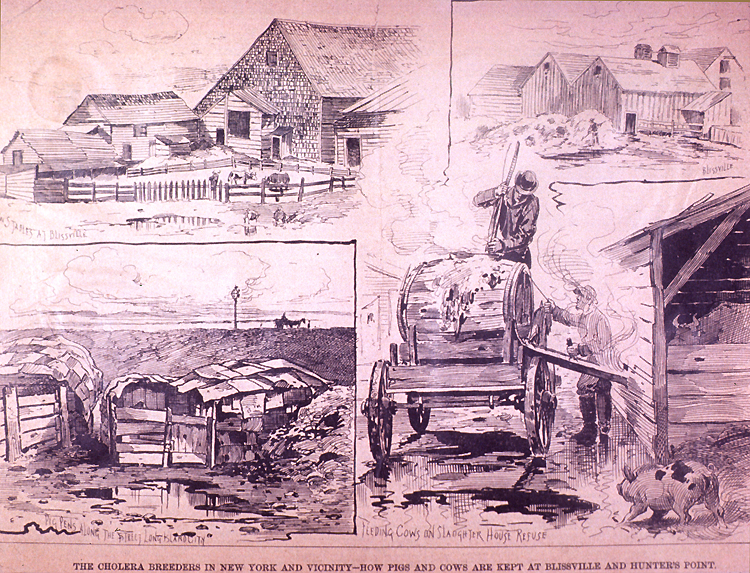
In 1879, conditions around the Hunters Point and Blissville sections of the Newtown Creek were infamous. The distilleries which lined the Queens banks produced a series of waste products, known collectively to the locals as “swill”, which was fed to a sickly group of cows and pigs imprisoned in overcrowded and hellish stables. Pneumonia and open sores were reported by state inspectors, and they intimated that animal waste was observed as mingling with the water in great abundances. The “swill milk” produced by these cattle was, of course, cheaper than more wholesome substitutes and meant for the children of the poor. The situation drew much attention at the time, and there is even an illustrated view of the conditions available at the National Institutes for Health, presented below (click image for full size).
The caption reads “The cholera breeders in New York and vicinity, how pigs and cows are kept at Blissville and Hunter’s Point.”
Who can guess, all there is, that might be buried down there… and what might be waiting to escape from a centuries long quarantine… in the deep sediments of the Newtown Creek?
from epa.gov
EPA conducted an Expanded Site Investigation (ESI) of Newtown Creek in 2009 as part of the Hazard Ranking System scoring process for NPL listing under Superfund. Based on the ESI, which was focused on Newtown Creek itself and not its tributaries, EPA concluded that metals, volatile organic compounds, and semi-volatile organic compounds (including polycyclic aromatic hydrocarbons and polychlorinated biphenyls) were present in Creek sediments at elevated concentrations. The variety and distribution of the detected contaminants suggests that they originated from a variety of sources. Previous environmental investigations of Newtown Creek, or specific portions of the Creek, also disclosed that sediments in Newtown Creek are contaminated by a wide variety of hazardous substances. Environmental investigations of upland parcels adjacent to or nearby the Creek have disclosed contamination of those parcels by hazardous substances similar to hazardous substances found in sediments in Newtown Creek.
Happy Birthday, Bayonne Bridge

– photo by Mitch Waxman
A Sunday, the first day that the Bayonne Bridge opened for use to the general public was 28,856 days ago, on November 15th, 1931 at 5 A.M.
from a Newtown Pentacle posting of June 26, 2009 (where a few of these photos first appeared)
The fourth largest steel arch bridge on Earth with a height of 150 feet over the water, it connects Bayonne, New Jersey’s Chemical Coastline with Staten Island. It’s primary mission is to allow vehicular traffic access to Manhattan via the Holland Tunnel…
The Bayonne Bridge was designed by a man who helped design the Hell Gate rail bridge on the East river- and was principal designer for the Verrazano bridge over the Narrows, The George Washingston Bridge over the Hudson River, the Bronx Whitestone Bridge over the East River, the Throgs Neck Bridge over the East River. He was brought in to simplify the design of mighty Triborough– which is actually a bridge and highway complex spanning multiple waterways and islands. A swede, Othmar Amman worked for Gustavus Lindenthal(designer of the the Queensboro and Hell Gate Bridges), and took over as head bridge engineer at the New York Port Authority in 1925. He also directed the planning and construction of the the Lincoln Tunnel.
He was Robert Moses’s “guy”.

– photo by Mitch Waxman
A brutal beauty, the elegant parabola of the Bayonne Bridge is not likely to remain unaltered at its centennial.
from wikipedia
The Bayonne Bridge is the fourth longest steel arch bridge in the world, and was the longest in the world at the time of its completion. It connects Bayonne, New Jersey with Staten Island, New York, spanning the Kill Van Kull.The bridge was designed by master bridge-builder Othmar Ammann and the architect Cass Gilbert. It was built by the Port of New York Authority and opened on November 15, 1931, after dedication ceremonies were held the previous day. The primary purpose of the bridge was to allow vehicle traffic from Staten Island to reach Manhattan via the Holland Tunnel.

– photo by Mitch Waxman
A new class of titan ship, the Panamax class cargo carrier, would be stymied from entering Newark Bay and the elaborate port infrastructure which lines its shores by the shallow height of the bridge’s roadway.
from nycroads.com (be sure to click through, and check out the historic photo of the bridge under construction)
Ground was broken for the Bayonne Bridge on September 1, 1928. The span is comprised of a two-hinged, spandrel-braced trussed arch in which the bottom chords form a perfect parabolic arch. As the span’s primary structural members, these manganese-steel chords carry most of the dead load and uniform live load, which is then transferred to the concrete abutments. The span’s top chords (which were constructed from a lighter silicon steel) and web members are stressed by live loads and temperature.

– photo by Mitch Waxman
Humorless, the suggestion to lower the water falls on deaf ears amongst those stern and hardened engineers employed by the Port Authority.
from panynj.gov
Initially, the bridge was planned for motor vehicles, bicycles, and pedestrians only. Accordingly, a suspension bridge design was developed since this type of bridge offered the most economical way to engineer a single span across the Kill Van Kull for motor vehicles. However, the suspension scheme was abandoned when the Port Authority commissioners insisted that considerations be made for at least two rail transit tracks to be added at some future date. (Studies showed that adapting a suspension design for rail traffic would be cost-prohibitive.) With rail traffic in mind, the bridge’s chief designer, Othmar H. Ammann, began developing a scheme that spanned the Kill Van Kull with a single, innovative, arch-shaped truss. As with the suspension bridge scheme, Ammann worked on the arch design in partnership with architect Cass Gilbert. The arch bridge that emerged promised to be a remarkably efficient solution, well suited to the site from both an engineering and aesthetic standpoint.

– photo by Mitch Waxman
One can only hope that the solution to the Bayonne Bridge’s height issue can be solved in as elegant a fashion as Othmar Ammann’s original design.
from panynj.gov
In 1931 the Port Authority built the Bayonne Bridge, which connects Bayonne, New Jersey and Staten Island, New York and sits at the entrance of the Port Authority’s maritime facilities over the Kill Van Kull. Due to the increasing size of vessels, the 151-foot airdraft (the distance from the water’s surface to the underside of the bridge roadway) of the bridge presents a navigational challenge to some vessels today – a challenge that is expected to increase as larger ships transit the Panama Canal after its expansion in 2015. The Port Authority recognizes the importance of developing and maintaining a world class port with deep and clear channels for vessels and the infrastructure to support the movement of cargo.
In order to address this navigational challenge, in 2008 the Port Authority commissioned the United States Army Corps of Engineers (USACE) to complete an analysis of the commercial consequences of and the national economic benefits that could be generated by a potential remedy of the Bayonne Bridge’s airdraft restriction. The final report concludes that despite the high cost of possible solutions, the national economic benefits (i.e. the transportation cost savings to the nation) that would result from implementing a remedy would far outweigh the costs. The total project cost of modifying or replacing the bridge could range from $1.3 billionto $3.1 billion and could take ten years or more to complete.
2010 Great North River Tugboat Race
– photos by Mitch Waxman
Sunday the 5th of September saw the Hudson River boiling with Tugboats, and your humble narrator was onboard the stout Launch 5 (a former NYPD patrol boat- aka the Patrolman Walburger- whose sturdy crew generously hosted me) shooting photos. Check out the flickr slideshow above (which can also be accessed here) and the race results below.
The Race results as released by the Working Harbor Committee:
18th Annual Great North River Tugboat Race & Competition – 5 September 2010 Working Harbor Committee
SHIP, Company – TIME- HP – CLASS – FINISH IN CLASS
- Maurania III – McAllister Towing – 5:09 – 4,000- A 1
- Cornell – Lehigh Maritime – 5:15 – 1,800 – A 2 (tie)
- Meagan Ann – Donjon Marine – 5:15 – 2,000 – A 2 (tie)
- Cheyenne – Donjon Marine – 5:25 – 1,800 – A 3
- Atlantic Salver – Donjon Marine – 5:55 – 7,200 – A 4
- Catherine Miller – Miller’s Launch – 6:23 – 1,200 – B 1
- Susan Miller – Miller’s Launch – 6:36 – 1,500 – B 2
- Sea Wolf – Sea Wolf Marine – 6:49 – 1,400 – B 3
- Mary H – Bren Transportation – 6:52 – 900 – B 4
- Vulcan – Derrick Marine – 6:56 – 500 – C 1
- W. O. Decker – Seaport Museum – 7:31 – 285 – C 2
- The Bronx – Robert & Lucy Apuzzo – 7:40 – 220 – C 3
- Shawn Miller – Miller’s Launch – 8:29 – 600 – C 4
- Lt. Michael Murphy – Scott Koen – 8:39 – 180 – C 5
Line Throw-
- Cheyenne 15 seconds
- Maurania III 16 seconds
- Susan Miller 18 seconds
Best Looking Tug- Mary H
Best Vintage Tug- Vulcan (1958)
Little Toot- The Bronx
Best Dressed- Meagan Ann (Pirates)
Best Tattoo- Meagan Ann (Multiple nautical tattoos)
Best Mascot- Maurania III (Chihuahua Maddie McAllister, wearing McAllister hat and
carried by small children)
Team Spirit (tie)- Miller’s Launch (3), Donjon Marine (3)
One of the big K-Sea boats arrived too late to compete.
Winners – Spinach Eating Contest
- Adult: Manny Rebelo (of tug Cornell)
- Child: Roland McAllister


 The Newtown Pentacle