Archive for October 2017
no business
It’s National Pasta Day, in these United States.

– photo by Mitch Waxman
Before I offer a conspiracy theory in today’s post, lets instead start with a bit of NY Harbor trivia – the height of all ships doing business within the Port of New York and New Jersey is governed by the height of the Verrazano Bridge’s span, as relative to the water. All cargo, military, and cruise ships which can be anticipated to someday enter NY harbor are actually designed with the Verrazano’s height in mind.
That means, ultimately, that this last exemplar of the House of Robert Moses erected in 1964, which sets a maximum height limit of exactly 228 feet over the water (at high tide), controls the design of a good chunk of the planet’s shipping fleets (although you’d be scraping the Verrazano’s deck at 228′ so they build them a bit shorter). A somewhat contemporaneous counterpart to the Verrazano is the Puente de las Américas (Bridge of the Americas) over the Panama Canal, which also plays a major role in the design of maritime vessels, setting a height limit of 201 feet over high water for any and all vessels using the crossing. The other approach to the Port of New York and New Jersey is governed by the Goethals Bridge over the Arthur Kill, which offers 135 feet of clearance, just to be entirely anal retentive about things.

– photo by Mitch Waxman
Verrazano Bridge is startlingly enormous, with a main span over the narrows stretching out for nearly a mile at 4,260 feet. Engineer Othmar Amman always liked to point out that his team had to take the curvature of the Earth itself into account when designing and placing the towers, which are off parallel to each other by 1.625 inches. When you add in the approaches on either side to the bridge, the entire thing is some 13,700 feet in length – roughly 2.6 miles. It’s now the 11th largest suspension bridge in the world, and the longest found on either American continent.
There are 143,000 miles of wire incorporated into its cables, enough to wrap around the earth’ equator 5.74 times or stretch half way to the moon. Its towers are 649.68 feet tall, making them the tallest structures outside of Manhattan in all of New York City. It carries nearly 190,000 vehicle trips a day, 69.35 million annually. The best estimates I’ve been able to find suggest that the combined steel of the bridge weighs some 1,265,000 tons.

– photo by Mitch Waxman
The Verrazano Bridge, due to its position and height, is affected by weather more heavily than any other span in New York Harbor. The roadway will actually sag down about a dozen feet during the summer months due to heat expansion, and the winds one encounter on the upper roadway preclude any discussion of pedestrian or bicycle paths being established. One can personally report that while driving over the thing during storms, my automobile was being rocked from side to side by heavy gusts of wind. The bridge is owned and operated by the MTA Bridges and Tunnels division, which is what Governor Nelson Rockefeller turned Robert Moses’s old Triborough Bridge and Tunnel Authority into.
The people at Bridges and Tunnels have a set of rules and customs governing the bridge during harsh weather conditions, which all depend on whether or not the roadways are wet or not, and whether the winds are either sustained or gusting. Speed restrictions begin to apply at 30 mph sustained winds and wet roads, while wet conditions coupled with sustained wind over 40 mph might trigger restrictions on crossings by motorcycles, mini buses, tractor trailers and other types of vehicles.

– photo by Mitch Waxman
I’ve noticed, over the years, that all of NYC’s bridges are possessed of a certain and unique to the span harmonic. Partially, it’s how the structure of the bridge interacts environmentally and also because of the sound of the vehicles running over it cause a vibration as their tires spin against the decks. To my hearing, the Verrazano makes a “wmmm-mmm-mhoooooosh-shhh” sound, but that could just be the particular interaction with the roadway of the vehicles which a humble narrator crosses the thing within, which have always been passenger cars. It’s efficacious to close your windows on the bridge no matter what, lest a torrent of air suddenly swirl into the passenger cabin, causing disarray and a tumult. I’ll leave it to musicians to tell you what key the Verazzano Bridge is in.
Like all MTA Bridges and Tunnel crossings, certain types of vehicles are forbidden. These types of vehicles (amongst others) include steam rollers, vehicles loaded with unconfined animals or poultry, wheelbarrows, and velocipedes.
Yes, they specifically mention velocipedes in the rules.
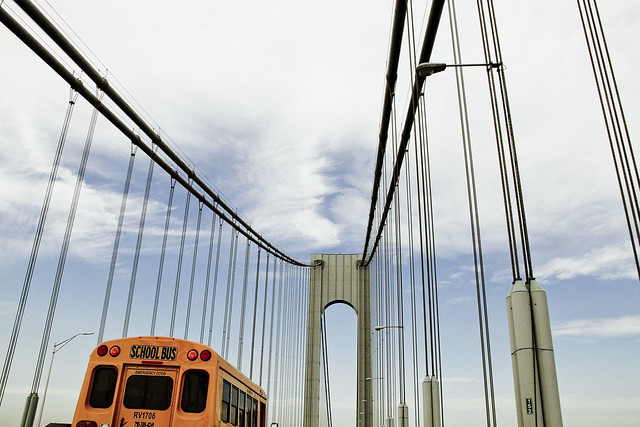
– photo by Mitch Waxman
I’ve always thought, with the born and raised in Brooklyn perspective that I am possessed by, that the bridge is actually some sort of giant shackle forcing the former City of Richmond or… Staten Island… not to secede from the City of Greater New York and join up with New Jersey instead. A mass exodus of Brooklynites, including my own parents, occurred during the late 1980’s and 90’s to Staten Island over the thing. Most of them, to quote my Dad, were “sick of this shit, and wanted to get the ‘eff out of here,” referring to the colloquialized “old neighborhood” which was “better back then.” I still don’t believe the old adage about being able to leave your door unlocked at night. Rent was a bit cheaper on Staten Island however, my parents perception of crime was far lower, and the semi suburban lifestyle encountered on Staten Island appealed to them in their retirement and dotage. They were also one step closer to Atlantic City where they liked to go on weekends away.
Staten Island is “car country,” unlike the city center neighborhood of Astoria, Queens where I now live. Mass transit (other than the ferry, I mean) exists but… you kind of need to have a car on Staten Island.

– photo by Mitch Waxman
Now for the conspiracy theory: A humble narrator is an idiot, of course, and has always cherished a personal theory that Robert Moses knew something more about NYC than he was letting on. Famously, before beginning his government career, Moses wandered the countryside on foot. Robert Caro suggests that even at a young age, he was planning highways and parks. Pffft… who does that at an early age? Moses was monster hunting, obviously, and he must have found something terrifying during his wanderings. I mean… c’mon… that’s fairly obvious, right?
Why else would he have built a steel and concrete cage around New York Harbor? Would old Bob Moses really have gone out of his way to destroy the coastal wetlands, swamps, and tidal marshes (which are precisely the sort of places you’d find monsters like “Grendels Mother” lurking) of New York Harbor for no reason other than malice? After conquering the human/fish hybrids at Hells Gate with his mighty Triborough, he set about the process of creating the world’s biggest padlock here in the narrows to close the door on his monstrous gate.

– photo by Mitch Waxman
Who can guess, all there is, that might be imprisoned down there beneath the 1,265,000 tons of steel? Is the arterial highway and bridge crossing system of New York City actually some sort of great barrier designed to keep slime dripping colossi in check? Is there some dark secret which will be held forever unknowable and immobile by the Verazzano Bridge?
What hidden and occult knowledge did Robert Moses take to the grave with him?
“follow” me on Twitter- @newtownpentacle
cemented hillocks
Today is World Food Day, on this hungry planet.

– photo by Mitch Waxman
As promised, here’s a few shots gathered on Friday the 13th at the Atlas Obscura “Into the Veil” event at Greenwood Cemetery. A friend I was showing them to on Friday asked me what the “night into day” technique I employed to capture these images entails other than long exposure times, and I tried to explain the exacting series of steps and settings which are employed, but by then he had fallen asleep. It’s complicated.
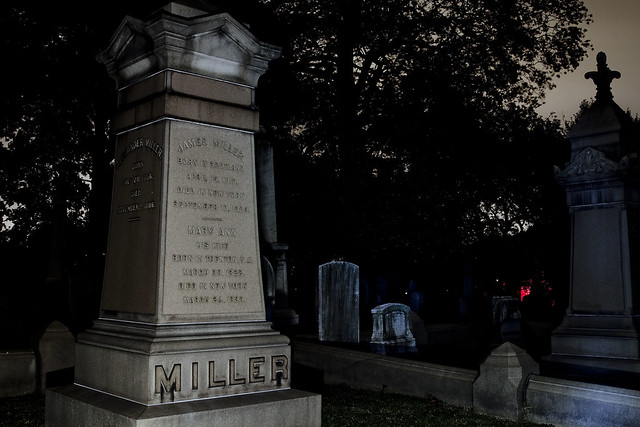
– photo by Mitch Waxman
In a couple of instances, I hung a work light of the front of my tripod. The shot above is a fair representation of what was within the range of human vision. The moon was occluded on Friday by heavy cloud cover and atmospheric humidity was quite high, which is ruinous for this sort of shooting due to the scattering and consumption of light by airborne moisture.

– photo by Mitch Waxman
The same setup, this time employing the whole checklist of “night into day” techniques which I’ve been working on. The difficult part of this, and why I’m stifled with the result, involves the sky – which isn’t blown out.

– photo by Mitch Waxman
LED lighting continues to grow in popularity, but it provides a bugbear of problems for digital photography. LED lights are actually strobing hundreds of times a minute, and throwing out weird wavelengths of saturated color light which the camera sensor struggles to interpret. Notice the difference between the automotive brake light generated red streak on the hill and the unnaturally garish reds of the LED architectural light on the Steinway Chapel at Greenwood.
Just have to figure out how to conquer that one, as I don’t think LED’s are going away anytime soon.
“follow” me on Twitter- @newtownpentacle
thunder crazed
It’s National Yorkshire Pudding Day, in these United States.

– photo by Mitch Waxman
Tonight, one will finally get to do something purely by choice rather than circumstance or obligation, as I’m attending Atlas Obscura’s “Into the Veil” event at Greenwoord Cemetery. Well… my plan doesn’t exactly revolve around “attending” so much as being in the Cemetery while the Atlas event is going on. A humble narrator is going to figure out where the crowds are headed and then me, the camera, and my trusty tripod are going off in an entirely different direction to do some long exposure night shots of the type contained in today’s post. I will consider tonight a great success if I do not have to talk to anyone.
It’s been a while since I was able to just “take pictures.”

– photo by Mitch Waxman
Last year, I made the mistake of going with a group to this thing. The herd dynamic found us wandering about in broad and aimless circles punctuated by sudden panicked urgency, as one person after the other suddenly announced that they needed to urinate. No one seemed to be able to coordinate their lavatorial schedules with the rest of the group, so it was fairly rare to get a ten minute interval of shooting in before we had to run off in the direction of a porta potty.
I’m like a camel in this regard, and when out “in the field,” carefully monitor the amount of liquids one consumes so as to not necessitate biological crises. Others in my group last year were convinced that they were visiting a Kuwaiti desert and required constant hydration, which resulted in excessive urination, as Greenwood is in… y’know… Brooklyn.

– photo by Mitch Waxman
My photographic plan for tonight revolves around long exposures and my unpatented “night into day” techniques. “Night into Day,” as I call it, involves exposures in the half minute to minute range accompanied by the usage of extremely narrow apertures, a tripod, and shutter release – for the curious. All the shots in today’s post were accomplished using this sort of procedure, for example the shot above was invisible to the human eye and was just a vast expanse of darkness, and my hope is that tonight I can capture a few memorable shots at Greenwood.
I’ll show you what I got next week, at this – your Newtown Pentacle.
Upcoming Tours and events
The Hidden Harbors Of Staten Island Boat Tour,
with Working Harbor Committee – Sunday, October 15th, 2 p.m. – 4 p.m.
A very cool boat tour that visits two of the maritime industrial waterways of New York Harbor which adjoin Staten Island and Bayonne in New Jersey – The Kill Van Kull and the Arthur Kill. There will be lots of tugboats, cargo docks, and you’ll get to see multiple bridges from the water – including the brand new Goethals Bridge. I’ll be on the mike, narrating with WHC board member Gordon Cooper – details here.
“follow” me on Twitter- @newtownpentacle
abrogated rights
Conflicting sources describe today as being either National Pumpkin Pie Day, and or National Gumbo Day – so sweet or savory, whatever floats your boat.

– photo by Mitch Waxman
A dollar short and a day late, that’s me, and why a single image greets you today. When your morning tasks involve calling the offices of two Borough Presidents, the City Council delegations from the four districts surrounding the Newtown Creek, a smattering of State Senators, and Assembly members, and half a dozen other important people… let’s just say it gobbles up your Newtown Pentacle time in expeditious fashion. Don’t ask, I can’t talk about it.
What I can say is that Sunday’s boat tour is nearly sold out, so if you want to attend – get your tix while you can for what promises to be a killer tour.
Upcoming Tours and events
The Hidden Harbors Of Staten Island Boat Tour,
with Working Harbor Committee – Sunday, October 15th, 2 p.m. – 4 p.m.
A very cool boat tour that visits two of the maritime industrial waterways of New York Harbor which adjoin Staten Island and Bayonne in New Jersey – The Kill Van Kull and the Arthur Kill. There will be lots of tugboats, cargo docks, and you’ll get to see multiple bridges from the water – including the brand new Goethals Bridge. I’ll be on the mike, narrating with WHC board member Gordon Cooper – details here.
“follow” me on Twitter- @newtownpentacle
bygone mystery
It’s National Sausage Pizza Day, in these United States.

– photo by Mitch Waxman
Gentrification… it’s all anyone wants to talk about these days, and it seems like people are just coming out of the woodwork to use the “G” word and pronounce the oncoming doom of NYC. One wonders where they’ve been all these years. All of us out here in the wilds of Brooklyn and Queens have watched first DUMBO, and then Williamsburg, and of late LIC and Greenpoint get hit by the wrecking ball, which is then followed by the erection of banal residential towers without any accompanying infrastructure to accommodate the increased population. For decades, voices in the wilderness have been yelling and screaming about this, and our pals over in the Shining City of Manhattan said “so what”?
Something else I’ve been saying for a decade now is that the Manhattancentric city planning model is the problem. Manhattan is not something you want to point to other than as a cautionary tale.

– photo by Mitch Waxman
Now that the same process is playing out in the East Village and Chelsea, where the ivory towered academics live and hang out, it’s become a crisis. You’ve got “not from here” interlopers showing up in Queens and sounding the alarm bells about a fire whereas those of who live here are ankle deep in ash. They inform us that we are not “real” community activists, and that they have the answer to all of our problems without any understanding of how things work. The tactics employed by these outsiders are provocative, and deadly to relationships between government and community which have been painfully and slowly built by generations past and maintained by those in the present.
Are these relationships effective? Is there nothing that can be done to resist the population loading and exploitation of Western Queens by the speculative financiers of Lower Manhattan? Are these outsiders correct in believing that 1960’s era protest techniques will do anything but cause the government people to circle their wagons? Would they be here at all if cherished Manhattan neighborhoods weren’t now in the sights of the financiers of the Real Estate Industrial Complex?
Are the financiers mustache twirling villains colluding with Tammany style politicians?

– photo by Mitch Waxman
Reality (census and tax base wise) states that the vast majority of residential buildings in NYC fall under the category of family owned small businesses, once you move away from the City’s core (think 5 subway stops from Manhattan). If you were to draw a bell curve depicting the rising rents in NYC and compare it to a) inflation, b) fuel costs, c) water taxes you’d find a disturbing concurrence in the shape of those curves. Our homeless situation is due largely to the fact that the City and State no longer supplies the levels of supplemental rent assistance to low income families which they used to, a program which I believe was suspended back in 2010, but I may be wrong on the date for that one. As the wrecking balls along the East River have demolished the industrial and warehousing sectors, low income New Yorkers have been forced to take service sector jobs which neither pay as well nor offer any sort of job security.
This is something which the folks who throw the “G” word around miss – jobs and job creation.

– photo by Mitch Waxman
For nearly a decade now, a humble narrator has been deriding the “statements that sound good at cocktail parties” thrown about by elected officialdom and real estate industrial complex employees alike. The REIC folks will offer that their construction activity creates mass employment, and that despite the tax abatements like 421a they enjoy, their projects are a nexus of job creation activity that includes the entire supply chain of their projects – concrete, steel, etc. This is actually true, but given that construction of a new building does not continue forever, it means that all of their contributions to the tax base tend to end after a period of 36-60 months after the demolition crew came in and knocked down the old factory or warehouse which provided career long employment. After that, the warehouse which employed thirty people is replaced by a residential building that has a porter, manager, and a super. It’s also common practice for the development corporation to transfer the property to a management corporation, whereupon all the agreements made by the former do not have to be honored by the latter.
Speaking from a historical perspective, NYC is defined by constant change, construction, and tumult – and going back to Astor – Real Estate has always been one of the major economic forces in our municipality since the earliest days. Believe it or not, the influence of the financial industry on Wall Street is a relatively recent thing. Used to be that industrial activity, shipping, and real estate were the dominant financial contributors to NYC’s health and wealth.

– photo by Mitch Waxman
I’ve said it before, and I fear I’ll be saying it for the rest of my life – infrastructure is the skeleton on which our municipal flesh hangs. Without, we’d be a bag of mostly water flopping around in the sun.
The very quality of our lives depends on the transit, water, sewerage, and electrical grids. Hospital beds, school desks, fire stations, police capabilities. All the social welfare agencies, old age homes and elderly rent control programs like SCRIE, are essential. I’ve had high ranking City officialdom use the metaphor for running the show as being “like working on the engine of a locomotive while moving at 1,000 mph, towards a cliff.” You need to tinker around enough to improve the system as you go – but shutting it down, going off the cliff, or applying the brakes to it are unthinkable options.
Thing is, infrastructure costs a lot of money, and involves a lot of labor. People who labor have, by definition, jobs. People who have jobs can afford to pay rent to the hundreds of thousands of residential small business property owners in NYC, which creates a tax base. Don’t know why I have to spell this out, but the “G” people don’t seem to understand it. Maybe it’s because academics and poli-sci majors at say… Hunter… don’t take economics classes and focus on their music instead. Dunno. Sometimes you gotta see the forest beyond the trees.
Upcoming Tours and events
The Hidden Harbors Of Staten Island Boat Tour,
with Working Harbor Committee – Sunday, October 15th, 2 p.m. – 4 p.m.
A very cool boat tour that visits two of the maritime industrial waterways of New York Harbor which adjoin Staten Island and Bayonne in New Jersey – The Kill Van Kull and the Arthur Kill. There will be lots of tugboats, cargo docks, and you’ll get to see multiple bridges from the water – including the brand new Goethals Bridge. I’ll be on the mike, narrating with WHC board member Gordon Cooper – details here.
“follow” me on Twitter- @newtownpentacle


 The Newtown Pentacle