Archive for the ‘Hudson River’ Category
curious customs
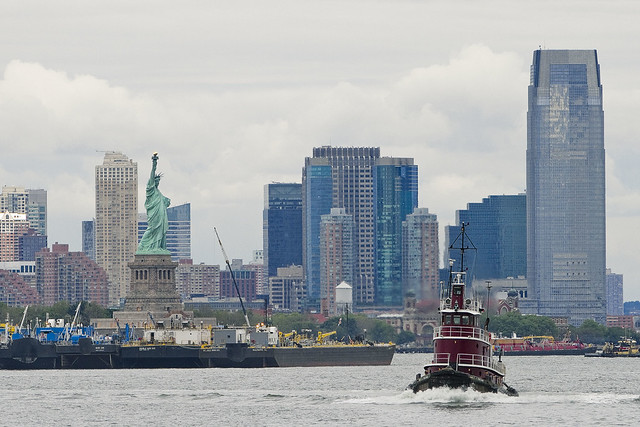
– photo by Mitch Waxman
The Marie J. Turecamo tug presented itself to a humble narrator recently, framing iconic views of the harbor for your perusal on this week’s “Maritime Sunday”. Periodically, when some magazine art buyer or advertising stalwart is looking for a harbor shot, my phone will ring and someone will ask for “a tugboat moving past the Statue of Liberty” or something similar. Invariably, the caller is seeking out free usage of the shot.

– photo by Mitch Waxman
Other photographers get angry with me when I allow free usage of this shot or that to various personages or groups, accusing me of devaluing the craft. “Information wants to be free” is my normal reply, and “an image too dearly held has no intrinsic valuation” is the follow up. This is when I’m called a schmuck, and informed that I’m being “taken advantage of”. Allow me to set the record straight on this subject, lords and ladies.

– photo by Mitch Waxman
A regular beneficiary of my largesse, whether it be the estimable Working Harbor Committee or the Newtown Creek Alliance or any of the other “worthy” harbor groups whom I regularly supply images to, receives a limited license to the photo. They cannot, for instance, use my shots in a manner which I haven’t specified or agreed to- web usage versus printed material. A byline is required, and if at any time I decide to ask them to pull the shot, this is my right as I’m retaining the image copyright and full usage rights. In advertising lingo, the shots are offered and licensed as “stock”, and the compensation asked for use of them is somewhat asymmetrical and seldom monetary.

– photo by Mitch Waxman
What I’m ultimately after is photographic access to people, places, and situations which are normally unattainable. I’ve been inside the Manhattan Bridge, walked on a Queensboro bridge completely devoid of traffic, been privy to dozens of situations that “press” photographers would have killed to get near. I’ve been to off limits spots all around the harbor, delved into the deepest recesses of the City, ascended to unattainable and high vantages, and seen things that most living New Yorkers barely suspect. If a group is doing something worth doing, as in the case of WHC with its education programs and senior citizen programming, or NCA’s quest to save the Newtown Creek from sophistry- I’m happy to donate the usage of a few images. On the other hand, if you see something you’d like a print of, or would like to license an image or two for commercial usage- contact me here.
Not exactly Project Firebox, but…

– photo by Mitch Waxman
Op Sail 2012 coincided with the annual Fleet Week event this year, and the John J. Harvey fireboat was there to greet everyone to its home port. Storied, the Harvey is no fire alarm box of course, but I just really dig this shot. The odd lighting was caused by a hole in the clouds which magically appeared over the Hudson just as the event was kicking into high gear, which lends a cinematic quality to the image.
Cue “flight of the valkyries”.
vast enclosure

– photo by Mitch Waxman
When you cut things down to the bone, and ask yourself the question “Who was the New Yorker that most profoundly changed the City?” it always comes back to one fellow. Ray Kelly or Mike Bloomberg would vie for the crown in modernity, in the long view of history Alexander Hamilton, DeWitt Clinton, Boss Tweed, or the Roebling clan have major claims on the title. Robert Moses would tell you that it was himself, and arguably, so would Osama Bin Laden.
In the opinion of a humble narrator, the crown belongs to one man- a Swedish immigrant named Othmar Ammann, and today is his birthday.
from wikipedia
Othmar Hermann Ammann (March 26, 1879 – September 22, 1965) was a American structural engineer whose designs include the George Washington Bridge, Verrazano-Narrows Bridge, and Bayonne Bridge.

– photo by Mitch Waxman
Brooklyn Bridge has the fame, Williamsburg Bridge the infamy, Manhattan Bridge is overlooked. The bridges of Othmar Ammann, however, are the ones which shaped the modern megalopolis and allowed the expansion and diaspora of New York’s laborers from the tenement neighborhoods of the five boroughs to the suburban satellites of modernity. The vast populations of Long Island and New Jersey and Westchester who commute into the city on a daily basis would have never achieved their current size, were Ammann removed from the story.
As a side note, and just to toot my own horn for a moment, the shot above was published last year in the New York Times- check it out here
Also from wikipedia
Othmar Ammann designed more than half of the eleven bridges that connect New York City to the rest of the United States. His talent and ingenuity helped him create the two longest suspension bridges of his time. Ammann was known for being able to create bridges that were light and inexpensive, yet they were still simple and beautiful. He was able to do this by using the deflection theory. He believed that the weight per foot of the span and the cables would provide enough stiffness so that the bridge would not need any stiffening trusses. This made him popular during the depression era when being able to reduce the cost was crucial. Famous bridges by Ammann include:
- George Washington Bridge (opened October 24, 1931)
- Bayonne Bridge (opened November 15, 1931)
- Triborough Bridge (opened July 11, 1936)
- Bronx-Whitestone Bridge (opened April 29, 1939)
- Walt Whitman Bridge (opened May 16, 1957)
- Throgs Neck Bridge (opened January 11, 1961)
- Verrazano Narrows Bridge (opened November 21, 1964)

– photo by Mitch Waxman
Othmar Ammann was a bit of an artist, his bridges achieving a rare thing for engineering projects, which is the elevation of a functional structure to the sublime. A prevailing theory in fine art and graphic design which emerged in the 20th century is “less is more”, and Ammann’s spans are manifestations of this concept in steel and cement.
from smithsonian.com
By the early 1960s, when the George Washington’s lower deck was added (as specified in the original plans), Ammann had all but eclipsed his mentor. Ammann’s other 1931 creation, the Bayonne Bridge connecting Staten Island and New Jersey, was until 1977 the world’s largest steel arch bridge — more than 600 feet longer than the previous record holder, Lindenthal’s Hell Gate Bridge.
Months before his death in 1965, Ammann gazed through a telescope from his 32nd-floor Manhattan apartment. In his viewfinder was a brand-new sight some 12 miles away: his Verrazano-Narrows suspension bridge. As if in tribute to the engineering prowess that made Ammann’s George Washington Bridge great, this equally slender, graceful span would not be surpassed in length for another 17 years.

– photo by Mitch Waxman
Eclipsed by the vain and power seeking during his sunset years, Ammann is one of the forgotten few who crafted the connections between the individual components of the archipelago islands of New York Harbor. Mighty Triborough or the graceful arch of the Bayonne Bridge speak to his sense of esthetic, and indicate that he was in touch with some higher imperative than merely moving automobiles from one place to another.
from nytimes.com
His works soar above the water, spanning the city’s rivers and connecting New York to the rest of the country. But who has heard of Othmar H. Ammann?
Donald Trump hadn’t, at least not back in 1964 when he was a high school student and his father took him to the dedication ceremony for the Verrazano-Narrows Bridge. ”It was a sad experience,” Mr. Trump recalled. ”For years, various politicians had fought the bridge. Now that it was built, I watched as these same people all got up and took credit for it, congratulating themselves and introducing one another. The only one not introduced was the man who made the bridge, Othmar Ammann.
chill currents

– photo by Mitch Waxman
Gaze in terror at the ice breaking tug Morro Bay, stalwart arm of the United States Coast Guard, as it maneuvers about the Hudson River. In terror that is, if you mean harm to the mariners or coastlines of the United States. It is maritime Sunday at the Newtown Pentacle once more, and this time around it’s a Coast Guard vessel in the spotlight.
from uscg.mil
USCGC MORRO BAY (WTGB-106)
Abstract
The USCGC MORRO BAY was commissioned 28 March 1981 at the Reserve Training Center in Yorktown, VA and served here until 1998. The MORRO BAY was the sixth of her kind in the Coast Guard. While stationed at Training Center, the MORRO BAY was involved in training and operations on the Chesapeake Bay. The MORRO BAY is currently home ported in New London, CT.
Ship’s History
The 140-foot Bay-class Cutters are state of the art icebreakers used primarily for domestic ice breaking duties. They are named after American Bays and are stationed mainly in Northeast U.S. and Great Lakes. Although specifically desinged for ice breaking duties, they also perform law enforcement, environmental protection, search & rescue operations and support for aids to navigation activities.
WTGBs use a low-pressure-air hull lubrication or bubbler system that forces air and water between the hull and ice. This system improves icebreaking capabilities by reducing resistance against the hull, reducing horsepower requirements.

– photo by Mitch Waxman
While researching this post, an interesting factoid about the Coast Guard emerged: the hull colors of Coast Guard vessels indicate their missions. Black hull- aids to navigation, White hull- maritime law enforcement and other safety-at-sea missions, Red hull- icebreaking.
Who knew?
Of course, the “Response Boat Medium” and “Response Boat Small”– both “SafeBoats“- are orange hulled, but the color scheme indications I found at the Coast Guard website do not discuss this hue.
from uscg.mil
The 140-foot Bay-class Cutters are state of the art icebreakers used primarily for domestic ice breaking duties. They are named after American Bays and are stationed mainly in Northeast U.S. and Great Lakes.
140-foot WTGBs in Service:
- BISCAYNE BAY (WTGB 104) St. Ignace, MI
- BRISTOL BAY* (WTGB 102) Detroit, MI
- KATMAI BAY (WTGB 101) Sault Ste. Marie, MI
- MOBILE BAY* (WTGB 103) Sturgeon Bay, WI
- NEAH BAY (WTGB 105) Cleveland, OH
- MORRO BAY (WTGB 106) New London, CT
- PENOBSCOT BAY (WTGB 107) Bayonne, NJ
- STURGEON BAY (WTGB 109) Bayonne, NJ
- THUNDER BAY (WTGB 108) Rockland, ME

– photo by Mitch Waxman
The Morro Bay, like all members of its class, looks smart and sound. An attractive boat, it nevertheless looks pretty fast and capable. These shots were taken at the Metropolitan Water Alliance’s “Heroes of the Harbor” gala last fall, where Morro Bay was performing the sort of political or parade duty which occupies its time during warm weather. During the cold months, it’s tasked with weightier matters, as a front line warrior battling the winter, and as a life line for stranded mariners.
Greetings to the crew, a hearty thanks is offered for their service, sacrifice, and skill. Stay safe, and hopefully we’ll see you in the City again when it warms up.
from wikipedia
The United States Coast Guard (USCG) is a branch of the United States Armed Forces and one of the seven U.S. uniformed services. The Coast Guard is a maritime, military, multi-mission service unique among the US military branches for having a maritime law enforcement mission (with jurisdiction in both domestic and international waters) and a federal regulatory agency mission as part of its mission set. It operates under the Department of Homeland Security during peacetime, and can be transferred to the Department of the Navy by the President at any time, or by Congress during time of war.
Founded by Alexander Hamilton as the Revenue Cutter Service on 4 August 1790, it is the United States’ oldest continuous seagoing service. As of August 2009 the Coast Guard had approximately 42,000 men and women on active duty, 7,500 reservists, 30,000 auxiliarists, and 7,700 full-time civilian employees.
cryptical books

– photo by Mitch Waxman
Just to affirm that your humble narrator is a multi disciplinary geek, whose nerd credentials cross into multiple devotions and subjects, today’s post takes us to the Hudson River and specifically- Esopus Island. An unremarkable spit of rock sticking out of the water not far from Kingston, Esopus nevertheless is a touchstone for high weirdness.
If these shots were taken in 1918 rather than 2010- one would have seen a bizarre Englishman crawling along the shorelines painting “Do What Thou Wilt Shall be the Whole of the Law” and “Every Man and Every Woman is a Star” on the stony outcrops in red.
from wikipedia
Crowley began another period of magical work on an island in the Hudson River after buying large amounts of red paint instead of food. Having painted “Do what thou wilt” on the cliffs at both sides of the island, he received gifts from curious visitors. Here at the island he had visions of seeming past lives, though he refused to endorse any theory of what they meant beyond linking them to his unconscious. Towards the end of his stay, he had a shocking experience he linked to “the Chinese wisdom” which made even Thelema appear insignificant.

– photo by Mitch Waxman
The self proclaimed “Great Beast” himself, Aleister Crowley spent much of the First World War in New York City, and the wild speculations that he was acting as an agent of British Intelligence during this time just might hold some water. In 1918, that horrible man decided on a “great magical retirement” (he had run out of money and driven at least two women to alcoholism and madness), shaved his head, and borrowed a tent and canoe from one of the many friends whom he cuckolded.
Here’s an image from a postcard depicting Esopus Island in 1907. In his diaries, Crowley called it Oesopus.
from wikipedia
Aleister Crowley (/ˈkroʊli/ kroh-lee; 12 October 1875–1 December 1947), born Edward Alexander Crowley, and also known as both Frater Perdurabo and The Great Beast, was an influential English occultist, astrologer, mystic and ceremonial magician, responsible for founding the religious philosophy of Thelema. He was also successful in various other fields, including mountaineering, chess and poetry. In his role as the founder of the Thelemite philosophy, he came to see himself as the prophet who was entrusted with informing humanity that it was entering the new Aeon of Horus in the early twentieth century.

– photo by Mitch Waxman
Crowley arrived on the island with scant supplies, and was known to have made a trip back to New York at least once to secure needed items. Local farmers, concerned and curious about their new neighbor, brought comestibles to the odd fellow- a charming and neighborly Yankee tradition. Curiously, the hermit spent his time mediating and translating an ancient Chinese text for his own amusement.
Crowley reported that he experienced an epiphany here, something that would overshadow even his own mystical revelations. Which brings us back to H.P. Lovecraft. For two people who are never supposed to have met, Lovecraft and Crowley had a LOT of friends in common.
from dec.ny.gov
Atlantic sturgeon are the stuff of myth and legends. They are the largest fish to regularly inhabit the Hudson River, reaching 10-12′ in length and weighing in excess of 350 lb. They are a primitive-looking and wonderfully adapted estuarine creature belonging to an order of fishes whose evolutionary origins reaches back at least 100 million years. Sturgeon grow very slowly, taking as long or longer than humans to reach maturity, and rivaling us in longevity, surviving 50 years or more in the wild. The river channel around Esopus Island, up to 60 feet deep, is a known congregation area for adult Atlantic sturgeon.

– photo by Mitch Waxman
Supposedly-
It would seem that one of the simple Yankee farmers who brought Crowley food and provisions was one Paul Rhodes, who would later become a correspondent and friend of Mr. Lovecraft. Rhodes created the only contemporaneous cinematic adaptation of one of Lovecraft’s tales- “The Other Gods” which was screened just once in 1924 for Mdm. Blavatsky’s Theosophical Society.
This should be taken with a grain of salt, as I haven’t been able to find independent confirmation of this timeline and it might be modern imposture. Regardless, witness the short film at the links below- if you dare.


 The Newtown Pentacle