Archive for the ‘Citi Building Megalith’ Category
occasional indifference
It’s all so depressing.

– photo by Mitch Waxman
Not too much to report to you today, Lords and Ladies. The hermitage season has certainly seen me shooting a whole lot of macro shots of foodstuffs, but otherwise a humble narrator has been stuck in the house nursing a wounded shoulder and disabled right arm. Wish I could describe some outré tale about the infirmity, but just chalk it up to age, and the “pain squirrel.” One has hit that section of life wherein something hurts every day, and whichever branch of the bodily tree that the pain squirrel has decided to inhabit that morning is where you’ll find the offending sensation.
Aches and pains are just a part of life, like taxes and a lonely death, after all.

– photo by Mitch Waxman
The shoulder thing has been a “mofo” however. I’m right hand dominant, and unfortunately the limb that hand dangles off of is the affected one. My left arm is used as little more than a paper weight, and the right one has been nigh useless for about a week. If this sort of thing was occurring in my left arm, of course, I’d be in a hospital and under the care of a cardiologist. Saying that, this has little to do with the heart and circulatory system, instead it’s a pinched nerve which is slowly unpinching. Opiate pain medications were required just to accomplish a few hours of sleep when the condition first manifested, and one was forced to fashion himself a sling. Shoulder and tricep were dancing around unbidden within the skinvelope, my bicep muscle felt as if it was being eaten by a horde of beetles, and my elbow was reporting back to the brain that it had become hollow. Additionally, my wrist was of the belief that it had become packed in ice.
The dog was quite concerned, but she made a play to assume the alpha/dominar position in our household pack. What can I say, she’s a dog, that’s what they do when they sense weakness. In the case of my dog, of course, rebellion took the form of her staring at me while she “woofed.” Her play ended when Our Lady of the Pentacle got home, since we all know who’s really in charge around here.

– photo by Mitch Waxman
Accordingly, I’ve got zilch as far as new stuff to show you this week. Today, and for the next couple of days, it’s going to be shots from the archives – such as the twilight shot of the Sunnyside Yards above. Pain Squirrel and canid rebellion notwithstanding, the show must go on.
“follow” me on Twitter- @newtownpentacle
refuge open
Street photography, literally, in today’s post.

– photo by Mitch Waxman
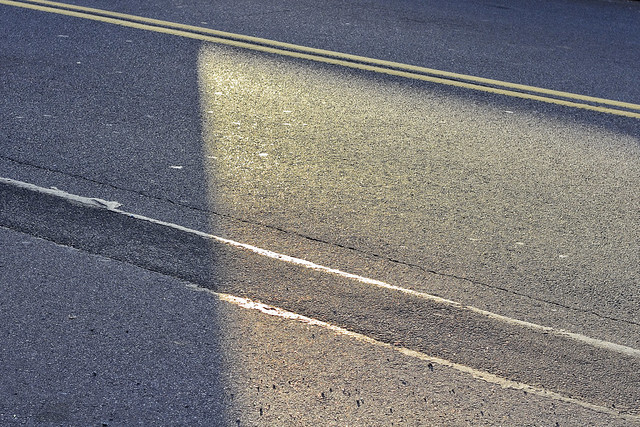
A humble narrator has been on a bit of a “notice everything” kick of late, which I imagine would translate into “normal person” as “by Jove, one is surrounded by things which have always been accepted but unquestioned.” Well, I guess that’s how normal people think, I wouldn’t know. One of the things I’ve gotten curious about lately are streets, and more specifically – the roadway itself. This has led me down a bit of a merry path, which has led to the realization that just about every road in NYC, the United States, and in fact the world is paved with industrial waste.
Elucidation follows, but first we need to discuss the development of the thoroughfare.
– photo by Mitch Waxman
Roads were originally created from the compaction of soil along trade routes in prehistoric times, and there were fairly common paths developed in Eurasia and Africa by around 10,000 BCE. The oldest stone paved road known to archaeology was built by the Egyptians, in roughly 2,300 BCE, although there are older “courdoroy” or log roads known (There’s a few in the UK which date back to around 4,000 BCE). Over on the Indian Subcontinent, streets were paved with brick as early as 3,000 BCE.
Famously, the Romans were bloody brilliant at building roads, many of which have lasted into modern times. Their system involved the excavation of a fairly deep trench, followed by the laying and tamping down of several feet of differing grades of stone into it, with the top layer formed from a series of carefully cut paving stones which were quite heavy. The bottom layers allowed for drainage, the top layer armored the structure while using the force of gravity to keep it in place. For about a thousand years, the Roman system (similar technologies were used in China, and amongst the Inca in South America) was the best you could really hope for.
The Europeans who colonized North America used crushed oyster shells and stones to form a road surface, and they mitigated the dust generated by horse and cart by using various forms of oil to hold the stuff in place. It wasn’t until the middle 18th century that roads became “modern” when a Frenchman named Pierre-Marie-Jérôme Trésaguet began working on carefully graded roads around Paris. Trésaguet was followed at the beginning of the 19th century by a Scot named Telford who created what modernity would refer to as “a cobblestone road” wherein the pavers were mortared in place using stone dust and gravel. Unfortunately, these methodologies used a tremendous amount of material, and required an enormous investment to lay the several feet of stone that was required for proper drainage and surface stability.
It was another Scot – John McAdam – who invented the precursor of the modern roadway, and his pavement came to be known as “Macadam.”

– photo by Mitch Waxman
Macadam roads wore tougher under carriage wheels, and were cheaper to build than “Telford’s”. Trial and error taught McAdam that a course of stones, broken up small enough and compacted by a heavy iron roller, would act as a solid mass if given proper drainage. It was perfect for horse and carriage, albeit a bit dusty. The roads of the industrial revolution era were generally paved in Macadam.
In 1902, a Swiss doctor named Ernest Guglielminetti hit upon the novel idea of using tar to coat the roads in Monaco. About twenty years later, an Englishman named Edgar Purnell Hooley patented a formula (in the UK and USA) which combined coal tar and blast furnace slag mixed into gravel and called his new product Tarmac, or Tarred Macadam. Tarmac became quite wide spread by the early days of the automobile, but by the late 1920’s the literal king of the road appeared and Tarmac went out of style.
Also, even by the beginning of the 20th century, physician and politicians alike began to realize that Coal Tar was a particularly unhealthy thing to loose upon the environment. Luckily, nothing bad had ever come out of the nascent petroleum industry.

– photo by Mitch Waxman
There are 42 gallons of crude oil in one of those shipping barrels which you always hear business people referring to. When the distillation process is complete, multitudes of chemicals are wrung out of it. 1.7% of every barrel ends up as a fairly inert form of tar which is referred to as “Asphalt or Road Oil.” Asphalt actually occurs naturally, and when it bubbled up out of the ground in historical settings, it was referred to as “pitch.”
Pitch was used for waterproofing the wooden joins on ships, inside buildings – anywhere you’d need a waterproof seal. It was also used as an incendiary for flaming arrows, and for boiling people you’d want to teach a lesson to. The British, and geologists, refer to naturally occurring Asphalt as “bitumen.” There’s natural lakes of the stuff to be found, notably in Trindidad/Tobago and it’s the tar you’ll find in the LaBrea Tar pits over on the left coast in Los Angeles.
The English were paving with Asphalt as early as the 1830’s, and in 1837 a fellow named Richard Tappin Claridge was granted a patent on a formulation for asphalt paving. Claridge’s company survived until the First World War, when it had just entered into a new venture to manufacture “Asphalted Macadam.”

– photo by Mitch Waxman
In New York City, modern day roads (with the exceptions of historic “Belgian Block” pavement, or the rare brick surface like Stockholm Street in Ridgewood) are paved with asphalted concrete. It’s a layer cake, according to the NYC DOT. There’s a base layer of gravel, which is covered by cement or concrete (which is sometimes reinforced with structural steel, depends of where it is and what the substrate is) which is armored by a top layer of asphalted concrete. Luckily, the roads in Queens are crappy, and on a recently replaced section of Northern Blvd. in Long Island City – you can see two of the layers surrounding a collapsing sewer drain.
It’s actually quite a thin crust, when you get down to it. This PDF at NYC.gov offers the “Materials” chapter of the DOT’s street design manual, and it covers the various approved road surfaces (sidewalks too) which you are encouraged to use in the City of Greater New York. It will tell you that, amongst other things, asphalted concrete is the most highly recycled substance in our municipality.
There is a “Green Asphalt” plant found in Blissville, at my beloved Newtown Creek, which is one of many facilities around the City which perform this sort of service. It seems that there is an economic, and practical, reason for placing these facilities within the City itself. Your “mix” needs to be within a certain distance of where you’re going to be laying it down, otherwise it begins to solidify and degrade in transit.

– photo by Mitch Waxman
Closer to home – my home at least – on Broadway in Astoria, a “trencher” was observed cutting its way through the street. You can see the layer cake of concrete and asphalt, and in the post which originally described the device – this one – your humble narrator reported that several largish chunks of timber were being brought to the surface along with the concrete and asphalt.
Broadway, in this section, is quite a complicated structure. The IND tracks of the R train are found at what’s probably 20-30 feet under the surface, which were constructing using the “cut and cover” method. There’s all kind of other stuff snaking around – sewers, utility tunnels, rat middens, etc. That means that the street is actually the uppermost section of a larger structure, meaning that if you fell down in the crosswalk – you’ve actually just landed on the roof of a building. As I mentioned above, how normal people think is a bit of a mystery to me.

– photo by Mitch Waxman
According to officialdom, 99% of Asphalt is recycled, and that 95% of the roads in the United States are paved with it. Asphalt pavement is rated according to the weather extremes it can withstand, and there are certain formulations designed for different climates. A different mix of tar and concrete is used for roads in Buffalo than those in NYC, for instance, due to climatological factors.
Engineers I’ve checked in with like the stuff – describing it as “easy to work with, and easy to repair.” It seems that a fresh laid bed of asphalted concrete is structurally a single unit – until something goes wrong under the surface or utility access requirements and repairs forces laborers to start cutting holes in it. That’s when the surface starts to flow, and pull, and crack. NYC is basically always working on one street or another – grinding, paving, laying new foundations. Given that a lot of the City sits on former wetlands, it’s a task best described as Sisyphean.

– photo by Mitch Waxman
So – back to the industrial waste part of things – according to a buddy who works as an Enviro-Cop, asphalt is actually a fairly benign substance as far as petroleum goes. Unlike other derivates, it’s environmentally stable once it has set. The recycling industry uses high levels of heat to release the bitumen from the concrete matrix, which allows it to be mixed in with a fresh batch of concrete and applied to a street. There’s all sorts of things which have, and still, get mixed into asphalted concrete. Although NYC claims its has never used the stuff on its roads, some have experimented with mixing in asbestos fibers, and or coal tar. Plastics collected by the recycling industry are often shredded and mixed in with the tar and concrete, as is glass. For a while, automotive tires were considered a good candidate for inclusion in the mix, but the cost of shredding steel belted rubber was too high. Routinely, fly ash from industrial furnaces is mixed in, along with all sorts of other stuff which would otherwise just fill up an ever shrinking square footage of municipal landfills and dumps. By the ton, the singularly largest part of the flow of NYC’s garbage involves the disposition of road construction waste. The fumes emitting from hot and freshly laid asphalt carry some risk, cancer wise, but the injuries most often associated with the material in its malleable form are laborers getting burned while working with it.
Regardless, it’s another one of the many byproducts produced by the petroleum industry. Remember, asphalt – which is found on nearly all of NYC’s 6,074 miles of roads and on 95% of the roads in the United States represents 1.7% of every barrel of crude oil sent to the refinery.
About half of that barrel will become gasoline.
According to the U.S. Energy Information: “In 2014, the United States consumed a total of 6.97 billion barrels of petroleum products, an average of about 19.11 million barrels per day. This total includes about 0.34 billion barrels of biofuels”.
Of course this beggars the question, a paradox actually, which asks: if 99% of asphalt is recycled, where’s all the freshly manufactured stuff going? 1.7% of 6.97 billion barrels of oil would suggest that the U.S.A. produces 118,490,000 barrels of fresh Asphalt (or road oil) per year.
“follow” me on Twitter- @newtownpentacle
impolite exclusions
It’s horrible to be me.

– photo by Mitch Waxman
Recent endeavor found me wandering amidst the Degnon Terminal in Long Island City during a light drizzle, which for one such as myself indicates that’s it’s time to start recording the things I see. Above, the off ramp of the Queensboro Bridge that doth feed traffic unto the Thomson Avenue Viaduct.
As I’ve stated in the past, NYC never looks as good as it does when it’s raining.

– photo by Mitch Waxman
I was on my way to attend a meeting for the group that’s sprung up around the abandonment of the Montauk Cutoff tracks by the MTA, a project which was described at this – your Newtown Pentacle – recently. The meeting of the so called “Cut off coalition” was taking place over in the former Waldes Koh I Noor complex in the Degnon Terminal, and since it was raining I used the subway to get there rather than my usual methodology of walking in pursuance of not getting drenched.

– photo by Mitch Waxman
The Degnon Terminal, just in case you’ve missed the thousands of times I’ve referenced it, is an industrial park which was built in the early 20th century by a fellow named Michael Degnon. Degnon and his team land filled a famously honerous swamp fed by Newtown Creek’s Dutch Kills tributary at around the same time that the Pennsylvania Railroad was busy building the Sunnyside Yards railroad complex. Degnon’s project took advantage of the yards, and provided for a “ship to rail” link at the head of Dutch Kills.
“Progress” was a pretty big concept back in the early 20th century, and the Degnon Terminal saw some of the first poured concrete mega structures in the United States rise from the reclaimed wetlands of LIC.

– photo by Mitch Waxman
Loose Wiles bakery, Eveready Battery, American Chicle and other large manufacturers based themselves here and provided tens of thousands of jobs, which drew the immigrant masses out of Manhattan and out to LIC and its environs. By the 1930’s, this section of LIC had become a vast industrial sector.
After the Second World War, when manufacturing in the northeastern United States began to decline, the buildings were left behind and nobody was quite sure what to do with them.

– photo by Mitch Waxman
In the early 1990’s, it was decided to demolish a hospital to make way for the new, and the Citi building megalith was erected. The first of the glass and steel skyscrapers in LIC, this malefic eidolon used to be a singular tower. That has changed in the last ten years, as multiple high rise residential buildings have risen around “court square.”

– photo by Mitch Waxman
Over on Pearson street off of Skillman, in the Degnon Terminal, the four building Koh I Noor complex found profitable life after splitting the property up amongst smaller tenants. The Waldes company manufactured milliners and tailoring supplies – it’s said that they invented the metal zipper, for instance. Warehouse businesses, printers, and small manufacturers have taken up residence here in the 21st century.
None of them utilize the rail, nor the maritime connections, and are instead truck based businesses.
“follow” me on Twitter- @newtownpentacle
circumstance which
Feasibility, in today’s post.

– photo by Mitch Waxman
As you’re reading this, in the filth choked furnace rooms and dark satanic mills of the NYCEDC, acolytes of the Real Estate Industrial Complex are working feverishly on the feasibility plan for the decking of the Sunnyside Yards. Syncopated, hammers are smashing out imperfections in the armor plating of their unholy works. Armies are at work, happily consuming the roughly two million dollars which have been allocated to their studies. At the end of the process, hordes of their making will emerge from the EDC’s subterranean vaults, proclaiming that a new order has been achieved, and all of New York’s problems will be solved by the fruits of their labor.
Housing will be made affordable, transit and other municipal services will be abundant and available, and the children of Queens will be assured a bright future. A great darkness will be conquered, and prosperity will spread through the land. In their keeps and towers will wizards and oligarchs rejoice, for Queens will be saved by those for whom the warren of lower Manhattan is a paradise.

– photo by Mitch Waxman
The grand obfuscation, of course, will arrive when the Mayor’s office announces that the feasibility study of the EDC has made recommendations that City Hall must follow. The inheritors of Tammany will omit the fact that the NYCEDC, or New York City Economic Development Corporation, is not some independent or autochthonous entity. Pretense that the board of the EDC is not composed entirely of political appointees from the Mayoral and Gubernatorial mansions, or that it’s ranking staffers are not in fact just awaiting their turn at either electoral or corporate fortune, will be offered.
Not mentioned either will be the fact that the current so called “Progressive” Mayor of New York City has merely adopted the policies and projects of a predecessor whom his fringe coalition demonized, and that the decking over of the Sunnyside Yards was and is the personal passion of Michael Bloomberg’s “aide de camp” Daniel Doctoroff.

– photo by Mitch Waxman
The coming of the darkness, an era when Sunnsyide will be referred to as “Shadowside” nears. One has been vocal about the opinion that sometime during the 21st century, at least some portion of the gargantuan rail yard found here in Western Queens will likely be decked over. The despoiled bureaucrats of Lower Manhattan have indicated to me, and others, that the decking will likely happen in three stages – a sort of creeping metastases which will begin with the section between LIC’s 21st street and Queens Plaza. This is the narrowest part of the Sunnyside Yards, incidentally, a part of the project which will be cheaper to accomplish than the sections abutting Northern Blvd. and Sunnyside.
During this last Summer, a meeting with the crew of loathsome sentience who are conducting the study began with a humble narrator slamming a box of donuts down on the table in front of them. I stated “when somebody comes to my house, I serve cake.” They did not know what to make of this, nor the unremitting hostility with which they were greeted. At one point during the meeting, I asked a high ranking member of the team to stop smiling, as it was freaking me out and there is absolutely nothing worth smiling about regarding this existential threat to the health and well being of Queens.
To their minds, the decking of the Sunnyside Yards represents a solution. To those of us who live in, and love, Western Queens – they are the coming of darkness and destruction, a barbarian horde sent to loot our communities and whose mission is to steal the sky and blot out the sun itself.
“follow” me on Twitter- @newtownpentacle
daytime pilgrimmage
Jackson Avenue, in today’s post.

– photo by Mitch Waxman
One has been watching the construction efforts underway at the former West Chemical site adjoining Queens Plaza for a while now. Building condominium towers in Queens Plaza is a questionable proposition, beggaring the question “who would really want to live in Queens Plaza?,” but the bigger one for me is “would you want to live on the former location of a chemical factory?.” I often remark to myself that the reason why the history of Queens is often so tough a nut to crack is the careful obfuscation of its past by the real estate industrial complex so as to preclude casual mention of the fact that so many of the new residential towers rising from Western Queens are in fact built atop such sites.
State and City officialdom call sites like these “brownfields,” which sounds a lot better than “toxic and irreversibly polluted” I guess. Just say “affordable housing” or “green infrastructure” and you’ll feel better about the whole thing.

– photo by Mitch Waxman
Brownfield remediation, or “opportunity area,” sounds a heck of a lot better at cocktail parties and let’s face it – lower Manhattan and North Brooklyn cocktail parties tend to grind into uncomfortable territory when you mention the environmental consequence of a century’s worth of industrial use. One would point out that at least the “powers that are” aren’t planning on putting a school on top of the old West Chemical site, but that brings up the uncomfortable subject of the infrastructure required to support a residential population being inserted into a former industrial zone, and the lack thereof, so that’s best avoided as well so as to not make the bond brokers skittish and derail the program.
It will not be conducive, condo sales wise, to mention all of those closed FDNY units or the frankly astounding conditions encountered at the centuried Queensboro or Ravenswood NYCHA projects, nor where the nearest hospital emergency room is located.

– photo by Mitch Waxman
The old “chickens coming home to roost” adage will likely be punching Western Queens in the nose some time in the late 2020’s – by my estimate. That’s when our trains will be running at (instead of near) capacity, our lack of school desks and hospital beds will be most apparent, and when the new populations installed in these former industrial corridors begin to organize – politically speaking. One wonders if these new populations will vote in as reliable and “party loyal” a fashion as the current residents do. Will the 20’s roar, or howl, for the Democrats?
The folks who can afford the so called “affordable housing,” rising from these “brownfields,” will they vote for a Democrat party candidate and continue the rule of the “Queens Machine” – or will they support somebody else who is a little more in tune with them socioeconomically? Only time, and a roll of the political dice, will tell.
“follow” me on Twitter- @newtownpentacle
Upcoming Tours –
July 12th, 2015
Glittering Realms Walking Tour
with Newtown Creek Alliance, click here for details and tickets.


 The Newtown Pentacle