Archive for the ‘Manhattan’ Category
May 21st

– photo by Mitch Waxman
The show must go on, as they say, yet your humble narrator is of heavy heart in announcing the Newtown Creek tour of May 21st, 2011- which is offered for your consideration by the Working Harbor Committee.
It is not the task of course, which tempers the normal ebullience experienced when an opportunity to share the wonders of the Newtown Creek with a group of enthusiasts from the comfort and safety of a modern vessel like the MV American Princess (which is outfitted with all the amenities one would expect to find during a harbor trip in a tourist Mecca such as New York City), crosses my path.
It is not that unnatural and uncontrollable timorousness which plagues me when I am asked to speak before “this group of pale enthusiasts” or “that gang of antiquarians”. Revealing and sharing the history of this amazing place is one the things I revel in, and brings me close to understanding what joy must be like.
from workingharbor.com
Visit Beautiful Newtown Creek Saturday, May 21, 2011
On MV American Princess, Boat departs from Pier 17, South Street Seaport, Manhattan NYC, 10am – 1pm
Souvenir Tour Brochure with historical information and vintage maps. Narration by experienced historical and environmental guest speakers. Complimentary soft drinks will be served. Come aboard for an intense Newtown Creek exploration! Our comfortable charter boat will travel the length of Newtown Creek. The tour will pause at many interesting locations for narration and discussion. Guest narrators will cover historical, environmental, and conservation issues. Large comfortable vessel with indoor & outdoor seating. Cruise runs rain or shine. Price: $60
To purchase tickets click here
or contact Tour Chairman Mitch Waxman: waxmanstudio(AT)gmail.com

– photo by Mitch Waxman
This is where the Industrial Revolution happened, and this trip will transverse and offer certain observations about the Newtown Creek’s present form and usage, and reveal a potentially bright future which this neglected ribbon of water- which provides the currently undefended border of Brooklyn and Queens- were it to be revitalized and renewed, might offer the future.
After boarding at South Street seaport, Working Harbor’s maritime experts will discuss the waterfront of Brooklyn as we pass beneath the Brooklyn Bridge and Manhattan Bridge, and finally passing under the Willamsburg Bridge. Our vessel will smoothly move past the neighborhoods of Dumbo, Williamsburg, and Greenpoint in Brooklyn, and offer spectacular views of Manhattan. This entire trip will be a photographer’s delight, incidentally, offering spectacular and unreal urban panoramas.

– photo by Mitch Waxman
At Long Island City, your humble narrator will presume to expose you to a short history of the Newtown Creek, and offer an identity to some of the enigmatic structures arrayed around the troubled industrial waterway.
Luckily for all concerned, there are other speakers who will relieve the crowd from my droning prattle, maritime experts and environmentalists included. Around Newtown Creek Alliance headquarters, there is some buzz amongst the staff about which one of the heavyweight orators will be onboard.
Soft drinks, one to a customer, will be complimentary as well.

– photo by Mitch Waxman
The American Princess will proceed past the titan Newtown Creek Waste Water Treatment Plant, the malign Dutch Kills, the cyclopean SimsMetal dock, the brutal symmetry of the Greenpoint Avenue Bridge, through the agglutinated heart of the Greenpoint Oil Spill, past the severed Penny Bridge at Meeker Avenue, and beyond the emerald devastations of Calvary Cemetery.
Then, we’re going to take a moment to remember our fallen friend… for just a moment.
I’m hesitant to mention this… as this is not what this trip is meant to be about, this is not a memorial event… but Bernie Ente is and will be so profoundly missed by many of us who will be conducting this tour, of which he is the originator and founder of… it would be in bad taste if a moment of silence to remember him, in this place which he expended so much of his attentions revealing and teaching and guiding about, were not offered. More on this in a later posting, but as the initial line says “the show must go on”, and that is exactly what Bernie would have us do.

– photo by Mitch Waxman
The course will continue, past the middle point of the Newtown Creek, and will plunge past the Maspeth Plank road, past the Phelps Dodge site and the Kosciusko Bridge. At the branching of the Newtown Creek which exists at the confluence of the East Branch and English Kills, we will witness the remains of the Maspeth Plank Road and approach the wicked end of the navigable section of the Newtown Creek itself and approach one the hydra like tributaries which spread languishing tendrils of rotting bulkheads and unused yet prime industrial waterfront locations all across Brooklyn and Queens.
This is not the world you know.

– photo by Mitch Waxman
Witness the startling elegance of the Grand Street Bridge, a century old swing bridge connecting Brooklyn and Queens, which signals the entrance to English Kills has been reached. Industrial heartland, this is a grossly contaminated section of the waterway which has- of course- been designated as a Federal Superfund site. Seeing the Newtown Creek in this state, this bizarre half life which is neither tick nor tock- industrial nor residential, is a fairly short term proposition.
Vast changes are coming which will literally alter the very landscape.

– photo by Mitch Waxman
The Kosciusko Bridge replacement, and the enormous new populations and residential conversion in progress and expected in Hunters Point South and Greenpoint, and the EPA conducting the initial stages of Superfund remediation (which will involve dredging and vast public works projects conducted by hundreds of contractors) will all be happening in roughly the same timeframe. Ten years from now, it will hard to recognize the place, and twenty more will render it a stranger to those who know it today.
In the English Kills, you will become transfixed by a waterfront frozen in some other century, and witness the extant vitality of those economies of heavy industry which build, and drain, and recycle, and dispose of. You don’t get Manhattan without a Newtown Creek, after all.

– photo by Mitch Waxman
We will proceed into the depths of English Kills near the Third Ward in East Williamsburg, Brooklyn. Our journey will cross the navigable sections of the Newtown Creek and begin it’s return journey to the Shining City of Manhattan and the South Street Seaport, leaving Greenpoint and Long Island City behind.
The plan for the return narration includes a full description and explanation of the Superfund situation by representatives of the Newtown Creek Alliance, and a return to Manhattan’s South Street Seaport. Personally, I’ll be at the bow during this part of the trip, as the photographic possibilities of moving languidly along the Creek with the sun behind us and illuminating both the creek lands and the Shining City as we smoothly speed across the East River beyond will be awe inspiring.
You haven’t experienced the Newtown Creek until you’ve sailed down it, and such a trip will disabuse you of viewing it with anything but wonder afterward. Simply, what is offered is a new perspective on the City of New York, one that less than 10% of New Yorkers have ever even heard of.

– photo by Mitch Waxman
Once again…
from workingharbor.com
Visit Beautiful Newtown Creek Saturday, May 21, 2011
On MV American Princess, Boat departs from Pier 17, South Street Seaport, Manhattan NYC, 10am – 1pm
Souvenir Tour Brochure with historical information and vintage maps. Narration by experienced historical and environmental guest speakers. Complimentary soft drinks will be served. Come aboard for an intense Newtown Creek exploration! Our comfortable charter boat will travel the length of Newtown Creek. The tour will pause at many interesting locations for narration and discussion. Guest narrators will cover historical, environmental, and conservation issues. Large comfortable vessel with indoor & outdoor seating. Cruise runs rain or shine. Price: $60
To purchase tickets click here
or contact Tour Chairman Mitch Waxman: waxmanstudio(AT)gmail.com
Cool Air

– photo by Mitch Waxman
One of the many startling things about H.P. Lovecraft’s unhappy life in New York, during which he suffered dire poverty, was that his favorite pass time seemed to have been wandering the streets tracking down antiquarian treasures- and He spent quite a bit of his time looking for artifacts of times gone by. Many of the locations mentioned in his fiction remain extant to this day, and sometime over the next couple of months your humble narrator will be journeying to Brooklyn to find the “Horror at Red Hook”.
Today, however, we’re on West 14th street in Manhattan- where “Cool Air” is set.
from wikipedia
The building that is the story’s main setting is based on a townhouse at 317 West 14th Street where George Kirk, one of Lovecraft’s few New York friends, lived briefly in 1925. The narrator’s heart attack recalls that of another New York Lovecraft friend, Frank Belknap Long, who dropped out of New York University because of his heart condition. The narrator’s phobia about cool air is reminiscent of Lovecraft himself, who was abnormally sensitive to cold.

– photo by Mitch Waxman
Lovecraft scholar S.T. Joshi has christened Kirk, Lovecraft, Long and a small group of others as “The Lovecraft Circle” and this is where they would meet up and carouse late into the night. In the 1920’s, this was a “Bachelor’s Boarding House”, and from the description of the modern establishment quoted below- it still is.
from chelseapinesinn.com
Chelsea Pines Inn is located in a five story walk-up row house that was built as a private home in the 1850s. In the 1980s, the building was transformed into a charming gay owned and operated hotel, where everyone has always been welcome. All guest rooms and common areas are decorated with original film posters from the Golden Age of Hollywood. Unique stores, galleries, restaurants, and clubs are within walking distance, and the world’s largest mass transit system is just a few steps away, so you can get anywhere in the city quickly and economically.
Originally built as a private home back when 14th Street was the northern end of the city, our building has gone through many exciting changes over the years. As the City grew around us it became a fashionable rooming house and was used as the setting in Cool Air, a short story about air conditioning, written well before air conditioning was invented, by the celebrated horror author H.P. Lovecraft. (Just as a note, Chelsea Pines Inn has central air.)
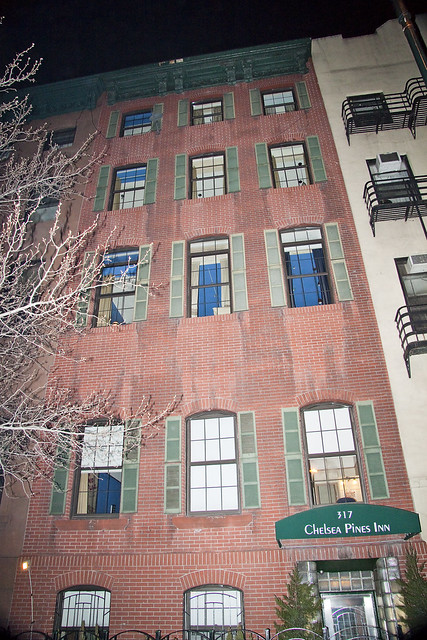
– photo by Mitch Waxman
The action in the story would have taken place on the third floor, where the narrator’s rooms were located. Dr. Muñoz would have been at the summit.
from H.P. Lovecraft’s “Cool Air”
It is a mistake to fancy that horror is associated inextricably with darkness, silence, and solitude. I found it in the glare of mid-afternoon, in the clangour of a metropolis, and in the teeming midst of a shabby and commonplace rooming-house with a prosaic landlady and two stalwart men by my side. In the spring of 1923 I had secured some dreary and unprofitable magazine work in the city of New York; and being unable to pay any substantial rent, began drifting from one cheap boarding establishment to another in search of a room which might combine the qualities of decent cleanliness, endurable furnishings, and very reasonable price. It soon developed that I had only a choice between different evils, but after a time I came upon a house in West Fourteenth Street which disgusted me much less than the others I had sampled.
The place was a four-story mansion of brownstone, dating apparently from the late forties, and fitted with woodwork and marble whose stained and sullied splendour argued a descent from high levels of tasteful opulence. In the rooms, large and lofty, and decorated with impossible paper and ridiculously ornate stucco cornices, there lingered a depressing mustiness and hint of obscure cookery; but the floors were clean, the linen tolerably regular, and the hot water not too often cold or turned off, so that I came to regard it as at least a bearable place to hibernate till one might really live again. The landlady, a slatternly, almost bearded Spanish woman named Herrero, did not annoy me with gossip or with criticisms of the late-burning electric light in my third-floor front hall room; and my fellow-lodgers were as quiet and uncommunicative as one might desire, being mostly Spaniards a little above the coarsest and crudest grade. Only the din of street cars in the thoroughfare below proved a serious annoyance.
first, Calvary

– photo by Mitch Waxman
Woe to that New Yorker who achieves our common societal goal, which is being always at the head of a long queue- first in line.
There isn’t much I can tell you about Esther Ennis, an Irish immigrant, other than she was the very first person buried in Calvary Cemetery in 1848. Intonations and rumors of a broken heart followed her to the grave, which seem to allude to a love affair gone wrong and conjure lurid fantasies of the port city of New York in the 1840’s. Unfortunately, no primary sources have emerged that discuss the young (for our modern era) woman.
On August 4, 1848, the new cemetery called Calvary Cemetery received its first interment, one Esther ENNIS. The purchase of this parcel of land and the acquisition over the years of over two hundred additional acres, enabled Calvary Cemetery to support the needs of most Catholics in the Archdiocese, especially in the New York City area.

– photo by Mitch Waxman
Quite obviously, this isn’t the original grave marker, its style and typography betray a 20th century vintage, and your humble narrator would wager that it was carved sometime in the 1920-1970 time period based on style and material. A half remembered and impossible to locate report from some forgotten publication once revealed that an Irish organization like the Hibernians (or was it a Catholic Charity of some stripe?) made it their business to place this marker on the presumed gravesite in Section 1 in First Calvary, but it doesn’t seem to have made it online so I may not supply a link to you- lords and ladies.
Regardless, this is one of Calvary Cemetery’s proverbial “needles in a haystack locations“, and is one easily bypassed by casual visitors to the great polyandrion.
from nytimes.com, an article from 1884 about Calvary’s first grave digger, John McCann
“Thirty-six years ago yesterday the first body was interred in Calvary Cemetery,” said John McCann, gatekeeper at the main entrance to the cemetery yesterday afternoon. “Yes, Sir, I remember it well. It was the body of Esther Ennis, a handsome looking Irish girl, who …

– photo by Mitch Waxman
The Manhattan address demarcated on the stone is 139 Clinton Street, which, presuming that the addresses on Clinton Street conform to the same logic as they did in 1848, should be here.
The following is one of the stitched panorama images which always present themselves awkwardly due to their odd shape. It’s an attempt to display the absolute magnitude of this spot, and the explosive growth of Calvary Cemetery from this exact location.
gazing back

– photo by Mitch Waxman
Following a friend around last week, I ended up in a shop on 9th avenue in Manhattan which sold all manner of spice and grain (as well as a few interesting cheeses and a nice variety of olives). Struck by the palette of flavor and the alien smell of unknown colors, I pulled out the camera and started shooting. Just a block from the “ass end” of the Port Authority Bus Terminal, this part of the City has always struck me as a mean section, rife with danger and lurking predators which frightens one who suffers from timidity- such as myself.
As I scanned the market, the spice began to work on me in the manner of some exotic drug, and your humble narrator’s thoughts began to whirl in the manner of a dervish…
from wikipedia
The spice trade is a commercial activity of ancient origin which involves the merchandising of spices, incense, hemp, drugs and opium. Civilizations of Asia were involved in spice trade from the ancient times, and the Greco-Roman world soon followed by trading along the Incense route and the Roman-India routes. The Roman-Indian routes were dependent upon techniques developed by the maritime trading power, Kingdom of Axum (ca 5th century BC–AD 11th century) which had pioneered the Red Sea route before the 1st century. By mid-7th century the rise of Islam closed off the overland caravan routes through Egypt and the Suez, and sundered the European trade community from Axum and India.
Arab traders eventually took over conveying goods via the Levant and Venetian merchants to Europe until the rise of the Ottoman Turks cut the route again by 1453. Overland routes helped the spice trade initially, but maritime trade routes led to tremendous growth in commercial activities. During the high and late medieval periods Muslim traders dominated maritime spice trading routes throughout the Indian Ocean, tapping source regions in the Far East and shipping spices from trading emporiums in India westward to the Persian Gulf and the Red Sea, from which overland routes led to Europe.
The trade was transformed by the European Age of Discovery, during which the spice trade, particularly in black pepper, became an influential activity for European traders. The route from Europe to the Indian Ocean via the Cape of Good Hope was pioneered by the Portuguese explorer navigator Vasco Da Gama in 1498, resulting in new maritime routes for trade.
This trade — driving the world economy from the end of the Middle Ages well into the modern times — ushered in an age of European domination in the East. Channels, such as the Bay of Bengal, served as bridges for cultural and commercial exchanges between diverse cultures as nations struggled to gain control of the trade along the many spice routes. European dominance was slow to develop. The Portuguese trade routes were mainly restricted and limited by the use of ancient routes, ports, and nations that were difficult to dominate. The Dutch were later able to bypass many of these problems by pioneering a direct ocean route from the Cape of Good Hope to the Sunda Strait in Indonesia.

– photo by Mitch Waxman
Lost in aromatic reverie and pedantic observations, the timeless nature and ubiquity of this sort of shop intruded rudely into my gentle musings. The presence of markets like this, with variegated imports from foreign lands presented gaily… Oh, the “historicity” of it.
After all, weren’t shops like this a large part of the original organizing principal behind cities, and the formation of what we call “civilization“?
from wikipedia
Some grains are deficient in the essential amino acid lysine. That is why a multitude of vegetarian cultures, in order to get a balanced diet, combine their diet of grains with legumes. Many legumes, on the other hand, are deficient in the essential amino acid methionine, which grains contain. Thus a combination of legumes with grains forms a well-balanced diet for vegetarians. Common examples of such combinations are dal (lentils) with rice by South Indians and Bengalis, dal with wheat in Pakistan and North India, and beans with corn tortillas, tofu with rice, and peanut butter with wheat bread (as sandwiches) in several other cultures, including Americans. The amount of crude protein found in grain is measured as Grain Crude Protein Concentration.

– photo by Mitch Waxman
Versions of this place have existed in every city in every time period since the beginning of the agricultural revolution, and trade in dried foodstuffs was the original economy. The comestibles offered here represent an enormous supply chain, as well, one which perverts the “feel good” concept of “organic” marketing. These “imported lentils from France” may satisfy some desire to be close to the earth, but they were shipped to Manhattan via a petroleum powered steel ship and delivered by a diesel truck.
In a lot of ways, the “greener” product would actually be found in a commercial supermarket, where a large conglomerate’s “economy of scale” can put food on the table spending far fewer “carbon dollars” and often at a significantly lower retail price- but that doesn’t sound good at cocktail parties.
from wikipedia
A pulse (Latin “puls”, from Greek “πόλτος” – poltos, “porridge” is an annual leguminous crop yielding from one to twelve seeds of variable size, shape, and color within a pod. Pulses are used for food and animal feed. The term “pulse”, as used by the Food and Agricultural Organization (FAO), is reserved for crops harvested solely for the dry seed. This excludes green beans and green peas, which are considered vegetable crops. Also excluded are crops that are mainly grown for oil extraction (oilseeds like soybeans and peanuts), and crops which are used exclusively for sowing (clovers, alfalfa). However, in common use these distinctions are not clearly made, and many of the varieties so classified and given below are also used as vegetables, with their beans in pods while young cooked in whole cuisines and sold for the purpose; for example black eyed beans, lima beans and Toor or pigeon peas are thus eaten as fresh green beans cooked as part of a meal. Pulses are important food crops due to their high protein and essential amino acid content. Like many leguminous crops, pulses play a key role in crop rotation due to their ability to fix nitrogen.
Just like words as “bean” and “lentil”, the word “pulse” may also refer to just the seed, rather than the entire plant.
of antique workmanship

– photo from “King’s views of New York City, A.D.1903” a public domain ebook courtesy Google Books

– photo by Mitch Waxman
Perusing the catalogs of historic photos which I routinely harvest from antiquarian sources such as the “google books” service over the holidays, I came across this image of the Stern Brothers store on 23rd street between 5th and 6th avenues in a 1903 photo survey of New York. For one reason or another, I’ve spent a lot of time marching up and down 23rd street and have always been curious about the structure (which currently houses a largish “Home Depot”).
from wikipedia
Stern Brothers was founded in 1867 by Issac, Louis and Benjamin Stern, sons of German Jewish immigrants. In 1867 they began selling dry goods in Buffalo, New York. From these humble beginnings the Stern Brothers became an important merchandising family in New York City.
In 1868 they moved to New York City and opened a one room store at 367 Sixth Avenue. In 1877 the store was again relocated to larger quarters at 110 West 23rd. Street. Outgrowing the store at 110 West 23rd. Street, Stern Brothers erected a new structure at the same location which became the new flagship store in 1878. It was noted for its cast-iron facade at 32 to 36 West 23rd. Street & 23 to 35 West 22nd. Street.
The building was designed by Henry Fernbach. It was enlarged according to a design by W.M. Schickel in 1892. The enormous, six story building was executed in the Renaissance Revival style. W.M. Schinckel’s typically 19th. century addition tripled the dimensions of the original structure on the eastern portion of the site. The tall central section of this addition animates the long and delicately detailed facade. The company’s monogram is still located above the central arch. (This structure is still in use today. The first floor houses a Home Depot, while the upper floors are showrooms.) The entire Sterns family worked in this store, which carried both luxury goods and merchandise the working classes. It was an elegant store noted for its fashionable clothes. Ladies from all over the city came to Stern Brothers for their Paris fashions. This enterprise was distinguished by its elegant door men in top hats and the generous and friendly service of the Sterns themselves.

A “longer” version of the same subject – photo by Mitch Waxman
On Tuesday, on my way to a client’s office on 23rd street to pick up a job, I made it a point of trying to find a similar vantage point to the one in the historic photo- although the 1903 version is clearly shot from the elevated landing of a staircase, or perhaps, the first story window of some long gone structure.
What remains in Manahattan these days is corporatized, commercialized, bland, and privatized- who would blame these stalwart titans of economic might for shunning and denying the requests of some shabby man with a camera who is unprofitably seeking the past?


 The Newtown Pentacle