Archive for the ‘New York Harbor’ Category
curious customs
– photo by Mitch Waxman
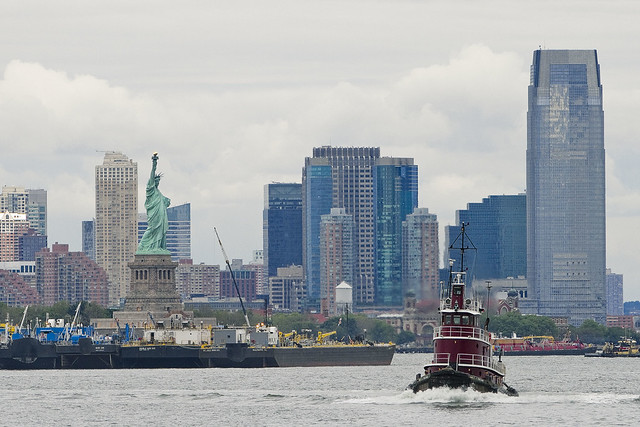
The Marie J. Turecamo tug presented itself to a humble narrator recently, framing iconic views of the harbor for your perusal on this week’s “Maritime Sunday”. Periodically, when some magazine art buyer or advertising stalwart is looking for a harbor shot, my phone will ring and someone will ask for “a tugboat moving past the Statue of Liberty” or something similar. Invariably, the caller is seeking out free usage of the shot.

– photo by Mitch Waxman
Other photographers get angry with me when I allow free usage of this shot or that to various personages or groups, accusing me of devaluing the craft. “Information wants to be free” is my normal reply, and “an image too dearly held has no intrinsic valuation” is the follow up. This is when I’m called a schmuck, and informed that I’m being “taken advantage of”. Allow me to set the record straight on this subject, lords and ladies.

– photo by Mitch Waxman
A regular beneficiary of my largesse, whether it be the estimable Working Harbor Committee or the Newtown Creek Alliance or any of the other “worthy” harbor groups whom I regularly supply images to, receives a limited license to the photo. They cannot, for instance, use my shots in a manner which I haven’t specified or agreed to- web usage versus printed material. A byline is required, and if at any time I decide to ask them to pull the shot, this is my right as I’m retaining the image copyright and full usage rights. In advertising lingo, the shots are offered and licensed as “stock”, and the compensation asked for use of them is somewhat asymmetrical and seldom monetary.

– photo by Mitch Waxman
What I’m ultimately after is photographic access to people, places, and situations which are normally unattainable. I’ve been inside the Manhattan Bridge, walked on a Queensboro bridge completely devoid of traffic, been privy to dozens of situations that “press” photographers would have killed to get near. I’ve been to off limits spots all around the harbor, delved into the deepest recesses of the City, ascended to unattainable and high vantages, and seen things that most living New Yorkers barely suspect. If a group is doing something worth doing, as in the case of WHC with its education programs and senior citizen programming, or NCA’s quest to save the Newtown Creek from sophistry- I’m happy to donate the usage of a few images. On the other hand, if you see something you’d like a print of, or would like to license an image or two for commercial usage- contact me here.
roving commission

– photo by Mitch Waxman
Lo, sigh heavily and behold- for once again it is Maritime Sunday at this, your Newtown Pentacle. This week, we’re focusing in on the DonJon Marine’s Sarah Anne moving (presumably) from Newtown Creek to the Port of Newark with a load of scrap metals. This is an oft repeated journey for the Tugs of New York Harbor, and offers quite an occupation.
from donjon.com
Since its incorporation in 1966, Donjon Marine has established and continues to seek long-term client relationships in a world where limited business resources demand a constant balancing of expenditures. Beginning with its foundation in the New York area as a pioneer in marine salvage services, Donjon has grown to become a leader in both conventional and environmental dredging. Its areas of expertise also include recycling, land and marine demolition, pollution control and remediation, heavy lift transport, marine transportation and landfill remediation/site management.

– photo by Mitch Waxman
The metals trade often comes up in these postings, partially due to my proximity to its center at Newtown Creek, and partially due to the wonder of it all. The claims which are made by those versed in macroeconomic and engineering circles is that the recycling process saves a lot of energy (and atmospheric emissions of concurrent gaseous pollution) from being used in the pursuit of new materials obtained via traditional mining and refining processes.
Click here for the Sarah Ann page at donjon.com, and get all her vital statistics

– photo by Mitch Waxman
Personal observation of the metal recycling process has shown, instead, the heaviest of machinery being operated at full throttle and spewing exhaust into the open air. The whole process is fed by trucks, barges, and vast ocean going ships whose journeys span continents.
Tremendous amounts of fuel, industrial machinery, and human labor are required.
from sname.marinelink.com
Donjon Marine, Co., Inc., a global marine services provider based in N.J., announced that Donjon has added the 2,700 hp twin screw tug Sarah Ann (ex-June K) to its expanding tug fleet. The 78 by 26 by 10.5-ft tug, with twin CAT 3512B diesels and a nine-ft draft, was built in 2003 by A&B Shipyard, Amelia, La. Designed principally for ship handling and assist work, barge towing and dredge assist, the tug’s draft is shallow enough to navigate the many creeks and estuaries throughout the Port of New York region.

– photo by Mitch Waxman
Often have I wondered how much is actually saved, environmentally, by the process. This is, of course, heresy to the environmental crowd. Any intellectual deviation from a political normative- such as “recycling is incontrovertibly good and has no cost”- even the act of questioning such logic, is met with disbelief and scorn.
Hey, I’m just asking.
Doesn’t sound good at cocktail parties in Manhattan, I guess.
from wikipedia
The scrap industry contributed $65 billion in 2006 and is one of the few contributing positively to the U.S. balance of trade, exporting $15.7 billion in scrap commodities in 2006. This imbalance of trade has resulted in rising scrap prices during 2007 and 2008 within the United States. Scrap recycling also helps reduce greenhouse gas emissions and conserves energy and natural resources. For example, scrap recycling diverts 145,000,000 short tons (129,464,286 long tons; 131,541,787 t) of materials away from landfills. Recycled scrap is a raw material feedstock for 2 out of 3 pounds of steel made in the U.S., for 60% of the metals and alloys produced in the U.S., for more than 50% of the U.S. paper industry’s needs, and for 33% of U.S. aluminum. Recycled scrap helps keep air and water cleaner by removing potentially hazardous materials and keeping them out of landfills.
June 30th, 2012- Working Harbor Committee Kill Van Kull walk

– photo by Mitch Waxman
My various interests out on the sixth borough, NY Harbor, have brought me into association with the Working Harbor Committee. A member of the group’s Steering Committee- I also serve as the “official” group photographer, am chairman and principal narrator of their annual Newtown Creek Boat Tour, and occasionally speak on the microphone during other tours (mainly the Brooklyn one). This year, the group has branched out into terrestrial explorations to compliment the intense and extant schedule of boat tours, and I’m going to be leading a Kill Van Kull walking tour that should be a lot of fun.
The Kill Van Kull, or tugboat alley as its known to we harbor rats, is a tidal strait that defines the border of Staten Island and New Jersey. A busy and highly industrialized waterfront, Working Harbor’s popular “Hidden Harbor – Newark Bay” boat tours provide water access to the Kill, but what is it like on the landward side?
Starting at the St. George Staten Island Ferry terminal, join WHC Steering Committee member Mitch Waxman for a walk up the Kill Van Kull via Staten Islands Richmond Terrace. You’ll encounter unrivaled views of the maritime traffic on the Kill itself, as well as the hidden past of the maritime communities which line it’s shores. Surprising and historic neighborhoods, an abandoned railway, and tales of prohibition era bootleggers await.
The tour will start at 11, sharp, and you must be on (at least) the 10:30 AM Staten Island Ferry to meet the group at St. George. Again, plan for transportation changes and unexpected weirdness to be revealed to you at MTA.info.
for June 30th tickets, click here for the Working Harbor Committee ticketing page
July 8th, 2012- Atlas Obscura Walking Tour- The Insalubrious Valley

– photo by Mitch Waxman
Newtown Creek Alliance historian Mitch Waxman will be leading a walk through the industrial heartlands of New York City, exploring the insalubrious valley of the Newtown Creek.
The currently undefended border of Brooklyn and Queens, and the place where the Industrial Revolution actually happened, provides a dramatic and picturesque setting for this exploration. We’ll be visiting two movable bridges, the still standing remains of an early 19th century highway, and a forgotten tributary of the larger waterway. As we walk along the Newtown Creek and explore the “wrong side of the tracks” – you’ll hear tales of the early chemical industry, “Dead Animal and Night Soil Wharfs”, colonial era heretics and witches and the coming of the railroad. The tour concludes at the famed Clinton Diner in Maspeth- where scenes from the Martin Scorcese movie “Goodfellas” were shot. Lunch at Clinton Diner is included with the ticket.
Details/special instructions.
Meetup at the corner of Grand Street and Morgan Avenue in Brooklyn at 11 a.m. on July 8, 2012. The L train serves a station at Bushwick Avenue and Grand Street, and the Q54 and Q59 bus lines stop nearby as well. Check MTA.info as ongoing weekend construction often causes delays and interruptions. Drivers, it would be wise to leave your vehicle in the vicinity of the Clinton Diner in Maspeth, Queens or near the start of the walk at Grand St. and Morgan Avenue (you can pick up the bus to Brooklyn nearby the Clinton Diner).
Be prepared: We’ll be encountering broken pavement, sometimes heavy truck traffic as we move through a virtual urban desert. Dress and pack appropriately for hiking, closed-toe shoes are highly recommended.
Clinton Diner Menu:
- Cheese burger deluxe
- Grilled chicken over garden salad
- Turkey BLT triple decker sandwich with fries
- Spaghetti with tomato sauce or butter
- Greek salad medium
- Greek Salad wrap with French fries
- Can of soda or 16oz bottle of Poland Spring
for July 8th tickets, click here for the Atlas Obscura ticketing page
July 22nd, 2012- Working Harbor Committee Newtown Creek Boat Tour
 |
 |
Many people know about the environmental issues facing Newtown Creek, but did you know that the Creek was once the busiest waterway in North America, carrying more industrial tonnage than the entire Mississippi River?
You’ll learn much more when Working Harbor Committee’s maritime historians and harbor experts
put it all in context during a Hidden Harbor Tours: Newtown Creek Exploration.
The heart of industrial New York, Newtown Creek was home port to hundreds of tugboats (one of which is the historic WO Decker). It was also an international destination for oceangoing ships and a vast intermodal shipping and manufacturing hub that employed hundreds of thousands of people. Forming the border of Brooklyn and Queens for nearly three miles, five great cities grew rich along the Newtown Creek’s bulkheads — Greenpoint, Willamsburg, Bushwick, Long Island City and Manhattan itself. The waterway is still a vital part of the harbor and the Working Harbor Committee (WHC) is proud to present this tour as part of the celebration of their tenth anniversary year.
Mitch Waxman, a member of WHC’s steering committee and the group’s official photographer, also serves with the Newtown Creek Alliance as its group Historian. In addition to working on WHC’s boat tours of the Creek, Mitch offers a regular lineup of popular walking tours, and presents a series of well-attended slideshows for political, governmental, antiquarian, historical and school groups. His website — newtownpentacle.com — chronicles his adventures along the Newtown Creek and in the greater Working Harbor.
He was recently profiled in the NY Times Metro section, check out the article here.
Upcoming tour: Hidden Harbor Tours: Newtown Creek Exploration.
On July 22nd, Mitch shares his unique point of view and deep understanding of the past, present and future conditions of the Newtown Creek as the narrator and expedition leader for this years Hidden Harbor Tours: Newtown Creek exploration.
Our NY Water Taxi leaves from South Street Seaport at 11 a.m. (sharp) on a three hour tour of the Newtown Creek. From the East River we’ll move into the Newtown Creek where we’ll explore explore vast amounts of maritime infrastructure, see many movable bridges and discover the very heart of the Hidden Harbor.
Limited seating available, get your tickets today.
 |
|||||||||||||||
|
|||||||||||||||


supposedly solid

– photo by Mitch Waxman
The DEP Pump House described in yesterday’s posting, which is located in Manhattan’s “Alphabet City” neighborhood, is found across the street from Con Ed’s East River Generating Station. Both facilities are, in turn, surrounded by vast residential complexes which long time New Yorkers might refer to as “The Projects“.
Governmental officials would prefer the term “affordable housing“, of course, or at the very least- “The Jacob Riis Houses”.
from wikipedia
The New York City steam system is a district heating system which takes steam produced by steam generating stations and carries it under the streets of Manhattan to heat, cool, or supply power to high rise buildings and businesses. Some New York businesses and facilities also use the steam for cleaning, climate control and disinfection.
The New York Steam Company began providing service in lower Manhattan in 1882. Today, Consolidated Edison operates the largest commercial steam system in the United States. The organization within Con Edison that is responsible for the system’s operation is known as Steam Operations, providing steam service to nearly 1,800 customers and serving more than 100,000 commercial and residential establishments in Manhattan from Battery Park to 96th Street uptown on the West side and 89th Street on the East side of Manhattan. Roughly 30 billion lbs (just under 13.64 megatons) of steam flow through the system every year.

– photo by Mitch Waxman
The subject of the post today has little to do with the aforementioned complex of buildings, they are mentioned strictly for contextual and geographic orientation of the Con Ed facility. My understanding is that this “cogeneration” facility is considered to be a desirable target to those ragged armies of third world sappers commonly referred to as “terrorists“, and several acquaintances and or friends have found themselves being interviewed by Police and Security personnel merely for having photographed the place.
from coned.com
In the grand tradition of the Jumbo dynamos, the six-story boilers installed at Fourteenth Street and East River were so large that a luncheon for nearly 100 people was served inside one of them before the renovated station went into operation in the late 1920s. During the opening day ceremony in 1926, Queen Marie of Rumania flipped the switch to start the 100,000 horsepower turbine generator.

– photo by Mitch Waxman
The view in the first two shots are from the East River, captured while onboard aquatic vessels, and the shot above is actually from the roof of the DEP Pump house.
The housing complex in the shot above is not true “public housing”, rather it is the Stuyvesant Town property. After the second World War, “urban renewal” projects such as the Riis Houses and Stuyvesant Town were seen as the answer to the endemic poverty found around and propagated by tenement slums. Funding and political impetus for large scale developments such as these- inspired by the ideations of a cryptofascist architect, LeCorbusier, and his disastrous “Tower in a park” conception- were made possible by both Federal and entrepreneurial sources.
Located on the east side of Lower Manhattan, the 43,000-sq.-ft. facility produces electricity and steam for homes and businesses throughout New York City. The project was completed May.
To repower the 360-MW power plant, the project team is performing all civil, structural, electrical and mechanical work, including the installation of major equipment, such as two GE Frame 7FA gas turbines, two Vogt-NEM, Inc. heat recovery steam generators and three Atlas Copco gas compressors. More than 100,000 lin. ft. of process pipe will be installed.
Construction of a new, onsite water treatment plant is also a part of the contract. The new treatment plant will consist of a 9,000 GMP reverse osmosis system that will produce pure water for steam generation. Electrical work includes the installation of 77,000 lin. ft. of conduit, 15,000 lin. ft. of cable tray, 665,000 lin. ft. of power and control cable and 30,000 electrical terminations.

– photo by Mitch Waxman
Historically, this area was known as the Gas House District, so named for an enormous number of multi story “high pressure” tanks and the hundreds of associated industrial buildings which serviced and supplied them. A network of pipes snaked out into Manhattan from the East River, supplying fuel to street lights, commercial customers, and even residences.
The adage “Don’t blow out the light” was displayed prominently in hotels and flop houses all over town during the 19th century, as newcomers to the City would often treat a gas light in the manner they would a candle- which would have disastrous, fatal, and often explosive results. The District followed the East River and extended from 14th to 27th streets.
The neighborhoods surrounding the Gas Light District was notorious for its violent crime.
from gsapp.org
Address: East 14th Street
Architect: Thomas E. Murray/Unknown
Date: 1926/1950s
The Consolidated Edison Company’s East River Generating Station dominates the eastern section of 14th Street, stretching from 13th and 17th Streets and between Avenue C and the East River. It was erected primarily in two phases, the first campaign completed in 1926 and the second in the 1950s. Because of its size and prominence, the East River Generating Station plays an important role in the history of the East River waterfront, as well as in the general evolution of power plant architecture in New York City. The widespread low-scale fabric of the Lower East Side, consisting mostly of tenement buildings, went generally unchanged for most of the nineteenth century and the early part of the twentieth century, while the rest of Manhattan was seeing the erection of skyscrapers and other tall buildings.
Driven by the increasing cost of power plant construction and the need to design “with an eye to the future,” the East River Generating Station of 1926 was designed to be less ostentatious than earlier stations that were typically of the Beaux-Arts Style, yet it was also less monolithic than contemporaries such as Hell Gate or Hudson Avenue Stations. The waterfront façade of this building was divided into three distinct bays in rectilinear form, a design scheme that allowed for easy expansion as need be. The building uses vertical fenestration and horizontal bands of limestone set within a field of dark red brick to give the façade a sense of visual excitement
mad spaces

– photo by Mitch Waxman
An upcoming walking tour, the Kill Van Kull walk for the Working Harbor Committee on June 30th, has called for repeated journeys to… Staten Island… to be undertaken by a humble narrator. Operations of the Staten Island Ferry make this possible, of course, and provide ample opportunity for the wandering photographer to gather interesting maritime shots.

– photo by Mitch Waxman
Goliath hulks like the fuel tanker in the shot above are commonly seen awaiting favorable tide or berthing around this boundary between Upper and Lower Harbors, but off in the distance is one of the true monsters of the sea.

– photo by Mitch Waxman
That’s the Dockwise Heavy Lift Ship Swan, which is basically a floating dry dock, and those are tugboats on its deck.
Far Eastern correspondent Armstrong, who has been writing the Working Harbor Committee blog for a while now, offered:
A heavy lift ship is designed to move large loads that can’t be handled by normally equipped ships. They are two types: semi-submerging – able to sink down into the water to lift ships and other heavy cargo onto deck for transport; and vessels that supplement unloading facilities at ports with inadequate equipment.
Swan is a semi-submersible heavy load vessel. The ship is 592 feet long (180.5m) and 105 feet wide (32.3m). The Swan’s massive deck is 416 x 103 feet (126.8m x 31.6m) and can handle a deck load of 56.616-20 tonnes/sq.m which translates to about 25,000 tons of heavy cargo.

– photo by Mitch Waxman
Apologies are offered for Image fidelity outside of the normal mean, but this ship was FAR away, and these are actual pixel, 100% pixel size and highly “cropped in” shots which represent less than a 10th of the total image originally captured. It was also kind of misty.

– photo by Mitch Waxman
Surprises like the Swan often lurk just off the shore of… Staten Island… The waters surrounding it provide egress to the cargo docks of Port Elizabeth Newark, especially the busy Kill Van Kull.
_______________________________________________________________________________
Also:
June 16th, 2012- Newtown Creek Alliance Dutch Kills walk (this Saturday)

– photo by Mitch Waxman
The Newtown Creek Alliance has asked that, in my official capacity as group historian, a tour be conducted on the 16th of June- a Saturday. This walk will follow the Dutch Kills tributary, and will include a couple of guest speakers from the Alliance itself, which will provide welcome relief for tour goers from listening to me rattle on about Michael Degnon, Patrick “Battle Ax” Gleason, and a bunch of bridges that no one has ever heard of.
for June 16th tickets, click here for the Newtown Creek Alliance ticketing page
June 23rd, 2012- Atlas Obscura Thirteen Steps around Dutch Kills walk

– photo by Mitch Waxman
Additionally- the “Obscura Day” Thirteen Steps around Dutch Kills tour proved that the efficacy and charms of the Newtown Creek’s least known tributary, with its myriad points of interest, could cause a large group to overlook my various inadequacies and failings. The folks at Atlas Obscura, which is a fantastic website worthy of your attentions (btw), have asked me to repeat the tour on the 23rd of June- also a Saturday.
for June 23rd tickets, click here for the Atlas Obscura ticketing page
June 30th, 2012- Working Harbor Committee Kill Van Kull walk
– photo by Mitch Waxman
My various interests out on the sixth borough, NY Harbor, have brought me into association with the Working Harbor Committee. A member of the group’s Steering Committee- I also serve as the “official” group photographer, am chairman and principal narrator of their annual Newtown Creek Boat Tour, and occasionally speak on the microphone during other tours (mainly the Brooklyn one). This year, the group has branched out into terrestrial explorations to compliment the intense and extant schedule of boat tours, and I’m going to be leading a Kill Van Kull walking tour that should be a lot of fun.
The Kill Van Kull, or tugboat alley as its known to we harbor rats, is a tidal strait that defines the border of Staten Island and New Jersey. A busy and highly industrialized waterfront, Working Harbor’s popular “Hidden Harbor – Newark Bay” boat tours provide water access to the Kill, but what is it like on the landward side?
Starting at the St. George Staten Island Ferry terminal, join WHC Steering Committee member Mitch Waxman for a walk up the Kill Van Kull via Staten Islands Richmond Terrace. You’ll encounter unrivaled views of the maritime traffic on the Kill itself, as well as the hidden past of the maritime communities which line it’s shores. Surprising and historic neighborhoods, an abandoned railway, and tales of prohibition era bootleggers await.
The tour will start at 11, sharp, and you must be on (at least) the 10:30 AM Staten Island Ferry to meet the group at St. George. Again, plan for transportation changes and unexpected weirdness to be revealed to you at MTA.info.
for June 30th tickets, click here for the Working Harbor Committee ticketing page
previously indifferent

– photo by Mitch Waxman
Despite excited anticipations- the main, backup, and double backup plans which I had so carefully concocted for photographing the Space Shuttle Enterprise on its journey up the Hudson to the Intrepid fell apart independently and left me with only terrestrial options for the point of view.
So many others would be photographing the installation of the grand device on the deck of the aircraft carrier from this common perspective that little value would have been achieved for me from this angle and it was decided to abort the mission. This is the price one pays for violating rule number one, which is “Make no assumptions”.
Apologies are offered to you, lords and ladies, for failing to deliver the goods.

– photo by Mitch Waxman
The shots presented instead are from the day before that heroic journey, depicting the spacecraft dangling over a barge at Weeks Marine in New Jersey on the Fifth of June. Happenstance had carried me out onto the water that day, as the estimable Working Harbor Committee was engaged in presenting three consecutive tours of the “Hidden Harbor”. The two trips during the day were the “Senior Tours” which are made possible by the Borough President of Manhattan, Scott Stringer.
These harbor tours offer a trip out on the sixth borough to the clientele of the various Senior Citizen Centers, and nearly a thousand people gather at the Circle Line annually to take advantage of the generosity and dispensation of Mr. Stringer.
Your humble narrator was narrating humbly, along with lead speaker Captain John Doswell.

– photo by Mitch Waxman
Three distinct passes were made past the Shuttle, two on the aforementioned Senior Tours, and the third on one of the “Hidden Harbor Sunset Tours” offered by the Working Harbor group (of which I am a member, and also serve on the Steering Committee). The Sunset Tours are spectacular, incidentally, and as summer is once more upon us- following a regular schedule of excursions.
Whenever we got close to the shuttle, the microphone was quickly handed to Capt. Doswell, and I raced to an opportune point of view to quickly crack out some shots.

– photo by Mitch Waxman
That expensive and rented Canon lens, which was mentioned recently, came in quite handy while attempting to get these shots. The extra clarity, sharpness, and reach it offered allowed me to get in quite close to the spacecraft- although I was physically the better part of a mile away.

– photo by Mitch Waxman
In those days before personal degeneracy and madness, when I was employed full time and on staff in the big leagues of the advertising industry, interesting opportunity often arose. When I announced that a holiday weekend trip to Florida was in the offing, during which I would be visiting an artist friend employed by the Disney corporation, a co worker asked if I would be interested in visiting nearby NASA.
Strings were pulled (I was working on a government account at the time), and soon Our Lady of the Pentacle and myself found were attending the NASA “diplomat tour”.

– photo by Mitch Waxman
An actual space shuttle engineer gave us a personal viewing and tour of the vast works of the space agency at the Johnson Space Center, and we encountered the space shuttle Atlantis in it’s “garage” and “up on the jacks”. Additionally, we were asked to don clean suits and entered the assembly room for the International Space Station as well as other hidden parts of the facility not normally shown to visitors.
Our visit was cut short as news that the USS Cole had been attacked spread through the installation, and NASA went into lockdown.

– photo by Mitch Waxman
The Enterprise has, of course, never been to space. Amongst the Shuttle fleet, it is sort of the “floor model”. It has done a lot of time in the air, as extensive studies of the aerodynamic properties and shape of the “space plane” have been carried out that altered the design of the later space going craft which followed it off the assembly line.
It now lives on 42nd street, on the west side, why not go have a look?
_______________________________________________________________________________
Also:
June 16th, 2012- Newtown Creek Alliance Dutch Kills walk (this Saturday)
– photo by Mitch Waxman
The Newtown Creek Alliance has asked that, in my official capacity as group historian, a tour be conducted on the 16th of June- a Saturday. This walk will follow the Dutch Kills tributary, and will include a couple of guest speakers from the Alliance itself, which will provide welcome relief for tour goers from listening to me rattle on about Michael Degnon, Patrick “Battle Ax” Gleason, and a bunch of bridges that no one has ever heard of.
for June 16th tickets, click here for the Newtown Creek Alliance ticketing page
June 23rd, 2012- Atlas Obscura Thirteen Steps around Dutch Kills walk
– photo by Mitch Waxman
Additionally- the “Obscura Day” Thirteen Steps around Dutch Kills tour proved that the efficacy and charms of the Newtown Creek’s least known tributary, with its myriad points of interest, could cause a large group to overlook my various inadequacies and failings. The folks at Atlas Obscura, which is a fantastic website worthy of your attentions (btw), have asked me to repeat the tour on the 23rd of June- also a Saturday.
for June 23rd tickets, click here for the Atlas Obscura ticketing page
June 30th, 2012- Working Harbor Committee Kill Van Kull walk
– photo by Mitch Waxman
My various interests out on the sixth borough, NY Harbor, have brought me into association with the Working Harbor Committee. A member of the group’s Steering Committee- I also serve as the “official” group photographer, am chairman and principal narrator of their annual Newtown Creek Boat Tour, and occasionally speak on the microphone during other tours (mainly the Brooklyn one). This year, the group has branched out into terrestrial explorations to compliment the intense and extant schedule of boat tours, and I’m going to be leading a Kill Van Kull walking tour that should be a lot of fun.
The Kill Van Kull, or tugboat alley as its known to we harbor rats, is a tidal strait that defines the border of Staten Island and New Jersey. A busy and highly industrialized waterfront, Working Harbor’s popular “Hidden Harbor – Newark Bay” boat tours provide water access to the Kill, but what is it like on the landward side?
Starting at the St. George Staten Island Ferry terminal, join WHC Steering Committee member Mitch Waxman for a walk up the Kill Van Kull via Staten Islands Richmond Terrace. You’ll encounter unrivaled views of the maritime traffic on the Kill itself, as well as the hidden past of the maritime communities which line it’s shores. Surprising and historic neighborhoods, an abandoned railway, and tales of prohibition era bootleggers await.
The tour will start at 11, sharp, and you must be on (at least) the 10:30 AM Staten Island Ferry to meet the group at St. George. Again, plan for transportation changes and unexpected weirdness to be revealed to you at MTA.info.
for June 30th tickets, click here for the Working Harbor Committee ticketing page


 The Newtown Pentacle