Archive for the ‘Greenpoint Avenue Bridge’ Category
curiously dissociated

– photo by Mitch Waxman
One presumes that it is merely part of the human condition to remember the bad rather than the good. War and the concurrent homefront is reminisced upon fondly, whereas peaceful spans are oft forgotten. Economic downturn, sickness and loss, even the Black Death are considered romantic. Pity abounds for the reputation of a place like Blissville, once a thriving bucolic community, which is remembered today as one of the darkest sections of the fabled Newtown Creek.
from wikipedia
Blissville is a neighborhood within Long Island City, in the New York City borough of Queens. It is bordered by Calvary Cemetery to the east; the Long Island Expressway to the north; Newtown Creek to the south; and Dutch Kills, a tributary of Newtown Creek, to the west. Blissville was named after Neziah Bliss, who owned most of the land in the 1830s and 1840s.


– photo by Mitch Waxman
Named for Neziah Bliss who -with Eliaphet Nott- founded the community in the early 19th century, Blissville was once what we would call “affordable housing” for the laborers of Newtown Creek. Sure, there were Europeans here since the 1600’s- in Maspeth and Hunters Point and in Brooklyn- but it wasn’t until the period right around the Civil War that things really kicked into gear around here.
from 1921’s Brooklyn Daily Eagle Almanac, Volume 36 – courtesy google books
NEWTOWN CREEK. Although less than four miles from its source, among the oil refineries of Blissville and Greenpoint, L. I., to ita mouth at the East River, Newtown Creek ia known as one of the “world’s busiest waterways.” The Mississippi River, from New Orleans to St. Paul, ia 1,” miles In length and flows through a great industrial and agricultural district. Recent figures show that 5,220,000 tons of cargo are carried annually on the upper and lower reaches of the longest river In the world, while the annual average of tonnage carried on the little four-mile Newtown Creek was 5,620,000.
Note: the bolded character in the quotation above resolves to something like 1,000 miles. the Mississippi has been significantly altered over the years.

– photo by Mitch Waxman
A chance encounter with a local historian of some note resulted in a critique of recent statements made by your humble narrator on this subject, (asserting that industry arrived here in force during the 1870’s) and he reminded me that there were industrial concerns operating in the area far earlier than even the arrival of Neziah Bliss. Tidal Grist mills, Lumber Yards, and the like were in these parts before the American Revolution, I will concede, and it is true that General Chemical, and M. Kalbfleish &Sons, and Peter Coopers Glue Factory were all well established along the Creek by 1840- all of which were early examples of the so called “Second Industrial Revolution” kicking into gear- it all depends on what you mean by “industry”.
from 1876’s Our dumb animals, Volumes 9-14 – courtesy google books
…an account of a visit of Mr. Bergh to certain stables attached to the distillery of Gaff, Fleischman & Co., at a place singularly named Blissville, on Long Island. Within the enclosure he found three immense stables, containing about nine hundred cows There was not a single door or window open, and the tainted atmosphere arrested the progress of all present Many cows were lying down, but the insufficient space necessitated their partly resting on one another. Dr. Raymond, Sanitary Superintendent of Brooklyn, says: “These animals never leave the stables, until, giving no more milk, and being- ‘ fattened,’ they are driven to the slaughter-house, contributing during life to the propagation of disease through their milk, robbing the inlant of its sole chance of life; and, alter death, furnishing diseased meat to nil consumers.”

– photo by Mitch Waxman
Master, apprentice, journeyman, mechanic- all of these terms had far different meaning in the past than they do today. So did the term “industrial”. Before the rail came through, and by rail I mean the Long Island Railroad- operations around the Creek were necessarily small. An employer of a hundred working men in 1800 would have been a tycoon, and the “factory” would have been no larger than a modern day primary school, and even then only the largest and most successful companies would have been so comfortably ensconced. After the rail came, something like Phelps Dodge or the Standard Oil works became possible- vast complexes of multi story structures, connected by rail tracks with bulkheaded docks, and chimneys belching smoke six to seven stories above the ground.
from 1879’s The Analyst, Volume 4 – courtesy google books
Sir,—In the month of February I made an official inspection of some cow stables, at a place called Blissville, on Long Island, which were connected with a distillery. Thinking that my investigations at that time might prove of some interest to yourself and other Public Analysts, I tako the liberty of writing you upon the subject.
At the time of my visit to the above stables there were between 700 and 800 cows in them, crowded into narrow stalls, to which they were fastened by a rope not more than three feet in length, which barely permitted them to lie down, but kept their mouths continually at a trough into which flowed the “swill” from the adjacent distillery in a steaming and fermenting condition.
Most of the animals were emaciated and feverish, and were affected with cough, diarrhoea, and polyuria. Some appeared to have recently arrived, and were in good condition. The temperature of several of the animals was noted, and ranged from 102° to 109°. The stable floors were kept all the time wet and slippery with excrementitious matters, and I did not see how it was possible for the cows to be milked and prevent the surrounding filth from splashing into the milk.
These poor creatures, crowded together within low sheds, with insufficient food, imperfect or no moans of ventilation, no exercise, no pure water to drink, and breathing an atmosphere poisoned by the exhalations from their wretched bodies, their excretions, and the steaming and fermented food, are expected, under these conditions, to secrete milk fit for human consumption.

– photo by Mitch Waxman
The vast populations of the five great cities around the Creek- Williamsburg, Greenpoint, Maspeth, Hunters Point, and New York- were made possible by the vast industrial mills which arrived in the middle and latter half of the 19th century. Those self same mills are what ended up staining the reputation of Blissville in the historic record. Any attempt to describe its homes, schools, and churches is overshadowed by the tales of pneumatic cattle, wormy pigs, bad air, and mountains of rotting offal. Pity poor Blissville, a place whose name brings a wry and ironic smile to the face of modern visitors. It was once a beautiful place to live.
from 1884’s Annual report of the State Board of Health of New York – courtesy google books
The stench nuisance next in the series along the main trunk of the Long Island railroad consists of and is located at and near the old distillery and yeast factory recently known as Gaff & Fleischmann’s, and now controlled by an ownership and superintendent mentioned in the inspector’s list. It has long been an insufferable nuisance because of the “swill-like odor of the mash,” and still more, because of the fact that the cattle stables on the right alongside the railroad track are reeking with semi-liquid filth (see page 12 of report marked C).
The next in the series is Preston’s bone-boiling, bone-burning and fertilizer establishment where the “web scrap,” horse-flesh, entrails and other putrescent matters from numerous fat rendering factories are stored in great quantities, and where bones and refuse flesh and waste “clippings” from the markets and elsewhere are boiled in kettles that are not kept suitably covered, which necessarily pollute the atmosphere to a considerable extent beyond the premises, which are located close along the south side of the Long Island railroad track. The business of calcining the bones obtained in the business just mentioned, and from other sources, is carried on at Preston’s factory, and is a source of very offensive stenches which extend along the line of the railroad for half a mile or more. This factory being a branch of the fertilizer factory owned by the same persons and situated near Keyport, N. J., much of the storage as well as mixing of materials for the latter establishment is carried on at this place in Blissville, and at times is the source of exceptional offensiveness.
Next is the place of John Kehoe, situated near Preston’s and the distillery above described. He boils fat in open kettles.
Reid’s fertilizer factory is next in order as we proceed eastward upon the north bank of Newtown creek. Superphosphate fertilizer is made by the use of sulphuric acid upon scrap and the phosphate rock of South Carolina.
Though the offensive odor does not extend a great distance, and probably is offensive to only railway passengers and along the line of the railway, the business is too offensive to be long permitted to remain close by the side of a great highway like that of the Long Island railroad.
Next in the series is the bone boiling establishment of Fred. Hoffner, who works with open kettles, giving off excessively offensive stenches.
Simon Steinfel’s rendering establishment, which is on Furman’s island in Newtown creek (and within the limits of Newtown), gives off very offensive emanations for a long distance in the course of the railway route. Great quantities of decomposing animal matters were found upon the premises in barrels and otherwise packed in readiness for rendering.
time convulsed

– photo by Mitch Waxman
As mentioned in yesterday’s posting, I spend an atrocious amount of time studying century old publications and journals found on google books. These periodicals, both trade and municipal in nature, often discuss the origins of the Newtown Creek as it exists today. At the beginning of the 20th century, when the Creek was at its arguable worst (environmentally speaking), there was a popular sentiment that engineering could fix all of its problems.
Hindsight suggests that they just made things worse, of course, but there’s the human condition for you. Pictured above is the Greenpoint Avenue Bridge in modernity, while below is the 1910 version.
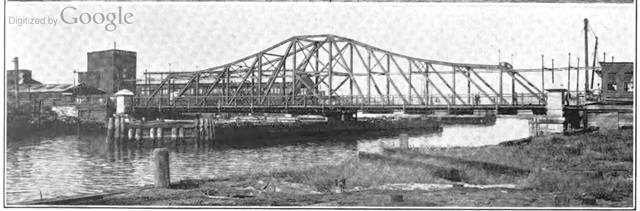
– photo from Engineering magazine, Volume 38, 1910- courtesy google books
This is the bridge that burned away in the 1919 Locust Hill Oil Refinery disaster, a swing bridge not unlike the relict Grand Street Bridge found further up the Creek. Whenever such “Now and then” shots come into my hands, especially images considered to be in the public domain- they will be eagerly shared at this- your Newtown Pentacle.
For more on the history of the Greenpoint Avenue Bridge and its environs, which I call DUGABO- Down Under the Greenpoint Avenue Bridge Onramp- click here
Also:

– photo by Mitch Waxman
An NCA event, which I for one am pretty stoked about:
April NCA meeting hosts Dr. Eric Sanderson
Thursday, April 26, 2012 at 6pm
Ridgewood Democratic Club, 6070 Putnam Avenue, Ridgewood, NY 11385
In addition to important updates from our members – in particular the Bioremedition Workgroup has been very busy! – we will be hosting a special presentation on the “Historical Ecology of Newtown Creek”.
Dr. Eric Sanderson, senior conservation ecologist at the Wildlife Conservation Society and author of “Mannahatta: A Natural History of New York City” (Abrams, 2009), will describe recent studies of the historical ecology of Newtown Creek, describing the original wetlands, creek channels, topography and vegetation of the area. He will show a series of 18th and 19th century maps of the watershed of the creek and discuss the process of synthesizing them into an integrated ecological picture that can be used to inform and inspire natural restoration and cultural appreciation of the Newtown Creek watershed. This work is part of the Welikia Project (welikia.org), an investigation into the historical ecology of the five boroughs of New York City and surrounding waters.
And this Saturday,

Obscura Day 2012, Thirteen Steps around Dutch Kills
Saturday April 28th, 10 a.m.
Your humble narrator will be narrating humbly at this year’s Obscura Day event on April 28th, leading a walking tour of Dutch Kills. There are a few tickets left, so grab them while you can.
“Found less than one mile from the East River, Dutch Kills is home to four movable (and one fixed span) bridges, including one of only two retractible bridges remaining in New York City. Dutch Kills is considered to be the central artery of industrial Long Island City and is ringed with enormous factory buildings, titan rail yards — it’s where the industrial revolution actually happened. Bring your camera, as the tour will be revealing an incredible landscape along this section of the troubled Newtown Creek Watershed.”
For tickets and full details, click here :
obscuraday.com/events/thirteen-steps-dutch-kills-newtown-creek-exploration
darkness and silence

– photo by Mitch Waxman
As mentioned in yesterday’s post, a humble narrator has been spending some time and effort in pursuit of filling in a lack of nocturnal photographs in my library of Newtown Creek shots. While in the midst of this on the Greenpoint Avenue Bridge, just last week, I heard the bells and whistles signaling the approach of a NY & Atlantic freight train.
The thing kind of snuck up on me, as my headphones were actively pumping out a carefully selected playlist of mid-career Motörhead. Lemmy Kilmeister, you must understand, is far louder than any mere locomotive.

– photo by Mitch Waxman
These are the sort of “night shots” which I’m trying not to get. High ISO, selectively focused, and overly grainy- all of which was actually unavoidable. Simply put, if you’re “hand holding” the camera and it’s dark, one must open the lens up- losing deep focus- and increase the “ISO sensitivity” of the camera, which introduces grain. Ideally, you’ve got the thing on a tripod, which I didn’t.
My other camera was set up with specialized night gear, but there was no way to get it set it up in time when surprised by the sudden appearance of the train.

– photo by Mitch Waxman
Out came my dslr, and with the help of a fortuitously placed hole in the fence of the GPA Bridge, the camera could be steadied and these shots were gained. This is probably not a terribly exciting tale to relate, but every photographer will understand my frustrations. Digital cameras are a technology still in infancy, and the form factor and capabilities of the things are still influenced by the shape and metaphor of older devices which used chemical emulsions (film) for recording.
One is reminded of 1960’s and 70’s televisions built into cabinetry it shared with “hi-fi” stereos, or clock radios. When will we forget the metaphor of a film camera and allow these devices to flower into their own?
singularly heavy

– photo by Mitch Waxman
So, nowadays one finds oneself hanging off bridges late in the evening attempting to capture “time exposures” after realizing that there aren’t all that many “night shots” in the library. Honestly, even I find this behavior suspicious, which is why there aren’t that many “night shots” in the aforementioned library. When the thermonuclear eye of god itself shines not upon the Newtown Creek is when a lot of the really “fun stuff” happens around these parts, only a small part of which involves a rodentine army which emerges and swirls out from hidden apertures in the concrete devastations.

– photo by Mitch Waxman
The first and second shots featured today are captured from the Pulaski Bridge, specifically the staircase which carries pedestrian traffic to Borden Avenue from the elevated path. The shot above looks toward Greenpoint with Manhattan behind it. The shutter was open something like eight seconds, which is why the water appears glassy and the artificial lighting of parking lot and lamp posts have taken on a star like halo. The halo is caused by the iris shutter mechanism within the camera, and is shaped by the blades of the device.

– photo by Mitch Waxman
The big problem I’m having with gathering this sort of material is actually the pedestrian nature of my movements. As automotive conveyance is a luxury which I currently do not enjoy, there are large sections of the Creeklands which I just don’t want to walk through at night. A vast physical coward and feckless quisling, the problems your humble narrator is experiencing are dual.
First- I am simply too meek and bookish to trust that the cruelty of the nocturne streets will leave me unmolested, and second- I fear that which may be revealed in the result. Who can guess what it is, that might march about the deserted industrial lowlands of the Newtown Creek when free from the tyranny of casual observation?
Project Firebox 38

– photo by Mitch Waxman
The ignominy of metallic pallor disguises this guardian of the public good as it hangs in vigil amongst the myriad ecstasies of Blissville in Queens. Deep below the cement and soil of this ancient village surge the ground waters of the Newtown Creek, and in nearby Greenpoint titan industries form the energy and wastewater backbone of New York City. Never quiet, Greenpoint Avenue is its home and the hoary byway is ennobled by its long and thankless service.


 The Newtown Pentacle