Archive for the ‘DUGABO’ Category
darkness and silence

– photo by Mitch Waxman
As mentioned in yesterday’s post, a humble narrator has been spending some time and effort in pursuit of filling in a lack of nocturnal photographs in my library of Newtown Creek shots. While in the midst of this on the Greenpoint Avenue Bridge, just last week, I heard the bells and whistles signaling the approach of a NY & Atlantic freight train.
The thing kind of snuck up on me, as my headphones were actively pumping out a carefully selected playlist of mid-career Motörhead. Lemmy Kilmeister, you must understand, is far louder than any mere locomotive.

– photo by Mitch Waxman
These are the sort of “night shots” which I’m trying not to get. High ISO, selectively focused, and overly grainy- all of which was actually unavoidable. Simply put, if you’re “hand holding” the camera and it’s dark, one must open the lens up- losing deep focus- and increase the “ISO sensitivity” of the camera, which introduces grain. Ideally, you’ve got the thing on a tripod, which I didn’t.
My other camera was set up with specialized night gear, but there was no way to get it set it up in time when surprised by the sudden appearance of the train.

– photo by Mitch Waxman
Out came my dslr, and with the help of a fortuitously placed hole in the fence of the GPA Bridge, the camera could be steadied and these shots were gained. This is probably not a terribly exciting tale to relate, but every photographer will understand my frustrations. Digital cameras are a technology still in infancy, and the form factor and capabilities of the things are still influenced by the shape and metaphor of older devices which used chemical emulsions (film) for recording.
One is reminded of 1960’s and 70’s televisions built into cabinetry it shared with “hi-fi” stereos, or clock radios. When will we forget the metaphor of a film camera and allow these devices to flower into their own?
singularly heavy

– photo by Mitch Waxman
So, nowadays one finds oneself hanging off bridges late in the evening attempting to capture “time exposures” after realizing that there aren’t all that many “night shots” in the library. Honestly, even I find this behavior suspicious, which is why there aren’t that many “night shots” in the aforementioned library. When the thermonuclear eye of god itself shines not upon the Newtown Creek is when a lot of the really “fun stuff” happens around these parts, only a small part of which involves a rodentine army which emerges and swirls out from hidden apertures in the concrete devastations.

– photo by Mitch Waxman
The first and second shots featured today are captured from the Pulaski Bridge, specifically the staircase which carries pedestrian traffic to Borden Avenue from the elevated path. The shot above looks toward Greenpoint with Manhattan behind it. The shutter was open something like eight seconds, which is why the water appears glassy and the artificial lighting of parking lot and lamp posts have taken on a star like halo. The halo is caused by the iris shutter mechanism within the camera, and is shaped by the blades of the device.

– photo by Mitch Waxman
The big problem I’m having with gathering this sort of material is actually the pedestrian nature of my movements. As automotive conveyance is a luxury which I currently do not enjoy, there are large sections of the Creeklands which I just don’t want to walk through at night. A vast physical coward and feckless quisling, the problems your humble narrator is experiencing are dual.
First- I am simply too meek and bookish to trust that the cruelty of the nocturne streets will leave me unmolested, and second- I fear that which may be revealed in the result. Who can guess what it is, that might march about the deserted industrial lowlands of the Newtown Creek when free from the tyranny of casual observation?
moderate size

– photo by Mitch Waxman
The news about the Queensboro Bridge Lamp Post broke into the larger City just the other day, and your humble narrator found himself being examined and interrogated by members of the news media.
That sounds worse than it actually was, they were all actually quite charming, but the abject self loathing which defines and informs my character is always a bit put out when dragged out into the light.
For the original postings about the thing, click here for “an odd impulse” and “wisdom of crowds“

– photo by Mitch Waxman
Standing exposed, in front of a possibly angry crowd of villagers, can carry severe repercussion for so onerous an individual as that one which stares at me from beyond silvered glass.
Really, it might have been best to just pretend that I missed the message, or was out of town. Of course, it has been years since I’ve left this city for even a single day, so zero efficacy would have met the claim. Whether it be bacchanal or shift work, the megalopolis has become an involuntary prison, and I’ve learnt to obey its whims.
Like a leaf, you, and free will is some cruel myth.

– photo by Mitch Waxman
This Sunday, as detailed in the blurb below, just such random chance will carry me to the Newtown Creek Waste Water Treatment Plant Nature Walk. There, in the radiated splendors of the Newtown Creek itself, shall gather the Newtown Creek Alliance for an Earth Day Celebration and BYO Picnic.
The public is invited, and encouraged to examine and explore a fabulous waterfront space which presents an unparalleled panorama of that legendary waterway, in the company of those who understand her mysteries best. Do join, don’t let my attendance hold you back, as I plan on holding to the shadows and lurking- in fear- away from crowds.
Also from newtowncreekalliance.org

– photo by Mitch Waxman
Earth Day BYO Picnic Lunch at the Newtown Creek Nature Walk
Sunday, April 22nd at 1 p.m.
Come join in for this casual celebration of the victory that is the Newtown Creek Nature Walk. Bring your own brown bag lunch and join the Newtown Creek champions who worked hard for years to win this unique waterfront park.
Sunday, April 22nd at the Newtown Creek Wastewater Treatment Plant Nature Walk between 1pm – 2pm.
Finally,

Obscura Day 2012, Thirteen Steps around Dutch Kills
April 28th, 10 a.m.
Your humble narrator will be narrating humbly at this year’s Obscura Day event on April 28th, leading a walking tour of Dutch Kills. The tour is already two thirds booked up, so grab your tickets while you can.
“Found less than one mile from the East River, Dutch Kills is home to four movable (and one fixed span) bridges, including one of only two retractible bridges remaining in New York City. Dutch Kills is considered to be the central artery of industrial Long Island City and is ringed with enormous factory buildings, titan rail yards — it’s where the industrial revolution actually happened. Bring your camera, as the tour will be revealing an incredible landscape along this section of the troubled Newtown Creek Watershed.”
For tickets and full details, click here :
obscuraday.com/events/thirteen-steps-dutch-kills-newtown-creek-exploration
strange corridors

– photo by Mitch Waxman
Staying current on the story of Newtown Creek involves attending a lot of meetings. Some are private, most public. Often, they came rapid fire and it feels as if every other evening is consumed. One of the many community groups which hold such gatherings is the Newtown Creek Monitoring Committee. I’m a guest at this particular gathering, and as such an attempt is made to remain silent and observe the proceedings.
The group engages in a dialogue with representatives of the NYC DEP, who are offered input from community representatives regarding issues that might arise from the presence of the Newtown Creek Waste Water Treatment Plant.
One of these issues, as you would imagine, is the spread of odors emanating from the vast facility.

– photo by Mitch Waxman
The DEP contract with a company, called “Odor Science and Engineering”, who specialize in the detection and discovery as well as elimination of point sources for malodorous gases. Luckily, an inspection of the plant by the company was scheduled for the following week and Christine Holowacz (DEP community liaison) arranged for a few of us to accompany the effort.
Pictured above is Kate Zidar (Newtown Creek Alliance Executive Director) and Laura Hoffman (Newtown Creek Monitoring Committee), who with myself, showed up bright and early to be fitted with hard hats and vests.

– photo by Mitch Waxman
We were introduced to Dr. Ned Ostojic Ph.D and P.E., Odor Science & Engineering’s Vice President & Director of Engineering.
A tall and dignified fellow, Dr. Ostojic spoke with a barely detectable yet pleasant European accent and was extremely hospitable to us as he described his function at the plant. An engineer, he was tasked with not only finding the sources of odor but describing practical solutions to eliminate them.

– photo by Mitch Waxman
Dr. Ostojic produced a device whose purpose was to combat a human perception bias called environmental adaptation. To describe it simply, the human mind filters out environmental stimuli to create a sense of “normalcy”. If you live on a noisy street, your brain filters out most of that noise and you become inured to the environmental background level. The brain functions in the same way with smell, something I know to be accurate. When I encounter the smell of the Newtown Creek, or of any sewer plant, no reaction is displayed while others openly gag.
My brain has become adapted to Newtown Creek.

– photo by Mitch Waxman
He asked us not to make fun of the devices name, which was a “Nasal Ranger”.
It allows calibrated measurement of smell based on a concentrating chamber which lies behind an aperture dial. The dial allows ever smaller samples to be inhaled into the device, which can then be graded on a subjective and numerical scale. Good science, don’t forget, is all about measurement and objective recording. The Nasal Ranger removes personal interpretation from data records, as its operators are trained according to an empirical standard.

– photo by Mitch Waxman
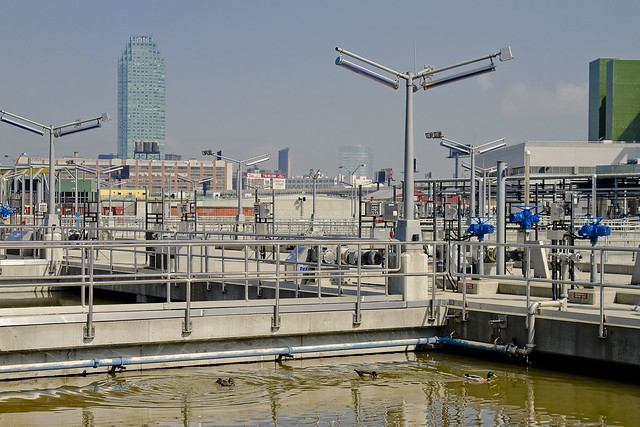
We three accompanied Dr. Ostojic on his walk through of the plant, and his duty this day was the inspection of the settling tanks which allow sewer borne debris to drop out, or be be skimmed from, the wastewater flow before it enters those famous digester eggs which distinguish this plant and betray its location on the skyline of New York City.

– photo by Mitch Waxman
Several times has your humble narrator been allowed to enter and record the grounds of this facility, found along the Newtown Creek, but this side of things has always been off limits because of extreme danger.
One of the curious facts related to me that day was that , were one of us to slip and fall into the highly aerated water and sewage in the tanks surrounding us, the liquid would not display much buoyancy. Because of all the dissolved gas in the liquid, neither would it slow your fall much and you would plummet- as if through air- some two stories to a hard cement floor.
In no uncertain terms, I was told, you would die. This was confirmed by one of my union buddies, who works at another plant in the DEP system.

– photo by Mitch Waxman
This is somewhere around midway through the sewage treatment process, after the larger bits of solute and debris carried in the flow have been removed. When the raw flow hits the plant, it carries wood and boxes and all sorts of garbage and debris with it. This gross matter is removed mechanically at another part of the plant. Next up is grit, which can be sand, soil, or just plain old coffee grounds. The rate of speed at which the wastewater races through the system makes even such innocuous contaminants hazardous to the works, and is removed by more specialized machines housed in separate “grit buildings”.

– photo by Mitch Waxman
Of course, nothing is perfect, and the job of these settling tanks is to skim off any floatable material which has evaded prior filtration. Fats, oils, and a surprising number of cigarette butts, tampon applicators, condoms, and other floatable material is seen at the collection side of the tanks. As they are open to the air, this is one of the spots which Dr. Ostojic regularly inspects and pays a great deal of attention to. He was constantly checking his readings and observations against the prevailing winds.

– photo by Mitch Waxman
Dr. Ostojic wasn’t alone for the inspection and was working with the fellow pictured above, who introduced himself as Gary Grumley. Mr. Grumley was working with a different detection device than Dr. Ostojic, a hydrogen sulfide detector.
Hydrogen sulfide, of course, is a colorless gas which is infamous for the fecund smell of decay commonly referred to as “rotten eggs”. Such emissions are responsible for a lot of community complaints, and are unfortunately part of the complex chemistry which accompanies the disposition of sewage.

– photo by Mitch Waxman
The device itself seemed sturdy, and Mr. Grumley arranged it neatly for photographing. He had begun work several hours prior to our arrival and began transmitting his findings and observations to Dr. Ostojic.

– photo by Mitch Waxman
A graphic map of the plant with its multitude of buildings, service areas, and zones was on Dr. Ostojic’s clipboard.
A running tally of various areas where an unexpected or intense odor was encountered had been kept, and each occurrence was registered with a numerical value or rating. We didn’t encounter anything truly horrible btw.
– photo by Mitch Waxman
An example was offered later in the day by the DEP’s Superintendent of the Plant, Jim Pynn, of Dr. Ostojic’s contributions.
It seems that a problem had developed around the hatches leading to an underground tank, cylindrical in shape, which had been located in a rectangular shaped shaft. An onerous odor was regularly emerging from the shaft, and Dr. Ostojic was called in. He determined that as wind passed over it, a venturi was forming in the space between the cylinder and the right angled walls which suctioned the tainted air from it’s enclosure and into the open air.
Dr. Ostojic’s simple solution, adding chevrons to the sides of the tank which would abort the formation of a vortex, saved the plant a costly redesign of the affected area. The smell stayed where it was meant to, as well.

– photo by Mitch Waxman
Dr. Ostojic was gracious and quite patient with us. A loving nickname for him, which is offered with wide smiles and a wink by those who work at the plant, is “Ned the Nose”.
Usually, when one is invited to attend a meeting at an industrial site in Greenpoint, Brooklyn- with someone named Ned the Nose- the encounter seldom turns out to be as pleasant as this was.

– photo by Mitch Waxman
Newtown Pentacle, we go these places so you don’t have to.
ALSO:
Your humble narrator will be narrating humbly at this year’s Obscura Day event on April 28th, leading a walking tour of Dutch Kills. The tour is already a third booked up, and as I’m just announcing it, grab your tickets while you can.
“Found less than one mile from the East River, Dutch Kills is home to four movable (and one fixed span) bridges, including one of only two retractible bridges remaining in New York City. Dutch Kills is considered to be the central artery of industrial Long Island City and is ringed with enormous factory buildings, titan rail yards — it’s where the industrial revolution actually happened. Bring your camera, as the tour will be revealing an incredible landscape along this section of the troubled Newtown Creek Watershed.”
For tickets and full details, click here :
obscuraday.com/events/thirteen-steps-dutch-kills-newtown-creek-exploration
Veneralia

– photo by Mitch Waxman
Technically speaking, this post is day late and a dollar short, as the holiday of Veneralia was traditionally observed by the Romans on April 1. Given the prankster traditions of our modern culture that revolve around the date, however, it was decided to run an acknowledgement of the holiday today- if the story of Troy has taught us anything, it’s “Don’t mess around with the Goddess of Love”.
from wikipedia
Venus was offered official (state-sponsored) cult in certain festivals of the Roman calendar. Her sacred month was April (Latin Mensis Aprilis) which Roman etymologists understood to derive from aperire, “to open,” with reference to the springtime opening of trees and flowers.
Veneralia (April 1) was held in honour of Venus Verticordia (“Venus the Changer of Hearts”), and Fortuna Virilis (Virile or strong Good Fortune), whose cult was probably by far the older of the two. Venus Verticordia was invented in 220 BC, during the last tears of Rome’s Punic Wars, in response to advice from a Sibylline oracle, when a series of prodigies was taken to signify divine displeasure at sexual offenses among Romans of every category and class, including several men and three Vestal Virgins.

– photo by Mitch Waxman
Veneration… the very root of the word comes from her name, this Roman deity named Venus. She wore many hats, and was worshipped in several aspects. The one which we at Newtown Pentacle HQ revere is the personification of Venus Cloacina, goddess of the main drain. Myrtle adorns the entranceway to that ceremonial room with ceramic tiles which we maintain, and rhyming prayers will be offered before a porcelain altar.
from wikipedia
In Roman mythology, Cloacina (Latin, cloaca: “sewer” or “drain”) was the goddess who presided over the Cloaca Maxima (“Great Drain”), the main trunk of the system of sewers in Rome. She was originally derived from Etruscan mythology. The Cloaca Maxima said to be begun by one of Rome’s Etruscan kings, Tarquinius Priscus, and finished by another, Tarquinius Superbus.
Titus Tatius, who reigned with Romulus, erected a statue to Cloacina as the spirit of the “Great Drain”. As well as controlling sewers, she was also a protector of sexual intercourse in marriage. Despite her Etruscan origins, she later became identified with Venus.

– photo by Mitch Waxman
Towering above the lowest point of New York City in Greenpoint, at the bottom of a geologic soup bowl (as it were), is the greatest temple of this goddess. If fancy strikes, as you drive along the BQE or traverse the streets of our ancient neighborhoods, remember to offer the ancient prayer:
“O Cloacina, Goddess of this place,
Look on thy suppliants with a smiling face.
Soft, yet cohesive let their offerings flow,
Not rashly swift nor insolently slow.
– courtesy sewerhistory.org
ALSO:
Your humble narrator will be narrating humbly at this year’s Obscura Day event on April 28th, leading a walking tour of Dutch Kills. The tour is already a third booked up, and as I’m just announcing it, grab your tickets while you can.
“Found less than one mile from the East River, Dutch Kills is home to four movable (and one fixed span) bridges, including one of only two retractible bridges remaining in New York City. Dutch Kills is considered to be the central artery of industrial Long Island City and is ringed with enormous factory buildings, titan rail yards — it’s where the industrial revolution actually happened. Bring your camera, as the tour will be revealing an incredible landscape along this section of the troubled Newtown Creek Watershed.”
For tickets and full details, click here :
obscuraday.com/events/thirteen-steps-dutch-kills-newtown-creek-exploration


 The Newtown Pentacle