Archive for the ‘DUGSBO’ Category
anonymous visitor
Bulkheads of the Newtown Creek, in today’s post.

– photo by Mitch Waxman
Last week, you saw a post about a Hindu statue found in a fairly obscure spot in Maspeth along the Newtown Creek at this, your Newtown Pentacle. Mentioned in that post, a couple of my Newtown Creek chums and I were out in a small boat and performing a bulkhead survey. What that means, and it’s something we Newtown Creek Alliance types do periodically, is that we do a close up observation of the armored shoreline. Armored is apt, as the Newtown Creek’s littoral zone is almost entirely covered in a variety of maritime structures which are referred to as “bulkheads.”
Some are designed for docking ships and boats, or tying up barges, others simply as barriers.

– photo by Mitch Waxman
Most of the shoreline along the Creek has lost its occupation over the last century, as business adopted a truck and automobile based model for shipping cargo. Lack of maintenance and the corrosive forces of nature have caused the bulkhead structures all over the Newtown Creek to decay. Some have collapsed. When a bulkhead has actually fallen apart, as seen above and below, it is considered to have become “habitat” by environmental officialdom.
Close inspection reveals what sort of life forms have taken up habitation in the cracks and fissures of what were once amongst the most valuable maritime bulkheads on Earth.
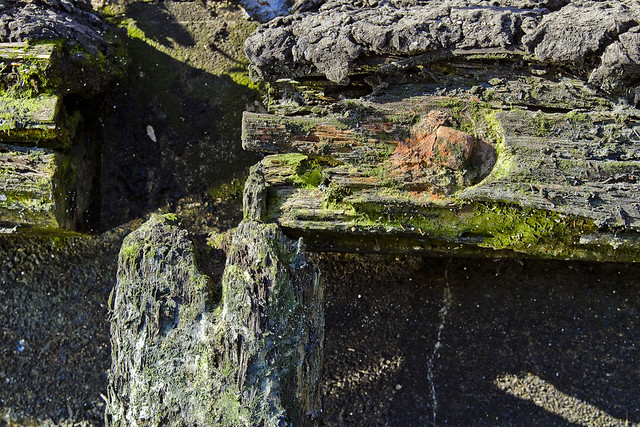
– photo by Mitch Waxman
All sorts of colony critters – lichens, molds, algae – are seen, for instance. They infest the flood zone, which is exposed and hidden by the tidal cycle. Wooden bulkheads along the Creek generally date back to the end of the 19th and beginning of the 20th centuries. This wood would have been treated with something like Creosote Oil to guard against infiltration by insects and smaller parasites. Creosote Oil was a by product of the gasification of Coal, one of the many, many commercial products which emanated from the pursuit of so called “Natural Gas.”

– photo by Mitch Waxman
A bit higher up in the tide line, and a rip rap shoreline. Rip Rap is basically a series of small boulders and large rocks which are dumped along shorelines. The good news about this sort of tidal liner is that it offers a tremendous amount of surface area for the aforementioned colony creatures to attach to, as well as macro organisms like barnacles, clams, and oysters to grab onto. The bad news is that there’s a lot of concrete included amongs the rocks and boulders, and as concrete decays the lime in it causes the water’s ph to rise and become acidic.
There’s also lots of “mystery pipes” that emerge from the shoreline hereabouts, as depicted above.

– photo by Mitch Waxman
The National Grid company, which operates an LNG distribution and storage operation at the former Brooklyn Union Gas Manufactured Gas Plant site in Greenpoint, doesn’t allow docking at its bulkheads. Accordingly, they erected a wooden shield all along the edge of their property. This sort of thing is actually a gigantic box driven into the mud that is filled with rip rap. The wooden planks provide ample attachment sites for colony critters and filter feeders.
This is a part of the Newtown Creek which is referred to as “The Turning Basin” and it is an engineered wide spot designed to allow a tug and articulated barge enough room and depth to be able to safely reverse course on the otherwise narrow waterway.

– photo by Mitch Waxman
A close up of a colony of Mussels attached to the National Grid bulkhead. One of NCA’s science people, a certain radical biologist, coined the term “Kidneys of the Creek” for filter feeders like this. Each mussel is able to process “x” number of gallons of water, and remove “y” amount of solute from it. Of course, this means that the Mussel itself becomes a concentrated blob of toxicity, but the sort of Mussels you commonly encounter on Newtown Creek aren’t the species which are part of the human food chain.
On the Creek, it’s the fish and crabs. The fish and crabs which people catch, and then eat, that they gather from Newtown Creek. Yes, you did just read that. The Federal EPA has confirmed this fact.

– photo by Mitch Waxman
You encounter masonry rising out of the water, which is capped by concrete, in many spots. This particular spot is about three miles from the East River. There are lots and lots of apertures in the shoreline here, and lightless chambers and flooded voids which recede beneath the “land’s” surface. The word “land” is in quotation as the area which touches the water, with just a few exceptions, was primevally a swamp or at best a flooded marsh. There is no true land, certainly on the Queens side, for a good half mile back from the present day shoreline. It’s all landfill, of the 18th and 19th century variety mainly – rubble, domestic and agricultural waste, ashes and cinders from furnaces and residential hearths. The areas around Grand Avenue, Maspeth Creek, and Dutch Kills, were largely reclaimed in the early 20th century and the ground is filled with more modern crap.

– photo by Mitch Waxman
Nearby the Maspeth Avenue Plank Road, Brooklyn side, a bulkhead of the same variety enjoyed by National Grid is in the process of collapsing and you can discern the internal structure of the thing. A creosote oil treated wooden box filled with rip rap. Self seeded, the plants you see are thorned and I can attest that those spikes will easily find your tender skin if you venture close enough.

– photo by Mitch Waxman
A little further to the west, on the Brooklyn side foundations of what was once called Penny Bridge, nearby the pipe which ExxonMobil returns water to the Creek which was extracted from their Greenpoint Oil Spill remediation efforts. I cannot tell you why anybody decided to hang razor barbed wires from bits of cord, but this improvised filtering technology does seem to be removing “floatable” pollution from the water in an admirable fashion.

– photo by Mitch Waxman
A Bulkhead Survey is something we Newtown Creek Alliance folks do from time to time, in pursuance of our mission to “reveal, restore, revitalize” the waterway. It’s a lot more fun than sitting in a bunch of meetings and arguing with regulators and corporate types, I can tell you. We don’t do the former it all that often, whereas the latter seems to be at least once every couple of weeks, but there you go.
My job in this sort of endeavor is to sit sideways in the boat and take a series of pictures, one shot is popped off every time I count to five mississippi, depending on how fast the boat is moving.
Ideally, we go out at low tide, when all the poisons hidden in the mud hatch out and stand revealed beneath the burning thermonuclear eye of God itself – along the lugubrious Newtown Creek.
“follow” me on Twitter- @newtownpentacle
soft and rubbery
DUGSBO, Down Under the Grand Street Bridge, in todays post

– photo by Mitch Waxman
So, on Saturday I had to do a tour of my beloved creek and found myself crossing into infinite Brooklyn via the venerable Grand Street Bridge. Running a bit late, I nevertheless found myself cracking out a few shots of the Newtown Creek scenery as the sky was uncharacteristically free of pesky avians. Life forms of any kind are best avoided, by one such as myself. Suddenly, the ancient bridge began to shudder, and one spun on his veritable heels to ascertain the source of the vibrations.

– photo by Mitch Waxman
Well, there’s something you don’t see every day, thought I. That’s an MTA Bus Company heavy duty tow truck “wrecker” pulling what appears to be a somewhat destructed double decker bus painted with primer gray.
As a note, one has always favored the British spelling for the name of that most decidedly neutral color – which is “Grey.”

– photo by Mitch Waxman
An amiable pilot was behind the wheel of the gray bus, who offered a gestural greeting as the wrecker towed him across that centuried span which joins Brooklyn’s Bushwick East Williamsburg with Queensican Maspeth. My guess is that they were heading for the titan Grand Street depot found on the Queens side of the currently undefended border between the two boroughs.

– photo by Mitch Waxman
Luckily, the shuddering emanations of the powerful diesel engine found within the wrecker dissipated as it entered Queens, and the Grand Street Bridge ceased its incessant uluations. This allowed me the time to capture an extra one thousandth of a second slice of reality, way out here in DUGSBO.
“follow” me on Twitter- @newtownpentacle
Upcoming Tours –
May 16, 2015 –
13 Steps Around Dutch Kills with Atlas Obscura
with Newtown Creek Alliance Historian Mitch Waxman, click here for details and tickets.
May 31, 2015 –
Newtown Creek Boat Tour
with Working Harbor Committee and Newtown Creek Alliance Historian Mitch Waxman, click here for tickets.
heavy boots
Yeah, Happy Earth Day.

– photo by Mitch Waxman
Another Earth Day rolls around, wherein large numbers of happy little sophists will gather together in Manhattan Parks and congratulate themselves for separating their trash into “recycling” and “garbage” parcels. They will pat each other on the back, and claim that NYC is the “greenest” and most “resilient” of American cities. You won’t see any of them visiting LIC, or Greenpoint, Maspeth, or Bushwick, or Ridgewood. They won’t think about what happens after they flush their toilets, either.
Few, if any, will find themselves having arrived at the Newtown Creek.

– photo by Mitch Waxman
They won’t see the black waters of Newtown Creek’s tributary Maspeth Creek, or smell the battery acid odor of raw sewage as it is entering the waterway. They won’t comment on the illegal dumping, or the true nature and environmental impact of the recycling industry. Greater good, they would say, were they to leave Manhattan.

– photo by Mitch Waxman
Few will visit Dutch Kills at low tide, over in LIC. If they did, they would be forced to rationalize the rotten egg smell as being produced by anaerobic microbes. They wouldn’t puzzle over the neon colors of this tributary of Newtown Creek, whose mouth is .75 of a mile from the East River.

– photo by Mitch Waxman
They won’t wander through the borderlands of Brooklyn and Queens to Ridgewood, and witness what the recycling process actually looks and smells like. They won’t worry about what they are breathing either.

– photo by Mitch Waxman
The Manhattan people like to feel as if they’re doing something to help the environment, and will do so in front of television cameras. They will make a show of discussing the banning of plastic grocery bags, or demand that NYC begins to compost its organics. They won’t realize that this composting has to be done somewhere within throwing distance of their Borough, and that it will carried by truck to some central receiving facility where it will be collected and stored whilst awaiting processing. They don’t know that this area will be somewhere along the Newtown Creek.

– photo by Mitch Waxman
They certainly won’t visit the tracks of the LIRR’s Bushwick Branch line, and see the hundreds of filled cargo boxes that compose the “garbage train.” They won’t care that the concentrating point of roughly 30-40% of NYC’s garbage is found on the corner of Varick Street and Johnson Avenue, nor about the thousands of trucks which descend upon it daily.
So – Happy Earth Day, from Newtown Creek.
“follow” me on Twitter- @newtownpentacle
Upcoming Tours –
May 3, 2015 –
DUBPO, Down Under the Pulaski Bridge Onramp
with Newtown Creek Alliance Historian Mitch Waxman, a free tour offered as part of Janeswalk 2015, click here for tickets.
May 31, 2015 –
Newtown Creek Boat Tour
with Working Harbor Committee and Newtown Creek Alliance Historian Mitch Waxman, click here for tickets.
possible opportunities
My beloved Newtown Creek, at the currently undefended border of Brooklyn and Queens.

– photo by Mitch Waxman
The spot which this shot was captured from is definitively in Queens, although it is quite close to the Brooklyn border which is currently somewhere on the Grand Street bridge in DUGSBO. Said border has moved around a bit over the years, as the political classes of both Boroughs vied for advantage over each other. Nearby Ridgewood has been claimed by both municipal entities over the years, for instance, as each attempted to increase its Congressional delegation or share of tax revenue from State or Federal government. This border dispute has become violent in the past, and it’s just a matter of time until another conflict springs up around the legislative demarcation. It would be a war of alliances, and entrenched positions, a grinding slaughterhouse which future generations might call – Brooklyn Queens War One, or BQW1.

– photo by Mitch Waxman
It has long been my supposition that were hostilities to break out between the two sides, the neighborhood of the Grand Street Bridge would form up the front line, functioning as a stand in for the Ardennes Forest as the setting for an unwanted but inevitable conflict. I’m sure that alliances would figure into this, eventually drawing the Bronx and Staten Island in. Manhattan would likely act as a war profiteer, selling weapons and intelligence to all sides. The random possibility of volunteer regiments from White Plains or Jersey City volunteering to fight is slim, but is definitively something for the Generals of both Borough Halls to figure into their strategic calculations. Last thing you’d want is a few hundred thousand fresh “Doughboys” showing up from Albany.

– photo by Mitch Waxman
Eventually, even Nassau County would find itself having to choose sides, as refugees from Canarsie and Jamaica seeking to escape the shelling flooded into the relative safety of the eastern suburbs. The Brooklyn aligned forces would have a naval advantage, I’m sure, as Queens has been stripped of much of her maritime infrastructure. With the Bronx at her back, however, Queens aligned forces would make it quite costly for the BKSI soldiery or naval forces to capture even an inch of ground. Don’t forget, Queens has the rails, which means that large scale troop deployments and even rail based guns are possible. The Battle of the Queensbridge Houses would surely be reminiscent of Stalingrad, and the Battle of Breezy Point remembered as a tragedy for both sides. Perhaps the blasted heaths of crater scarred Hunters Point and an artillery blasted Greenpoint might serve as a cautionary tale for future generations.
Also, Queens has all the airports.
“follow” me on Twitter- @newtownpentacle
Project Firebox 81
An ongoing catalog of New York’s endangered Fireboxes.

– photo by Mitch Waxman
This bad boy is on Grand Avenue in Maspeth, and seems to be one of the few fully functioning Fireboxes in the area. It’s stationed in front of what used to be a cardboard box factory, which is a tremulous duty.
Shine on sweet Firebox, shine on.
“follow” me on Twitter- @newtownpentacle
Want to see something cool? Summer 2013 Walking Tours-
Glittering Realms– Saturday, August 3rd, 2013
Newtown Creek walking tour with Mitch Waxman and Atlas Obscura, tickets now on sale.
Kill Van Kull– Saturday, August 10, 2013
Staten Island walking tour with Mitch Waxman and Working Harbor Committee, tickets now on sale.
13 Steps around Dutch Kills– Saturday, August 17, 2013
Newtown Creek walking tour with Mitch Waxman and Newtown Creek Alliance, tickets now on sale.


 The Newtown Pentacle