Archive for the ‘newtown creek’ Category
obvious that
More on the proposed Maspeth Homeless Shelter.
– photo by Mitch Waxman
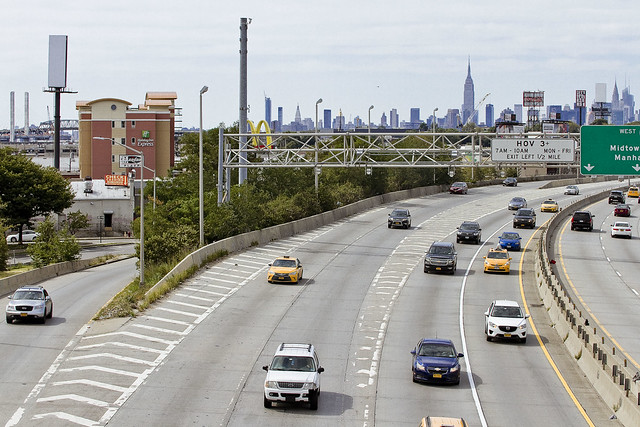
In yesterday’s post, the northern side of the area surrounding the proposed Homeless Shelter in Maspeth was descirbed in somewhat excruciating detail. The proposal put forward from the Mayor’s office calls for converting a Holiday Inn hotel on 55th Road to provide housing for one of NYC’s most vulnerable groups of people, and the location of it seems to be an entirely random choice of venue which City Hall arrived at by throwing a dart at a map of districts which didn’t support the Mayor in the last election cycle. The decision has already caused one long serving local politician to lose her job in an elective primary to an upstart and relative unknown who strongly objects to the placement of this facility, something which I’m sure the political establishment hereabouts will hold against the “Dope from Park Slope” when he attempts to get reelected.
That’s the hotel in the shot above, the tan and coral structure just to the south of the Long Island Expressway.
– photo by Mitch Waxman
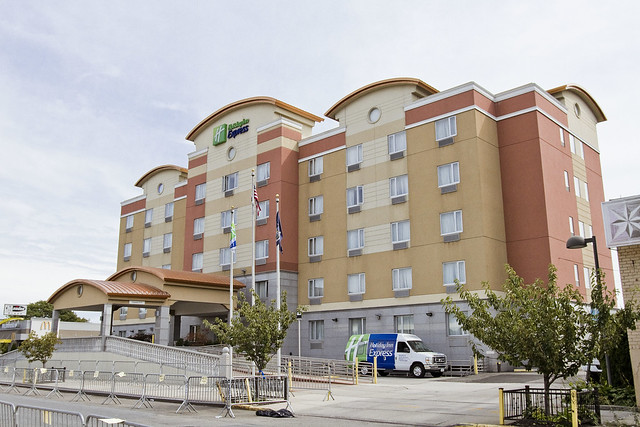
Other than being a bland architectural travesty, the hotel itself is inoffensive. As a note, there is another nearby hotel found to the north on Maurice Avenue across the street from Mt. Zion cemetery – a Comfort Inn branded establishment which, like the Holiday Inn pictured above, exploits the European tourist market and offers lodging at a rate significantly lower than the ones offered at hotels closer to the City center. The shot above is from 55th Road, by the way.
– photo by Mitch Waxman
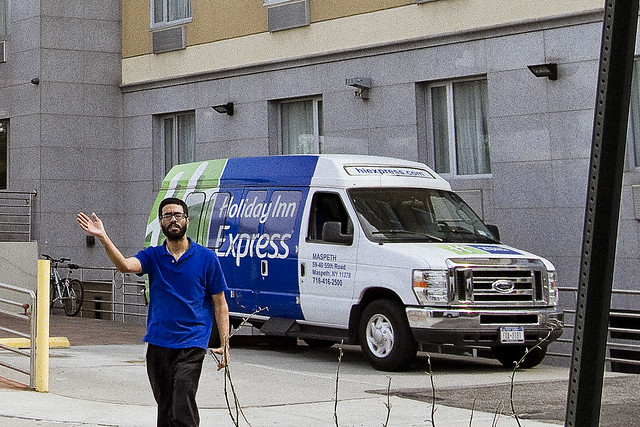
While I was gathering these shots, the fellow above emerged from the hotel. He first informed me that I couldn’t take photos of the structure without a permit, then kind of invaded my personal space while telling me he didn’t want his photo published in a newspaper. This is a web site, incidentally, so I would offer to the gentleman pictured above that he needs to be more specific when stating his prohibitions. I reminded him that I was on the sidewalk of an adjoining property, of course, and that he had no right to attempt to circumnavigate the constitution of these United States on the subject of photography of those things which are visible from the sidewalk. He also sundered his right to privacy by confronting me thusly. Were I assigning any sort of editorial “slant” to this photo, he would have a legitimate beef with me, but since I’m not – he doesn’t.
As I always say, if you don’t me to point a camera at you, don’t hassle me when I’m shooting.
– photo by Mitch Waxman
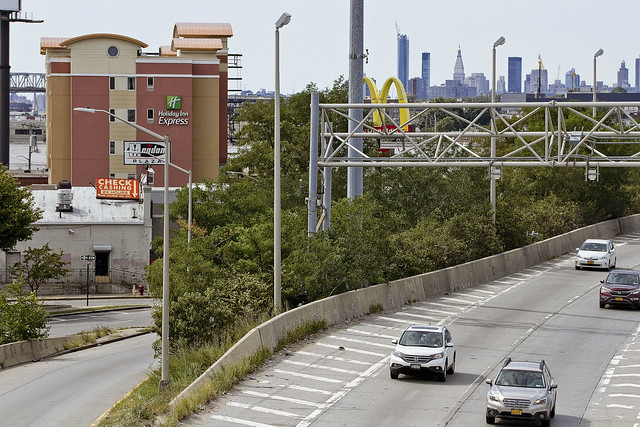
As stated in yesterday’s post, my objections to the placement of this facility revolve around the actual location of it, which I honestly believe to be a violation of the human rights of a vulnerable population.
The Holiday Inn sits across the street from the Long Island Expressway, which produces a standing wall of high decibel sound. While I was shooting the shot above, I actually called a friend, whom I could not hear even though my headphones were in – and she could barely make out what I was saying despite the fact that I was shouting into the microphone.
– photo by Mitch Waxman
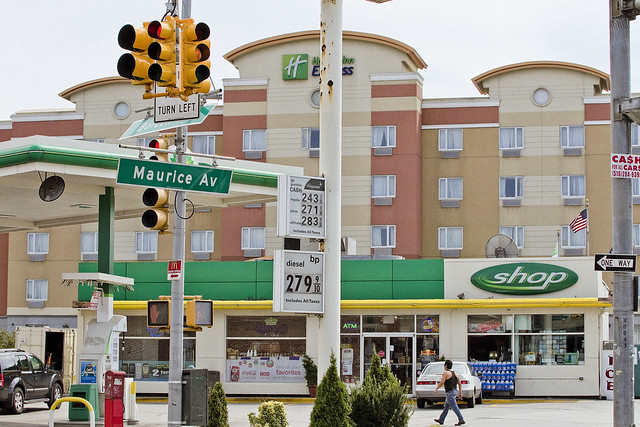
This gas station with a convenience store is directly across the street from the hotel, and would presumptively fill the role of a supermarket for purchasing food and other existential necessaries. As is the case with such locations, everything you can purchase within is priced as high as the market will bear, and food items available are typically highly processed food stuffs designed for a long shelf life.
I guess the Mayor thinks that microwave burritos are good enough for these so called “Homeless” he’s planning on exiling to industrial Maspeth.
– photo by Mitch Waxman
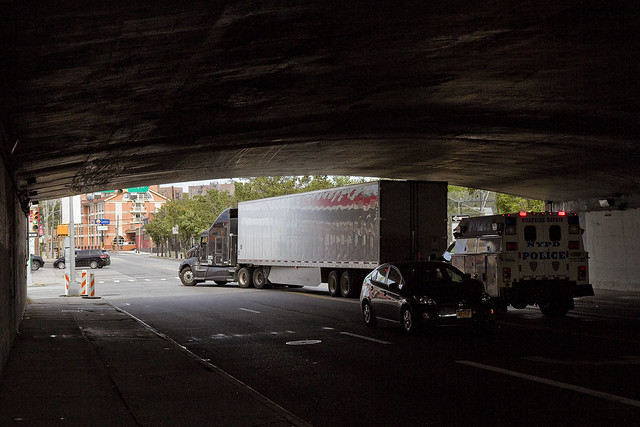
The character of the streets surrounding the hotel can be best described as truck routes. The sidewalks found under the overpasses of the highway have no pedestrian protections like bollards or jersey barriers, and are littered with debris and dead pigeons. There is no lighting, and perpetual shadow exists down in these spaces.
– photo by Mitch Waxman
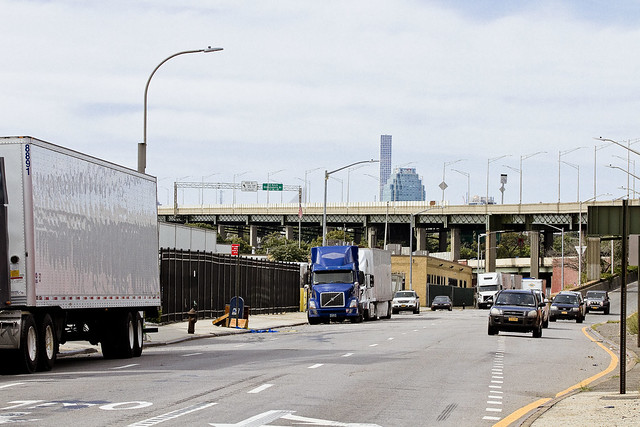
To the west – more highways, cemeteries, and industrial sprawl.
– photo by Mitch Waxman
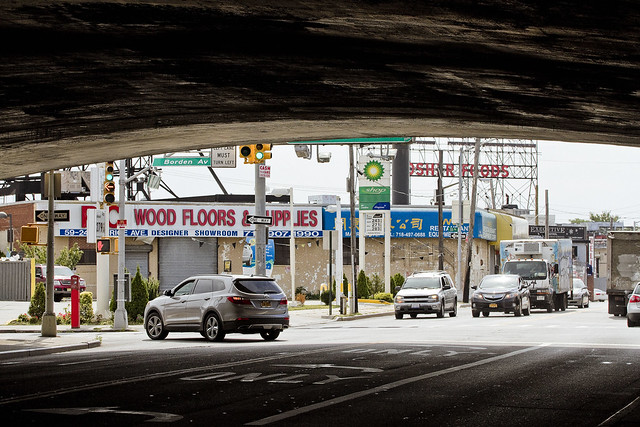
To the south – the roads lead to the industrial zone surrounding the Newtown Creek superfund site.
– photo by Mitch Waxman
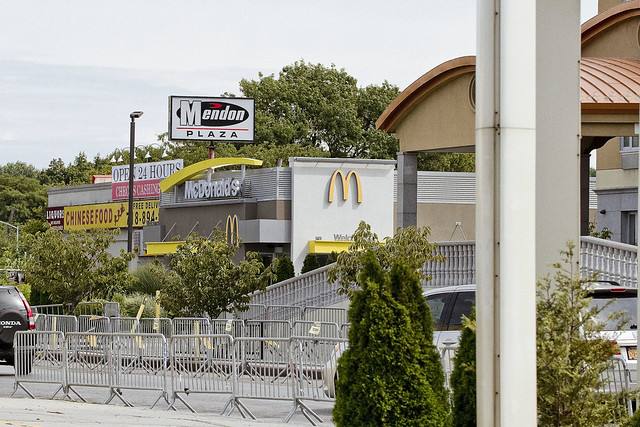
To the east – McDonalds and a Chinese take out restaurant offers an alternative food source to the microwaved burritos and packaged snack cakes found at the gas station convenience store. Luckily, there’s a financial institution in this little strip mall – a check cashing location, which like all examples of such institutions offers high interest payday loans and charges a usurious amount for cashing a check.
The people proposed for exile to this hotel are going to need somewhere to cash their benefit checks, after all, why not ensure that they get to keep as little of it as possible?
– photo by Mitch Waxman
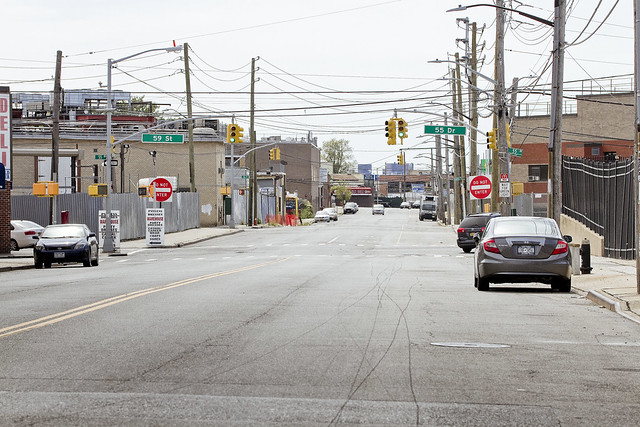
Looking south – up Maurice Avenue. At the top of the hill, around a half mile away, is the Goodfellas/Clinton Diner on Rust Street, if you need a landmark. The businesses located in the area are mainly warehouse operations, and there’s still a bit of manufacturing going on in the area, but it’s highly unlikely that any of the businesses in this area would hire a down on their luck person for an entry level job.
– photo by Mitch Waxman
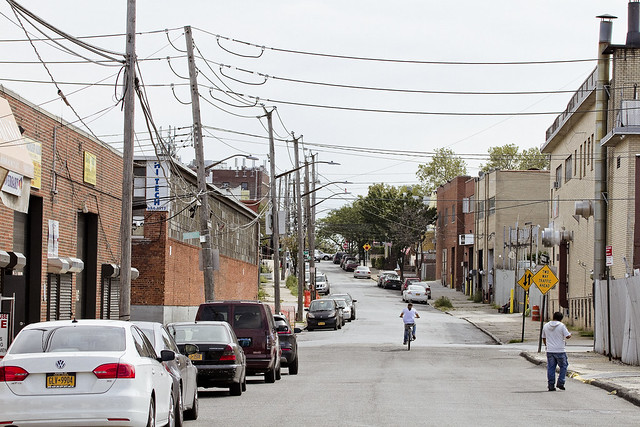
Pictured above is 55th drive, looking east, this street is found behind the hotel property lot. Bleak, this is an industrial street which hosts a few Korean family owned kitchen cabinet manufacturers and a couple of warehouse operations. During the week – the fleets of trucks which carry their wares, and palettes of their products, populate roadway and sidewalk alike.
– photo by Mitch Waxman
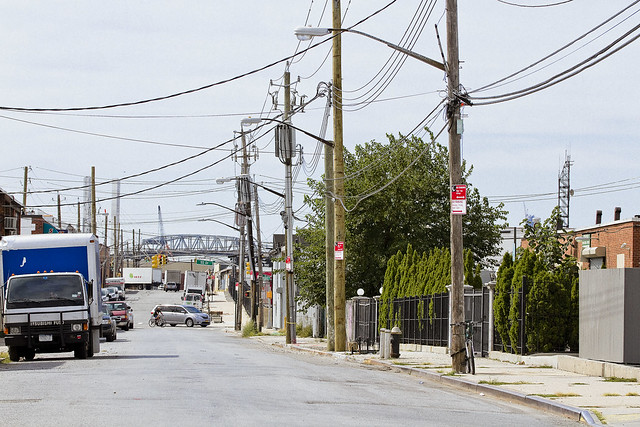
Looking west along 55th drive, the Koscisuzcko Bridge project is visible, but I don’t think that an opportunity for work will manifest itself for the proposed occupants of the Holiday Inn hotel there either.
What are the people that the City wants to move in here supposed to do to fill their days?
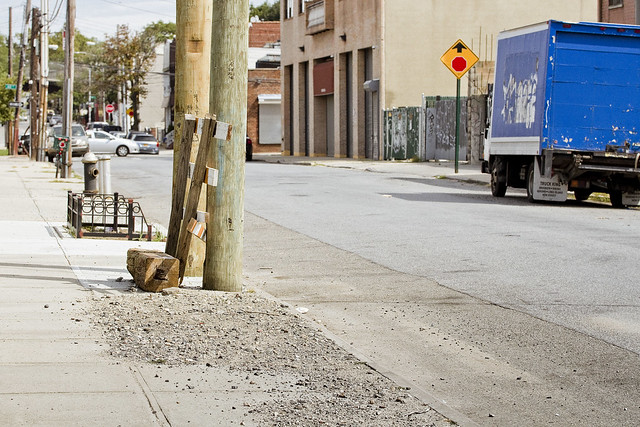
– photo by Mitch Waxman
The condition of the sidewalks and streets along 55th drive are fairly crappy. As with all the industrial neighborhood sidewalks you’ll find in Western Queens – illegally dumped junk, debris, and gravel are randomly deposited.
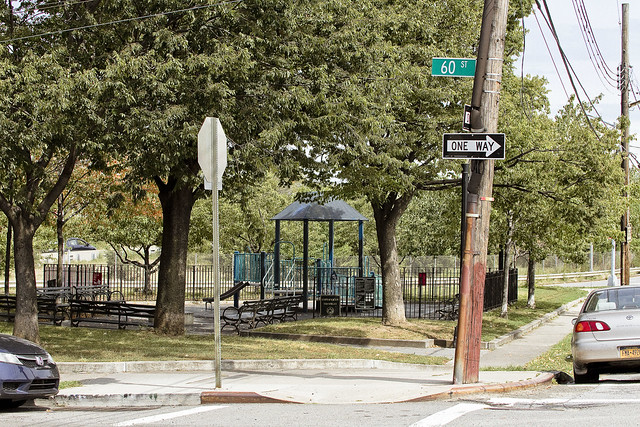
– photo by Mitch Waxman
This playground and pocket park is one of the very few public green spaces in Maspeth’s northern section, and will likely become the place where the residents of the Hotel spend their time.
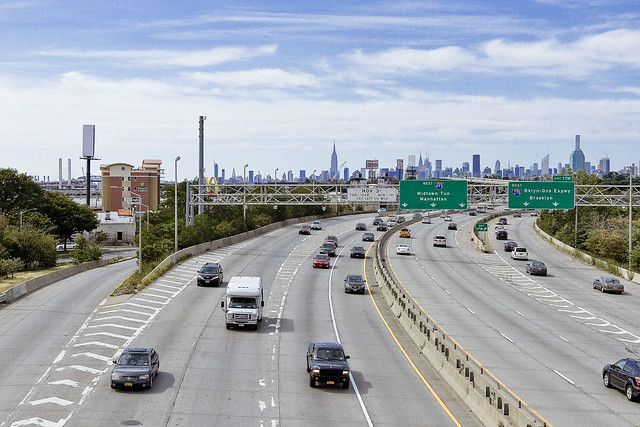
– photo by Mitch Waxman
So, does it make sense?
Is it smart to exile a vulnerable population in an industrial zone found along an elevated highway that carries close to a half million vehicle trips a day and which produces an ear shattering din? Is it ok for these people to be exploited by a check cashing location, and to have to make a choice between eating convenience store food, Chinese take out, or at McDonalds? Or, is it just expedient?
Spotty bus service is a regular complaint for the residents of the surrounding neighborhood, and Maspeth is notoriously a “transit desert.” How will the people housed in this Holiday Inn access medical or social services without a car?
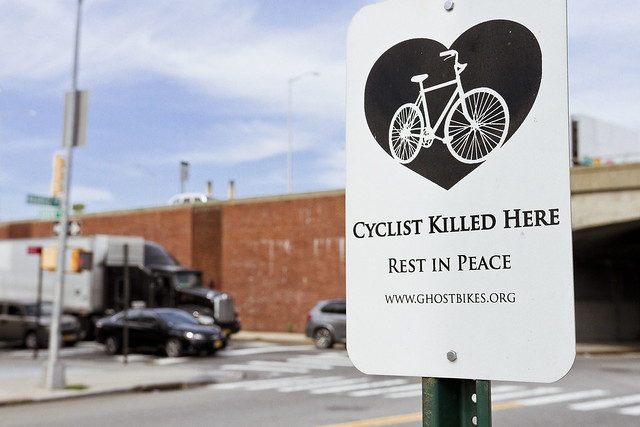
– photo by Mitch Waxman
What do you think?
Upcoming tours and events:
“The Untold History of the Newtown Creek (aka Insalubrious Valley)” walking tour
with New York Adventure Club, Saturday, October 1st from 11:00 a.m. to 1:00 p.m.
Click here for tickets.
“First Calvary Cemetery” walking tour
with Brooklyn Brainery, Saturday, October 8th from 11:00 a.m. to 1:00 p.m.
Click here for tickets.
“follow” me on Twitter- @newtownpentacle
dizzily down
From the perspective of a wandering mendicant…

– photo by Mitch Waxman
Often have I commented on the hazy “intertidal” zones found along the former borders of long forgotten town and village municipalities in Western Queens – in fact, I’ve coined the term “angles between” for them. There’s – functionally – no one alive today who has a personal remembrance of Maspeth or Woodside being referred to as towns or villages with clearly defined borders due to urban sprawl and the life’s work of Robert Moses. When the City of Greater New York consolidated Long Island City and the county of Newtown into a new entity called “Queens,” it’s at these hazy border areas that the Manhattan people got away with literal “bloody murder.” The export of Manhattan’s dirty industries, it’s unwanted poor, the corpses of its dead – all were sent east to what was – then – a still quite agricultural community called Queens. This also happened to the Bronx and Staten Island, and to a lesser degree Brooklyn.
The local politicians in the “lesser” boroughs were more than happy to take on the cemeteries, heavy industries, and garbage handlers in the name of “progress” and doing favors for the hidden elites of Manhattan.

– photo by Mitch Waxman
The Shining City of Manhattan replaced its tenements, its abattoirs, its manufactured gas plants with what at the time would have referred to as “modern” apartment blocks. For you real estate savvy types – that’s so called “pre war” developments like Tudor City in Murray Hill, Peter Cooper Town/Stuyvesant Village which sits on the former site of several Manufactured Gas Plants, or the United Nations building (built into the former site of several slaughterhouses and abattoirs that was known as “blood alley”). The process of converting industrial Manhattan over to a residential and commercial center kicked into high gear in the years before and directly following the Second World War, the age of “urban renewal.” That’s when the highways were jammed through on Long Island, the dairy farms of Queens were converted to housing tracts, and the “Manhattancentric” school of thought concerning development really kicked in. The tenements emptied as the teeming masses sought a better life in Queens, and further east in suburban Nassau and Suffolk counties. This turned Western Queens into a transit corridor for trade and commuters.
It’s all about “the City” and literally all roads for hundreds of miles in any direction lead to Manhattan.
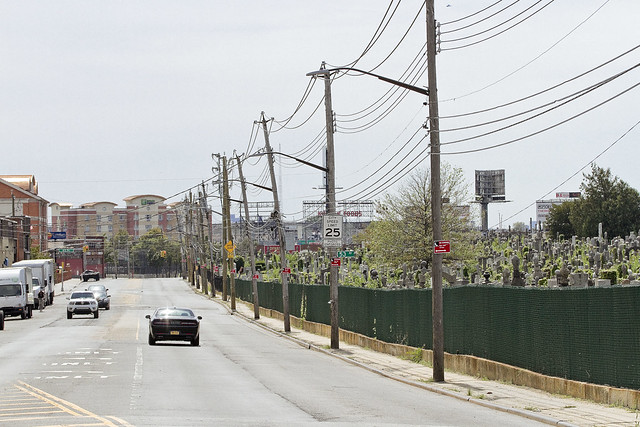
– photo by Mitch Waxman
Mt. Zion cemetery – that’s its Maurice Avenue fence line pictured above and it’s in the center of all the shots in today’s post – is categorically in Maspeth, and it is infested with tiny gecko like lizards. Saying that, it also defines Maspeth’s blurry border with Woodside in the same way that Maspeth’s border with LIC’s Blissville section is defined by the Koscisuzcko Bridge. The cemetery is fairly ancient by Queens’s standard, it’s roughly 78 acres in size, there’s around 210,000 interments therein, and its first burial in Mt. Zion was conducted in 1893. There used to be a Gypsy encampment here, a shanty town that was home to a Romani tribe from Transylvania that called itself the “Rudari,” or “Ludar,” depending on whom you ask. The Rudari, just for the sake of literary trivia, are the same tribe that worked for Count Dracula in the Bram Stoker novel named for the vampire lord. The historical record of Queens usually refers to them as “The Maspeth Gypsy’s,” and it should be mentioned that referring to them using such nomenclature would be considered a racist hate crime and slur in the modern day European Union.
The Rudari were renowned for copper working and animal training. The reason that the circus train still comes to Western Queens every year is that the circus industry used to buy trained critters – bears, horses, etc. – from them. Many Rudari found work at the Phelps Dodge copper refinery along Newtown Creek, and remnants of their community persist to this day in the Sunnyside Gardens area along Queens Blvd.

– photo by Mitch Waxman
There are a series of semi detached one and two story homes in the area directly surrounding Mt. Zion, which are sandwiched between the Long Island Expressway and Brooklyn Queens Expressway. To the south is the heavy manufacturing district surrounding the eastern side of Newtown Creek and its tributary Maspeth Creek. Mixed use industrial zoning directly touches the cemetery, and hundreds of truck based warehouse businesses are located hereabouts. There is also a large footprint Coca Cola distribution center nearby, and a primary shipping hub for United Parcel Service is less than a mile away, as is the warehouse and distribution center for the Duane Reade retail empire. Mt. Zion’s western side is directly across the street from the Second, Third, and Fourth sections of Calvary Cemetery. Pictured in the first shot of today’s post is part of the Department of Sanitation’s colossal vehicle maintenance facility, which is right next door to an NYPD vehicle maintenance facility, and there’s an FDNY vehicle maintenance facility nearby as well. Suffice to say that these are heavily travelled streets, here under the Long Island Expressway and just a short walk away from Newtown Creek.
If you talk to the people who live anywhere near this area, their common complaint always involves the amount of trucks and cars which use their neighborhood as a thoroughfare. Of course, talking to the people of Queens is considered an obstacle by City Hall, and a loathsome requirement when implementing their policies.

– photo by Mitch Waxman
Mt. Zion cemetery was set up for members of the Jewish community, whose burial laws are a bit different than the Catholic ones. Jews are meant to buried singularly, rather than having multiple bodies in the same gravesite as in the Catholic tradition. This means that Mt. Zion sprawls and has the appearance of being overcrowded. There are sections of the cemetery which are virtually impassable due to this, where it is impossible to find a place to put your foot down between the rows of tombstones.
The streets surrounding it are barren, virtually treeless, and are a favored spot for illegal dumping of construction debris and other garbage.

– photo by Mitch Waxman
The reason that this little travelogue is being presented today involves the plans recently presented by the De Blasio administration to convert a hotel in the area over to a homeless shelter. A subsequent post will detail the hotel and the area directly surrounding it, but this is the northern side of the zone which the “Big Little Mayor” has picked to warehouse those who are considered socially and economically undesirable. The community of Maspeth has responded with their characteristic flair, and pushed back on City Hall with considerable skill and energy. City Hall, as is its habit under the current Mayor reacted to the protests by implying that Maspeth’s indignation is fueled by racism. Several publications picked up this theme, and the Internet commentarium knee jerk followed the rhetoric offered by the administration of the “Dope from Park Slope.”
My personal views on the Maspeth shelter project were the subject of a debate recently with a former colleague whose views and perspectives I greatly respect, but the argument I make about the placement of people – people who exist at the lowest end of the socio-economic spectrum – in this area is that it’s a human rights violation.
Simply put, it ain’t exactly a bed of salubrious roses out around these parts even if you’ve got money in your pocket, let alone when you’re down and out. This wouldn’t be a shelter, this would be a penal colony.

– photo by Mitch Waxman
Maspeth, as in the community of, has been doing a great job of demonstrating its objections to the placement of a homeless shelter hereabouts. They don’t need me to chime in, or make war, for them.
What I’ve found disturbing is that the knee jerk reportage mentioned above that describes their objections in terms of “rich white people” not wanting “poor black people” in their neighborhood – which has been presented by news sites that have covered the protests.

– photo by Mitch Waxman
To start, there’s a few different sides to Maspeth. To the south and east, you do indeed have a somewhat suburban and moneyed section that is populated by people of European decent. To the south and west you’ve got an industrial zone, but you’ll find the odd block of homes in there, the residents of which are a hodge podge of “everybody.” On the north western side, here around Mt. Zion, my observations have revealed a population who are pretty much the same mix of people you see everywhere in Woodside, Sunnyside, Astoria and so on. East and Southeast Asians, Africans and African Americans, Irish, Jews, Italians, Levantines, Middle Easterners – the whole “vibrant diversity” mix that the politicians are always crowing about.
The “homeless” are not a monolithic people comprised from a single racial group with a common ancestor. Who these “homeless” are would be best defined, by Marxist economists, as the “underclass” and what they have in common is not the color of their skin but grinding poverty. I’ve always argued that just calling these people “the homeless” is dehumanizing and that it’s done by those armchair academics who have never actually known someone living on the street in any context other than dropping a quarter in their cup. There is no “homeless problem,” rather there’s tens of thousands of individual problems. Siting them away from a familiar setting, breaking whatever they have left of a social network, treating them like something to be warehoused in a neighborhood of warehouses – this ain’t the right idea.
On the subject of every neighborhood having to do “its fair share” – Maspeth already handles close to 20% of NYC’s garbage, it hosts the LIE and BQE, has several NYS and one Federal Superfund sites in it, and there are intersections where close to 3-400 heavy trucks an hour roll through on their way to Manhattan. The garbage train also transits through Maspeth a few times a day, which represents and comingles Brooklyn’s share of the garbage handling with Maspeth’s.

– photo by Mitch Waxman
There are virtually no mass transit lines available from this location, police patrols are infrequent at best, and at night this is a virtually abandoned part of the city. Bus service is spotty, and it’s one of the places in Queens where you truly need a personal vehicle to get around.
There are streets with no sidewalks here in the half mile around the proposed shelter.

– photo by Mitch Waxman
The shocking ignorance of City Hall regarding the existential realities of Western Queens never fails to amaze me. All they seem to know about our neighborhoods is what they see on maps rolled out on mahogany desktops that have pins stuck into them by paid cronies. I’ve met several members of the Dept. of City Planning over the years, and the ones who I respect the hell out of are the ones who put on a pair of sneakers periodically and go out for walks in the areas they’re assigned to. I don’t always agree with their choices, but I do respect them.
I have a random idea, which is to site a homeless shelter on 11th street in Park Slope, just off fifth avenue.
Tomorrow, we’ll cross under the highway and take a direct look at what Mayor Bill De Blasio considers as being a good fit for one of the most vulnerable populations of people in NYC to call their temporary home, since he hasn’t decided to lead by example and convert his aforementioned house on Park Slope’s 11th street over to either affordable housing or for use as a shelter.
Upcoming tours and events:
“First Calvary Cemetery” walking tour
with Brooklyn Brainery, Saturday, October 8th from 11:00 a.m. to 1:00 p.m.
Click here for tickets.
“follow” me on Twitter- @newtownpentacle
slanting floor
Cool Cars, Sunnyside/LIC edition.

– photo by Mitch Waxman
That’s a 1962 vintage Ford Mercury “Comet” 2 door sedan you see in the shot above.
I didn’t have time to properly shoot it, as I was on my way to Greenpoint to conduct a walking tour of Newtown Creek. For frequent commenter George the Atheist, who questioned my oft asserted statement last week that “I had business to attend to in Greenpoint” – if I say I have business in Greenpoint, it’s likely related to Newtown Creek or one of my walking tours. At any rate, the shots in today’s post are kind of a “hit and run.”
At any rate, and as mentioned, the cool car you see above is a 1962 Mercury Comet.

– photo by Mitch Waxman
It was pretty “cherry,” this Comet.
The Mercury Comet was originally meant to be part of Ford’s Edsel line, but when they ended that “brand” it was assigned to the Mercury brand instead. It was developed with, and is quite similar to the Ford Falcon – which is coincidentally a “cool car” that I had focused in on over in Astoria not too long ago.

– photo by Mitch Waxman
I believe this to be an S22 sports model Comet, by the way, due to its six bullet shaped tail lights and trunk design, but as always – I’m no auto dealer or expert in such matters. If I’m right, there a 101 HP, 6 cylinder engine under the hood, with a manual 4 speed transmission. Ford manufactured a few variants on the Comet, including a station wagon called the “Villager.”
“follow” me on Twitter- @newtownpentacle
leaping shadows
Lets talk about the Kosciuszcko Bridge, huh?

– photo by Mitch Waxman
Since the big bridge over Newtown Creek’s 77th birthday is coming up – August 23rd for the vulgarly curious – one decided to walk over and through Calvary Cemetery into West Maspeth the other day and check out the latest progress which the NYS DOT and their contractors are making on replacing it. The Kosciuszcko Bridge replacement project is humming along.
As a note, this post represents no special access or anything, just some specialized knowledge about Newtown Creek and the points of view thereupon which I am privy to. If there’s an angle of view on the Creek I don’t know about by this point, I will buy you a drink for showing it to me.

– photo by Mitch Waxman
As is my habit, one has been keeping a running tally of posts about the project.
To start – this 2012 post tells you everything you could want to know about Robert Moses, Fiorella LaGuardia, and the origins of the 1939 model Kosciuszko Bridge. Just before construction started, I swept through both the Brooklyn and Queens sides of Newtown Creek in the area I call “DUKBO” – Down Under the Kosciuszko Bridge Onramp. Here’s a 2014 post, and another, showing what things used to look like on the Brooklyn side, and one dating back to 2010, and from 2012 discussing the Queens side – this. Construction started, and this 2014 post offers a look at things. There’s shots from the water of Newtown Creek, in this June 2015 post, and in this September 2015 post, which shows the bridge support towers rising. Additionally, this post from March of 2016 detailed the action on the Queens side. Most recently, here’s one from May of 2016, and one from June of the same year.

– photo by Mitch Waxman
The roadway which will be the easterly BQE section leading out of Queens is now largely in place. There’s still a bunch of work going on up there, presumptively it involves the sort of rebar work observed in the May 2016 post linked to above.

– photo by Mitch Waxman
The shape of the cable stay section of the new bridge is beginning to form up as well.

– photo by Mitch Waxman
The steel sections are prefabricated and shipped to the job site via flat bed truck, where they’re then hoisted up and attached to the towers and cables.

– photo by Mitch Waxman
Looking down 56th road from Blissville into Maspeth. The area in the left hand side of the shot used to be an NYPD tow yard, which was a great example of NYC’s macabre sense of humor. NYPD tow pounds are typically in places which you can’t reach without a car, and since they’ve just taken your car…

– photo by Mitch Waxman
Looking north towards Sunnyside from 56th road. You can really discern the difference in height between the 1939 and modern bridges in the shot above. Apparently, part of the traffic engineering underlying the new bridge project is to eliminate the steep incline from the approaches.

– photo by Mitch Waxman
Looking south towards Brooklyn, while still on 56th road. The property fence line I’m shooting over is the former home of the Phelps Dodge refinery, which is said to be a particularly toxic hot spot.

– photo by Mitch Waxman
A bit closer to the water, on another part of the former Phelps Dodge properties which isn’t quite so “hot,” pollution wise. This is the parking lot of a wholesaler catering to the restaurant trade.

– photo by Mitch Waxman
The cable stay span of the new bridge is growing steadily towards Brooklyn in the shot above. To me, it looks like it’s going to be connected to the Brooklyn side ramp fairly soon.

– photo by Mitch Waxman
A close up on the ramp, and you can see the itty bitty construction guys at work right on the edge.

– photo by Mitch Waxman
Same perspective, but wide angle. That’s the Newtown Creek flowing below, and we are looking west towards Manhattan. Again, notice the height differential between the two spans.

– photo by Mitch Waxman
Looking south again, this time from Maspeth’s 43rd street. The contractors have a lot of their equipment and prefabricated materials staged out here.

– photo by Mitch Waxman
Back on 43rd street, but this time from the very edge of the project site, looking south along the spine of the BQE.
There you are.
Upcoming Events and Tours
Sunday, August 14th, 11:00 p.m. – 1:00 p.m. –
Calvary Cemetery Walking Tour,
with Atlas Obscura. Click here for more details.
Sunday, August 21, 11:00 a.m. – 1:00 p.m. –
Poison Cauldron Walking Tour,
with Atlas Obscura. Click here for more details.
Wednesday, August 24, 6:00 p.m. – 8:00 p.m. –
Port Newark Boat Tour,
with Working Harbor Committee. Click here for more details.
“follow” me on Twitter- @newtownpentacle
angled planes
Not rodents, the groundling burrowers are instead mammalian and obligate nasal breathers.

– photo by Mitch Waxman
The groundling burrowers have a nearly 360 degree field of vision, with their only blind spot directly in front of them at the tip of their nose. They are crepuscular (meaning they’re most active around dawn and again at dusk), and are digigrades (meaning that they walk around on their toes – five on the front feet and four on their stern). The sound of their screams are blood chilling, they have two sets of those chisel like front teeth, and just about every predator you can think of is after them. When one of their number spots danger, the groundlings are known to thump their powerful hind legs on the ground to alert the others.
The burrowers watch the skies. Death circles above.

– photo by Mitch Waxman
The groundlings burrow into the loam. Their tunnel entrances are well hidden, from above. The tunnels themselves are called burrows. If and when a complex of these subterranean tunnels – or burrows – is found, it’s referred to as a “warren.” More than half of the population of their entire race is found in North America. The males are called “bucks” and the females “does.” Should you find a place where a warren exists, you have likely found what’s known as either a nest, or a “herd,” but what is referred to most commonly as a “colony.”
The burrowers watch the horizons, for death can come at them from all sides.

– photo by Mitch Waxman
They don’t burrow deeply, the groundlings. If at all possible, they’ll move into deep burrows dug by other animals, true rodents such as groundhogs or rats. In an ideal world, perfection would be a series of already excavated voids in the earth, which these lagomorphs could theoretically connect via individual burrows and create a multi acre warren. This would form a hidden groundling metropolis of prodigious size.
Safety is found below, where death means solace.

– photo by Mitch Waxman
First Calvary Cemetery in LIC’s Blissville section, in NYC’s borough of Queens. Founded by Archbishop Dagger John Hughes in 1848 as the primary burial ground for the Roman Catholic Church of NYC. The final mailing address for millions of humans, it is observably infested with obligate nasal breathers – these groundling burrowers. Were it only possible to witness a cross section of the mound Calvary is built into, called Laurel Hill, and the warren it contains…
Who can guess, all there is, that might be buried down there?
Upcoming Events and Tours
Sunday, August 14th, 11:00 p.m. – 1:00 p.m. –
Calvary Cemetery Walking Tour,
with Atlas Obscura. Click here for more details.
Sunday, August 21, 11:00 a.m. – 1:00 p.m. –
Poison Cauldron Walking Tour,
with Atlas Obscura. Click here for more details.
Wednesday, August 24, 6:00 p.m. – 8:00 p.m. –
Port Newark Boat Tour,
with Working Harbor Committee. Click here for more details.
“follow” me on Twitter- @newtownpentacle


