Archive for the ‘Photowalks’ Category
curious pacts
The great anniversary, in today’s post.

– photo by Mitch Waxman
It all started in the Belgian Congo, over in Africa, when a fellow named Robert Rich Sharp discovered the deposit near a little town called Shinkolobwe.
The Union Minière du Haut Katanga, a Belgian Mining Company, assumed control over the resource and began to refine the material into something useful. It was something unique, this mineral deposit at Shinkolobwe, and the mine was soon producing ore materials that were 65% pure. Other global deposits of the stuff, discovered and exploited later in the 20th century, were considered major finds if they held 5% pure ore, and Shinkolobwe is described as a “freak occurrence in nature” by minerologists. The Belgians owned the Congo, and UHMK held a virtual monopoly on the rare elements found within the colony. Refineries were set up in Shinkolobwe, and both the town and the mine were excised from maps and official mention.
When the Second World War broke out, Belgium fell before the German Blitzkrieg, but the UMHK had already stockpiled some 1,200 metric tonnes of refined ore in the United States. It was stored in New York City, where UMHK had warehoused it on Staten Island, beneath the Bayonne Bridge. On the 18th of September in 1942 – Edgar Sengier, the head of UMHK, had a meeting with United States General Kenneth Nichols.
Nichols purchased the 1,200 tonnes of refined uranium from the Belgian Company, which was already in America and warehoused on Staten Island, and arranged for another 300 tonnes of the stuff to be shipped across the Atlantic from Shinkolobwe for usage by the War Department of the United States. This transaction ultimately caused the death of some 66,000 people, and the maiming of at least 70,000 more, a scant three years later on this day in 1945. Thousands more died on the 9th, but that’s another story.

– photo by Mitch Waxman
The military project General Nichols represented was started in 1939, eventually employing more than 130,000 people and costing nearly US $2 billion (about $26 billion in 2015 dollars). There were four known major deposits of the precious ore in 1940: one in Colorado, one in northern Canada, Joachimstal in Czechoslovakia, and Shinkolobwe in the Belgian Congo. Joachimstal was in German hands. The Canadian and American deposits were quickly nationalized, and the Congo mother lode was soon held firmly by British interests.
Across North America, dozens of industrial plants were built and got to work.

– photo by Mitch Waxman
History is full of “what if’s.” What if Charlemagne had refused the title of Holy Roman Emperor? What if John III Sobieski didn’t break the Ottoman siege of Vienna in 1683? What if Chingis Khan had never invaded the Middle East? What if the Japanese Empire didn’t attack Pearl Harbor and force the United States into the Second World War? One can speculate…
Eventually, the U.S. would have intervened in Europe. Simply put, the English and French owed billions in war debts from the First World War to American banks, and the U.S.A would have been forced to intervene simply to protect its interests. The Pacific was considered an American and British lake back then, and the Phillipines were a de facto American colony in the 1930’s – so it was only a matter of time before the Japanese Empire and the United States would find themselves in one conflict or another.

– photo by Mitch Waxman
Like the European Powers, the Japanese understood what “total war” meant in the age of industry. Their miraculous conversion, in just one century, from Medieval backwater to industrial superpower had already resulted in Japanese forces utterly dominating and annihilating both German and Russian armies in one sided conflicts. Their naval strength was staggering, and by the 1930’s their armies made short work of capturing the infinite resources of China. Pearl Harbor was meant to be a decapitating blow, clipping the Eagle’s wings.
There are mistakes in history, blunders of epic scale, and Pearl Harbor ranks up there with the Khwarazm Shah telling Chingis Khan to go fuck himself. The America that the Japanese empire attacked wasn’t the one we know today, full of soul searching and unsure of itself – rather it was the country which had produced Teddy Roosevelt, Henry Ford, Andrew Carnegie, and especially John D. Rockefeller.
It had also produced Robert Oppenheimer and General Leslie Groves, whom General Kenneth Nichols worked for.

– photo by Mitch Waxman
The ore purchased from the Union Minière du Haut Katanga by General Kenneth Nichols, which was scratched out of the earth in the Belgian Congo’s Shinkolobwe mine and stored in a warehouse on Staten Island, was uranium. The United States of America used that ore to refine and produce Plutonium in a massive industrial complex which it built in just six years. On September 18th, 1942 – the fate of two Japanese cities was sealed when the ore came passed into the hands of the Manhattan Project, which came to fruition on August 6th in 1945.
Seventy years ago today – a device named Little Boy carried that ore, mined from Shinkolobwe and stored in Staten Island, over a city called Hiroshima in Japan.
“follow” me on Twitter- @newtownpentacle
Upcoming Tours –
August 8th, 2015
13 Steps Around Dutch Kills – LIC Walking Tour
with Atlas Obscura, click here for details and tickets
ordinary interpretation
First Calvary Cemetery, in today’s post.

– photo by Mitch Waxman
It’s been a while since a post about my favorite place in Queens has been offered at this, your Newtown Pentacle. For those of you who have recently arrived, Calvary was the official burying ground of the Roman Catholic Church for about a century. There are four sections, which contain more than six million interments, and the oldest section (First Calvary) was consecrated in 1848 by the Archbishop “Dagger” John Hughes. It adjoins the lugubrious Newtown Creek, a century of its expansion has largely consumed a 19th century community called Blissville, and it is the final resting place for mobsters, governors, and the rightful king of Ireland.
Calvary Cemetery is a movie star, having provided Hollywood with the setting for funereal scenes in multiple films. Fictional characters buried here in the movies range from Don Corleone in the Godfather to both Uncle Ben and Gwen Stacey in Sony’s Spider Man franchise. Bruce Wayne’s parents are buried here as well.

– photo by Mitch Waxman
Calvary Cemetery is a built environment, the crown of what was once known as Laurel Hill. A broad slope rises from the former swamps found along Northern Blvd., gaining altitude and moving through what is now called Sunnyside, and cresting at the former family farm of the colonial era Alsop family. Laurel Hill’s altitude then drops precipitously to the flood plains of Newtown Creek. In the 1850’s and 60’s, Church laborers extensively remodeled Laurel Hill to fit its mission, creating a private drainage system and removing millions of tons of top soil. By the late 19th century, Calvary had become a major destination for mourners from the largely catholic population of lower Manhattan and it was served by both ferry and trolley lines. Along its borders – road houses, saloons, and hotels were found.
That is, until the age of industry really kicked into gear along the Newtown Creek.

– photo by Mitch Waxman
One of Calvary’s neighbors was a company originally called General Chemical, but which is better known today as Phelps Dodge. General Chemical manufactured sulphuric acid (amongst other things) and Phelps Dodge, which was engaged in the copper business, acquired General Chemical at the start of the 20th century. They would use the acid produced here to free valuable metals from the ore it was laced into. General Chemical was not popular with its neighbors, due to the effluent which would drift out of its smoke stacks.
According to anecdotes from the time, coming from both Blissville and the town directly east of it – Berlin (now known as West Maspeth) – this effluent would wither gardens, ruin laundry hung out to dry, and in the case of Calvary Cemetery right next door – dissolve the tombstones.

– photo by Mitch Waxman
Marble is particularly vulnerable to acidification, and visibly rots away when exposed to ph’s high enough to be classified thusly. Pictured today is an 1866 monument dedicated to a person named “Mary Kiernan.” This monument bears the classic “rot” and weathering exhibited by acid damaged marble. Touching the stone, you’d pull your hand away and discover a sandy grit sticking to your fingers.

– photo by Mitch Waxman
General Chemical found itself in a real pickle on this issue, as “public relations” hadn’t been invented yet, and the Church was pressuring the largely Irish political establishment of Tammany Hall to do something to help them. The company’s response was to build the tallest smoke stack to be found anywhere in the United States (at the time), with the goal of keeping the noxious emanations of the plant as far away from the ground as possible. They also planted a series of vegetable gardens in Blissville and Berlin, and began inviting reporters to witness the thriving patches of cabbage growing within throwing distance of their acid factory.

– photo by Mitch Waxman
Here’s the inscription on the Kiernan monument, and as you’ll observe, most of the fine detail in the carving has the appearance of melted ice cream. Like General Chemical, and so many other of the great corporations which once distinguished Newtown Creek – Phelps Dodge has come and gone.
Of all that was here along the Creek in the decade leading up to the Civil War, only the genuine antiquity that is Calvary Cemetry remains.

– photo by Mitch Waxman
Across the cemetery, you’ll notice statuary bearing similar damage. The main source of acidification today comes from the exhaust of automobile traffic, as it mixes with atmospheric humidity, which eats away at the stone. Calvary Cemetery is bounded by the Long Island Expressway on its northern side, and the Brooklyn Queens Expressway is found less than a half mile to the east. Greenpoint Avenue, and Review Avenue are local truck routes which host extremely heavy traffic.
All told, nearly a half million vehicles a day pass by the cemetery every single day of the year, here in the Netwon Pentacle.
“follow” me on Twitter- @newtownpentacle
Upcoming Tours –
August 8th, 2015
13 Steps Around Dutch Kills – LIC Walking Tour
with Atlas Obscura, click here for details and tickets
unknown things
114th precinct, I’m talking to you.

– photo by Mitch Waxman
Broadway in Astoria is a lovely stretch of small shops and restaurants which are enjoyed by the largely working class population found hereabouts. Sure, there’s noise, bad actors, crime and all that – no different from you’d find along any commercial strip in the City of Greater New York but our local gendarme does a pretty reasonable job of keeping a lid on things. Luckily, Astoria is somewhat self policing, and there’s so much going on at all times that no one thing can ever really become a paramount concern.
What we’ve got a lot of, however – which the local Bulls inexplicably overlook – is public drunkenness and vagrancy.

– photo by Mitch Waxman
At 42nd street and Broadway, where you’ll find Tsigonia Paint, a colony of alcoholic vagrants has set up shop and have been present in this area for several years. Once upon a time, there were three of them, which became six, and now there’s around twenty regulars. Before any of you Columbia University people crawl up my back and announce that your liberal sensibilities are offended by this post, or opine that I’m some sort of caveman, let us first define the fact that these fellows aren’t homeless – they are in fact bums. How do I know this? Because unlike those of you in the Ivory Towers of scholastic solemnity, I’ve actually talked with them and learned their names and stories. The fellow in the shot below who is standing up is a tragic figure named Andres, for instance.
Not a week goes by that somebody in the neighborhood doesn’t have to threaten to call the police to get these guys to vacate a residential driveway, stoop, or doorway. For most of us it’s common practice to just step over them as they sleep one off. They inhabit this corner, and you’ll observe them composing a small fraction of the day laborer population that hangs around Tsigonia Paint hoping to pick up work. Nothing wrong with that, of course, a man has to work. These guys, however, aren’t here to work – except on their buzz.

– photo by Mitch Waxman
I’ve sat and watched patrol car after patrol car roll right past scenes like the ones depicted in today’s post. It has been pointed out by me to various neighbors and elected officials that this is the sort of thing which can kill a neighborhood. Government people have said to me that these drunks will not be arrested, and that the best I could hope to happen is that the cops will harass them a little bit in the hopes of getting them to move on.
One corrosive effect that the presence of these fellows in the neighborhood has created is generally transmitted to other Spanish speaking immigrants, 99% of whom are not just productive but SUPER productive members of the community, which is an ugly consequence.
Since it seems to be completely fine for drunks to congregate hereabouts, a population of heroin addicts has recently claimed the corner of 41st street and Broadway (at the Queens Library) for their turf. That’s what I mean about “corrosive effect” btw.

– photo by Mitch Waxman
The shots above and below you’ve seen before, lords and ladies. The fellow in the shot below was personally rescued by your humble narrator back during the epic cold snap in February, when he fell asleep in front of my house and was turning blue as he froze to the sidewalk in front of HQ. A quick call to 911 saw FDNY arrive and take him off to Elmhurst Hospital. I ended up having to help the two EMT’s get him onto the stretcher, as he was fighting them.
NYPD? Never showed, not on their radar.
Is it legal to get drunk and pass out on the streets of Astoria with an open bottle of booze in your hand?
How about shitting in the street? Is that ok as well?

– photo by Mitch Waxman
Seldom am I confrontational with NYPD officers, I would point out. Whatever the current political vogue is regarding them, I nevertheless have a terrific amount of respect for the badge and personal relationships with both on duty and retired officers inform as to how much crap they have to endure during any given workday.
Why, however, doesn’t this obvious “Quality of Life” issue merit their attentions? Is it because of Compstat? Is it something political? Is this some of that “vibrant diversity” that all the politicians go on about at work?

– photo by Mitch Waxman
What shreds me is that people have to walk their kids around these vagrants, and explain to them why some man is drunkenly crapping between two parked cars. For these kids, this sort of thing is normal.
114th precinct, I implore you to do something about this problem before we begin to slide further back into the chaos of the 1980’s. I promise that I will vote for anybody else than the current Mayor in return.
“follow” me on Twitter- @newtownpentacle
Upcoming Tours –
August 8th, 2015
13 Steps Around Dutch Kills – LIC Walking Tour
with Atlas Obscura, click here for details and tickets
decadent element
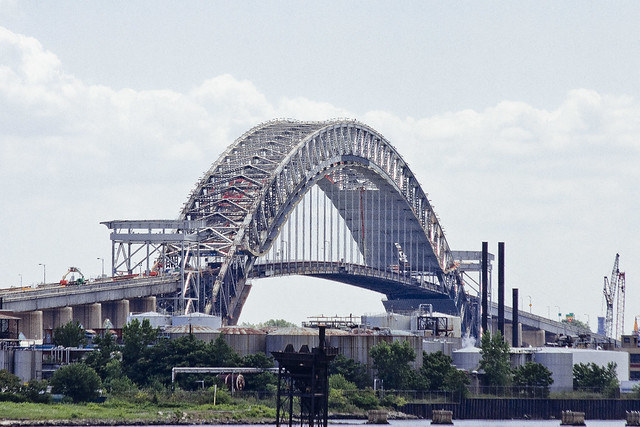
Bayonne Bridge progress, in today’s post.
– photo by Mitch Waxman
A recent Working Harbor Committee excursion, one of our education tours for kids (typically inner city teenagers who are introduced to the idea of a career on the water or at the ports by Martime professionals and Coast Guard Officers whom we bring onboard) headed out to Port Elizabeth Newark. These kids tours are what WHC is really about, and the public tours we do are actually fundraisers that support these other efforts.
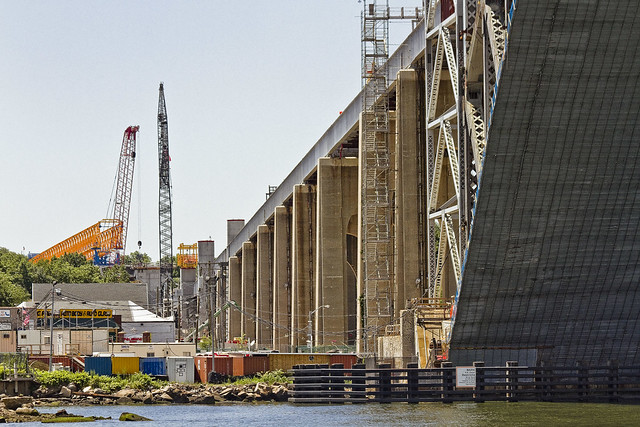
Your humble narrator was onboard solely to photograph this time around, and I soon found myself focusing in on the Bayonne Bridge reconstruction project.
– photo by Mitch Waxman
There are three major bridge projects underway in NY Harbor at the moment – two are replacements (Kosciuszko Bridge at Newtown Creek, and Tappan Zee over the Hudson) and the third is a retrofit – Bayonne Bridge.
In the case of Othmar Amman’s masterful Bayonne Bridge, the roadway is being raised to allow a new class of cargo ship access to the Port Newark terminals and it’s the BB’s owner which is running the show – The Port Authority of New York and New Jersey.
– photo by Mitch Waxman
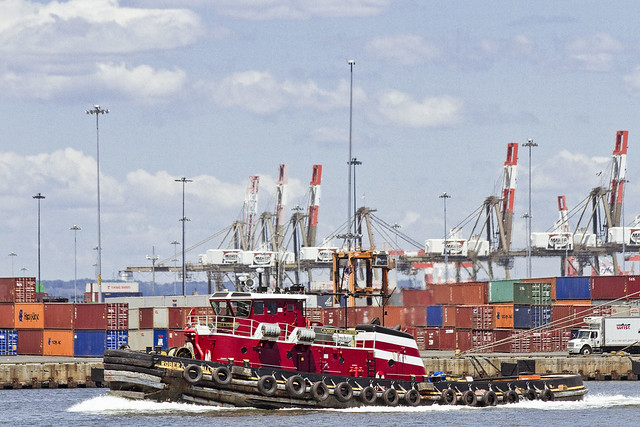
Bayonne Bridge spans the Kill Van Kull, connecting Staten Island’s North Shore to New Jersey. Just beyond it is the busiest cargo operation in the North Eastern United States. The continuing modernization of global container based shipping operations has created a sort of arms race to see how big a cargo ship can get (economy of scale) and the most recent iterations of these giants cannot cross under the roadway. In order to remain economically viable, the Port Authority has been forced to redesign the bridge so as to accommodate these larger vessels.
– photo by Mitch Waxman
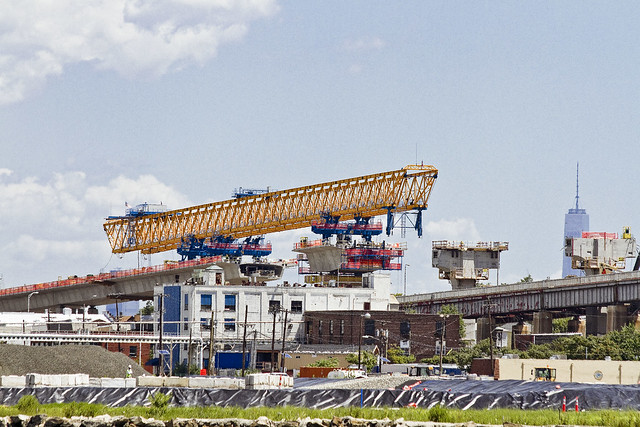
There’s all sorts of “big industry” involved in this sort of undertaking, and in the shot above and below, you will observe a “beam spreader.” It’s job is to hoist the sections of approach roadway into place and hold them steady while crews of workers secure them to both the pylons which will support them and to the previous sections already installed.
You can see the difference in altitude between the old and new roadway in the shot above, with the older approach visible to the right hand side of the shot, backed up by the Freedom Tower.

– photo by Mitch Waxman
After decades of inertia, wherein the various governmental entities found here in the megalopolis barely had the funding to perform basic maintenance on the various bits of infrastructure which make it possible to move people and commerce around, it’s actually startling to see so much of it going on all at once.
There is no investment more prosaic to make than in infrastructure. Unfortunately, in the case of all three bridge projects mentioned, none of them have avoided the mistakes of the House of Moses and incorporated a light rail line or any sort of mass transit into their modernizations. We are reinforcing and advancing the age of the Automobile.
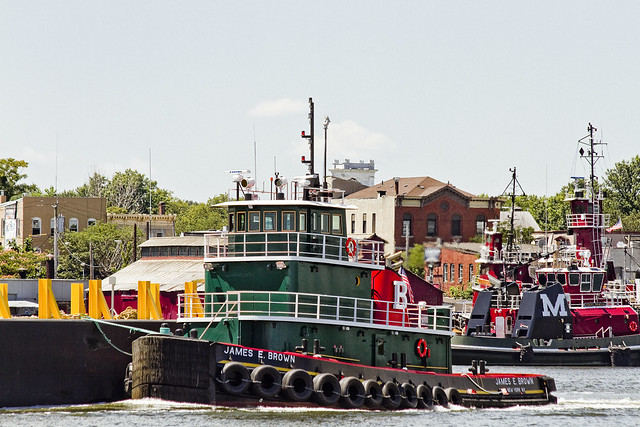
– photo by Mitch Waxman
Still, as I’m sure the crew of the James E. Brown tugboat would say about the project – “I feel good.”
Sorry – could not resist the pun.
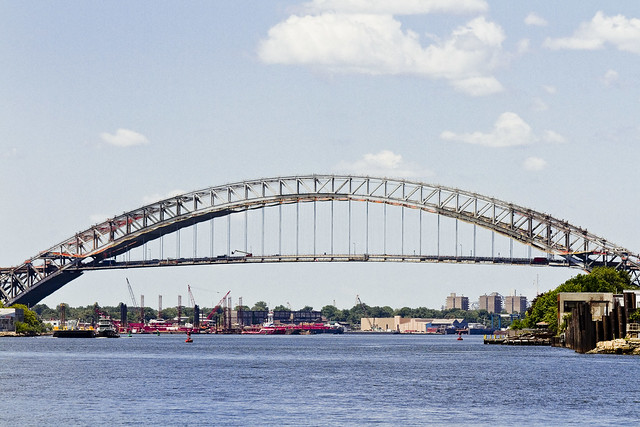
– photo by Mitch Waxman
The Bayonne Bridge project is ongoing, and will continue to be documented at this – your Newtown Pentacle.
For more on the Bayonne Bridge project, direct from the “horse’s mouth” as it were – check out this page at the Port a Authority’s website.
“follow” me on Twitter- @newtownpentacle
Upcoming Tours –
August 8th, 2015
13 Steps Around Dutch Kills – LIC Walking Tour
with Atlas Obscura, click here for details and tickets
evil design
Getting around town, in today’s post.

– photo by Mitch Waxman
A humble narrator’s antipathy towards entering the rat infested bunkers of sweating concrete that underlie the megalopolis has been fully explored in prior posts at this, your Newtown Pentacle. What are you going to do, though? There’s really only one truly economical way to get around in our city, and the subway is it.

– photo by Mitch Waxman
You could drive, I suppose, but one such as myself lives a mere three stops out from the City center, and cannot imagine bearing the costs and pain in the neck that maintaining an automobile would entail. My solution has always been to rent a car when I need one, which is not that often. It’s an expensive caprice, but no where even close to paying annual insurance, gas, and paying for the inevitable parking tickets.

– photo by Mitch Waxman
One has been making a dedicated effort to use the MTA bus system in the last year, as many of the places which I’m headed for in Queens are not served by the Subway system (or if they are, I have to loop through all of Manhattan to get there from Astoria). For instance, getting to Ridgewood, a distance of less than 6 miles from Astoria, would necessitate a 50 minute ride on the M which would visit most of Manhattan and a significant chunk of North Brooklyn.

– photo by Mitch Waxman
Far and away, my favorite form of transit are the ferries, and in particular the giant orange ones. East River Ferry has ironed out a lot of the kinks in their service in the last year, btw, and there’s now a smart phone app which publishes a schedule and anticipated times of arrival at the various landings. You can also purchase tix via the app. The big orange boat is free, incidentally, and is amongst other things – the most popular tourist destination in NYC.

– photo by Mitch Waxman
One would enjoy using the rich man’s preferred mode of transit, if only as a diversion, but this mode of transportation is ridiculously expensive – something like $2,000 per hour.
The best way to see NYC is on foot, of course.
This Sunday, I’ll be leading a walking tour of the eastern side of Newtown Creek for Newtown Creek Alliance, btw. Tix are still available, see the links below for more info.
“follow” me on Twitter- @newtownpentacle
Upcoming Tours –
August 2nd, 2015
The Insalubrious Valley of the Newtown Creek – Bushwick & Mapeth Walking Tour
with Newtown Creek Alliance, click here for details and tickets.
August 8th, 2015
13 Steps Around Dutch Kills – LIC Walking Tour
with Atlas Obscura, click here for details and tickets
 The Newtown Pentacle