Archive for the ‘Photowalks’ Category
quite convinced
– photo by Mitch Waxman
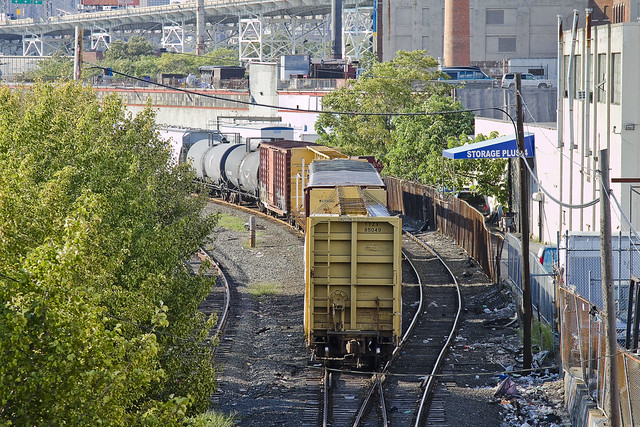
Recent financial setbacks and personal problems infect your humble narrator with a form of deep melancholy and a vast ennui. When such moments come upon me, there is a certain pizzeria in Greenpoint (Norman corner of Manhattan, near the train) whose offerings can be summed up best as: an actual and old fashioned “Brooklyn Slice”. On the day I spied this collection of rail cars at the so called “Bliss Tower” in DUGABO, I had scuttled forth from the rolling hillocks of my beloved Astoria in pursuit of one of these aforementioned slices, in an effort designed to brighten my mood.

– photo by Mitch Waxman
Errors and omissions mar my record when discussing the Rails, much to the chagrin of the knowledgable railfan community (whose helpful comments and corrections are always appreciated here at Newtown Pentacle). As such, what I can categorically tell you is that this a New York & Atlantic Locomotive, one of the 11 engine units which service the 269 miles of track operated upon by the Glendale based company in Brooklyn, Queens, and both Nassau and Suffolk counties. It shares much of its road with the passenger based Long Island Railroad, and NY&A’s distinctive emerald, white, and black engines are regularly observed around the Newtown Creek.

– photo by Mitch Waxman
Across the Newtown Creek Watershed, one encounters a landscape built for rail. Long abandoned track beds lie buried in inches of road asphalt, pointing the way to industrial giants long absent. Train stops orphaned from their purpose, spars and switches which were rudely severed to make room for modernity. All of it operated at street grade, and the remnants of the iron road are often the only tangible remains of great concerns and financial largesse. If you follow the right spar, you’ll discover that the NYPD Barricades unit was once Thypin Steel, or that LaGuardia Community College was once the Loose Wiles bakery and part of the Degnon Terminal.

– photo by Mitch Waxman
Within the communities which surround the Newtown Creek, a complaint often repeated concerns the presence of large numbers of trucks utilizing local streets in their quest to move goods from A to B. I had the privilege last year of attending a presentation by certain factions within the Port Authority that described a proposal which would eliminate several thousand truck trips a day throughout the City and over the George Washington Bridge, simply by shipping New York City’s garbage out to land fill utilizing locomotive rather than automotive means. Calculations about air pollution, road maintenance costs, and vehicular accident rates were presented at the time which compared rail quite favorably with truck based shipping.There was a maritime component to the plan as well, which was a bit hazy, but the train concept was spun gold.

– photo by Mitch Waxman
The shot above represents an NY&A Locomotive making a drop off of a customer in Maspeth near the ill fated St. Saviour’s church site, where they will uncouple a car or two for the unloading or loading of certain cargo. An unthinkable amount of trucks would be required to carry the same tonnage. The subject of Green Technology and “Greening New York” is often bandied about by many these days. Too much of the conversation, however, is “cocktail party environmentalism”- which sounds great but just isn’t practical on a policy level.
I’ve developed this funny notion, however, that the way forward is actually to re-imagine and re-invent the heaviest industry of them all.

– photo by Mitch Waxman
Rail infrastructure is what made Long Island City the factory of not just New York, but the entire world at the turn of the last century and multiple generations of capitalists and real estate interests founded vast fortunes because of the initial investment in it. Newtown Creek was the busiest waterway in North America, carrying more ship and barge traffic than the entire Mississippi for a time, and all of that maritime activity was fed by rail. Intermodal rail floats actually carried whole trains across the harbor to Manhattan, Staten Island, New Jersey and beyond. Imagine the benefits, in both individual wealth and environmental health, were we to try and save the future by looking for solutions in the past.
I’m still kind of forming this idea up for myself, but the key to it is containerization. More on this soon.
What do you, lords and ladies, think on the subject? Use the comments “Reply box” below, if you would like to start a conversation about it.
searing gusts

– photo by Mitch Waxman
That which does not think nor breathe yet instead hungers, a malign intelligence which cannot possibly exist yet nevertheless stares down upon the world of men from the apex of the Megalith, sits upon what can only be called a Hlidskjalf.
Odin had one, a chair set upon the highest peak from which he would dispatch his all seeing ravens- Huginn and Muninn– to spy upon men and report tales of mortal vanity and sin back to his “high seat”.

– photo by Mitch Waxman
A feverish and singular eye gazes down from its sapphire high seat, its vantage affording it the 53rd highest point of view available in New York City.
Your humble narrator maintains a vast cadre of whistle blowers, neighborhood cranks, idle laborers, low level government workers, and casual informants in the prosecution of this blog. Reports returned from this network who have witnessed the tableau laid before them from atop floors of the Megalith are tantalizing.
One might see the Battery and Hell Gate, Brooklyn’s East River and its Jamaica Bay coastlines, and every bridge to Manhattan for the price of turning ones head from up there- or so I am told.

– photo by Mitch Waxman
That behemoth which cannot possibly lurk there, squatting diabolically atop the highest point on Long Island as it searches the land below for rapacious profit, what can it know about the human world it gazes upon? Can it understand individuality, and environment, or does it just see numbers?
Were such an impossibility to exist, would it believe itself to be some sort of god as Odin did- an undying and omnipresent entity served globally by a growing and humorless army of mortal acolytes?

– photo by Mitch Waxman
All this is idle speculation, of course?
little memories

– photo by Mitch Waxman
What you’re looking at used to be one of the centers of the world, the Long Island Railroad terminus at 2nd street and Borden Avenue. The original version of the place was built in 1861 and provided egress to Manhattan via an enormous ferry terminal which shuttled commuters back and forth across the East River. This was (and is) the literal “End of the Line”.

– photo by Mitch Waxman
The station was electrified (WRONG, Sharp Eyed Reader “Kevin” points out that these are diesel trains) along with the rest of the LIRR western spurs, when the tunnels to Manhattan were opened in the early 20th century. The tunnels allowed direct transport to Penn Station, eliminating those delays associated with weather which plagued the ferry service.
Today, excess capacity during the slack time between rush hours can be found idling on the tracks on any given day.

– photo by Mitch Waxman
Several versions of the station have been installed here- for instance, a calamitous fire in 1902 destroyed the wooden buildings and train sheds which distinguished the place in the late 19th century. A trip to the acknowledged masters on the subject- the website arrts-arrchives.com is recommended for the curious.
revel and chaff

– photo by Mitch Waxman
As soon as the rain died down, I descended from Newtown Pentacle HQ here in the rolling hillocks of Astoria to the so called “Zone A” to see what Irene might have wrought here in western Queens. The shot above is from Second Street near Borden Avenue, at the largish worksite which Skanska has been employing hundreds for the last few months. Cleverly, the construction giant had dug a diversion ditch to allow storm water drainage.
Smart.

– photo by Mitch Waxman
“There will be plenty of cameras walking around in Tower Town, so it would be silly of me to spend much time there” were the actual words spoken to my walking companion, who we’ll call the Charismatic Croat (CC). CC was also told that we’d be taking a short walk, and would be back in a half hour. He’s used to my lies and wasn’t surprised when we had inexorably headed for another part of “Zone A”.
All through the storm, I was wishing that I had the camera out at Newtown Creek, or at least Dutch Kills.

– photo by Mitch Waxman
Curiosity about the actions of the much feared storm surge upon the fragile bulkheads of Dutch Kills was killing this cat, and I dragged CC back and forth over these streets. There was some flooding, but in the usual places that flood anyway. Back on 2nd street, a few nice shots of the surge were captured by Jesse Winter and others, and an actual wave of East River had risen up and flooded 2nd. The Crab House was bailing water from their basement and more than one giant puddle still remained.
Down at Dutch Kills, 29th street and the large truck yard which houses this cement company were under a foot or more of water- but they are regularly immersed by small amounts of rain anyway.

– photo by Mitch Waxman
What made the day noteworthy, from a Newtown Creek point of view, was this little river of urban chocolate flowing out of one of the many CSO’s (Combined Sewer Outfall) which are found abundantly along the waterfront of the Creek and it’s tributaries. It smelled just the way it looks like it might. One often sees discharges coming from these CSO’s, but this was just a spectacular flow.

– photo by Mitch Waxman
I will point out that this could be soil washed into the pipes during the tremendous amount of rain which Irene brought to Queens. It could be sand or actually be a chocolate spill at some industrial confectionary which got washed into the sewers or something. That’s what I said to CC at the time.
Doesn’t smell like chocolate, the Charismatic Croat opined.
quite submerged

– photo by Mitch Waxman
Today, I’m going to be uncharacteristically quiet, it’s all about the pictures. I was dreaming about flying again, in the manner of a super hero, and pulled these shots (some of which you’ve seen in other posts) together.

– photo by Mitch Waxman
Whenever I can attain some altitude, an attempt is made to record it, especially in the low lying areas of western Queens and North Brooklyn. In this shot, it was the Roosevelt Island Tram which elevated my point of view.

– photo by Mitch Waxman
Attempts and entreaties have been made- but so far- nobody in Long Island City has offered me roof or high floor access to shoot from one of the tower buildings. Haven’t asked anyone on Roosevelt Island yet, but the views of Queensboro and the East River must be glorious at night from there.

– photo by Mitch Waxman
I have been to the Ravell Hotel roof, which is in the lower right hand corner of the shot, which offers amazing views of the bridge and whose vantage lines up with the burning thermonuclear eye of God itself for “Manhattanhenge“.

– photo by Mitch Waxman
In Long Island City, the industrial zones are typically low lying in character, with few buildings exceeding 4 stories. Extreme reticence has been exhibited by property owners, when approached with requests of photographic access to their roofs or grounds. Insurance liability is the usual reply.

– photo by Mitch Waxman
The ultimate viewing platform, of course, would be from the Citibank Megalith. Like Odin on his hildskalf, one might observe the entire world from up there, seeing the in the perspective of that thing in its summit which cannot possibly exist and does not think or breathe, yet hungers.

– photo by Mitch Waxman
From up there, the entire soup bowl of New York Harbor is available for viewing. The megalith is visible from many faraway points in the harbor, and if you can see it- it can see you. On a clear day, the thing in its summit (were it to exist) can see the Narrows and Long Island Sound and Jamaica Bay and the Hudson.

– photo by Mitch Waxman
Terrestrial and aquatic vantages have been my only succor in recent months, but an urge to look down from above is upon me, and scry the ancient patterns of life which invisibly govern the present City.

– photo by Mitch Waxman
Probably why I’m dreaming of flying…


