Archive for the ‘Pickman’ Category
excite attention
It’s National Bologna Day, in these United States.

– photo by Mitch Waxman
For many reasons, a humble narrator has found himself at Hallets Cove along the Astoria waterfront in recent weeks. Partially, this recent focus was related to a humble narrator being invited to write a guest blog for the NYC Ferry service’s new Astoria stop (check it out here), but didn’t go “super granular” with it in my usual manner. Something I learned while writing my old Brownstoner Queens column was sometimes you need to approach a story, and a more general audience, with a different voice than you normally would (the NYC Ferry is operated by the Hornblower company, under the auspices of the NYC EDC, in case you’re wondering).
The other reason I’ve been down at Hallets Cove a lot in recent weeks has been to actually use the Ferry to get to and from work, as the MTA has seemingly deduced that nobody in Queens needs to get to and from Manhattan on the weekends. Luckily, my destination for conducting boat tours is Pier 11, which is one of the terminal stops for the ferry, so problem solved.

– photo by Mitch Waxman
The kids of Queens never disappoint, as evinced by these phalluses recently scratched into the sand at Hallets Cove. There’s actually a lot of fine detail to appreciate in these, from the spurts to the hairy sacks. Good show.
As a note, I know of just three sandy beaches along the East River, Hallets Cove being one.

– photo by Mitch Waxman
The future site of a floating “Eco Dock” as my pals from the Waterfront Alliance call it, one has long been fascinated by the muddy flats underlying a discarded pier found at the entrance to the NYCHA Astoria Houses on what is historically known as Lawrence Point, but which has been rechristened as “Astoria Point” by real estate interests and elected officialdom alike.
This sort of marshy area is immensely important to the ecology of the waters surrounding NYC, as my pals from Riverkeeper will tell you, and you don’t see very much of it.

– photo by Mitch Waxman
There’s a derelict pier overflying those muddy flats, which as mentioned, will be replaced with an eco dock. My understanding is that the pier was installed to support a radio station’s broadcast tower, specifically WLIB, back in 1953. Further, I’m told that the radio station abandoned this location in 1967, and that the structure has been feral ever since.

– photo by Mitch Waxman
If you haven’t tried out the new ferry service leaving from Astoria yet, I recommend it for nothing other than seeing the sights. The route carries you along the east channel of the East River, which transits between the Ravenswood section of Long Island City and Roosevelt Island. You’ve got some pretty incredible stuff along the route, including both the Roosevelt Island Lift bridge and the amazing Queensboro bridge, and the Big Allis power plant is on display as well.
This particular ferry service makes an amended series of stops as compared to the longer tenanted East River route, stopping first at Roosevelt Island, then the northern ferry stop at Hunters Point, 34th street and then Pier 11/Wall Street in Manhattan. Im personally really looking forward to the upcoming Soundview route, opening in 2018, which will go to the southeastern Bronx – which is the unknown country for one such as myself.
Check the Astoria ferry out, what else have you got to do?
Upcoming Tours and events
Exploring Long Island City, from Luxury Waterfront to Abandoned Factories Walking Tour,
with NY Adventure Club – Sunday, November 12th, 2:30 p.m. – 4:30 p.m.
Long Island City is a tale of two cities; one filled with glittering water-front skyscrapers and manicured parks, and the other, a highly active ground transportation & distribution zone vital to the New York economy — which will prevail? With Newtown Creek Alliance Historian Mitch Waxman – details here.
“follow” me on Twitter- @newtownpentacle
secret societies
It’s National Brandied Fruit Day, in these United States.

– photo by Mitch Waxman
Another few weeks to go and then I get to become gods lonely man again, a situation which a humble cannot wait for this year. There’s been a couple of days in the last week wherein my “full armor” has been deployed, and a filthy black raincoat has been observed by the hard hats of Newtown Creek as it flaps about in the wind beyond their fences. The “me” who conducts the tours is by design a very nice fellow, generous with his time, and entirely mission oriented towards my portion of the Newtown Creek Alliance motto of “reveal, restore, revitalize.” I’m on the “reveal” side of things, incidentally. As far as the other two go, I’d advise you visit newtowncreekalliance.com and check out the various street end projects in Maspeth and Greenpoint being worked on my colleagues at NCA, as well as the very promising “North Henry Street project” and Living Dock. NCA is loosely affiliated with multiple organizations around the Newtown Creek watershed, sharing both members and goals.
One of those organizations is the frankly spectacular Smiling Hogshead Ranch on Skillman Avenue at Pearson Place in Long Island City. A community garden and urban farm, the Hogshead folks are presenting a Harvest Festival at their site tomorrow – Saturday the 21st – between noon and seven p.m. I’m going to conduct three short walks for them, free, starting at 2, 3:30, and 5 if you want to come along and meet the folks who turned a derelict set of rail tracks into a verdant green space with little more than the sweat of their brows.

– photo by Mitch Waxman
One realizes that he is deluding himself about just being able to button up the raincoat and disappear into the miasmic air of the Newtown Creek for a while, since I’ve become fairly familiar to the folks who work around the creeklands and despite all of my best efforts to remain isolated from humanity… one will end up having to talk to them. Unfortunately, I have become… some how… garrulous and affable. This shakes my entire self image.
How the hell did this outsider end up being affable? Just the other day, one opined to “Our Lady of the Pentacle” that I have somehow become “approachable” in recent years. Used to be that when I walked into a shop, security would follow me around and old ladies would clutch at their purses out of shock and fear. I’d see some monster staring at me from across the room, and then while reaching out to touch its horrible countenance, suddenly realize that I was looking in a mirror and touching a pane of silvered glass. Our Lady informed that I’m old now, which makes me seem less “edgy” than formerly.
Saying that, a couple of rather inexpensive but recent additions to my camera bag have created new possibilities for night shooting, which is something I plan on doing a LOT of in the coming months of sepulchral darkness and cold.

– photo by Mitch Waxman
Oh, to dance along the bulkheads again. Filthy black raincoat flapping in the wind, camera in hand, dodging trucks and trains. Recording the truth of our times in graphic narrative and garish color, and uncovering the tales of days gone by when clear eyed mariners plied the grease choked water in steam powered vessels. Poking my lens into the nooks and crannies of that lugubrious cataract of urban decay known as the Newtown Creek…
“follow” me on Twitter- @newtownpentacle
stymied appetites
It’s National Seafood Bisque Day, in these United States.

– photo by Mitch Waxman
One loathes the fact that the Queens Cobbler, a probable serial killer operating on both sides of the Newtown Creek who leaves single shoes behind as a taunt to both community and gendarmes alike, left this stiletto heeled shoe behind at the very same Astoria saloon at which a humble drinks his troubles away. Just last weekend, on a night when I had brought my little dog Zuzu out with me for an evening of commiseration with the neighborhood commentariat – as I was walking my trusty canine around the corner to allow for a moment of her lavatorial relief – this scene was encountered.
Should you find a singular size 11 Merell hiking boot displayed prominently somewhere in North Brooklyn or Western Queens, that means the Cobbler has finally zeroed in on me and that you’ll need to find a replacement for this – your Newtown Pentacle. If you see a headline saying “blogger catches killer” then it’ll mean I got the best of him or her.

– photo by Mitch Waxman
One has been working on a Newtown Creek event, one which is not public facing I’m afraid, assiduously over the last couple of weeks and is highly distracted. Due to this – and other obligations – one hasn’t had a lot of “me” time. One of those many obligations recently saw me attending a rather contentious meeting with environmental officialdom in Sunnyside, where I noticed some fellow doing his job in the rain at a local tire shop on 39th street.
The “G” bomb, which is the term I use for the unfolding wavefront of so called “gentrification” has observedly hit the street side auto industry hardest in recent years. Gas stations, taxi yards, tire shops, mechanics – have all been disappearing at a rapid rate in recent years. They occupy large lots and generally have shallow pockets, a pair of factors which are quite attractive development opportunities for the Real Estate Industrial Complex.

– photo by Mitch Waxman
A Subway conductor recently told me that MTA employees absolutely hate it when shots like the one above are captured. They are especially enraged when their faces are recognizable. One plans on continuing to photograph the men and women who operate the system, however. Just last night, when a token booth worker at Fulton Street made me miss two trains so that he could complete a phone call with his wife before performing the transaction to charge up my Metrocard, I didn’t take his picture as I was particularly “geared up” with a tripod and bag of lenses and my hands were full.
Another reason for me to enjoy enraging the MTA workforce with photos captured involves the weekend habits they employ, announcing that a train is going express to some extant locale just after the subway doors close at Queens Plaza, negating any chance of not visiting Forest Hills or Briarwood.
“follow” me on Twitter- @newtownpentacle
doomed intuitions
It’s National Chocolate Cupcake Day, in these United States.

– photo by Mitch Waxman
Legend has it that on one particular evening Mose the Fireboy, who was the legendary “sachem” and hero of the Bowery B’hoys gang in 19th century NYC, heard that a sea serpent had appeared on the East River. Mose, a giant whose legends are similar to those of the gargantuan lumberjack Paul Bunyan, rowed out onto the river and plucked the leviathan from the water with his bare hands. Strangling the monster in his iron grip, Mose then skinned the great beast and brought his prize to McGurk’s Suicide Parlor – a bar formerly found on the west side of the Bowery, nearby Cooper Square at east 4th street. It’s said that the skin hung over the bar afterwards, as a totem of the mysteries of the harbor and testament to the great strength and power of Mose. Mose supposedly could extinguish blazes by clapping his hands and was known to smoke three cigars at the same time. If his horse wasn’t pulling the fire wagon fast enough, Mose would pick up the horse in one hand and the wagon in the other and carry them. Mose the fireboy was apparently quite a fellow, so much so that he was a regular character appearing in Bowery theater productions centered around “life in our town.”
The largest known specie of eel, incidentally, is the European Conger, which is known to grow to lengths of nearly ten feet and achieve body weights of up to 240 pounds. They’re native to the eastern Atlantic Ocean and tend towards the European coastline. They’re carnivorous, feeding on all sorts of deep sea critters, and have been found at depths of up to 3,840 feet. The American Eel is a relative dwarf in comparison, achieving lengths of up to 4 feet and body weights of up to 17 pounds.

– photo by Mitch Waxman
The largest living crab, and largest arthropod as well, is the Japanese Spider Crab. Large specimens can spread their clawed arms out to span 18 feet, and they can weigh as much as 42 pounds. Closer to home, the American Lobster (Homarus americanus) is known to achieve weights of 44 pounds and body lengths of two feet – excluding their claws. Both are members of the Malacostraca class of crustaceans, whose ancestors first appear in the fossil record during the Cambrian age. All sorts of large marine animals are spotted in the East River from time to time – including cetaceans like Whales and Dolphins, large bony fish and living fossils like the Sturgeon, and occasionally sea turtles.
The leatherback sea turtle is the largest extant turtle and fourth largest living reptile, and can be found in nearly all of the world’s ocean waters. Leatherbacks can grow to nearly seven feet in length and achieve body weights of up to 2,000 pounds. Sea Turtle ancestry dates back to the Triassic age.

– photo by Mitch Waxman
In 1895, the NY Times offered reports of a sea serpent of more than 100 feet in length moving quickly through New York Harbor about a half mile from shore. According to the testimony of one Willard P. Shaw of Wall Street, it repeatedly raised its head out of the water more than ten feet above the waves. Shaw’s story was confirmed by other witnesses.
This sounds like the sort of thing we would need Mose the Fireboy to handle.
Who can guess, all there is, that might be sloshing and swimming around down there?
“follow” me on Twitter- @newtownpentacle
no business
It’s National Pasta Day, in these United States.

– photo by Mitch Waxman
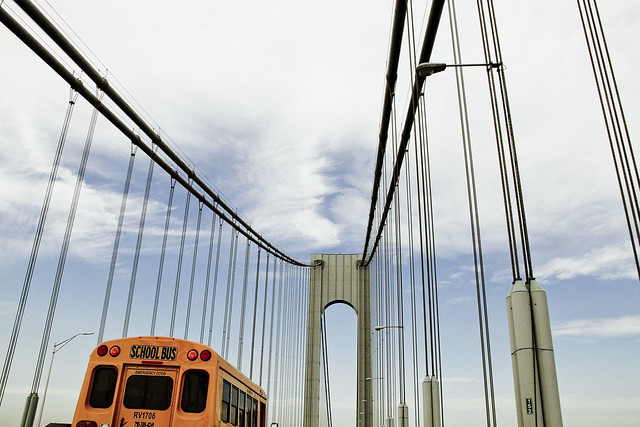
Before I offer a conspiracy theory in today’s post, lets instead start with a bit of NY Harbor trivia – the height of all ships doing business within the Port of New York and New Jersey is governed by the height of the Verrazano Bridge’s span, as relative to the water. All cargo, military, and cruise ships which can be anticipated to someday enter NY harbor are actually designed with the Verrazano’s height in mind.
That means, ultimately, that this last exemplar of the House of Robert Moses erected in 1964, which sets a maximum height limit of exactly 228 feet over the water (at high tide), controls the design of a good chunk of the planet’s shipping fleets (although you’d be scraping the Verrazano’s deck at 228′ so they build them a bit shorter). A somewhat contemporaneous counterpart to the Verrazano is the Puente de las Américas (Bridge of the Americas) over the Panama Canal, which also plays a major role in the design of maritime vessels, setting a height limit of 201 feet over high water for any and all vessels using the crossing. The other approach to the Port of New York and New Jersey is governed by the Goethals Bridge over the Arthur Kill, which offers 135 feet of clearance, just to be entirely anal retentive about things.

– photo by Mitch Waxman
Verrazano Bridge is startlingly enormous, with a main span over the narrows stretching out for nearly a mile at 4,260 feet. Engineer Othmar Amman always liked to point out that his team had to take the curvature of the Earth itself into account when designing and placing the towers, which are off parallel to each other by 1.625 inches. When you add in the approaches on either side to the bridge, the entire thing is some 13,700 feet in length – roughly 2.6 miles. It’s now the 11th largest suspension bridge in the world, and the longest found on either American continent.
There are 143,000 miles of wire incorporated into its cables, enough to wrap around the earth’ equator 5.74 times or stretch half way to the moon. Its towers are 649.68 feet tall, making them the tallest structures outside of Manhattan in all of New York City. It carries nearly 190,000 vehicle trips a day, 69.35 million annually. The best estimates I’ve been able to find suggest that the combined steel of the bridge weighs some 1,265,000 tons.

– photo by Mitch Waxman
The Verrazano Bridge, due to its position and height, is affected by weather more heavily than any other span in New York Harbor. The roadway will actually sag down about a dozen feet during the summer months due to heat expansion, and the winds one encounter on the upper roadway preclude any discussion of pedestrian or bicycle paths being established. One can personally report that while driving over the thing during storms, my automobile was being rocked from side to side by heavy gusts of wind. The bridge is owned and operated by the MTA Bridges and Tunnels division, which is what Governor Nelson Rockefeller turned Robert Moses’s old Triborough Bridge and Tunnel Authority into.
The people at Bridges and Tunnels have a set of rules and customs governing the bridge during harsh weather conditions, which all depend on whether or not the roadways are wet or not, and whether the winds are either sustained or gusting. Speed restrictions begin to apply at 30 mph sustained winds and wet roads, while wet conditions coupled with sustained wind over 40 mph might trigger restrictions on crossings by motorcycles, mini buses, tractor trailers and other types of vehicles.

– photo by Mitch Waxman
I’ve noticed, over the years, that all of NYC’s bridges are possessed of a certain and unique to the span harmonic. Partially, it’s how the structure of the bridge interacts environmentally and also because of the sound of the vehicles running over it cause a vibration as their tires spin against the decks. To my hearing, the Verrazano makes a “wmmm-mmm-mhoooooosh-shhh” sound, but that could just be the particular interaction with the roadway of the vehicles which a humble narrator crosses the thing within, which have always been passenger cars. It’s efficacious to close your windows on the bridge no matter what, lest a torrent of air suddenly swirl into the passenger cabin, causing disarray and a tumult. I’ll leave it to musicians to tell you what key the Verazzano Bridge is in.
Like all MTA Bridges and Tunnel crossings, certain types of vehicles are forbidden. These types of vehicles (amongst others) include steam rollers, vehicles loaded with unconfined animals or poultry, wheelbarrows, and velocipedes.
Yes, they specifically mention velocipedes in the rules.
– photo by Mitch Waxman
I’ve always thought, with the born and raised in Brooklyn perspective that I am possessed by, that the bridge is actually some sort of giant shackle forcing the former City of Richmond or… Staten Island… not to secede from the City of Greater New York and join up with New Jersey instead. A mass exodus of Brooklynites, including my own parents, occurred during the late 1980’s and 90’s to Staten Island over the thing. Most of them, to quote my Dad, were “sick of this shit, and wanted to get the ‘eff out of here,” referring to the colloquialized “old neighborhood” which was “better back then.” I still don’t believe the old adage about being able to leave your door unlocked at night. Rent was a bit cheaper on Staten Island however, my parents perception of crime was far lower, and the semi suburban lifestyle encountered on Staten Island appealed to them in their retirement and dotage. They were also one step closer to Atlantic City where they liked to go on weekends away.
Staten Island is “car country,” unlike the city center neighborhood of Astoria, Queens where I now live. Mass transit (other than the ferry, I mean) exists but… you kind of need to have a car on Staten Island.

– photo by Mitch Waxman
Now for the conspiracy theory: A humble narrator is an idiot, of course, and has always cherished a personal theory that Robert Moses knew something more about NYC than he was letting on. Famously, before beginning his government career, Moses wandered the countryside on foot. Robert Caro suggests that even at a young age, he was planning highways and parks. Pffft… who does that at an early age? Moses was monster hunting, obviously, and he must have found something terrifying during his wanderings. I mean… c’mon… that’s fairly obvious, right?
Why else would he have built a steel and concrete cage around New York Harbor? Would old Bob Moses really have gone out of his way to destroy the coastal wetlands, swamps, and tidal marshes (which are precisely the sort of places you’d find monsters like “Grendels Mother” lurking) of New York Harbor for no reason other than malice? After conquering the human/fish hybrids at Hells Gate with his mighty Triborough, he set about the process of creating the world’s biggest padlock here in the narrows to close the door on his monstrous gate.

– photo by Mitch Waxman
Who can guess, all there is, that might be imprisoned down there beneath the 1,265,000 tons of steel? Is the arterial highway and bridge crossing system of New York City actually some sort of great barrier designed to keep slime dripping colossi in check? Is there some dark secret which will be held forever unknowable and immobile by the Verazzano Bridge?
What hidden and occult knowledge did Robert Moses take to the grave with him?
“follow” me on Twitter- @newtownpentacle


 The Newtown Pentacle