Archive for the ‘Pickman’ Category
jester’s whim
Is reality real, really?

– photo by Mitch Waxman
Your humble narrator spends an awful lot of time gazing at his navel, but can’t shake the sneaking suspicion that reality is some sort of confidence game. One of the “very bad ideas” which can literally drive you mad is the notion that none of this is real, and that the world is in fact either a simulation or hallucination. This is usually the time when my dad would slap me across the face, ask me if that felt real, and then remind me to pass him the screw driver he asked for. Still, one wonders, and more than wonders…
from wikipedia
A hallucination is a perception in the absence of a stimulus which has qualities of real perception. Hallucinations are vivid, substantial, and located in external objective space. They are distinguished from the related phenomena of dreaming, which does not involve wakefulness; illusion, which involves distorted or misinterpreted real perception; imagery, which does not mimic real perception and is under voluntary control; and pseudohallucination, which does not mimic real perception, but is not under voluntary control. Hallucinations also differ from “delusional perceptions”, in which a correctly sensed and interpreted stimulus (i.e. a real perception) is given some additional (and typically bizarre) significance.

– photo by Mitch Waxman
If your eyes are misting over at the thought of reading more of the self pitying existential claptrap which is periodically offered at this, your Newtown Pentacle, apologies are offered. The question of perception, and as an artist- of reproduction- is something which has long interested me. It’s one thing to be standing at Queens Plaza and perceive that a train has arrived, but how does the brain put that together – do the math- from a photograph?
A great primer on subjective realities and the circuitry of perception is found in Oliver Sacks’ “The Man Who Mistook His Wife for a Hat,” which discusses how the intracranial landscape is both neurologically formed and kept informed by the data gathering network and sensors of the nervous system.
from wikipedia
The process of perception begins with an object in the real world, termed the distal stimulus or distal object. By means of light, sound or another physical process, the object stimulates the body’s sensory organs. These sensory organs transform the input energy into neural activity—a process called transduction. This raw pattern of neural activity is called the proximal stimulus. These neural signals are transmitted to the brain and processed. The resulting mental re-creation of the distal stimulus is the percept. Perception is sometimes described as the process of constructing mental representations of distal stimuli using the information available in proximal stimuli.

– photo by Mitch Waxman
Perceptions of social “monkey” stuff are easy to understand, as the qualities of every interaction with another human is run through a checklist of prejudices, past grievances, wounds, and defeats for possible objection or approval. That is a purely individual thing, dependent on one’s past experience and cultural heritage or baggage. It’s why some folks “don’t like the look” of others, and forms the third leg of the “throne of evil” along with the first and second legs- disappointment and loneliness.
The question I always wonder about, however, is this- when two people say something is blue or red or yellow or round or sqaure, what subjective criteria can be asserted which defines what those terms mean to them? How do we know that a traffic light turned red looks the same to me as it does to you? Is it the same red we see?
What might you or I be seeing, that no one else can perceive?
from wikipedia
The ganzfeld effect (from German for “complete field”) or perceptual deprivation, is a phenomenon of perception caused by exposure to an unstructured, uniform stimulation field.
It has been most studied with vision by staring at an undifferentiated and uniform field of colour. The visual effect is described as the loss of vision as the brain cuts off the unchanging signal from the eyes. The result is “seeing black” – apparent blindness. It can also elicit hallucinatory percepts in many people, in addition to an altered state of consciousness.
Ganzfeld induction in multiple senses is called multi-modal ganzfeld. This is usually done by wearing ganzfeld goggles in addition to headphones with a uniform stimulus.
A related effect is sensory deprivation. With sensory deprivation, however, a stimulus is minimized rather than unstructured. Ganzfeld is thus perceptual deprivation. Hallucinations that appear under prolonged sensory deprivation are similar to elementary percepts caused by luminous ganzfeld, these include transient sensations of light flashes or colours. Hallucinations caused by sensory deprivation can, like ganzfeld-induced hallucinations, turn into complex scenes.
“follow” me on Twitter- @newtownpentacle
Want to see something cool? Summer 2013 Walking Tours-
Kill Van Kull– Saturday, August 10, 2013
Staten Island walking tour with Mitch Waxman and Working Harbor Committee, tickets now on sale.
13 Steps around Dutch Kills– Saturday, August 17, 2013
Newtown Creek walking tour with Mitch Waxman and Newtown Creek Alliance, tickets now on sale.
unsanctioned frenzy
Pondering while wandering.

– photo by Mitch Waxman
I’m all ‘effed up. As is my habit during the summer, vast explorations of existential angst and delusion rule those intracranial electrical impulses which one might generously describe as thoughts. Fear, repulsion, and raw terror are the contents of that glob of salty fat which sits between the oddly shaped ears, above the loathsome mouth, and an inch or two behind the spectacles. The particular organ in question has been giving me trouble of late, and in the future I intend to use it gently as a repetitive stress injury seems to be taking hold.
from wikipedia
A semi-trailer is a trailer without a front axle. A large proportion of its weight is supported by a road tractor, a detachable front axle assembly known as a dolly, or the tail of another trailer. A semi-trailer is normally equipped with landing gear (legs which can be lowered) to support it when it is uncoupled.

– photo by Mitch Waxman
Disappointment and loneliness are the root causes of all the worlds trouble, the Castor and Pollux of evil. One such as myself, however, is drawn to their stormy coastlines with its craggy delights. Your humble narrator has too full a schedule for the “Bon Vivant” and joys of summer, it seems, and is instead a mass of mouldering psychological injuries held together with string and sealing wax. Frivolities are not meant for such a creature- who is nothing less than an assassin of joy, mental weakling, physical coward, and a most feckless quisling.
from wikipedia
Emotional baggage is an everyday expression that correlates with many varied but similar concepts within social sciences, self-help movements, and other fields: its general concern is with unresolved issues of an emotional nature, often with an implication that the emotional baggage is detrimental.
As a metaphorical image, it is that of carrying all the disappointments, wrongs, and trauma of the past around with one in a heavy load.

– photo by Mitch Waxman
Arcane ideations torment, coupled as they are with a startling emotional numbness, and one suspects that all this might not actually be happening. A sneaking suspicion, lurking maliciously at the scarred threshold of that glob of electrically charged, and quite salty, fat a couple of inches behind my glasses is not interpreting the world accurately, torments. A long standing delusion one suffers from, separate from the one which causes me to always look over my left shoulder when walking through Woodside at night, is that this all might be some sort of cruel simulation being run by an extra dimensional and all powerful entity which seeks to stress test and then judge one harshly according to an arbitrary set of rules. The existence of such a being would be outlandish, of course, as there is no evidence of such an entity other than in desert legends, folk stories, and peasant traditions.
from wikipedia
The simplest use of brain-in-a-vat scenarios is as an argument for philosophical skepticism and solipsism. A simple version of this runs as follows: Since the brain in a vat gives and receives exactly the same impulses as it would if it were in a skull, and since these are its only way of interacting with its environment, then it is not possible to tell, from the perspective of that brain, whether it is in a skull or a vat. Yet in the first case most of the person’s beliefs may be true (if they believe, say, that they are walking down the street, or eating ice-cream); in the latter case their beliefs are false. Since the argument says one cannot know whether one is a brain in a vat, then one cannot know whether most of one’s beliefs might be completely false. Since, in principle, it is impossible to rule out oneself being a brain in a vat, there cannot be good grounds for believing any of the things one believes; a skeptical argument would contend that one certainly cannot know them, raising issues with the definition of knowledge.
“follow” me on Twitter- @newtownpentacle
Want to see something cool? Summer 2013 Walking Tours-
Kill Van Kull– Saturday, August 10, 2013
Staten Island walking tour with Mitch Waxman and Working Harbor Committee, tickets now on sale.
13 Steps around Dutch Kills– Saturday, August 17, 2013
Newtown Creek walking tour with Mitch Waxman and Newtown Creek Alliance, tickets now on sale.
peculiar erudition
Neither Tea nor Tiger…

– photo by Mitch Waxman
After Richard Croker and the Tammany crew in Manhattan managed to beg, borrow, and steal enough support and patronage in Albany and around the independent municipalities which they successfully consolidated into the City of Greater New York in 1898, they had bills to pay. Tammany paid its way by handing out open ended municipal contracts, and in 1903, one them was called the Grand Street Bridge. The slogans bandied about by the local politicians who were not playing ball with the Manhattan crowd was “Keep the Tiger out of Queens,” or “Neither Tea nor Tiger.”

– photo by Mitch Waxman
In the run up to the consolidation, which was decided by a special election, a banner hung nearby this spot which admonished that were the Tammany crowd to gain control of Queens and Brooklyn they would create a wasteland of noxious industries, cemeteries, and trash heaps here. Back then, it was called Whites Dock, and the swampy wetlands were described as being thick with fish and mussels as late as the 1880’s.

– photo by Mitch Waxman
The first bridge here, a wooden drawbridge was erected in 1875, followed by a second wood bridge erected in 1890. The modern day Grand Street Bridge over Newtown Creek was opened in 1903, was built by the King Bridge Co. and is a swing bridge. A swing bridge is s structure that pivots 90 degrees on a mechanical turntable, allowing maritime traffic egress by opening an aperture. Grand Street Bridge is the frontline, the DMZ, of the currently undefended border of Brooklyn and Queens.
“follow” me on Twitter- @newtownpentacle
Want to see something cool? Summer 2013 Walking Tours-
Kill Van Kull– Saturday, August 10, 2013
Staten Island walking tour with Mitch Waxman and Working Harbor Committee, tickets now on sale.
13 Steps around Dutch Kills– Saturday, August 17, 2013
Newtown Creek walking tour with Mitch Waxman and Newtown Creek Alliance, tickets now on sale.
vast and inscrutable
…stand beside her, and guide her…

– photo by Mitch Waxman
A joke those of involved with New York Harbor throw readily around is that there is a coast guard regulation which states that every harbor tour has to stop at the Statue of Liberty. Its become such a ubiquitous part of the “experience” that I barely shoot the thing anymore, which is a huge mistake.
Never, never, ignore an icon. That is, unless you are jaded idiot like me.

– photo by Mitch Waxman
Many of the tourists on the Staten Island Ferry- did you know that the Staten Island Ferry is NYC’s #1 tourist destination- come out just for their statue shot. At the mid point of the 30 minute trip, port or starboard (depending) gets mobbed with visitors taking “selfies” and family shots. When your humble narrator is onboard the big orange boat, I’m usually looking for unusual harbor traffic and treat the statue as little more than background.
Liberty is not just part of the landscape, nor should it ever be taken for granted.

– photo by Mitch Waxman
Given the events of the last decade or so, with the beating of war drums and other dire portents omnipresent, even one such as myself has begun to look toward this ubiquitous icon with new eyes. She was the product of a brutal era, the symbol of a comparatively innocent time, and meant to serve as a beacon. According to Teddy Roosevelt, she was useless as a light house.
Its a complicated concept- this “liberty,” as embodied by a 111 and a half foot tall French chick with a four and half foot long nose and a thirty five foot waistband who is well over a hundred years old.
“follow” me on Twitter- @newtownpentacle
Want to see something cool? Summer 2013 Walking Tours-
Modern Corridor– Saturday, July 13, 2013
Newtown Creek walking tour with Mitch Waxman and Atlas Obscura, tickets now on sale.
Kill Van Kull– Saturday, August 10, 2013
Staten Island walking tour with Mitch Waxman and Working Harbor Committee, tickets now on sale.
13 Steps around Dutch Kills– Saturday, August 17, 2013
Newtown Creek walking tour with Mitch Waxman and Newtown Creek Alliance, tickets now on sale.
Modern Corridor
Want to see something cool? Bring a camera, and follow me.

– photo by Mitch Waxman
When I decided to start doing walking tours of the Newtown Creek watershed a few years ago, I found myself presented with a significant organizational issue. There’s a different story to be told about Maspeth than there is about Greenpoint (also, there are arguably two Greenpoints), yet… the two communities are inextricably linked up. Same thing with Bushwick and Ridgewood, or the residential centers at the Creek’s intersection with the East River. 3.8 miles long by around a mile wide, the Creeklands are vast when on foot. There is also SO much information to pass along, not just about the Creek’s past, but about all the stuff that’s going on right now- EPA, Superfund, the cool things my pals in NCA are doing with Green Infrastructure and Citizen Science…

– photo by Mitch Waxman
My solution was to simply to connect the stories of these places up along the ancient roads or paths along which they grew, and follow the water from one borough to another. “Poison Cauldron” does the Greenpoint to Bushwick route, “Insalubrious Valley” follows a colonial era turnpike path, “Glittering Realms” moves from residential East River Greenpoint back to the industrial zone along another colonial pathway, and “13 Steps around Dutch Kills” traces the Queens tributary back to the Creek and ends at its smaller counterpart Whale Creek in Brooklyn.
The new one- “Modern Corridor”- is all about Hunters Point, one of the least known sections of New York City, which sits directly opposite the Shining City of midtown Manhattan.

– photo by Mitch Waxman
This “Modern Corridor” walking tour starts at the old city center, nearby Jackson Avenue and Court Square, and explores the brave new world rising from the ashes of a 19th century industrial titan- the independent municipality of Long Island City. Writ large, the growing community of the titan real estate development which has reshaped the colonial vintage section of Queens called Hunters Point will be encountered, and one of the finest parks in the entire city visited. This park is built upon a significant piece of rail infrastructure which once allowed train cars to be loaded onto barges for maritime transport to Manhattan and points west.

– photo by Mitch Waxman
Then we walk through to the proverbial wrong side of the tracks, and to the industrial machine surrounding the infamous Newtown Creek. Former home to sugar refineries and cargo docks, rail yards and powerhouses, this will be the future home of thousands who will live in the forthcoming Hunters Point South development which has already begun construction. See it as it is, before the towers rise and the land is reshaped to modern wants and desires.
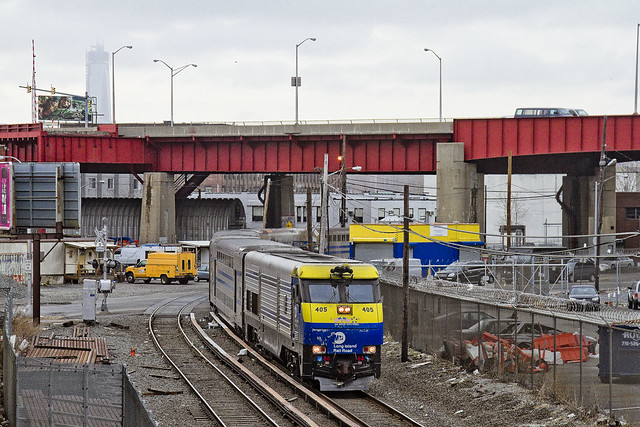
– photo by Mitch Waxman
Skirting along the Creek, you’ll see vast infrastructure, visit DUPBO (Down under the Pulaski Bridge Onramp), and walk over railroad tracks as we head back to the modern incarnation of Long Island City. Bring your cameras, as your friends won’t believe you when you try to describe the places you’ve witnessed. Closed toe shoes are also highly recommended, as is a hat or parasol as there will be little to no shelter from the burning thermonuclear eye of god itself. The walk will be approximately 2 hours in length and will cross all sorts of ground. There will be one flight of stairs involved.
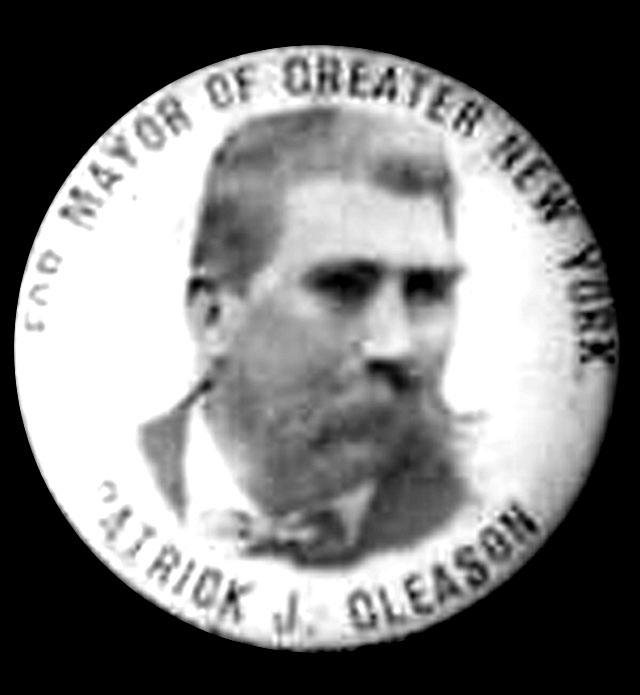
– photo by Mitch Waxman
We’ll be passing from the 21st century all the way back to the 1600’s with particular emphasis on the late 19th century, when the fellow pictured above- the notorious Patrick “Battle-Ax” Gleason, served as the last Mayor of Long Island City. Gleason was personally responsible for the construction of the exquisite PS1 schoolhouse pictured in the second shot above, which nearly bankrupted LIC- amongst other imbroglios. Dogged by claims and accusations (and at least one conviction) of corruption- Gleason used to sit in a barber chair outside the Miller Hotel- which is today the LIC Crab House- and hold court with constituent and passerby alike. This was his favorite spot, directly across the street from the LIRR train and ferry terminal. He told those he met to avoid addressing him as “Mayor”, instructing them instead to “Just call me Paddy.”
Hope you can come along, this Saturday at 10- meetup at Court Square Station on Jackson Avenue.


 The Newtown Pentacle