Archive for the ‘LIRR’ Category
nature transmutes

– photo by Mitch Waxman
A humble narrator just can’t get enough of the Long Island Railroad yard in Long Island City.
Back in January of this year, while “wondering uneasily“, we established that the LIRR station in Long Island City accomplishes tasks which it would take some 30,000 horses to accomplish on a daily basis. Last year, in October- these very tracks were visited in “Deeply Hidden“.
Simply put, I’m kind of drawn to this spot.
from wikipedia
This station has 13 tracks, two concrete high-level island platforms, and one wooden high-level island platform. All platforms are two cars long and accessible from Borden Avenue just west of Fifth Street. The northernmost one, adjacent to tracks 2 and 3, is the only one used for passenger service. The other concrete platform adjacent to tracks 6 and 7 and the wooden one adjacent to tracks 8 and 9 are used for employees only. All tracks without platforms are used for train storage. The southernmost four tracks are powered by third rail while the remaining tracks are used only by diesel-powered trains.

– photo by Mitch Waxman
Once upon a time, street grade rail crossings were pretty common in Western Queens, but these days there are only a few that I know about. As always, never will I claim to be an expert on this subject, as there’s too many alphanumeric terms involved for me to remember. As mentioned in the past, mathematics isn’t my strong suit, and I’ve always been cursed by a sort of numbers based dyslexia. I’m all ‘effed up.
from wikipedia
The Long Island Rail Road owns an electric fleet of 836 M7 and 170 M3 electric multiple unit cars, and 134 C3 bilevel rail cars powered by 23 DE30AC diesel-electric locomotives and 22 DM30AC dual-mode locomotives.
In 1997 and 1998, the LIRR received 134 double-decker passenger cars from Kawasaki, including 23 cab control cars, and 46 General Motors Electro-Motive Division diesel-electric locomotives (23 diesel DE30ACs and 23 dual-mode DM30ACs) to pull them, allowing trains from non-electric territory to access Penn Station for the first time in many years, due to the prohibition on diesel operation in the East River Tunnels leading to Penn Station.

– photo by Mitch Waxman
Arithmetic challenged, in a Jewish family, this marks one as worse than an idiot. The stereotype which opines that Jews are possessed of a certain aptitude for mathematics is fairly accurate (or at least it generally is in my family), and black sheep status was assigned me as early as second grade when they rolled out long division. Consistently low scores on the math section of standardized testing always betrayed my inadequacies to scholastic authorities, and was a great cause of concern to my parents. Reports from teachers fed their dire suspicions that I would someday end up “a bum on da bowery” or “shovelin shit on da street”.
from wikipedia
The DE30AC and DM30AC locomotives replaced aging GP38s, Alco FA1/FA2s, F7As and F9As, and MP15AC and SW1001 locomotives, with GP38s used to push and pull diesel trains and other locomotives used to provide HEP for the trains. The bodies of the DE30AC and the DM30AC are similar; the difference is the ability of the DM30AC to use electric third rail while the diesel engine is off, enabling the locomotive to use the East River Tunnels into New York Penn Station. DM30ACs have third rail contact shoes, permitting direct service from non-electrified lines in eastern Long Island via the western electrified main lines all the way to Penn Station. A few such trains a day run on the Port Jefferson, Oyster Bay, and Montauk Branches. The engines’ naming scheme: DM = Dual Mode, DE = Diesel Engine, 30 = 3000 hp, AC = Alternating Current traction motors.

– photo by Mitch Waxman
I’m told that people suffering from several different cognitive disorders spend their time memorizing train schedules and details about the rail system, and that they find some solace in the purely numerical language which governs the subject. Me, I just wander around aimlessly, and get the giggles when I’m lucky enough to randomly come across a train passing so close by. My major malfunction is taking too many pictures of trains and boats, it would seem.
from 1877′s “Long Island and where to go!!: A descriptive work compiled for the Long R.R. Co.“, courtesy google books:
Long Island City is the concentrating point upon the East river, of all the main avenues of travel from the back districts of Long Island to the city of New York. The great arteries of travel leading from New York are Thomson avenue, macadamized, 100 feet wide, leading directly to Newtown, Jamaica and the middle and southern roads on Long Island, and Jackson avenue, also 100 feet wide, and leading directly to Flushing, Whitestone and the northerly roads.
Long Island City is also the concentrating point upon the East river, of the railway system of Long Island.
The railways, upon reaching the city, pass under the main avenues of travel and traffic, and not upon or across their surface.
elaborately fashioned

– photo by Mitch Waxman
While moving through DUPBO (Down Under the Pulaski Bridge Onramp) the other day, a passing train forced me to halt my ceaseless marching momentarily. Suffering from a malfunction, my headphones were not working, and the ultimate horror of being alone with my thoughts occurred. A brief interlude with your humble narrator has been described as exhausting, and that’s when the interviewee is feeling generous or is governed by polite behavioral norms. Long exposures to my uniquely abhorrent personality have been known to induce madness, encourage alcoholism, and destroy all hope for peace. An expectation of normalcy is usually abandoned by those unable to escape my presence shortly after first contact.

– photo by Mitch Waxman
My family describes me as best taken in small doses, and does their best to disavow, deny, and distance themselves. Imagine what it must be like, between my ears, as one cannot escape from oneself. With the headphones roaring their cacophony, it is often possible for me to drown my endless narrative of self referential critique and worry, but without them the omnipresence of paranoid wonderings is impossible to evade. What you read in this blog is what I’m like all the time.

– photo by Mitch Waxman
Poverty stricken of late, my plan to get every last millimeter of sole from my last pair of hiking boots backfired, causing an injury of some kind to my left foot. Not severe, discomfort is barely noticeable until several miles into a walk, but after a while it becomes uncomfortable. While standing in DUPBO, one wondered if it might be something truly horrible and I began to ponder if it might be foot cancer. This led me to begin thinking about whether or not there was any such thing as “foot cancer” (there is), which led me to begin wondering about all the other aches and pains which I experience and attempted to ascribe a hypochondriacal “worst case” scenario to each.

– photo by Mitch Waxman
Constant thought is given to being struck by a truck, or car, or train of course. I also worry about things falling off of buildings- did you know that bricks sometimes just come loose and fall? Falling air conditioners, electrified utility lines, even sinkholes could randomly cross my path. There are feral dogs, packs of rats, hordes of flesh eating centipedes, and aggressive seagulls… One could fall in the creek head first and get stuck in the mud, be drawn into a wood chipper, or end up stuffing a fifty gallon drum after taking a photo of something I shouldn’t have. It is not fun thinking these thoughts, and impossible for me to turn them off. Over the years, I’ve seen a lot of things happen in New York City, things which are admittedly “statistically unlikely” but happened nevertheless- decapitation, bloodcicles, and pineapple with ham on pizza. Oddly enough, I seldom worry about being struck by lightning- go figure.

– photo by Mitch Waxman
This is, of course, why I keep my headphones buried firmly in my ears and the volume turned way up, on these long walks around Queens and the Newtown Creek. It’s also why, as soon as budget allowed, a new pair of shoes were purchased, because you cannot run away from imagined dangers when your left foot hurts. The repair to the headphones has been accomplished as well, and as this shadow of what looks like a man strides forth, he no longer is forced to listen to a fear crazed maniac within his head. Still worried about foot cancer though… So many things can happen to you…
tones and accents

– photo by Mitch Waxman
Sauntering suspiciously through the hinterlands of Maspeth, along the malign fence lines of Rust Street, your humble narrator suddenly sensed a cacophony of ringing bells which occluded all reason. Assuming that one of my states was coming on, those hours of panic and terror brought on by a weakened constitution and the numerous afflictions which plague me, my first instinct was to monitor both pulse and temper.
Suddenly I realized that this ringing in my ears, now accompanied by a clattering and approaching ruckus, heralded the nearness of a train!
Note: Train folks, if you’ve got anything to say or link to regarding the actual model of locomotive, please use the comments link for this post. Every time a train photo is displayed here, I get at least a couple of emails telling me something cool about the locomotive. Please share, and leave a comment.
A
from wikipedia
Tinnitus can be perceived in one or both ears or in the head. It is usually described as a ringing noise, but in some patients, it takes the form of a high-pitched whining, electric buzzing, hissing, humming, tinging or whistling sound, or as ticking, clicking, roaring, “crickets” or “tree frogs” or “locusts (cicadas)”, tunes, songs, beeping, sizzling, sounds that slightly resemble human voices or even a pure steady tone like that heard during a hearing test. It has also been described as a “wooshing” sound, as of wind or waves. Tinnitus can be intermittent, or it can be continuous, in which case it can be the cause of great distress. In some individuals, the intensity can be changed by shoulder, head, tongue, jaw, or eye movements.

– photo by Mitch Waxman
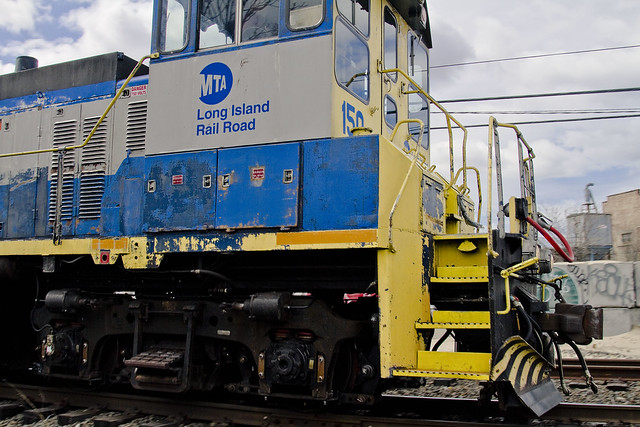
This was once one of the busiest stretches of rail in New York, let alone the United States. The Long Island Railroad (in its various guises, incarnations, and corporate forebears) have maintained their “road” here since the 1860’s. A shame, these tracks are a shadow of their former self and it’s not all that frequently that one sees traffic along the route. Hurling myself across the busy truck route, your humble narrator quickly sprang onto that fence which vouchsafe the track from trespass and interference, and whipped out the camera and began clicking away.
from wikipedia
The LIRR chartered the New York and Jamaica Railroad on September 3, 1859, and a supplement to the LIRR’s charter passed March 12, 1860 authorized it to buy the NY&J and extend to Hunters Point. The LIRR carried through with the NY&J purchase on April 25, along with the purchase of a short piece of the Brooklyn and Jamaica at Jamaica, and the next day it cancelled its lease of the Brooklyn and Jamaica, but continued to operate over it. The Brooklyn Central and Jamaica Railroad, a consolidation of the B&J with the new Brooklyn Central Railroad, began operating from South Ferry over the top of the tunnel, along the B&J tracks to Flatbush Avenue, and south on the new Fifth Avenue Line in August 1860. The new line to Hunters Point was officially opened on May 9, 1861, with regular service starting May 10. A ferry connection (Hunter’s Point Ferry) was initially advertised to James Slip; connecting boats began running to East 34th Street Pier in October. he BC&J soon began operating horse cars over the old line from South Ferry, connecting with LIRR trains at Jamaica. The tunnel was closed off in December.
– photo by Mitch Waxman
This double engine was hurtling along, which was somewhat remarkable. When I do see trains along this route, 9 times out of 10 they are NY & Atlantic freight trains which lumber along at a fairly tepid pace compared to this blue and gold comet which roared past me. Sadly, a diminished capacity for joy and low threshold for excitation allow one to consider the witnessing of this passing locomotive to be the high point of the day. Juvenile in character despite advanced years, it does not take much to impress one such as myself.
from wikipedia
Federal regulators limit the speed of trains with respect to the signaling method used. Passenger trains are limited to 59 mph and freight trains to 49 mph on track without block signal systems. (See dark territory.) Trains without “an automatic cab signal, automatic train stop or automatic train control system” may not exceed 79 mph. The order was issued in 1947 (effective 31 Dec 1951) by the Interstate Commerce Commission following a severe 1946 crash in Naperville, Illinois involving two Chicago, Burlington & Quincy Railroad trains. Following the 1987 Chase, Maryland train collision, freight trains operating in enhanced-speed corridors have been required to have locomotive speed limiters to forcibly slow trains rather than simply alerting the operator with in-cab signals. The signal panel in the Maryland crash had been partially disabled, with a muted whistle and a missing light bulb.

– photo by Mitch Waxman
Undoubtedly, as these tracks lead toward the Long Island City yard- which offers connections to both Manhattan and the gargantuan Sunnyside Yard- it is impossible to speculate on their final destination, but these engines were headed to somewhere in Long Island City.
for more on the twisting trackways of the Montauk Cutoff, check out this trainsarefun.com page

– photo by Mitch Waxman
On the Queens side of the Newtown Creek, a loathsome flood plain typified by concreted devastation and the relicts of the industrial revolution, the Long Island Railroad has long been the proverbial “800 pound gorilla” and as such- goes wherever it wants to go.
For visual orientation to more familiar locales, notice that dagger in the heart of Queens- the Sapphire Megalith- embedded in the innocent soil of Court Square in LIC, or the distant Freedom Tower under construction in lower Manhattan.
from wikipedia
“800 pound gorilla” is an American English expression for a person or organization so powerful that it can act without regard to the rights of others or the law. The phrase is rooted in a riddle:
“Where does an 800 lb. gorilla sleep?”
The answer:
“Anywhere it wants to.”
Also,

Obscura Day 2012, Thirteen Steps around Dutch Kills
April 28th, 10 a.m.
Your humble narrator will be narrating humbly at this year’s Obscura Day event on April 28th, leading a walking tour of Dutch Kills. The tour is already half booked up, and as I’m just announcing it, grab your tickets while you can.
“Found less than one mile from the East River, Dutch Kills is home to four movable (and one fixed span) bridges, including one of only two retractible bridges remaining in New York City. Dutch Kills is considered to be the central artery of industrial Long Island City and is ringed with enormous factory buildings, titan rail yards — it’s where the industrial revolution actually happened. Bring your camera, as the tour will be revealing an incredible landscape along this section of the troubled Newtown Creek Watershed.”
For tickets and full details, click here :
obscuraday.com/events/thirteen-steps-dutch-kills-newtown-creek-exploration
graceful valleys

– photo by Mitch Waxman
A structure which may be discerned in the distance, within the shot above, at Sunnyside Yards is the 35th street or Honeywell Bridge. The location of the camera which captured it was astride the 39th street or Harold Avenue bridge at Steinway Street, where ongoing construction has rendered a hidden breach in the fencing which normally frustrates its purpose by obfuscating the view.
For a discussion of another of the bridges which cross these titan rail yards, click here for the posting “incaculable profusion”, examining the Thomson Avenue Viaduct to the west.
from forgotten-ny.com
When the Yards were built, Long Island City, to the north of the Yards, was effectively cut off from Sunnyside and Maspeth, to the south. Viaducts were built at Queens Boulevard (which was itself under construction in 1910), Honeywell Street, Harold Avenue, and Thomson Avenue. Laurel Hill Avenue (43rd Street) Gosman Avenue (48th Street) and Woodside Avenue were carried under the railroad.

– photo by Mitch Waxman
A paucity of such apertures in the fence lines around the yards exists, which is appropriate in this age of heightened vigilance, and the discovery of something large enough to accept the lens of a dslr is tantamount to observing a unicorn to one such as myself. Of course in the midst of all this faux security and theater, I can show you a dozen different places where you could work mischief if you chose to. Such is always the case with large installations like this one, however, and illegal trespass is not the Newtown Pentacle way.
The real estate happy characters in Manhattan are desirous to rob me of this vista, as evidenced in the document linked to below, describing the feasibility and benefits of decking over these yards and expanding the population of western Queens by tens of thousands. It seems to be a plan of some vintage, however, crafted before the financial crisis and concurrent economic crisis experienced by the region and country at large since 2008 (when do we get to start calling this a depression?).
from nyc.gov
Sunnyside Yards, one and three-quarters of a mile long and 1,600 feet across at its widest point, is the largest site in this inventory. The total deckable airspace of its 14 parcels – over 167 acres – is more than double the size of the next largest airspace site, the 74-acre NYCT Coney Island Maintenance Shop and Yards (K5000). This one corridor contains around one-sixth of the entire deckable airspace in this inventory.
The potential for large scale land uses above these yards is extraordinary. With the possible exception of Staten Island’s west shore, no other large tracts of “vacant” land remain in the City. Moreover, Sunnyside Yards is defined by a surrounding context of relatively dense development and plentiful transit access.
At the behest of former Deputy Mayor for Economic Development and Rebuilding Daniel Doctoroff, DCP’s Housing, Economic and Infrastructure Planning (HEIP) unit conducted a preliminary analysis concerning the viability of decking over and developing Sunnyside Yards. The HEIP unit determined that the most desirable sites within the yards were two roughly rectangular areas running from the southwest to the northeast; the northern third of both sites is located northeast of Queens Boulevard.

– photo by Mitch Waxman
These trusses which fly over the Sunnyside Yards are actually rather new. The Honeywell and Harold Bridges (39th and 35th streets), for instance, were totally rebuilt recently. The Honeywell Bridge reopened in 2003 after having laid fallow and closed to pedestrian and vehicle traffic for better than 20 years. The night shot above, by the way, is betrayed by its format and shape as being from my trusty old Canon G10, which is still in service at this- your Newtown Pentacle.
from nytimes.com
In 1979, inspectors from the city’s Department of Transportation judged the 1,600-foot four-lane bridge, which was built in 1909, to be on the verge of falling down. The inspection occurred near the end of an era in which the city, nearly broke and as exhausted as a disco dancer at dawn, partly balanced its budget by deferring maintenance on bridges. Tom Cocola, a department spokesman, said once costs had been cut by removing the bridge from the city’s regular inspection schedule, ”we probably just forgot about it.”
wondering uneasily

– photo by Mitch Waxman
Each one of the DE30AC Long Island Railroad engines one typically observes at the ancient Long Island City station at Hunters Point is rated to 3,000 Horsepower. So says the google.
As a humble narrator is given to literal interpretations of statements like this, an idea occurred, which might present an answer to the so called “hum” which bedevils area residents.
Horses.
from wikipedia
The LIRR chartered the New York and Jamaica Railroad on September 3, 1859, and a supplement to the LIRR’s charter passed March 12, 1860 authorized it to buy the NY&J and extend to Hunters Point. The LIRR carried through with the NY&J purchase on April 25, along with the purchase of a short piece of the Brooklyn and Jamaica at Jamaica, and the next day it cancelled its lease of the Brooklyn and Jamaica, but continued to operate over it.

– photo by Mitch Waxman
Logistical conundrums abound in this scheme of mine, mastering a team of 3,000 horses for instance, would be hubris enough to make a Roman blush.
A thousand pounds of horseflesh each, the 3,000 strong equine army would each require some 10-12 gallons of water and 1-1.5% of it’s body weight in food per day (US Army daily forage rations were given as 12 lbs of oats and 14 lbs of hay per 900 lb. horse). Marvelously enough, the mountains of manure generated by the animals could act as fertilizer for roof top farms which could in turn grow the food.
It would be a virtuous circle for all, except for the customers of the LIRR itself, who will be moving to Syosset at no more than 3mph.
from wikipedia
The DE30AC and DM30AC locomotives replaced aging GP38s, Alco FA1/FA2s, F7As and F9As, and MP15AC and SW1001 locomotives, with GP38s used to push and pull diesel trains and other locomotives used to provide HEP for the trains. The bodies of the DE30AC and the DM30AC are similar; the difference is the ability of the DM30AC to use electric third rail while the diesel engine is off, enabling the locomotive to use the East River Tunnels into New York Penn Station. DM30ACs have third rail contact shoes, permitting direct service from non-electrified lines in eastern Long Island via the western electrified main lines all the way to Penn Station. A few such trains a day run on the Port Jefferson, Oyster Bay, and Montauk Branches. The engines’ naming scheme: DM = Dual Mode, DE = Diesel Engine, 30 = 3000 hp, AC = Alternating Current traction motors.

– photo by Mitch Waxman
Oh, and there’s also something like ten trains that use this station daily, so that’s actually 30,000 horses. That’s the estimated equine population of New Hampshire.
Imagine all the primate jobs this scheme would generate as well, hundreds if not thousands of green jobs- Veterinarians, Agriculturists, Teamsters, Roof-top Botanists.
from wikipedia
Long Island City station was built on June 26, 1854, and was rebuilt seven times during the 19th Century. On December 18, 1902, both the two-story station building, and an office building owned by the LIRR burned down. The station was rebuilt on April 26, 1903, and was electrified on June 16, 1910.
Before the East River Tunnels were built, the Long Island City station served as the terminus for Manhattan-bound passengers from Long Island, who took ferries to the East Side of Manhattan. The passenger ferry service was abandoned on March 3, 1925, although freight was carried by car floats (see Gantry Plaza State Park) to and from Manhattan until the middle twentieth century. Today ferry service is operated by NY Waterway.


 The Newtown Pentacle