Archive for the ‘railroad’ Category
Things to do!
July 28th, 2012- Working Harbor Committee Kill Van Kull walk- This Saturday

– photo by Mitch Waxman
The Kill Van Kull, or tugboat alley as its known to we harbor rats, is a tidal strait that defines the border of Staten Island and New Jersey. A busy and highly industrialized waterfront, Working Harbor’s popular “Hidden Harbor – Newark Bay” boat tours provide water access to the Kill, but what is it like on the landward side?
Starting at the St. George Staten Island Ferry terminal, join WHC Steering Committee member Mitch Waxman for a walk up the Kill Van Kull via Staten Islands Richmond Terrace. You’ll encounter unrivaled views of the maritime traffic on the Kill itself, as well as the hidden past of the maritime communities which line it’s shores. Surprising and historic neighborhoods, an abandoned railway, and tales of prohibition era bootleggers await.
The tour will start at 11, sharp, and you must be on (at least) the 10:30 AM Staten Island Ferry to meet the group at St. George. Again, plan for transportation changes and unexpected weirdness to be revealed to you at MTA.info.
for July 28th tickets, click here for the Working Harbor Committee ticketing page
August 5th, 2012- Newtown Creek Alliance Walking Tour- The Insalubrious Valley

– photo by Mitch Waxman
Newtown Creek Alliance historian Mitch Waxman will be leading a walk through the industrial heartlands of New York City, exploring the insalubrious valley of the Newtown Creek.
The currently undefended border of Brooklyn and Queens, and the place where the Industrial Revolution actually happened, provides a dramatic and picturesque setting for this exploration. We’ll be visiting two movable bridges, the still standing remains of an early 19th century highway, and a forgotten tributary of the larger waterway. As we walk along the Newtown Creek and explore the “wrong side of the tracks” – you’ll hear tales of the early chemical industry, “Dead Animal and Night Soil Wharfs”, colonial era heretics and witches and the coming of the railroad. The tour concludes at the famed Clinton Diner in Maspeth- where scenes from the Martin Scorcese movie “Goodfellas” were shot.
Lunch at Clinton Diner is included with the ticket.
Details/special instructions.
Meetup at the corner of Grand Street and Morgan Avenue in Brooklyn at 11 a.m. on August 5, 2012. The L train serves a station at Bushwick Avenue and Grand Street, and the Q54 and Q59 bus lines stop nearby as well. Check MTA.info as ongoing weekend construction often causes delays and interruptions. Drivers, it would be wise to leave your vehicle in the vicinity of the Clinton Diner in Maspeth, Queens or near the start of the walk at Grand St. and Morgan Avenue (you can pick up the bus to Brooklyn nearby the Clinton Diner).
Be prepared: We’ll be encountering broken pavement, sometimes heavy truck traffic as we move through a virtual urban desert. Dress and pack appropriately for hiking, closed-toe shoes are highly recommended.
Clinton Diner Menu:
- Cheese burger deluxe
- Grilled chicken over garden salad
- Turkey BLT triple decker sandwich with fries
- Spaghetti with tomato sauce or butter
- Greek salad medium
- Greek Salad wrap with French fries
- Can of soda or 16oz bottle of Poland Spring
for August 5th tickets, click here for the Newtown Creek Alliance ticketing page
nature transmutes

– photo by Mitch Waxman
A humble narrator just can’t get enough of the Long Island Railroad yard in Long Island City.
Back in January of this year, while “wondering uneasily“, we established that the LIRR station in Long Island City accomplishes tasks which it would take some 30,000 horses to accomplish on a daily basis. Last year, in October- these very tracks were visited in “Deeply Hidden“.
Simply put, I’m kind of drawn to this spot.
from wikipedia
This station has 13 tracks, two concrete high-level island platforms, and one wooden high-level island platform. All platforms are two cars long and accessible from Borden Avenue just west of Fifth Street. The northernmost one, adjacent to tracks 2 and 3, is the only one used for passenger service. The other concrete platform adjacent to tracks 6 and 7 and the wooden one adjacent to tracks 8 and 9 are used for employees only. All tracks without platforms are used for train storage. The southernmost four tracks are powered by third rail while the remaining tracks are used only by diesel-powered trains.

– photo by Mitch Waxman
Once upon a time, street grade rail crossings were pretty common in Western Queens, but these days there are only a few that I know about. As always, never will I claim to be an expert on this subject, as there’s too many alphanumeric terms involved for me to remember. As mentioned in the past, mathematics isn’t my strong suit, and I’ve always been cursed by a sort of numbers based dyslexia. I’m all ‘effed up.
from wikipedia
The Long Island Rail Road owns an electric fleet of 836 M7 and 170 M3 electric multiple unit cars, and 134 C3 bilevel rail cars powered by 23 DE30AC diesel-electric locomotives and 22 DM30AC dual-mode locomotives.
In 1997 and 1998, the LIRR received 134 double-decker passenger cars from Kawasaki, including 23 cab control cars, and 46 General Motors Electro-Motive Division diesel-electric locomotives (23 diesel DE30ACs and 23 dual-mode DM30ACs) to pull them, allowing trains from non-electric territory to access Penn Station for the first time in many years, due to the prohibition on diesel operation in the East River Tunnels leading to Penn Station.

– photo by Mitch Waxman
Arithmetic challenged, in a Jewish family, this marks one as worse than an idiot. The stereotype which opines that Jews are possessed of a certain aptitude for mathematics is fairly accurate (or at least it generally is in my family), and black sheep status was assigned me as early as second grade when they rolled out long division. Consistently low scores on the math section of standardized testing always betrayed my inadequacies to scholastic authorities, and was a great cause of concern to my parents. Reports from teachers fed their dire suspicions that I would someday end up “a bum on da bowery” or “shovelin shit on da street”.
from wikipedia
The DE30AC and DM30AC locomotives replaced aging GP38s, Alco FA1/FA2s, F7As and F9As, and MP15AC and SW1001 locomotives, with GP38s used to push and pull diesel trains and other locomotives used to provide HEP for the trains. The bodies of the DE30AC and the DM30AC are similar; the difference is the ability of the DM30AC to use electric third rail while the diesel engine is off, enabling the locomotive to use the East River Tunnels into New York Penn Station. DM30ACs have third rail contact shoes, permitting direct service from non-electrified lines in eastern Long Island via the western electrified main lines all the way to Penn Station. A few such trains a day run on the Port Jefferson, Oyster Bay, and Montauk Branches. The engines’ naming scheme: DM = Dual Mode, DE = Diesel Engine, 30 = 3000 hp, AC = Alternating Current traction motors.

– photo by Mitch Waxman
I’m told that people suffering from several different cognitive disorders spend their time memorizing train schedules and details about the rail system, and that they find some solace in the purely numerical language which governs the subject. Me, I just wander around aimlessly, and get the giggles when I’m lucky enough to randomly come across a train passing so close by. My major malfunction is taking too many pictures of trains and boats, it would seem.
from 1877′s “Long Island and where to go!!: A descriptive work compiled for the Long R.R. Co.“, courtesy google books:
Long Island City is the concentrating point upon the East river, of all the main avenues of travel from the back districts of Long Island to the city of New York. The great arteries of travel leading from New York are Thomson avenue, macadamized, 100 feet wide, leading directly to Newtown, Jamaica and the middle and southern roads on Long Island, and Jackson avenue, also 100 feet wide, and leading directly to Flushing, Whitestone and the northerly roads.
Long Island City is also the concentrating point upon the East river, of the railway system of Long Island.
The railways, upon reaching the city, pass under the main avenues of travel and traffic, and not upon or across their surface.
impelling fascination

– photo by Mitch Waxman
Long time readers will recognize the shot above from a January 2012 posting entitled “Hermes Trismegistus“, which describes the great statue which adorns the Vanderbilt Rail Palace known as “Grand Central Terminal” in Manhattan.
Recent adventure carried me to the place, where I found myself with an uncommon view of the Tiffany Clock which bejewels the carving.

– photo by Mitch Waxman
Inside of it.
More on this in a posting next week, but I can’t just sit on these shots without sharing them. The clock face itself is pretty enormous.
A simple image search will show this to hardly be a unique photo, but regardless, this was a thrilling place to visit.
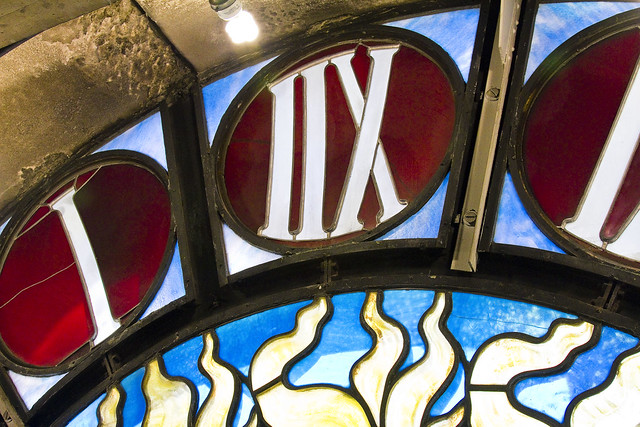
– photo by Mitch Waxman
There is a chamber back here, of masonry and exposed steel, which the clock is mounted into. The number six on the clock’s face is a window outfitted with a hinge. This wasn’t “urban exploration”, incidentally, my presence here was sanctioned.

– photo by Mitch Waxman
This is what Park Avenue looks like from the clock at Grand Central Station, that’s Union Square in the distance. Click the image to check out larger views at flickr.
More next week.
____________________________________________________________________________
Click for details on Mitch Waxman’s
Upcoming boat tours of Newtown Creek
July 22nd, 2012 NEXT SATURDAY
Working Harbor Committee Newtown Creek Boat Tour

elaborately fashioned

– photo by Mitch Waxman
While moving through DUPBO (Down Under the Pulaski Bridge Onramp) the other day, a passing train forced me to halt my ceaseless marching momentarily. Suffering from a malfunction, my headphones were not working, and the ultimate horror of being alone with my thoughts occurred. A brief interlude with your humble narrator has been described as exhausting, and that’s when the interviewee is feeling generous or is governed by polite behavioral norms. Long exposures to my uniquely abhorrent personality have been known to induce madness, encourage alcoholism, and destroy all hope for peace. An expectation of normalcy is usually abandoned by those unable to escape my presence shortly after first contact.

– photo by Mitch Waxman
My family describes me as best taken in small doses, and does their best to disavow, deny, and distance themselves. Imagine what it must be like, between my ears, as one cannot escape from oneself. With the headphones roaring their cacophony, it is often possible for me to drown my endless narrative of self referential critique and worry, but without them the omnipresence of paranoid wonderings is impossible to evade. What you read in this blog is what I’m like all the time.

– photo by Mitch Waxman
Poverty stricken of late, my plan to get every last millimeter of sole from my last pair of hiking boots backfired, causing an injury of some kind to my left foot. Not severe, discomfort is barely noticeable until several miles into a walk, but after a while it becomes uncomfortable. While standing in DUPBO, one wondered if it might be something truly horrible and I began to ponder if it might be foot cancer. This led me to begin thinking about whether or not there was any such thing as “foot cancer” (there is), which led me to begin wondering about all the other aches and pains which I experience and attempted to ascribe a hypochondriacal “worst case” scenario to each.

– photo by Mitch Waxman
Constant thought is given to being struck by a truck, or car, or train of course. I also worry about things falling off of buildings- did you know that bricks sometimes just come loose and fall? Falling air conditioners, electrified utility lines, even sinkholes could randomly cross my path. There are feral dogs, packs of rats, hordes of flesh eating centipedes, and aggressive seagulls… One could fall in the creek head first and get stuck in the mud, be drawn into a wood chipper, or end up stuffing a fifty gallon drum after taking a photo of something I shouldn’t have. It is not fun thinking these thoughts, and impossible for me to turn them off. Over the years, I’ve seen a lot of things happen in New York City, things which are admittedly “statistically unlikely” but happened nevertheless- decapitation, bloodcicles, and pineapple with ham on pizza. Oddly enough, I seldom worry about being struck by lightning- go figure.

– photo by Mitch Waxman
This is, of course, why I keep my headphones buried firmly in my ears and the volume turned way up, on these long walks around Queens and the Newtown Creek. It’s also why, as soon as budget allowed, a new pair of shoes were purchased, because you cannot run away from imagined dangers when your left foot hurts. The repair to the headphones has been accomplished as well, and as this shadow of what looks like a man strides forth, he no longer is forced to listen to a fear crazed maniac within his head. Still worried about foot cancer though… So many things can happen to you…
curiously dissociated

– photo by Mitch Waxman
One presumes that it is merely part of the human condition to remember the bad rather than the good. War and the concurrent homefront is reminisced upon fondly, whereas peaceful spans are oft forgotten. Economic downturn, sickness and loss, even the Black Death are considered romantic. Pity abounds for the reputation of a place like Blissville, once a thriving bucolic community, which is remembered today as one of the darkest sections of the fabled Newtown Creek.
from wikipedia
Blissville is a neighborhood within Long Island City, in the New York City borough of Queens. It is bordered by Calvary Cemetery to the east; the Long Island Expressway to the north; Newtown Creek to the south; and Dutch Kills, a tributary of Newtown Creek, to the west. Blissville was named after Neziah Bliss, who owned most of the land in the 1830s and 1840s.


– photo by Mitch Waxman
Named for Neziah Bliss who -with Eliaphet Nott- founded the community in the early 19th century, Blissville was once what we would call “affordable housing” for the laborers of Newtown Creek. Sure, there were Europeans here since the 1600’s- in Maspeth and Hunters Point and in Brooklyn- but it wasn’t until the period right around the Civil War that things really kicked into gear around here.
from 1921’s Brooklyn Daily Eagle Almanac, Volume 36 – courtesy google books
NEWTOWN CREEK. Although less than four miles from its source, among the oil refineries of Blissville and Greenpoint, L. I., to ita mouth at the East River, Newtown Creek ia known as one of the “world’s busiest waterways.” The Mississippi River, from New Orleans to St. Paul, ia 1,” miles In length and flows through a great industrial and agricultural district. Recent figures show that 5,220,000 tons of cargo are carried annually on the upper and lower reaches of the longest river In the world, while the annual average of tonnage carried on the little four-mile Newtown Creek was 5,620,000.
Note: the bolded character in the quotation above resolves to something like 1,000 miles. the Mississippi has been significantly altered over the years.

– photo by Mitch Waxman
A chance encounter with a local historian of some note resulted in a critique of recent statements made by your humble narrator on this subject, (asserting that industry arrived here in force during the 1870’s) and he reminded me that there were industrial concerns operating in the area far earlier than even the arrival of Neziah Bliss. Tidal Grist mills, Lumber Yards, and the like were in these parts before the American Revolution, I will concede, and it is true that General Chemical, and M. Kalbfleish &Sons, and Peter Coopers Glue Factory were all well established along the Creek by 1840- all of which were early examples of the so called “Second Industrial Revolution” kicking into gear- it all depends on what you mean by “industry”.
from 1876’s Our dumb animals, Volumes 9-14 – courtesy google books
…an account of a visit of Mr. Bergh to certain stables attached to the distillery of Gaff, Fleischman & Co., at a place singularly named Blissville, on Long Island. Within the enclosure he found three immense stables, containing about nine hundred cows There was not a single door or window open, and the tainted atmosphere arrested the progress of all present Many cows were lying down, but the insufficient space necessitated their partly resting on one another. Dr. Raymond, Sanitary Superintendent of Brooklyn, says: “These animals never leave the stables, until, giving no more milk, and being- ‘ fattened,’ they are driven to the slaughter-house, contributing during life to the propagation of disease through their milk, robbing the inlant of its sole chance of life; and, alter death, furnishing diseased meat to nil consumers.”

– photo by Mitch Waxman
Master, apprentice, journeyman, mechanic- all of these terms had far different meaning in the past than they do today. So did the term “industrial”. Before the rail came through, and by rail I mean the Long Island Railroad- operations around the Creek were necessarily small. An employer of a hundred working men in 1800 would have been a tycoon, and the “factory” would have been no larger than a modern day primary school, and even then only the largest and most successful companies would have been so comfortably ensconced. After the rail came, something like Phelps Dodge or the Standard Oil works became possible- vast complexes of multi story structures, connected by rail tracks with bulkheaded docks, and chimneys belching smoke six to seven stories above the ground.
from 1879’s The Analyst, Volume 4 – courtesy google books
Sir,—In the month of February I made an official inspection of some cow stables, at a place called Blissville, on Long Island, which were connected with a distillery. Thinking that my investigations at that time might prove of some interest to yourself and other Public Analysts, I tako the liberty of writing you upon the subject.
At the time of my visit to the above stables there were between 700 and 800 cows in them, crowded into narrow stalls, to which they were fastened by a rope not more than three feet in length, which barely permitted them to lie down, but kept their mouths continually at a trough into which flowed the “swill” from the adjacent distillery in a steaming and fermenting condition.
Most of the animals were emaciated and feverish, and were affected with cough, diarrhoea, and polyuria. Some appeared to have recently arrived, and were in good condition. The temperature of several of the animals was noted, and ranged from 102° to 109°. The stable floors were kept all the time wet and slippery with excrementitious matters, and I did not see how it was possible for the cows to be milked and prevent the surrounding filth from splashing into the milk.
These poor creatures, crowded together within low sheds, with insufficient food, imperfect or no moans of ventilation, no exercise, no pure water to drink, and breathing an atmosphere poisoned by the exhalations from their wretched bodies, their excretions, and the steaming and fermented food, are expected, under these conditions, to secrete milk fit for human consumption.

– photo by Mitch Waxman
The vast populations of the five great cities around the Creek- Williamsburg, Greenpoint, Maspeth, Hunters Point, and New York- were made possible by the vast industrial mills which arrived in the middle and latter half of the 19th century. Those self same mills are what ended up staining the reputation of Blissville in the historic record. Any attempt to describe its homes, schools, and churches is overshadowed by the tales of pneumatic cattle, wormy pigs, bad air, and mountains of rotting offal. Pity poor Blissville, a place whose name brings a wry and ironic smile to the face of modern visitors. It was once a beautiful place to live.
from 1884’s Annual report of the State Board of Health of New York – courtesy google books
The stench nuisance next in the series along the main trunk of the Long Island railroad consists of and is located at and near the old distillery and yeast factory recently known as Gaff & Fleischmann’s, and now controlled by an ownership and superintendent mentioned in the inspector’s list. It has long been an insufferable nuisance because of the “swill-like odor of the mash,” and still more, because of the fact that the cattle stables on the right alongside the railroad track are reeking with semi-liquid filth (see page 12 of report marked C).
The next in the series is Preston’s bone-boiling, bone-burning and fertilizer establishment where the “web scrap,” horse-flesh, entrails and other putrescent matters from numerous fat rendering factories are stored in great quantities, and where bones and refuse flesh and waste “clippings” from the markets and elsewhere are boiled in kettles that are not kept suitably covered, which necessarily pollute the atmosphere to a considerable extent beyond the premises, which are located close along the south side of the Long Island railroad track. The business of calcining the bones obtained in the business just mentioned, and from other sources, is carried on at Preston’s factory, and is a source of very offensive stenches which extend along the line of the railroad for half a mile or more. This factory being a branch of the fertilizer factory owned by the same persons and situated near Keyport, N. J., much of the storage as well as mixing of materials for the latter establishment is carried on at this place in Blissville, and at times is the source of exceptional offensiveness.
Next is the place of John Kehoe, situated near Preston’s and the distillery above described. He boils fat in open kettles.
Reid’s fertilizer factory is next in order as we proceed eastward upon the north bank of Newtown creek. Superphosphate fertilizer is made by the use of sulphuric acid upon scrap and the phosphate rock of South Carolina.
Though the offensive odor does not extend a great distance, and probably is offensive to only railway passengers and along the line of the railway, the business is too offensive to be long permitted to remain close by the side of a great highway like that of the Long Island railroad.
Next in the series is the bone boiling establishment of Fred. Hoffner, who works with open kettles, giving off excessively offensive stenches.
Simon Steinfel’s rendering establishment, which is on Furman’s island in Newtown creek (and within the limits of Newtown), gives off very offensive emanations for a long distance in the course of the railway route. Great quantities of decomposing animal matters were found upon the premises in barrels and otherwise packed in readiness for rendering.


 The Newtown Pentacle