Archive for the ‘railroad’ Category
putrescent juice

– photo by Mitch Waxman
My long, indeed “Grand Walk”- a semi conscious amble whose path is revealed only by images found on my camera card sometime later- had carried me from Manhattan to the Grand Street Bridge. A revelation and totem of the political border of Queens and infinite Brooklyn, it would not be inappropriate to describe it as a former gateway to hell itself.
Not quite 100 years ago, the sky would have been black with the product of smokestacks, and every surface exposed to their fumes would be painted with a greasy residue of the worst kind of filth imaginable.
from Harper’s weekly, Volume 38, 1894- courtesy Google books
AN INSALUBRIOUS VALLEY.
The city of Brooklyn, having purged itself of the malodorous political institutions that were so long a blot upon its southern border, might well turn its attention to some nuisances of a more literally malodorous kind that flourish along its northern border, a detailed description of which will be found in another column of the Weekly’. It appears that in an early day the valley of Newtown Creek, which is the boundary between Kings and Queens counties, was selected by various manufacturers as an eligible site for the location of factories. The location was then far on the outskirts of the city, and no doubt quite unobjectionable. A great variety of institutions were set iu operation here, including those useful and necessary but unpleasant factories whose purpose it is to transform the animal refuse of a city into merchantable produce. The gases generated by these factories had an odor almost unendurable, as any one can testify who was accustomed to travel on the Long Island Railroad from the Thirty-fourth Street ferry in years gone by. But so long as railroad passengers were the only sufferers, nothing could be done to abate the nuisance, and there were for a long time no residents near to make complaint, as the growing city very naturally held back at a respectful distance from so undesirable a neighborhood.

– photo by Mitch Waxman
If one did not frequent the district, the smell would be overwhelming but the sense most offended would likely be the visual faculties. There are things which ordinary people should not see or know too much about. The customs and mores of the graveyard come to mind, and so does the imagery produced on the battlefield or on the inside of a slaughterhouse.
Amidst the farms of oil tanks and forests of chimneys, without gazing too deeply, one would notice the mounds of dead horses and dogs first- then, the tons of human shit would come into focus.
from The Sanitary Era, Volume 1, 1887, courtesy google books
Newtown Creek — No city in the Union has so foul a pest hole at its boundaries as Brooklyn. The sludge acid discharged from the works of the Standard Oil Company seems to possess an ominous potency for stirring up the sewage in the creek, and its black and thickened current seethes with bubbles of sulphuretted hydrogen. The shores, banked with this acid and with nameless filth, empoison the atmosphere at low water, while every rising tide seems to free a new supply of sludge. When to the oil industry is added the manufacture of fertilizers and a plenitude of pigs along Queens County shore, the sources of supply for a great nuisance or a grievous plague are discernible to all but official eyes and nostrils. Newtown Creek should be filled up, though not with sludge acid, and the nuisance makers removed to a distance. Our, Health Commissioner is authority for the statement that “You might as well try to fight the devil as the Standard Oil Company.”

– photo by Mitch Waxman
At this spot on the Newtown Creek, where the bone boilers and fat renderers rubbed shoulders with glue factories and manure manufacturers and acid factories, infernal mountains of organic waste materials were gathered. Necessary for the industrial pursuits of these corporate entities- the rail brought Manhattan and Brooklyn’s putrescent garbage, human waste, dead animals and anything else which once lived to them.
There was one company whose particular specialty was recovering useful chemicals from rotting cow and pig blood, produced in fantastic amounts by the armies of butchers staffing the slaughterhouses of New York and the abattoirs of Brooklyn.
No. 4—Grand Street Bridge—
The contract for the construction of this bridge was awarded to Bernard Rolf, on August 7, 1900, at an estimated cost of $173.379.90. The bridge should have been completed on October 21, 1901, but it was fourteen months later, December 26, 1902, before it could be used, and then for only part of the day; and it was not until February 5, 1903, that it was accepted and declared open for traffic.
The contractor presented claims for extra allowances, and a committee, consisting of the late Mr. C. C. Martin, Consulting Engineer; the then Deputy Commissioner, and the Engineer in Charge, reported a finding, which was accepted by the contractor and the City. The total cost of the bridge was $172,748.06.
Several important changes were found necessary in the operating machinery; New end wedges have been put in place and steel bearings have replaced certain cast-iron ones. One hand-turning gear has been installed. Stationary signal lamps, showing white and red, have been placed at the ends of the draw span. Hanging platforms have been erected at the ends of the draw span, and a platform built around the centre pier. These platforms have more than paid for themselves in the cost of repairs and erection. The railing has been painted, and the draw is working satisfactorily.

– photo by Mitch Waxman
Maspeth, troubled motherland of Queens, lays claim to this corner of the Creeklands in modernity and when exiting the Grand Street Bridge onto Grand Avenue (it changes to Avenue as it enters Queens, transmogrifies into Broadway at the heart of historic Newtown at Queens Blvd., and loops into Astoria finally terminating nearby Hallets Cove at the East River) one can say one has been there, although the lovely hills and quaint homes by which one might normally distinguish Maspeth are not present here.
Heaps of fecal matter and rotting pestilence, along with storm clouds of buzzing insects, are mentioned in first hand accounts gathered over a multiple decade period regarding this area.
from Illustrated history of the borough of Queens, New York City, 1908 courtesy google books
The untold thousands who travel every year to and from the places of amusement on the shore of the Atlantic Ocean, or to and from the large race-tracks, ride along the anything but beautiful banks of Newtown Creek, and gain from them their impression of what the borough is. This is the first impression, and therefore the strongest, and it is difficult to dispel it, for the majority of people stick to a conviction once formed, and are loath to change it, even in the face of powerful arguments. Nobody likes to admit that he was wrong or mistaken in his judgment; it is rather human to defend a position once taken.even after one has begun to doubt its correctness. And it is no exaggeration to state that perhaps ninety per cent of all the people passing through Queens Borough know nothing of it except that it contains dismal swamps, railroad yards and factories distributing evil smells and ugly to the last degree.

– photo by Mitch Waxman
Odd, the shot above and others not published indicate that my so called “Grand Walk” took an unexpected turn at this point, leaving Grand and turning North at Page Place. This is the first deviation from common street car and trolley routes which my dreaming gait carried me through.
I must have seen one of the odd cats which frequent or inhabit the area, a polydactyl line which has been mentioned in prior postings of this, your Newtown Pentacle.
from The City record, Volume 6, Part 4, 1878, courtesy google books
Newtown creek ior many years has been a source of nuisance. It receives the contents of several of the large sewers ot Brooklyn. From above Penny Bridge to the East river are factories of various descriptions, oil refiners, fat inciters, gut cleaners, distilleries, car stables, super-phosphate factories, ammonia works, varnish works, and last, but not least, immense piles of stable manure, stored for future shipment, the refuse from all of which runs into the creek, and polluting the waters to such an extent as to have killed all the fish. At low tide acres of land, covered to the depth of several inches with fat, the refuse of the oil-stills, are exposed. At high tide the oily portion of this refuse floats on the surface of the water, still giving forth its characteristic tarry odor. To add to this, many oil works, when the storage tanks are full, run their waste alkali and even their sludge-acid into the creek ; in the latter case giving rise to the well known sludge smell. During the visit of Drs. Chandler and Janeway, on the 14th inst., the material flowing from the drains at the Franklin Oil Works and at Pratt s Refinery was tested and found to be decided acid, affording proof that the sludgeacid was being discharged as above stated.
Frequently during the agitation of the oil with the oil of vitriol the covers of the agitating tanks are left open and the tfl-smefling fumes are allowed to escape into the air.
Near by are also melters boiling fat in open kettles, a method long since abandoned in New York. The stench from all these various operations is very offensive. There is a preference on the part of the manufacturers of fertilizers to manipulate the sludge-acid in the vicinity of the oil works, especially during hot weather, since it is asserted that if sludge-acid is diluted soon after its flow from the agitator, about twenty-five per cent, of it readily separates as tar, but if allowed to stand for forty eight hours in warm weather it becomes thick and ropy, the tar rises slowly and is removed with difficulty and only in small quantities. Moreover, transportation of the extra bulk of tar increases its cost to the consumer. On the other hand, as the acid is sold by yearly contract, as soon as the storage tanks are full, the refinery has no object In its further preservation and naturally allows the surplus to run into the creek.

– photo by Mitch Waxman
Imagine the scene, a century past, in this place where the industrial revolution happened. Further, let us speculate whether the bone boilers and fat renderers would sell their services as “recycling” in our modern context with it’s sophisticate euphemism. See the smoking stacks atop the mills, smell the rich perfume offered by the offal docks, hear the machines and pumps grinding away, touch the cadaverous piles of rot, taste the world which was.
Who can guess, all there is, that might be buried down there?
from Annual report of the State Board of Health of New York, 1883, courtesy google books
Simon Steinfel’s rendering establishment, which is on Furman’s island in Newtown creek (and within the limits of Newtown), gives off very offensive emanations for a long distance in the course of the railway route. Great quantities of decomposing animal matters were found upon the premises in barrels and otherwise packed in readiness for rendering.
- Kirkman & Sons’ rendering establishment, near Steinfel’s, boil and render fat and scrap in open kettles.
- At John C. Muller & Co.’s bone-black factory, at the same place as above mentioned, imported and domestic bones are burned, after being boiled in open kettles to remove all fat. The bone-tar, one of the results of bone varnish, is mixed with soft coal and burned as fuel. It is very offensive.
- C. Meyer’s bone-black factory, at the same place and of essentially the same business, is very offensive. The odor is described by the inspectors, who are expert chemists, as being extremely pungent and sickening. They say: It is doubtful if this industry can be carried on without being offensive constantly. The drainage of all these works on Furman’s island, on Newtown creek, as here described, passes out through an open ditch into the creek.
- Henry Berau’s rendering establishment on Newtown creek has the contract for removing dead animals from Brooklyn. This place is tributary to that of Preston’s, already described. His business is exceedingly offensive, and too near the populous cities and their suburbs.
- These several places are sources of constant offensiveness to railway travelers, and few have any idea of the sources whence the stenches come.
- Brooklyn Excavating Co.’s dumping of night soil is carried on near the border of Brooklyn city-lines, between Grand street and North Second street, only 300 feet from the railroad track. The stench from the nuisance is exceedingly offensive.
- Benjamin Eosenzweig’s fat rendering near Newtown creek, near the railroads, is excessively offensive, the work being carried on from seven in the evening till five in the morning.
- G. W. Baker’s fertilizer factory, close by the railroad track, between Grand street and Metropolitan avenue, is excessively offensive. It manufactures rotten bone manure, tank sediment manure and neatsfoot oil.
Things To Do!!!

– photo by Mitch Waxman
Mr. Kevin Walsh, supreme and unyielding webmaster of the intrepid Forgotten-NY.com will be teaming up with Richard Melnick of the Greater Astoria Historical Society for a walking tour of Skillman Avenue, a street which begins in Long Island City at 49th avenue and ends in Woodside at Roosevelt Avenue. Your humble narrator will be along for the trip, and has been busy producing the snazzy collateral booklet for the trip, and folks- this one is a visual feast.
Photography enthusiasts will find themselves especially pleased, as will the general antiquarian community, as we move through a fast moving and epic landscape crowded with the sky flung monumental relics of an industrial revolution.
Trace the history of Queens from a civil war era rail road station, stagger through the mighty Degnon Terminal, marvel at the titan Sunnyside Yards, and experience the pastoral glories of entering the Sunnyside- all in under 3 miles on Saturday, April 16th at 11:30AM.

– photo by Mitch Waxman
The price of this tour, and one just might think of it as tuition, for time spent with Mr. Walsh and Mr. Melnick often leaves one with the sense of having attended a scholarly dissertation- will be $25. This relative pittance, however, includes the price of an informative and handsome BW booklet written by Mr. Walsh and illustrated with photography whose odd style would be familiar to regular readers of this- your Newtown Pentacle.
The intended route is detailed here, or visit Forgotten-NY’s tour page here.
As mentioned, Mr. Melnick of the Greater Astoria Historical Society will be assisting Mr. Walsh, and has vouchsafed a discount of some 20% for the existing members of his esteemed group, bringing the price to a mere $20.
pounding and piping

– photo by Mitch Waxman
Ahh, the return of warmth and a fortuitous angling of the burning thermonuclear eye of god itself has resulted in a vast series of walks, which form something of a survey when viewed homologously. Temperatures may continue to underwhelm, but the glorious light which distinguishes the western coast of Queens has woken from its hibernation, and so has your humble narrator.
A shabby juggernaut once more scuttles forth!
from wikipedia
Long Island City station was built on June 26, 1854, and was rebuilt seven times during the 19th Century. On December 18, 1902, both the two-story station building, and an office building owned by the LIRR were burned down in a fire. The station was rebuilt on April 26, 1903, and was electrified on June 16, 1910.
Before the East River Tunnels were built, the Long Island City station served as the terminus for Manhattan-bound passengers from Long Island, who would then connect to a ferry to the East Side of Manhattan. The passenger ferry service was abandoned on March 3, 1925, although freight was carried by car floats (see Gantry Plaza State Park) to and from Manhattan until the middle twentieth century. Today ferry service is operated by New York Water Taxi.

– photo by Mitch Waxman
Experimentation with the digital image, from both the capture and the processing angles, resumes.
To wit, “single image HDR”, images- wherein (non photography people can just skip over this part) a single raw image is rendered 1 stop higher and then lower than the metered exposure and then combined in photoshop to highlight the “sweet spot” from all three iterations. Garish, the images nevertheless reveal a wide range of shadow detail and highlight compression otherwise unattainable in a single exposure. A digital image, indeed.
from wikipedia
The Main Line is a rail line owned and operated by the Long Island Rail Road in the U.S. state of New York. It begins in Long Island City and runs directly across the middle of Long Island, terminating in Greenport approximately 95 miles (153 km) from its starting point. Along the way, five branches diverge from the Main Line. Eastern portions of the Main Line are also identified by branch names. These branches, in order from west to east, are:
- Port Washington Branch (at Wood Interlocking in Woodside, Queens)
- Hempstead Branch (at Queens Interlocking along the Queens/Nassau County border)
- Oyster Bay Branch (at Nassau Interlocking in Mineola)
- Port Jefferson Branch (at Divide Interlocking in Hicksville)
- Ronkonkoma Branch – name given to the Main Line east of Hicksville
- Central Branch (at Beth Interlocking at Bethpage) – a single track with no stations, connecting the Main Line to the Montauk Branch
- Greenport Branch – name given to the non-electrified Main Line east of Ronkonkoma

– photo by Mitch Waxman
Highly “monkeyed around with”, there’s just something about these HDR shots which draws me in- but of course, your humble narrator was once a comic book artist and is naturally drawn toward these sorts of primary colorscapes. This section of the megalopolis could easily be called “Gotham” rather than “Long Island” City.
I would be remiss if the arrts-arrchives pages of historic photos and deep historical insight weren’t linked out to, so click here and here and here. These are VERY cool pages, and worth your time.
a ghastly plot
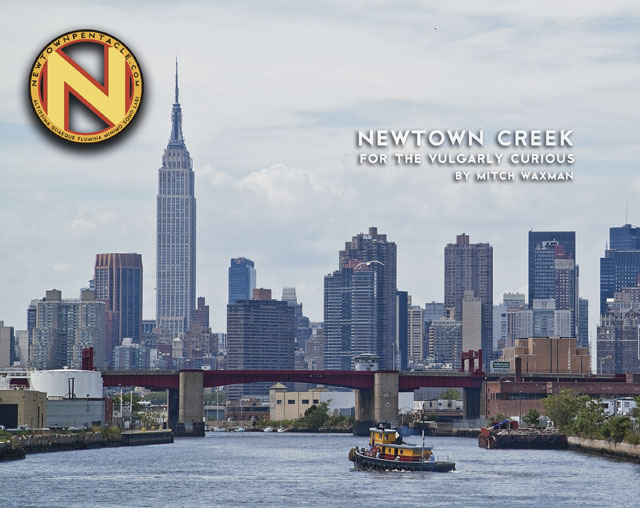
“Newtown Creek for the Vulgarly Curious” is a fully annotated 68 page, full-color journey from the mouth of Newtown Creek at the East River all the way back to the heart of darkness at English Kills, with photos and text by Mitch Waxman.
Check out the preview of the book at lulu.com, which is handling printing and order fulfillment, by clicking here.
Every book sold contributes directly to the material support and continuance of this, your Newtown Pentacle.
Project Firebox 19

– photo by Mitch Waxman
Decapitated, this firebox on Skillman Avenue and Honeywell Street has long been severed from its designed functionality. I’m told by certain knowledgeable sources that you simply cannot remove the stump of an alarm box from its appointed spot, as the circuitry which governs the entire system will be affected by its absence rendering the surrounding neighborhood’s chain of Fireboxes blind to urgent cries of imminent immolation.
This firebox, however, finds a new utility for the needs of the few – or in this case the one- as opposed to the many it once protected, for your humble narrator routinely uses the dinner plate sized platter which crowns it as a makeshift camera platform when photographing the titan Sunnyside Yard with its backdrop of the shield wall of that Shining City which squats squamously across the River of Sound.


 The Newtown Pentacle