Archive for the ‘Staten Island’ Category
subsidiary impression

– photo by Mitch Waxman
You see it all the time, here at your Newtown Pentacle. The Bayonne Bridge, deemed an archaic impediment to navigation by those scions of NY harbor whose hidden machinations are confined to secretive board room meetings at Port Authority and the NYC EDC, is often used as a frame for tugboat shots by your humble narrator. Othman Amman’s second masterpiece (after Hellgate), the bridge is destined to be altered shortly. Accordingly, a group of enthusiasts, antiquarians, and weirdos were gathered one fine September morning to walk across it.
from a Newtown Pentacle posting of June 26, 2009
The fourth largest steel arch bridge on Earth with a height of 150 feet over the water, it connects Bayonne, New Jersey’s Chemical Coastline with Staten Island. It’s primary mission is to allow vehicular traffic access to Manhattan via the Holland Tunnel…
The Bayonne Bridge was designed by a man who helped design the Hell Gate rail bridge on the East river- and was principal designer for the Verrazano bridge over the Narrows, The George Washingston Bridgeover the Hudson River, the Bronx Whitestone Bridge over the East River, the Throgs Neck Bridge over the East River. He was brought in to simplify the design of mighty Triborough– which is actually a bridge and highway complex spanning multiple waterways and islands. A swede Swiss, Othmar Amman worked for Gustavus Lindenthal (designer of the the Queensboro and Hell Gate Bridges), and took over as head bridge engineer at the New York Port Authority in 1925. He also directed the planning and construction of the the Lincoln Tunnel.
He was Robert Moses’s “guy”.

– photo by Mitch Waxman
We came to… Staten Island… via the ferry, and accessed a bus which took us to a less than savory section of the forgotten borough adjoining the bridge. There, the walkway was gained and off we went. Amongst our number was Kevin Walsh of Forgotten-NY fame, my aide de camp and far eastern correspondent Armstrong, as well as our railroad expert, and a certain lady who knows that all that glitters is gold. Stairway to heaven, indeed.
from panynj.gov
Initially, the bridge was planned for motor vehicles, bicycles, and pedestrians only. Accordingly, a suspension bridge design was developed since this type of bridge offered the most economical way to engineer a single span across the Kill Van Kull for motor vehicles. However, the suspension scheme was abandoned when the Port Authority commissioners insisted that considerations be made for at least two rail transit tracks to be added at some future date. (Studies showed that adapting a suspension design for rail traffic would be cost-prohibitive.) With rail traffic in mind, the bridge’s chief designer, Othmar H. Ammann, began developing a scheme that spanned the Kill Van Kull with a single, innovative, arch-shaped truss. As with the suspension bridge scheme, Ammann worked on the arch design in partnership with architect Cass Gilbert. The arch bridge that emerged promised to be a remarkably efficient solution, well suited to the site from both an engineering and aesthetic standpoint.

– photo by Mitch Waxman
Like the thrice damned Kosciuszko Bridge over my beloved Newtown Creek, Bayonne Bridge is a relict of an earlier age with a less than bright future. Public fortunes will be spent on reengineering it to fit the needs of private commercial interests. Government sources describe a scenario in which the arch itself will remain unaltered, but that the road which it carries will be obliterated and replaced. Increasingly important to accomplish the walk before this happened, we ignored the signs along the walkway adjuring against suicide and left… Staten Island… for New Jersey to see what could be seen. More to come…
Also- Upcoming tours…

for an expanded description of the October 13th Kill Van Kull tour, please click here

for an expanded description of the October 20th Newtown Creek tour, please click here
things to do!
for an expanded description of the October 13th Kill Van Kull tour, please click here
for an expanded description of the October 20th Newtown Creek tour, please click here
certain phases

– photo by Mitch Waxman
This is another one of the shots I’ve been chasing all summer. It is not an easy thing to photograph a lit up moving thing from another moving thing, at night, and capture the background in acceptable sharpness- even on Maritime Sunday.
belching aperture

– photo by Mitch Waxman
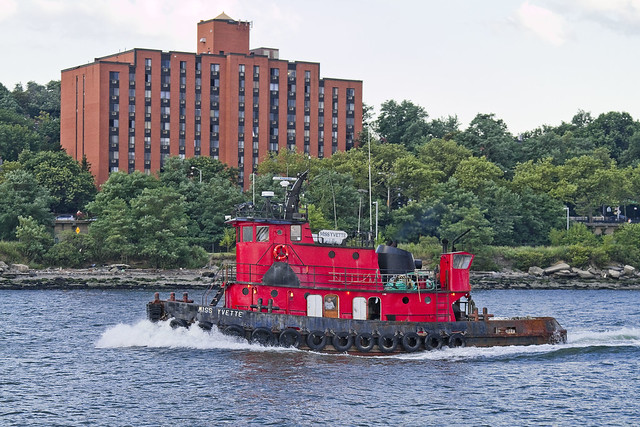
This Maritime Sunday, a psychologically overwhelmed and physically exhausted narrator presents to you the little Miss Yvette tug, as it motors down the Kill Van Kull. That’s… Staten Island… in the background, and the red, black, and blue tarp witnessed back there is part of a road salt operation called “Atlantic Salt”.

– photo by Mitch Waxman
Call sign WDE7815, Miss Yvette is not a terribly large or fast tug- with a maximum recorded speed of 7.8 knots (9mph) and a length of some 22 meters (roughly 72 feet). She is owned and operated by the Sterling Equipment company, and was built in 1975. An “inland tug”, Miss Yvette boasts a 1200 HP twin screw drive, and is 106 gross tons.
– photo by Mitch Waxman
She used to be blue and white, having spent some of her career with Hallan Marine, but is a proud scarlet these days. These shots were captured while onboard a Working Harbor Committee trip to the Port of Newark Elizabeth, just a few weeks ago.
diurnal prison

– photo by Mitch Waxman
During the colonial era, there were small operators who exploited the route in two masted ships called Periaugers, but it wasn’t until 1817- when a farm boy from Staten Island started a motorized service- that the most popular tourist destination in New York City truly got started. The farm boy bought a steamboat called Nautilus with a loan from his mother, which was captained by his brother in law. Not many people would recognize the name of that Captain- John DeForest- but it’s easy to be overlooked in the historical record when your brother in law was named Cornelius Vanderbilt.

– photo by Mitch Waxman
The consolidated City of New York took possession of the route from the Vanderbilts in 1905, as the family had moved into decidedly less maritime interests like railroads and real estate speculation. It’s run by the NYC DOT today, and is the most reliable of all the mass transit systems in the entire city with a 96% on time rate. The particular ferry boat in these shots is the Guy V Molinari, named for the long sitting and dynastic Borough President of Staten Island.

– photo by Mitch Waxman
An astounding set of statistics accompanies the huge orange boats which trawl back and forth between Staten and Manhattan Islands. The service crosses the archipelago some 35,000 times annually, carrying 60,000 people per day- which resolves to some 20 million riders per year. All free. The Ferry was the origin of the Vanderbilt empire, and when Cornelius Vanderbilt died in 1877- he was worth some 100 million dollars, which would be worth something like two billion today. He was born a pauper in 1794.

– photo by Mitch Waxman
The ferry terminals at both ends of the approximately 30 minute trip have recently been modernized and upgraded. Whitehall terminal in Manhattan allows connection to subway and bus lines, and on the Staten Island “St. George” side- you can catch the bus or Staten Island rail. Hundreds are employed directly by the operation, with a “long tail” of suppliers and contractors supplying various services and employing thousands more. The City recently issued an “RFP” or “Request For Proposal” for new and modernized ferry boats to augment the aging fleet.


 The Newtown Pentacle