Posts Tagged ‘Brooklyn’
frightful pull

– photo by Mitch Waxman
During the hot part of the summer of 2011, Kevin Walsh was planning one of his Second Saturday tours, and as your humble narrator had agreed to assemble the tour booklet for the outing- I was along for the ride, which is how I ended up in in Brooklyn (the “lands of my boit”). My mom used to refer to this intersection of Flatbush and Church Avenues at “flatboosh and choich” when I was a kid, spoke in hushed tones about “the shawpping dat uzed to be dere”, and my dad avoided it like the plague because of the traffic.
The highlight of my trip to Brooklyn that day was that I was going to Lovecraft Country.
Here’s what Mr. Kevin Walsh of forgotten-ny said about the place
Flatbush Dutch Reformed has had three incarnations: a wood structure built on orders from Governor General Peter Stuyvesant in 1654, a stone building in 1699, and the current one built from Manhattan schist dating to 1798. The churchyard goes back to the church’s very beginnings and contains stones inscribed in both English and Dutch. Among the many stained glass windows are a few by Louis Comfort Tiffany. The tower contains a clock and bell that are dated 1796, plus a 10-bell chime that was cast by the Meneely Foundry of Troy, N.Y., and installed in 1913.

– photo by Mitch Waxman
For those of you who are not enormous nerds, H.P. Lovecraft was a writer who lived in Brooklyn for awhile, but he always longed for his New England homeland. Weird Fiction was his bag, and his work survived him. H.P was a dedicated long distance walker, and an amateur historian who made the best of his time in New York visiting significant and historically interesting sites all over the City.
“Lovecraft Country” is a fan term for the fictional locations and mythic locales described so vividly by the author, and refers to coastal Massachusetts more often than not. In Brooklyn though, things are real, and so is “Lovecraft Country”.
from wikipedia
Flatbush Dutch Reformed Church Complex, also referred to more simply as the Flatbush Reformed Church, is a historic Dutch Reformed church (now a member of the Reformed Church in America) at 890 Flatbush Avenue and 2101-2103 Kenmore Terrace in Flatbush, Brooklyn, New York. The complex consists of the church, church house, parsonage, and cemetery. The congregation was founded in 1654. The 2 1⁄2-story stone church building was constructed in 1796 and features a stone tower with stone belfry. The stained glass windows are by Tiffany studios and commemorate the descendants of many early settlers of Flatbush. The church house is a 2 1⁄2-story red brick and limestone building. The parsonage is a 2 1⁄2-story wood-frame house moved to its present site in 1918. The cemetery is the last resting place of most of the members of the early Dutch families of Flatbush. The earliest legible grave marker dates to 1754.

– photo by Mitch Waxman
While exploring the place for myself, as Kevin (and Newtown Pentacle’s Far Eastern Correspondent Armstrong) was dying from heat exhaustion and taking cover in the shade of a venerable oak, one thing that gained my attention were the names on the stones. Suydam, Martense… These are character names from some of Lovecraft’s stories. Lovecraft saw evil in New York City, and was terrified by the tight quarters and crowded streets which distinguished the immigrant era. (He was of course, kind of a racist, very much a product of his time- don’t forget how common such tribalism was, and how novel and new the non ethnocentric and very all inclusive “progressive politique and so called meritocracy” is).
Kevin and Armstrong both guzzled water, but I was not parched and required only further explorations.
H.P. Lovecraft said
My coming to New York had been a mistake; for whereas I had looked for poignant wonder and inspiration in the teeming labyrinths of ancient streets that twist endlessly from forgotten courts and squares and waterfronts to courts and squares and waterfronts equally forgotten, and in the Cyclopean modern towers and pinnacles that rise blackly Babylonian under waning moons, I had found instead only a sense of horror and oppression which threatened to master, paralyse, and annihilate me.
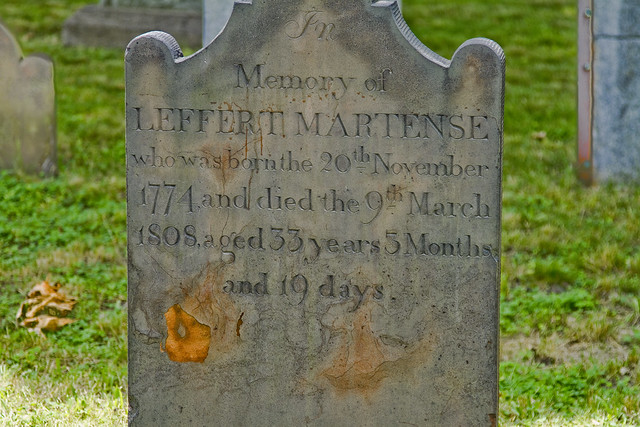
– photo by Mitch Waxman
One of the places which comes up again and again in his writings is this very churchyard, apparently it left quite the impression upon Lovecraft, and inspired his story “The Hound”. He confessed to desecrating this graveyard, incidentally, which is strictly against Newtown Pentacle policy.
This is also why I don’t guzzle water while in graveyards, as such quaffing will inevitably result in the need for urination, which might lead to desecration.
(First Calvary in Queens has two well maintained and world class public lavatories at the entrance gates, btw.)
H.P. Lovecraft was actually here in 1922
On September 16, 1922, Lovecraft toured the Flatbush Reformed Church in Brooklyn with his friend Rheinhart Kleiner, writing about the visit in a letter:
Around the old pile is a hoary churchyard, with internments dating from around 1730 to the middle of the nineteenth century…. From one of the crumbling gravestones–dated 1747–I chipped a small piece to carry away. It lies before me as I write–and ought to suggest some sort of horror-story. I must place it beneath my pillow as I sleep… who can say what thing might not come out of the centuried earth to exact vengeance for his desecrated tomb? And should it come, who can say what it might not resemble?[

– photo by Mitch Waxman
This particular parcel of “Lovecraft Country” has an awful lot of New York City history associated with it, Peter Stuyvesant and the “Degenerate Dutch” and all that. Road extensions of a toll road called Flatbush Avenue past a watch tower… Frankly, the sort of “historian history” which your humble narrator always bolloxes up. I’ve had the pleasure of meeting Rob Schweiger, Brooklyn’s borough historian, and he can offer a far more cogent history of this place than I can. So can the oft mentioned Kevin Walsh.
I can tell you a lot about Newtown Creek and it’s locale, but this part of colonial Brooklyn ain’t my bag.
from “the Lurking Fear”, courtesy hplovecraft.com
No one outside the backwoods had believed these varying and conflicting stories, with their incoherent, extravagant descriptions of the half-glimpsed fiend; yet not a farmer or villager doubted that the Martense mansion was ghoulishly haunted. Local history forbade such a doubt, although no ghostly evidence was ever found by such investigators as had visited the building after some especially vivid tale of the squatters. Grandmothers told strange myths of the Martense spectre; myths concerning the Martense family itself, its queer hereditary dissimilarity of eyes, its long, unnatural annals, and the murder which had cursed it

– photo by Mitch Waxman
I don’t know why I’m always drawn to cemetery trees, a humble narrator will confess, but there’s always something about these vegetable growths fed by an obvious and morbid nutrition. An ominous portent, a spooky resonance, a dissonant note. For some reason, my perception leads me to see shapes in their whorls and crags, shapes which form into recognizable “things”- much like searching for the shape of a dragon in cloud formations.
The scientifically minded call it Pareidolia.
from “The Horror at Red Hook”, courtesy hplovecraft.com
Suydam was a lettered recluse of ancient Dutch family, possessed originally of barely independent means, and inhabiting the spacious but ill-preserved mansion which his grandfather had built in Flatbush when that village was little more than a pleasant group of colonial cottages surrounding the steepled and ivy-clad Reformed Church with its iron-railed yard of Netherlandish gravestones.

– photo by Mitch Waxman
I don’t think I get enough sleep, that’s what it is. It renders me highly suggestible, and perhaps I should drink some more water, and follow Mr. Walsh’s example when visiting “Lovecraft Country“.
from wikipedia
Oneirophrenia is a hallucinatory, dream-like state caused by several conditions such as prolonged sleep deprivation, sensory deprivation, or drugs (such as ibogaine). From the Greek words “ὄνειρο” (oneiro, “dream”) and “φρενός” (phrenos, “mind”). It has some of the characteristics of simple schizophrenia, such as a confusional state and clouding of consciousness, but without presenting the dissociative symptoms which are typical of this disorder.
Persons affected by oneirophrenia have a feeling of dream-like unreality which, in its extreme form, may progress to delusions and hallucinations. Therefore, it is considered a schizophrenia-like acute form of psychosis which remits in about 60% of cases within a period of two years. It is estimated that 50% or more of schizophrenic patients present oneirophrenia at least once.
vague stones and symbols

– photo by Mitch Waxman
A caprice which your humble narrator enjoys, long have I referred to this part of the Newtown Creek as “DUGABO” – an abbreviation for “Down Under the Greenpoint Avenue Bridge Onramp“. Historically, this has always been home to companies who deal in the refining and distribution of fuel- whether it was spermaceti oil, coal, natural gas, or petroleum. Standard Oil had a base here, and it’s modern day incarnation as Exxon Mobil is still very much present in the locale.
A long history of fires and industrial accidents surround DUGABO, from the Locust Hill and Sone and Fleming refinery fires in the 1880’s to a 1919 immolation which consumed the bridge itself. Standing in the middle of this area of concentrated wealth and industry, however, is a 9 story tall enigma.

– photo by Mitch Waxman
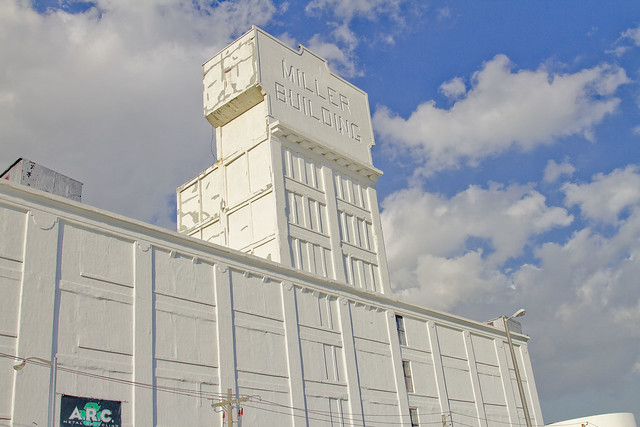
425 Greenpoint Avenue is the address of this structure, and its bold face designates itself as “The Miller Building”.
Like many of the enormous factory structures which grace the Newtown Creek Watershed, its original purpose has been lost to changing economic times and in modernity it serves as a self storage warehouse. The building is visible from great distance, and for those of involved in the history of Newtown Creek- something of a mystery. Even my departed friend Bernard Ente, whose encyclopedic knowledge of Newtown Creek was legendary, was stumped as to its original purpose. It looks for all the world like a grain terminal. It’s not.

– photo by Mitch Waxman
First hand accounts from current occupants of the building offered few clues to its origins, although descriptions of an ad hoc pet cemetery located on its grounds tantalize with their wild suggestions. It is located in a petrochemical center, a poured concrete structure which is at a minimum 90 years old and some 9 stories in height (which is remarkable in itself), and stands on some of the most valuable real estate (from a early to mid 20th century point of view) in New York City.

– photo by Mitch Waxman
All the usual sources, including the estimable database maintained by the NYC Department of Buildings, return few if any results on its origins. this is often the case with older structures that were built in the so called outer boroughs around the time of “consolidation” and I’m sure that somewhere in the Brooklyn Borough Hall there must exist a record of the place in the atavist files of the City of Brooklyn- but I have not been able to find them. Accordingly, an attempt has been made to “beat the brush” amongst the many historical enthusiasts I have been fortunate enough to meet over the last few years.
T.J. Connick, a scholar who I’ve never met in person and know only from the vast interwebs, has been immensely helpful in the endeavor and is singled out for generously adding to the research effort.

– photo by Mitch Waxman
Modern cohorts who run a large petro chemical business based on Kingsland Avenue responded to my queries about the Miller Building with “it used to be a glue factory” as late as the 1970’s. In fact, many Greenpointers will repeat this, as a 20th century glue and varnish factory was housed here which was legendary for its effluent smells. The earliest mention I’ve been able to find about the place, and which surely discusses the antecedent of the modern structure, is in a 1911 trade journal.
From Paint, oil and drug review, Volume 52 , courtesy google books
Unknown cause, Tuesday, July 11, destroyed the plant of the Charles Miller varnish works, at Greenpoint avenue and Newtown Creek, Brooklyn. The flames threatened surrounding factories, but the firemen kept the blaze confined to the doomed building. At the time there were but few employes in the place, and they escaped without injury. The damage was estimated at $3,000.

– photo by Mitch Waxman
Logically- the modern Miller Building must have been erected sometime in the eight years between the 1911 fire and a conflagration in 1919 known as “The Standard Oil fire”. “The Miller building” discussed in the link below is obviously the modern structure.
From 1919’s Insurance newsweek, Volume 20, courtesy google books
Across the street from this plant is the Miller Building, which is fireproof and has wired glass windows. This building was undamaged, and prevented the fire from reaching the buildings of the Green Point Storage Co., in which are stored naval supplies such as resin and tar. The New York fire insurance companies also had lines on this risk. A remarkable fact was that no one was killed. This was probably due to the fact that exploding oil does not have the force of powders, and also much less concussion. The tanks that were blown, however, were twisted and torn as if some colossal force had thrown them down from a great height. The blazing oil which ran about in rivulets was a constant menace to the other tanks. The office of the Standard Oil Co., which was supposed to have been of fireproof construction, was destroyed, but most of the important records were saved.
Additionally, the 1919 fire was explored here at your Newtown Pentacle, in the posting “Tales of Calvary 11- Keegan and Locust Hill“.

– photo by Mitch Waxman
T.J. Connick, in answer to my queries about the Miller Building, sent along these fascinating tidbits which are presented as received:
- Charles A. Miller appears, as described in my previous email, as father to Charles Clifford Miller.
- It appears that Charles A Miller and Mrs. raised family at 128 Kent Street. Mr. & Mrs. were active in the Third Church (Universalist). Daughter Hattie was Sunday school teacher. Florence I. Miller appears at the address, class of 1903 at Pratt Institute. Maybe it’s Hattie, maybe some other relation.
- Mrs. Charles A Miller’s obit appears in July 2, 1901 Brooklyn Eagle (p.2). Her name was Justice Liberty Miller – no joke. She died at 43.
- Oct 26, 1913 Brooklyn Daily Eagle (page 2) reports on marriage of Charles Clifford Miller. He married Hazel Walrath of Fort Plain, NY in Universalist Church ceremony in her home town. He was described as head of Eclipse Box & Lumber Company (this located 425 Greenpoint), member of Northport Yacht Club (his yacht the 30-foot Dutchess), and motorist.
- The couple planned to make their home at 13 Greenway Terrace, Forest Hills (Queens)
- Subdued affair due to recent death of his father Charles Miller “prominent manufacturer of Brooklyn and a widely known Universalist.”
- Advertisement appeared in New York Lumber Trade Journal of May 1, 1921
“FOR SALE or LEASE Planing Mill & Lumber Yard
Tel. 1803 Greenpoint Charles C. Miller
425 Greenpoint Ave. Brooklyn NY - I also found description of Charles C. Miller where the author states that he Miller had recently joined Eclipse Box after association with Eclipse Oil Works.
- Charles A Miller (presumably his father) appears in 1911 Directory of Directors in City of New York: Miller, Charles A. with Standard Oil Co., 425 Greenpoint Ave., Brooklyn
- Charles Clifford Miller died in Fall of 1945 at home in Forest Hills.
- Miller’s a common name; makes searches tough. Eclipse Box & Lumber a definite, and Charles Clifford Miller’s association established in the wedding report in the Eagle, and by industry items in some trade journals from 1904 onwards. As regards “varnish” connection, Miller was flexible with his operation. A 1904 report indicated that his business was providing wood shavings to the gaslight industry in the neighborhood. The leftovers were used to make boxes, hence Eclipse Box & Lumber. Boxes were varnished, why not make your own? Same for Glue, etc.
– photo by Mitch Waxman
Connections with the Universalist sect track- in 1913, as the 425 Greenpoint Avenue address was given in a Universalist journal for a “Recording Secretary” named Ida Ritter East at the address. My bet would be that old man Miller was listing his office address, and that Ida was his actual secretary- but that’s idle supposition.
Connick’s postulations are also confirmed by this link which offers the address of Eclipse Box and Lumber at the selfsame 425 Greenpoint.
Eclipse seemed to have been sharing the space with other companies as early as 1917, if one believes the testimony of one Charles M. Bopp. Manhattan Briar Pipe Co. was on site as late as 1919, according to this scanned newspaper.

– photo by Mitch Waxman
A fairly reliable source, in 1912’s THE EASTERN DISTRICT of BROOKLYN, Eugene Armbruster listed:
“Eclipse Oil Works, Newtown Creek. The Eclipse Box & Lumber Company, Greenpoint Avenue. American Varnish Company, Greenpoint Avenue” as having occupied this part of the Newtown Creek waterfront.
Additionally, the Universalist creed of Charles A. Miller seems to be confirmed in this outtake from a Brooklyn Citizens Almanac of 1894:
Third Universalist of Reconciliation— North Henry st., near Nassau av.; org. 1857; Pastors. Alice Kinney Wright and Alfred Ellsworth Wright, 206 North Henry St.; Chas. A. Miller, Sec, 128 Kent St.; membership, 33; sittings. 300; S.S. Supt, C. H. Palmateer, 159 Dupoht St ; S.S. membership, 146; value of property, 88,000; Trustees: C. H. Palmateer, C. A. Miller, A. P. Howard, J. W. Moore, Chas. E. Lund and Jas. English.

– photo by Mitch Waxman
Connick, it seems, is a force to be reckoned with. Thank you, T.J.
Personally speaking, I’m still not satisfied, and feel as if the Miller Building has defeated me. How, exactly, does an obviously significant structure such as this escape the historical record so successfully? Newtown Creek is in many ways a black hole as far as the aforementioned record goes, but this is frankly ridiculous… Grrr.
My hope would be that one of you, the knowledgeable lords and ladies of Newtown, will read this post and have some mercy upon a humble narrator- sharing some anecdote or family history that will put a face of some kind on this place. I can always be reached at this address.

– photo by Mitch Waxman
Thanks, again, to T.J. Connick. At least have an idea who “Miller” was, and some of the texture of what happened in and around this mysterious structure which rises high above the Newtown Creek.
As far as the latter day history of the building, I think the picture says it all.
dark and stern

– photo by Mitch Waxman
Just the other day, one observed this crow walking down the center median of the Greenpoint Avenue Bridge. For the purposes of nomenclature, we’ll refer to him as the Grey Crow. Even by the standards of their kind, this particular Crow seemed seedy and more than a little “off”. For those of you new to the ongoing story of the Crows- if a piece of metal, or a mattress, or anything shiny- finds its way to the sidewalk anywhere in western Queens or North Brooklyn, itinerant metal collectors like this gentleman sweep in and grab it. Soiled and blackened by their occupation, these foot soldiers of recycling then make their way to one of the several scrap metal dealers in the neighborhood, where they sell the materials at market rates and by the pound. Often, these fellows won’t wait for metals to reach the curbside midden, and they will harvest whatever metals they might happen across- as recently documented by Ms. Heather at NY-shitty.com.

– photo by Mitch Waxman
While one applauds the industry of the Crows, for they are a hard working bunch who operate in an invisible and unspoken economy at the absolute bottom of the economic spectrum, they are often the proverbial “rats in the walls” of our community. One need only walk through one of the 22,000 square acres of cemetery which distinguish western Queens to see the effects of their actions. Monument and mausoleum are part of their harvest, and the valuable white bronze and copper adornments which have been pried loose from century old graves are testament to their actions. Of late, manhole and gas main covers have been part of their harvest. The Grey Crow didn’t seem to be carrying any of this illicit cargo, but these sullen and solitary men (they are almost always men) are opportunist scavengers nibbling in at the edges of civilization.

– photo by Mitch Waxman
Dark in aspect and mood, existing at the edge of law and society, the Crows are growing in population- no doubt due to the worsening economic conditions which have been felt by all. This Grey Crow drew my attention due to the reckless manner in which he crossed the busy Greenpoint Avenue Bridge, walking down the center median of the traffic choked span which crosses the malign Newtown Creek between Blissville in Queens and Greenpoint in Brooklyn. Like many of his kind, when he observed a shabby man in a black trench coat pointing a camera at him, sneering commentary and verbal threats were offered to that photographic mendicant, who remains as always- your humble narrator.
groves and gardens

– photo by Mitch Waxman
Yesterday, being the 10th of November, your humble narrator found himself at the Brooklyn Navy Yard for the opening of the Building 92 museum, a newly public space at that venerable institution found on the Wallabout.
from bldg92.org
The mission of the Brooklyn Navy Yard Center at BLDG 92 is to celebrate the Navy Yard’s past, present and future, and to promote the role the Yard and its tenants play as an engine for job creation and sustainable urban industrial growth. By providing access to exhibits, public tours, educational programs, archival resources and workforce development services, BLDG 92 reinforces the Yard’s unique bonds with the community and inspires future generations to become industrial innovators and entrepreneurs.
The Brooklyn Navy Yard Center at BLDG 92 is an exhibition and visitors center that is operated as a program of the Brooklyn Navy Yard Development Corporation.

– photo by Mitch Waxman
One of my associates from the Working Harbor Committee had brought me along, and upon arriving, I was handed a rather elaborate press kit. Said kit included facts and glad tidings about the new museum, which is housed in a renovated 1857 era structure.
from wikipedia
On the eve of World War II, the yard contained more than five miles (8 km) of paved streets, four drydocks ranging in length from 326 to 700 feet (99 to 213 meters), two steel shipways, and six pontoons and cylindrical floats for salvage work, barracks for marines, a power plant, a large radio station, and a railroad spur, as well as the expected foundries, machine shops, and warehouses. In 1937 the battleship North Carolina was laid down. In 1938, the yard employed about ten thousand men, of whom one-third were Works Progress Administration (WPA) workers. The battleship Iowa was completed in 1942 followed by the Missouri which became the site of the Surrender of Japan 2 September 1945. On 12 January 1953, test operations began on Antietam, which emerged in December 1952 from the yard as America’s first angled-deck aircraft carrier.

– photo by Mitch Waxman
The press event began with a naval color guard and pledge of allegiance, after which a group of kids were led on stage. The aim of the museum is of an educational nature, which made their presence seem appropriate.
from wikipedia
The Wallabout became the first spot on Long Island settled by Europeans when several families of French-speaking Walloons opted to purchase land there in the early 1630s, having arrived in New Netherland in the previous decade from Holland. Settlement of the area began in the mid-1630s when Joris Jansen Rapelje exchanged trade goods with the Canarsee Indians for some 335 acres (1.36 km2) of land at Wallabout Bay, but Rapelje, like other early Wallabout settlers, waited at least a decade before relocating fulltime to the area, until conflicts with the tribes had been resolved.

– photo by Mitch Waxman
All the best people from the Manhattan establishment were there, including Mayor Mike Bloomberg and Christine Quinn, Speaker of the City Council.
from “A history of the city of Brooklyn : including the old town and village of Brooklyn, the town of Bushwick, and the village and city of Williamsburgh” by Gabriel Furman, 1824, courtesy archive.org
John (George) Jansen de Ratalie, one of the Walloon emigrants of 1623, who first settled at Fort Orange (Albany), and in 1G26 removed to Amsterdam, on Manhattan Inland. On the lGth of June, 1637, Bapalie purchased from its native proprietors a piece of land called ” Hennegackonk,” lying on Long Island “in the bend of Mareckkawieck,” now better known as Wallabout Bay. This purchase, comprising about three hundred and thirty-five acres, now occupied in part by the grounds of the United States Marine Hospital, and by that portion of the city between Nostrand and Grand Avenues — although it may have been, and probably was, more or less improved as a farm by Bapalie — was not occupied by him as a residence until about 1654. 3 By that time, the gradual influx of other settlers, many of whom were Walloons, had gained for the neighborhood the appellation of the “Waal-Bogt,” or “the bay of the foreigners.”

– photo by Mitch Waxman
Mayor Bloomberg starting things off, describing the project and it’s significance to the crowd of dignitaries and veterans. He seemed to be in a particularly jocular mood.
from wikipedia
Michael Rubens Bloomberg (born February 14, 1942) is an American business magnate, politician, and philanthropist. Since 2002, he has been the Mayor of New York City and, with a net worth of $19.5 billion in 2011, he is also the 12th-richest person in the United States. He is the founder and eighty-eight percent owner of Bloomberg L.P., a financial news and information services media company.

– photo by Mitch Waxman
Apparently, the Navy Yard is an object of some attention for City Hall and hizzoner described the various political twists and financial turns over the last decade which culminated at this ceremony.
from nyc.gov
Mayor Michael R. Bloomberg and Brooklyn Navy Yard Development Corporation President Andrew Kimball cut the ribbon today on BLDG 92, a $25 million exhibition and visitors center that documents the historic significance of the 300-acre Brooklyn Navy Yard, and announced new hiring commitments from Navy Yard tenants. Over the coming year, tenants including Steiner Studios, Shiel Medical Laboratories, B&H Photo, Duggal Visual Solutions, Cumberland Packing, Ares Printing and Mercedes Distribution have agreed to work with the Navy Yard’s expanded employment program – to be housed in BLDG 92 – to place over 300 local residents in new jobs. To date, more than 1,000 local residents have been placed in jobs over the past 10 years. The new program will make a special effort to place veterans returning from Iraq and Afghanistan in the new jobs.

– photo by Mitch Waxman
A surprisingly large audience was present, including representatives of the various trade unions which worked on the project.
from wikipedia
A trade union (British English) or labor union (American English) is an organization of workers that have banded together to achieve common goals such as better working conditions. The trade union, through its leadership, bargains with the employer on behalf of union members (rank and file members) and negotiates labour contracts (collective bargaining) with employers. This may include the negotiation of wages, work rules, complaint procedures, rules governing hiring, firing and promotion of workers, benefits, workplace safety and policies. The agreements negotiated by the union leaders are binding on the rank and file members and the employer and in some cases on other non-member workers.
Originating in Europe, trade unions became popular in many countries during the Industrial Revolution, when the lack of skill necessary to perform most jobs shifted employment bargaining power almost completely to the employers’ side, causing many workers to be mistreated and underpaid. Trade union organizations may be composed of individual workers, professionals, past workers, or the unemployed. The most common, but by no means only, purpose of these organizations is “maintaining or improving the conditions of their employment”.

– photo by Mitch Waxman
Congresswoman Nydia Velazquez spoke next, as the Brooklyn Navy Yard is contained within her district. I had an opportunity to chat briefly with her afterwards, but we talked mainly about Newtown Creek.
from wikipedia
Nydia Margarita Velázquez (born March 28, 1953) is the U.S. Representative for New York’s 12th congressional district, serving since 1993. She is a member of the Democratic Party. The district includes residential areas of three boroughs (Brooklyn, Queens and Manhattan). She is the first Puerto Rican woman to be elected to Congress, and the chair of the Congressional Hispanic Caucus until January 3, 2011.

– photo by Mitch Waxman
Speaker Quinn spoke next, and described the managers of the project with great admiration.
also from nyc.gov
“The Navy Yard is a testament to New York City’s resilience and creativity,” said NYC Council Speaker Quinn. “Through thoughtful redevelopment efforts, what was once a thriving shipbuilding facility is now a model urban industrial park that houses some of the City’s most cutting edge companies. We are proud at the Council to have partnered with the Administration, State, Borough President Markowitz, and the Brooklyn Navy Yard to make BLDG 92 a reality and are thrilled to see that it will help connect local residents to more than 300 new jobs.”

– photo by Mitch Waxman
This fellow was a State Senator, I believe, named Daniel Squadron.
from wikipedia
Daniel Squadron is the state senator for the 25th district of the New York State Senate. He is a Democrat. The 25th Senate District covers lower Manhattan and an area of Brooklyn down the East River from part of Greenpoint to Carroll Gardens, and eastward to part of Downtown Brooklyn.
Before his election to the state senate, Squadron attended the Fieldston School in Riverdale, New York. He later served as a top aide to U.S. Senator Chuck Schumer, and helped to write Schumer’s book “Positively American: Winning Back the Middle-Class Majority One Family at a Time”. He ran in the Democratic primary against 30 year incumbent Martin Connor on September 9, 2008, defeating Connor with approximately 54% of the vote.

– photo by Mitch Waxman
Next up was Deputy Mayor Bob Steel.
from nyc.gov
Robert K. Steel is Deputy Mayor for Economic Development. He is responsible for the Bloomberg Administration’s five-borough economic development strategy and job-creation efforts, as well as its efforts to expand job training, strengthen small business assistance, promote new industries, diversify the economy, and achieve the goals of the New Housing Marketplace Plan, which is designed to build or preserve enough affordable housing for 500,000 New Yorkers by 2014. He spearheads the Administration’s major redevelopment projects, including those in Lower Manhattan, Flushing, Hunters Point South, Coney Island, Stapleton, the South Bronx, and Hudson Yards. Deputy Mayor Steel oversees such agencies as the Department of Housing Preservation and Development, Department of City Planning, Department of Small Business Services, NYC Economic Development Corporation and NYC & Company, and he serves as Chair of Brooklyn Bridge Park board.
Prior to his 2010 appointment as Deputy Mayor, Steel was the President and CEO of Wachovia. From 2006 to 2008, Steel was the Under Secretary for Domestic Finance at the U.S. Department of the Treasury. Prior to entering government service, Steel spent nearly 30 years at Goldman Sachs, ultimately rising to become co-head of the U.S. Equities Division and Vice Chairman of the firm. He is a graduate of Duke University and the University of Chicago’s Booth School of Business, and has distinguished himself as Chairman of Duke’s Board of Trustees, Chairman of the Aspen Institute’s Board of Trustees, Senior Fellow at the Harvard Kennedy School of Government, a member of the FDIC Advisory Committee on Economic Inclusion, Chairman of The After-School Corporation, and Co-Founder of SeaChange Capital Partners, an organization dedicated to helping nonprofits grow.

– photo by Mitch Waxman
Several military veterans were in attendance, as mentioned, these fellows had served on the USS Missouri which was launched from the Navy Yard during the second World War.
from wikipedia
USS Missouri (BB-63) (“Mighty Mo” or “Big Mo”) is a United States Navy Iowa-class battleship, and was the fourth ship of the U.S. Navy to be named in honor of the U.S. state of Missouri. Missouri was the last battleship built by the United States, and was the site of the surrender of the Empire of Japan which ended World War II.
Missouri was ordered in 1940 and commissioned in June 1944. In the Pacific Theater of World War II she fought in the battles of Iwo Jima and Okinawa and shelled the Japanese home islands, and she fought in the Korean War from 1950 to 1953. She was decommissioned in 1955 into the United States Navy reserve fleets (the “Mothball Fleet”), but reactivated and modernized in 1984 as part of the 600-ship Navy plan, and provided fire support during Operation Desert Storm in January/February 1991.
Missouri received a total of 11 battle stars for service in World War II, Korea, and the Persian Gulf, and was finally decommissioned on 31 March 1992, but remained on the Naval Vessel Register until her name was struck in January 1995. In 1998, she was donated to the USS Missouri Memorial Association and became a museum ship at Pearl Harbor, Hawaii.

– photo by Mitch Waxman
Another veteran was sitting on the dais, who was interviewed in a documentary on the project which accompanied and was distributed with the press kit.
from bldg92.org
Be among the first to walk through the gates of the Brooklyn Navy Yard when BLDG 92 opens to the public on 11/11/11. We will offer free tours, family fun and prizes to celebrate our grand opening.
Free shuttle service for opening weekend: From 12-6PM, the blue Brooklyn Navy Yard shuttle bus will make continuous loops between BLDG 92 and downtown Brooklyn (intersection: Jay Street and Willoughby Street) easily accessible from the Jay St/Metrotech station (A,C,F,N,R) and a quick walk from Borough Hall Stations (2,3,4,5)
Fri, Sat, Sun 12-6

– photo by Mitch Waxman
Along with the color guard, there was a military band present.
from wikipedia
The U.S. Navy School of Music was founded at the Washington Navy Yard by order of the Chief of the Bureau of Navigation on 26 June 1935. The school was originally run by the U.S. Navy Band, with members of the Navy Band teaching classes and private lessons in addition to their regular performance duties with the band. After the commencement of World War II, these duties were deemed too onerous for the Navy Band personnel and the school was separated from the band and relocated to the Anacostia Naval Receiving Station in Washington, D.C. on 24 April 1942.

– photo by Mitch Waxman
I was particularly taken with the Sousaphone player for some reason.
from wikipedia
The sousaphone is a valved brass instrument with the same tube length and musical range as other tubas. The sousaphone’s shape is such that the bell is above the tubist’s head and projecting forward. The valves are situated directly in front of the musician slightly above the waist and most of the weight rests on one shoulder. The bell is normally detachable from the instrument body to facilitate transportation and storage. Excepting the instrument’s general shape and appearance, the sousaphone is technically very similar to a standard (upright) tuba.
For simplicity and durability, modern sousaphones almost definitively use three non-compensating piston valves in their construction, in direct contrast to their concert counterparts’ large variation in number, type, and orientation. It has been incorrectly noted that the tuba is a conical brass instrument and the sousaphone is a cylindrical brass instrument; actually both instruments are semi-conical—no valved brass instrument can be entirely conical, since the middle section with the valves must be cylindrical. While the degree of conicity of the bore does affect the timbre of the instrument much as in a cornet and trumpet, or a euphonium and a trombone, the bore profile of a sousaphone and most tubas is similar.

– photo by Mitch Waxman
Within the structure, this is that 22,000 pound anchor that you’ve heard mentioned in other reports.
from wikipedia
The words ὀδὁντες and dentes (both meaning “teeth”) are frequently used to denote anchors in Greek and Latin poems. The invention of the teeth is ascribed by Pliny to the Tuscans; but Pausanias gives the credit to Midas, king of Phrygia. Originally there was only one fluke or tooth, whence anchors were called ἑτερόστομοι; but a second was added, according to Pliny, by Eupalamus, or, according to Strabo, by Anacharsis, the Scythian philosopher. The anchors with two teeth were called ἀμϕἱβολοι or ἀμϕἱστομοι, and from ancient monuments appear to have resembled generally those used in modern days except that the stock is absent from them all. Every ship had several anchors; the largest, corresponding to our sheet anchor, was used only in extreme danger, and was hence peculiarly termed ἱερά or sacra, whence the proverb sacram anchram solvere, as flying to the last refuge.

– photo by Mitch Waxman
The museum offered few vantage points of the actual working Navy Yard, this was one of them.
from nydailynews.com
“This will be a way for the public for the first time since 1801 to penetrate our walls and learn about our history and what we’re doing now,” said Brooklyn Navy Yard Development Corp. president Andrew Kimball. “We’ve worked really hard to break down that separation with the community.”
into the world

– photo by Mitch Waxman
Sleep has not come easily for your humble narrator of late, and dreaming offers little nepenthe. Days and nights it would seem, are consumed with images of the dread Newtown Creek and its insalubrious valley. English Kills in particular, the logical paramount of the waterway and the heart of darkness itself, draws my attention.
It is important to mention here that I am speaking from a personal point of view in this post and not espousing a majority opinion or policy of any of the “groups” with which the Newtown Pentacle has become affiliated. There are those I work for, work with, or work for me- who might not agree with statements made in this post offered to stimulate discussion on “common wisdom”.

– photo by Mitch Waxman
A decision which proved controversial this summer, on several Newtown Creek boat tours, was my demand that we no longer cross the Metropolitan Avenue Bridge with the general public on board. This is a deviation from prior years, but the prurient interest and wonderment of viewing the place is far outweighed by the risk posed to those who are exposed to its poisons. If you want to go back there, there are other options and other parties who will take you. Often it will be in a small vessel, often a kayak. Which is the point of this missive.

– photo by Mitch Waxman
As mentioned, last week your humble narrator met with that staff of Manhattan doctors which have long maintained my delicate equilibrium. One of the topics of examination which the white coat crowd brought forward to me was the environmental exposure which my activities along the Creek brings, the long term consequences of same, and certain laboratory testing which they would like me to undergo due to my walking its banks. Paradoxically, certain interests involved in the ongoing story of the Newtown Creek held me to task for statements about water quality as related to recreational boating, fearing that my opinions might harm their particular interests and provide fuel for their critics in officialdom.

– photo by Mitch Waxman
Everybody’s friends at EPA are still in the process of discovering all that there may be which is buried down there, and until the results of their analysis are revealed (which will be nearly a decade from now)– no hard and fast statement about the water quality can be considered reliable or sound. Apocrypha and incomplete discoveries, however, suggest that a witch’s brew of worst case scenarios are to be found all along the Creek- and especially in the section of English Kills which lies beyond DUMABO (Down Under the Metropolitan Avenue Bridge).

– photo by Mitch Waxman
The “numbers” which most use to discuss water quality in this place are relative to the presence of microscopic entities like the enterococcus, bacterial counts of which are calculated relative to recent rain events and so called “outfalls”. Famously, the rule in most of NY harbor is to wait 72 hours after it rains before swimming or boating because of a “high count”, and the folks at DEP calculate the success of their endeavors based on an accounting of the population of this particular microbial specie (a Federal Standard, they used to use Fecal Coliform). Virii and Prions are neither tested for, nor counted.
When a beach is closed, its usually because “the count” is high, for instance. The difference to the surrounding waters which Newtown Creek presents is that sewer borne bacteria are merely the tip of the iceberg which floats in this stagnant water.
Don’t forget- orange juice and ice do not a screw driver make, it’s when you stir in the vodka that you achieve a proper and singular cocktail bearing a potency beyond that of its individual components.

– photo by Mitch Waxman
An enormous waste transfer station acts as a concentrating point for the putrescent waste of New York City just back there, producing an excruciating stink. The shorelines of this particular valley are lined with state superfund sites, and large sewer outfalls feed millions of gallons of human waste into English Kills annually. That CSO “flow” also carries with it every chemical which has passed through a human filter- birth control and steroid pharmaceuticals, undigestable food additives and dyes, and all the runoff from the gutters which carries solvents, automotive drippings, and whatever washes out of the enormous acreage of cemeteries which distinguish the neighborhoods around the Newtown Creek watershed.
Not trying to “gross you out”, but facts are immutably facts.

– photo by Mitch Waxman
Detractors would offer that your humble narrator is not a doctor, scientist, or much of anything at all. They would further inform you that I am a doomsayer, alarmist, and given to making unfounded statements based on a layman’s understanding of the complex chemistry which composes the so called waters of Newtown Creek. They call me a vulgar fool as well, but not to my face.
All this is true, of course, but it doesn’t mean that I’m incorrect.


 The Newtown Pentacle