Posts Tagged ‘East River’
dense curtain

– photo by Mitch Waxman
The 1.3 billion gallon a day flow of New York City’s sewage really should be defined as a third major river.
That’s 1,300,000,000 gallons a day or 474,500,000,000 gallons of night soil a year.
1.3 billion is approximately the population of China.
Pictured above is the DEP Sludge Vessel M/V Newtown Creek. A veteran, she was was laid down by the Wiley Manufacturing Co. in 1967. Just under 324 foot long, M/V Newtown Creek can carry 102,000 cubic feet of cargo and weighs in at 2,557 gross tons.
from nywea.org
The largest vessels, M/V Newtown Creek and M/V North River, are semiautomated motor vessels with more than twice the capacity of the original sludge vessels. The crew size was reduced to eight in 1980 and reduced again in 1987 to the current size of six. In 1987, MPRSA was amended, and ocean dumping was moved from the 12-mi site to a 106-mi site. As a result, the operation of the M/V was changed to in-harbor work transporting sludge to four newly constructed New York City ocean-going barges for disposal to the 106-mi site.
In 1991, to comply with the Ocean Dumping Ban Act (ODBA), the M/V Newtown Creek, North River and Owls Head began transporting sludge from plants without dewatering facilities or other means of conveyance to plants with dewatering facilities for processing. Since barges were no longer needed, three were retired, and one, the Udalls Cove, was kept as part of the fleet for emergencies.

– photo by Mitch Waxman
Forty-four and change years is a long time to be working any job, especially one with the city.
M/V Newtown Creek was cruising along the East River one winter’s afternoon, just before sunset, and your humble narrator was similarly crossing the water- only I was upon the Queensboro Bridge’s pedestrian walkway, en route to the Shining City.
from nyc.gov
Presently, NYC-DEP Marine Section uses these three sludge vessels for the transportation of liquid sludge from wastewater treatment plants without dewatering capabilities.

– photo by Mitch Waxman
The DEP people actually refer to these ships as “Honey Boats”, by the way, or at least some of the ones that I’ve interacted with have.
It’s gallows humor, the refined and thickened sludge that these vessels carry does not have the appearance and seeming viscosity of honey, rather it is said to be darkly colored and resemble pea soup.
from wikipedia
The New York City Department of Environmental Protection (NYCDEP) manages the city’s water supply, providing more than 1.1 billion US gallons (4,200,000 m3) of water each day to more than 9 million residents throughout New York State through a complex network of nineteen reservoirs, three controlled lakes and 6,200 miles (10,000 km) of water pipes, tunnels and aqueducts. The DEP is also responsible for managing the city’s combined sewer system, which carries both storm water runoff and sanitary waste, and fourteen wastewater treatment plants located throughout the city. The DEP carries out federal Clean Water Act rules and regulations, handles hazardous materials emergencies and toxic site remediation, oversees asbestos monitoring and removal, enforces the city’s air and noise codes, bills and collects on city water and sewer accounts, and manages citywide water conservation programs.
Emily Lloyd was the commissioner of the Department of Environmental Protection until resigning in 2008. On November 30, 2009, New York City Mayor Michael Bloomberg appointed Caswell F. Holloway to be the new commissioner of NYCDEP. Following Holloway’s appointment as the new NYC Deputy Mayor for Operations, Mayor Bloomberg appointed Carter H. Strickland, Jr. to be the new commissioner of NYCDEP on August 17, 2011.
hewn rudely

– photo by Mitch Waxman
Recently, your humble narrator was onboard a speeding vessel as it hurtled down the River of Sound (or East River as it’s known to modern residents). Turning from the jewel like facade of the Shining City called Manhattan, my thoughts turned to Long Island City and it’s burgeoning Tower Town neighborhood, known to ancient residents as Ravenswood and Hunters Point.
High above and distant from the water I was traveling across, an impression nevertheless grew in my mind that the monocular thing which cannot possibly exist in the spire of that Sapphire Megalith turned and fixed its gaze upon our tiny craft- an intuition of which of I am certain.
from “Laws of the State of New York, Volume 2“, 1870, courtesy google books
AN ACT to incorporate Long Island City.
Passed May 6, 1870; three-fifths being present
The People of the State of New York, represented in Senate and Assembly, do enact as follows:
TITLE I.
Section 1. All that part of the town of Newtown in city the County of Queens, included within the following boundaries, to wit: Beginning at the mouth of Newtown creek, on the east side of the East river, running thence easterly along the center line of said Newtown Creek to the westerly side of the Penny bridge (so called); thence northerly along the westerly side of the Bushwick and Newtown turnpike to the road on the southerly side of Calvary cemetery, known as the road to Dutch Kills; thence along the center of said last-named road on the southerly and westerly sides of Calvary cemetery as far as the boundaries of said cemetery extend; thence northerly along sajd cemetery to the center of the road leading to Green Point, on the northerly side of said cemetery; thence along said last-mentioned road to the intersection of the same with the road leading from Calvary cemetery to Astoria; thence easterly to the center of Woodside avenue ; thence northerly along the center line of said avenue to Jackson avenue; thence northeasterly along the center of the Bowery Bay road to low water mark in Bowery bay; thence westerly along low water mark to the East river; thence southerly along low water mark in the East river, to the place of beginning, shall be a city known as Long Island City; and the citizens of this State, from time to time inhabitants within the said boundaries, shall be a corporation by the name of “Long Island City,” and as such may sue and be sued, complain and defend, in any court, make and use a common seal and alter it at pleasure; and may receive by gift, devise, grant, bequest or purchase, and hold and convey, such real and personal property as the purposes of said corporation may requite.

– photo by Mitch Waxman
The reputation endured by Long Island City in the 19th and most of the 20th centuries can hardly be described as desirable, as the historical record displays. The ancient home of graft, as it has been called, the hybrid assemblage of distant villages and towns into a single municipality which occurred in 1870 spawned a seemingly lawless community.
Tales of gambling dens, vice ridden hotels and inns, foreign born highwaymen, and an endless series of corrupt political organizations abound in contemporaneous accounts of the place.
from “Wallace’s monthly, Volume 8 By John Hankins Wallace“, 1882, courtesy google books
Ever since the enactment of the law against pool selling the police and judicial authorities of this city have been more or less persistent and successful in their attempts to suppress this form of gambling. Whatever charges of negligence and connivance may be brought against them, their services have been valuable and in a measure successful. This is evident from the fact that this particular form of gambling has been driven across the river into Queens County, Long Island, where the dirty scoundrels and their victims congregate to transact their nefarious business. Their protection there, by the local authorities, has been so thoroughly and even fiercely exposed by the daily press that an honest man don’t like to be seen crossing the ferry to Hunter’s Point, or Long Island City, as it is called. In the public estimation the place has become a moral lazaretto and in a choice of residence a man would not have much to choose between that and a smallpox hospital. But why should all this odium lie cast upon poor little tax ridden and rogue ridden Long Island City?

– photo by Mitch Waxman
It is said that when Manhattan outlawed bare knuckle boxing, barges with rings and bleachers upon them appeared at Hunters Point and ferries would carry crowds from the larger city to so called “pugilist exhibitions”. Additionally, according to Comstock and other guardians of the public good, when horse parlors and pool betting (the modern day numbers racket) were similarly banned in the Shining City- a flurry of such activity began across the river at what we moderns would call Long Island City. All of this increasingly organized crime was nourished and populated by the transient customers of the Long Island Railroad and a concurrent Ferry station- again, I’m owing this to period reports from reliable (and multitudinous) sources.
Of course, in LIC, it was the mayor, coroner, police chief, and fire department who both (personally) owned and operated the back room casinos, whorehouses, and dens of iniquity. The LIRR bosses cared little, as long as local government did not get in their way, and the payoff demands were reasonable. It was only during the era of Patrick Gleason that things got out of hand and the LIRR finally had enough of it.
from Wikipedia
Gantry Plaza State Park is a state park on the East River in the Hunter’s Point section of Long Island City, in the New York City borough of Queens.
The 10-acre (4.0 ha) park first opened in May 1998 and was expanded in July 2009. The southern portion of the park is a former dock facility and includes restored gantry cranes built in the 1920s to load and unload rail car floats that served industries on Long Island via the Long Island Rail Road tracks that used to run along 48th Avenue (now part of Hunter’s Point Park). The northern portion of Gantry Plaza State Park was a former Pepsi bottling plant.

– photo by Mitch Waxman
The days of the Rail bosses secretly pulling the strings here are long gone, their proudest achievements reduced to show pieces for the slavering pet of that thing which cannot possibly persist in the Megalith. Cherished and nurtured beneath the unblinking and fire sheathed eye of that which does not breath, nor sleep, yet hungers- this coagulation of industry and greed which it nurtures here is a tangled knot of labor unions, land speculators, and ambitious politicians. This pet- a drooling hound of limitless appetite and vainglorious aspiration has no name- but its malice and cold desire is clearly manifest in Tower Town and will soon spread along the waterfront south across Hunters Point and then into Brooklyn and beyond…
Allegorical references to “Fenrir the Wolf” would seem appropriate, but would be inaccurate- an ancient nomen for a modern threat…
For now, can we just refer to the force trapped behind the black gates of Western Queens as the “Real Estate Industrial Complex“?
from “A history of Long Island: from its earliest settlement to the present time, Volume 1” 1902, courtesy google books
It is noticeable that some of the deeds in the early part of the last century conveying lots at Hunter’s Point call it Long Island City. It continued to be a straggly, dreary, povertystricken place, with few settlers and these of the poorest class, until the Long Island Road, because it could not make the necessary arrangements in Brooklyn, selected it as the main terminus of the road. Since then it has steadily increased in population, and as the First Ward of Long Island City it rapidly assumed the lead in the destinies of that now happilv departed shade. Railway and manufacturing interests have steadily built up its population and added to its material resources, most of which, however, were mercilessly squandered by political intriguers.
usual symptoms

– photo by Mitch Waxman
Existential reality and physical weakness govern this day, as your humble narrator is off to the shining city for consultations with the staff of medical specialists and practitioners whose art maintains an acceptable equilibrium between life and death for him. They plan on siphoning off some of my very lifeblood, and subjecting it to alchemical tests, as well as poking and piercing at my increasingly fragile leather with instrumentation whose appearance fills me with a nameless dread. Their prescribed potions will be assessed for effectiveness, and I will face inquisition regarding diet and lifestyle.

– photo by Mitch Waxman
Such exposure to the vagaries of science are required by the increasing fragility and easily upset homogeneity of life as one grows older, part of the overdue bill owed to the universe for that lifestyle of youthful vulgarity and distasteful indulgence which I once enjoyed. I prefer to tuck my conscious mind away in a little corner of my head, behind my left ear, and let them do to my body what they will- for that is the whole of their law. The great equalizer in our society is always found in the hospital ward, where commoner and king alike find themselves sitting on a paper covered table while wearing a cheap gown as strangers perform laboratory tests upon them.

– photo by Mitch Waxman
The staff of medical professionals which are employed on my behalf are, despite my lowly status and financial devastation, actually quite competent and highly placed- ignoring their vast experience and advice would be (and is) foolish. Weak in mind as well as body, I often dismiss this advice, but that is is part of the strange trade off one often makes in modern life- sacrificing what you know is good for you in favor of the quick fix and a feel good option. Seldom do I leave their offices without dire predictions or warnings having been offered, and today will most likely not be an exception.
irrepassable gate
– photo by Mitch Waxman
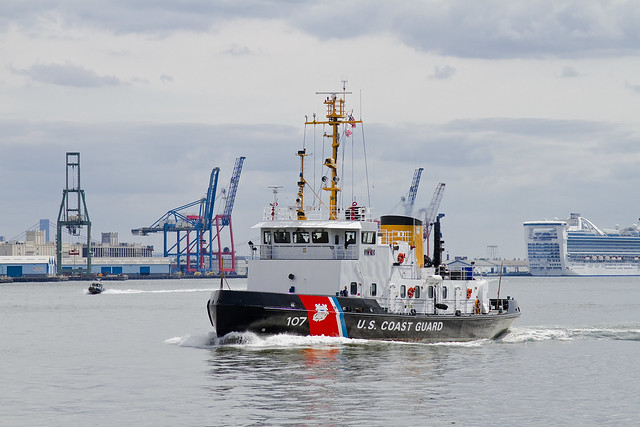
Awhile back, I posted this series of shots to Flickr, and an enigmatic shipping enthusiast from the vast interweb hive mind immediately commented “140′ Bay Class Icebreaking Tug USCGC PENOBSCOT BAY WTGB-107 homeport Bayonne, NJ.”.
From wikipedia
The USCG Bay-class icebreaking tug is a class of 140-foot (43 m) icebreaking tugs of the United States Coast Guard, with hull numbers WTGB 101 through to WTGB 109.
They can proceed through fresh water ice up to 20 inches (51 cm) thick, and break ice up to 3 feet (0.91 m) thick, through ramming. These vessels are equipped with a system to lubricate their progress through the ice, by bubbling air through the hull.

– photo by Mitch Waxman
When focusing in on this ship, I just thought it looked cool. Turns out that this class of vessels has a long and storied past.
Here’s a Coast guard shot of Penobscot Bay in action during the winter…
Here’s the official story, courtesy United States Coast Guard:
from uscg.mil
The 140-foot Bay-class Cutters are state of the art icebreakers used primarily for domestic ice breaking duties. They are named after American Bays and are stationed mainly in Northeast U.S. and Great Lakes.
WTGBs use a low-pressure-air hull lubrication or bubbler system that forces air and water between the hull and ice. This system improves icebreaking capabilities by reducing resistance against the hull, reducing horsepower requirements

– photo by Mitch Waxman
Note: I should mention that members of the USCG have offered me very good, yet unofficial, advice on appropriate maritime footwear in the past- which may render some personal bias on my part for the organization.
The USCG also maintains a short history page on this ship, which can be accessed here.
such a sight

– photo by Mitch Waxman
Apologies for the dire tone of today’s post, this is the sort of narrative which Our Lady of the Pentacle usually asks me to pass her the hemlock following recitation, but I’m in a mood.
Knowledge of what might occur or exist behind these stout walls in Ravenswood, and the dire truth of what it might be that they guard against is strictly forbidden. The very pavement which provides a pedestrian path alongside these sky flung ribbons of masonry is delineated with the property line of the facility. Private security guards patrol in merciless boredom, watching for the itinerant photographer who might stray too close to this line.
In an age of terror, curiosity is an esoteric and questionable trait.
from wikipedia
Esotericism or Esoterism signifies the holding of esoteric opinions or beliefs, that is, ideas preserved or understood by a small group or those specially initiated, or of rare or unusual interest. The term derives from the Greek ἐσωτερικός (esôterikos), a compound of ἔσω (esô): “within”, thus “pertaining to the more inward”, mystic. Its antonym is “exoteric”.
The term can also refer to the academic study of esoteric religious movements and philosophies, or more generally of alternative or marginalized religious movements or philosophies whose proponents distinguish their beliefs, practices, and experiences from mainstream institutionalized traditions.
Examples of esoteric religious movements and philosophies include Alchemy, Astrology, Anthroposophy, Christian mysticism, Magic, Mesmerism, Rosicrucianism, Swedenborgianism, Spiritualism, the Christian Theosophy of Jacob Böhme and his followers, and the theosophical currents associated with Helena Blavatsky and her followers. There are competing views regarding the common traits uniting these currents, not all of which involve “inwardness”, mystery, occultism or secrecy as a crucial trait.

– photo by Mitch Waxman
Angry and pessimistic, your humble narrator fears not, simply because the cosmos manifests and organizes itself in wild chaotics which are beyond all ability to predict or control. Comfort is found in a simple credo of “there is no “then”, there is no “future”, there is only “now”.” Tomorrow might bring a megatsunami or asteroid hit, or a simple infection whose result resolves lethally.
If one was to consider all the possible distopian end states of our civilization with clear eyed rationalism, it would engender longing for a new dark age of blissful ignorance.
from wikipedia
This is the argument that technological civilizations may usually or invariably destroy themselves before or shortly after developing radio or space flight technology. Possible means of annihilation include nuclear war, biological warfare or accidental contamination, nanotechnological catastrophe, ill-advised physics experiments, a badly programmed super-intelligence, or a Malthusian catastrophe after the deterioration of a planet’s ecosphere. This general theme is explored both in fiction and in mainstream scientific theorizing. Indeed, there are probabilistic arguments which suggest that human extinction may occur sooner rather than later. In 1966 Sagan and Shklovskii suggested that technological civilizations will either tend to destroy themselves within a century of developing interstellar communicative capability or master their self-destructive tendencies and survive for billion-year timescales. Self-annihilation may also be viewed in terms of thermodynamics: insofar as life is an ordered system that can sustain itself against the tendency to disorder, the “external transmission” or interstellar communicative phase may be the point at which the system becomes unstable and self-destructs.
From a Darwinian perspective, self-destruction would be a paradoxical outcome of evolutionary success. The evolutionary psychology that developed during the competition for scarce resources over the course of human evolution has left the species subject to aggressive, instinctual drives. These compel humanity to consume resources, extend longevity, and to reproduce—in part, the very motives that led to the development of technological society. It seems likely that intelligent extraterrestrial life would evolve in a similar fashion and thus face the same possibility of self-destruction. And yet, to provide a good answer to Fermi’s Question, self-destruction by technological species would have to be a near universal occurrence.
This argument does not require the civilization to entirely self-destruct, only to become once again non-technological. In other ways it could persist and even thrive according to evolutionary standards, which postulate producing offspring as the sole goal of life—not “progress”, be it in terms of technology or even intelligence.

– photo by Mitch Waxman
Childishly, one attempts to explain away the inherited guilt of a thousand generations with the declaration of personal innocence as if some sort of absolution actually mattered. Fate is not malleable, and one born to be king will rule in luxury while those others born to labor will toil and sweat in Malthusian dross.
That thing which might exist at the summit of the sapphire megalith, which does not think or breathe but eternally hungers as it gazes down upon men, finds our antics both humorous and quite profitable.
from wikipedia
Predestination is the Divine foreordaining or foreknowledge of all that will happen; with regard to the salvation of some and not others. It has been particularly associated with the teachings of John Calvin. Predestination may sometimes be used to refer to other, materialistic, spiritualist, non-theistic or polytheistic ideas of determinism, destiny, fate, doom, or adrsta. Such beliefs or philosophical systems may hold that any outcome is finally determined by the complex interaction of multiple, possibly immanent, possibly impersonal, possibly equal forces, rather than the issue of a Creator’s conscious choice.

– photo by Mitch Waxman
Civilizations under threat typically react to existential terror by crafting novel mythologies about Doomsday, populating their nightmares with demonic entity and barbarian horde. Vast sums are spent on throwing up city walls, procuring the services of night watch and city guard, and armoring vital infrastructure against the attentions of barbarian sappers. Paranoid imaginings, colored by the capability and abilities of the threatened culture, place god like powers in the hands of bogeymen. In our own age, it is supposed that the esoteric weaponry achieved by the vast industrial power of superstates can be cobbled together with grocery store items and incomplete scientific formulae downloaded from dubious sources.
As always, the true threat comes from within, and it is the product of isolated fear, paranoid loneliness, and economic doldrums. (If you believe in suitcase atomics, you know very little about nuclear weapons, and I’ve got a bridge in Brooklyn that’s for sale)
from wikipedia
In Norse mythology, Ragnarök (Old Norse “final destiny of the gods”) is a series of future events, including a great battle foretold to ultimately result in the death of a number of major figures (including the gods Odin, Thor, Týr, Freyr, Heimdall, and Loki), the occurrence of various natural disasters, and the subsequent submersion of the world in water. Afterward, the world will resurface anew and fertile, the surviving and reborn gods will meet, and the world will be repopulated by two human survivors. Ragnarök is an important event in the Norse canon, and has been the subject of scholarly discourse and theory.

– photo by Mitch Waxman
Race, ethnicity, and class have always been the fifth column in the American superstate- but a new and far more dangerous force now rages across the nation. Like scavengers biting at the heels of a wounded elephant, the demands of the quarterly profit report and the galvanizing competition of foreign nations has caused the financial industries of our nation to anatomize the American industrial base and render us a nation of waitresses and waiters.
Race and ethnicity are unimportant again, the only color anyone sees any more is green- whether it be rightist profiteering or amorphous leftist societal engineering.
from wikipedia
The terms ethnicity and ethnic group are derived from the Greek word ἔθνος ethnos, normally translated as “nation”. The terms refer currently to people thought to have common ancestry who share a distinctive culture.
Herodotus is the first who stated the main characteristics of ethnicity in the 5th century BCE, with his famous account of what defines Greek identity, where he lists kinship (Greek: ὅμαιμον – homaimon, “of the same blood”), language (Greek: ὁμόγλωσσον – homoglōsson, “speaking the same language”, cults and customs (Greek: ὁμότροπον – homotropon, “of the same habits or life”).
The term “ethnic” and related forms from the 14th through the middle of the 19th century CE were used in English in the meaning of “pagan, heathen”, as ethnikos (Greek: ἐθνικός, literally “national”) was used as the LXX translation of Hebrew goyim “the nations, non-Hebrews, non-Jews”.
The modern meaning emerged in the mid 19th century and expresses the notion of “a people” or “a nation”. The term ethnicity is of 20th century coinage, attested from the 1950s. The term nationality depending on context may either be used synonymously with ethnicity, or synonymously with citizenship (in a sovereign state).
The modern usage of “ethnic group” further came to reflect the different kinds of encounters industrialised states have had with external groups, such as immigrants and indigenous peoples; “ethnic” thus came to stand in opposition to “national”, to refer to people with distinct cultural identities who, through migration or conquest, had become subject to a state or “nation” with a different cultural mainstream. — with the first usage of the term ethnic group in 1935, and entering the Oxford English Dictionary in 1972.

– photo by Mitch Waxman
The risks of living in the scientific era are many. The long comfortable childhood of religious fervor and spiritual ecstasy enjoyed by mankind has at long last begun to give way to prosaic logic and motivated self interest. The vast ennui commented on by Sartre and others in the years following the 2nd phase of the 20th centuries “Thirty Years War”, a vague sense that the Hiroshima bomb signaled the death of God itself and ignited the spiritual longings for times gone by and gnostic interests which have come to be known as “New Age” is the rallying cry for the religious ecstatics who populate and color modern discourse.
The Wahabbi is not so different from the fundamentalist Christian or the Hasidic Jew in terms of clinging to orthodox familiarity in the hope of returning to some mythical age of holy splendor. They’re willing to take the air conditioning and cell phones, fly on intercontinental jets, and use the Internet- but are unwilling to swallow the truth that these manifest technologies represent. You can’t cherry pick scientific fact, and cafeteria empiricism is as unctuous to me as similar approaches to Catholicism or Jewry are to adherents of those belief systems.
Of course- they’ve got angels, I’ve got the Hydrogen bomb to believe in.
from wikipedia
Historian Jacques Barzun termed science “a faith as fanatical as any in history” and warned against the use of scientific thought to suppress considerations of meaning as integral to human existence. Many recent thinkers, such as Carolyn Merchant, Theodor Adorno and E. F. Schumacher considered that the 17th century scientific revolution shifted science from a focus on understanding nature, or wisdom, to a focus on manipulating nature, i.e. power, and that science’s emphasis on manipulating nature leads it inevitably to manipulate people, as well. Science’s focus on quantitative measures has led to critiques that it is unable to recognize important qualitative aspects of the world.
Philosopher of science Paul K Feyerabend advanced the idea of epistemological anarchism, which holds that there are no useful and exception-free methodological rules governing the progress of science or the growth of knowledge, and that the idea that science can or should operate according to universal and fixed rules is unrealistic, pernicious and detrimental to science itself. Feyerabend advocates treating science as an ideology alongside others such as religion, magic and mythology, and considers the dominance of science in society authoritarian and unjustified. He also contended (along with Imre Lakatos) that the demarcation problem of distinguishing science from pseudoscience on objective grounds is not possible and thus fatal to the notion of science running according to fixed, universal rules.

– photo by Mitch Waxman
Such thoughts are the reason why the long walks with my camera are best performed alone, for these are the sort of things that occupy my thoughts while perambulating the concrete realities of western Queens and the larger Newtown Pentacle. Notions of self importance and aggrandizement fall by the wayside when one witnesses Lindethal’s bridge with it’s double cantilevers, or the ruins of the centuried terracotta house on Vernon. The shoulders of giants are what we stand upon, as we gaze suspiciously at each other.
Btw, I got scooped on the revelation of the exquisite and baroque details of the Terracotta House being revealed, check out sugarnthunder.com for their far more timely set of images and comments.
from wikipedia
The word religion is sometimes used interchangeably with faith or belief system, but religion differs from private belief in that it has a public aspect. Most religions have organized behaviors, including clerical hierarchies, a definition of what constitutes adherence or membership, congregations of laity, regular meetings or services for the purposes of veneration of a deity or for prayer, holy places (either natural or architectural), and/or scriptures. The practice of a religion may also include sermons, commemoration of the activities of a god or gods, sacrifices, festivals, feasts, trance, initiations, funerary services, matrimonial services, meditation, music, art, dance, public service, or other aspects of human culture.
The development of religion has taken different forms in different cultures. Some religions place an emphasis on belief, while others emphasize practice. Some religions focus on the subjective experience of the religious individual, while others consider the activities of the religious community to be most important. Some religions claim to be universal, believing their laws and cosmology to be binding for everyone, while others are intended to be practiced only by a closely defined or localized group. In many places religion has been associated with public institutions such as education, hospitals, the family, government, and political hierarchies.


 The Newtown Pentacle