Posts Tagged ‘Long Island City’
nature transmutes

– photo by Mitch Waxman
A humble narrator just can’t get enough of the Long Island Railroad yard in Long Island City.
Back in January of this year, while “wondering uneasily“, we established that the LIRR station in Long Island City accomplishes tasks which it would take some 30,000 horses to accomplish on a daily basis. Last year, in October- these very tracks were visited in “Deeply Hidden“.
Simply put, I’m kind of drawn to this spot.
from wikipedia
This station has 13 tracks, two concrete high-level island platforms, and one wooden high-level island platform. All platforms are two cars long and accessible from Borden Avenue just west of Fifth Street. The northernmost one, adjacent to tracks 2 and 3, is the only one used for passenger service. The other concrete platform adjacent to tracks 6 and 7 and the wooden one adjacent to tracks 8 and 9 are used for employees only. All tracks without platforms are used for train storage. The southernmost four tracks are powered by third rail while the remaining tracks are used only by diesel-powered trains.

– photo by Mitch Waxman
Once upon a time, street grade rail crossings were pretty common in Western Queens, but these days there are only a few that I know about. As always, never will I claim to be an expert on this subject, as there’s too many alphanumeric terms involved for me to remember. As mentioned in the past, mathematics isn’t my strong suit, and I’ve always been cursed by a sort of numbers based dyslexia. I’m all ‘effed up.
from wikipedia
The Long Island Rail Road owns an electric fleet of 836 M7 and 170 M3 electric multiple unit cars, and 134 C3 bilevel rail cars powered by 23 DE30AC diesel-electric locomotives and 22 DM30AC dual-mode locomotives.
In 1997 and 1998, the LIRR received 134 double-decker passenger cars from Kawasaki, including 23 cab control cars, and 46 General Motors Electro-Motive Division diesel-electric locomotives (23 diesel DE30ACs and 23 dual-mode DM30ACs) to pull them, allowing trains from non-electric territory to access Penn Station for the first time in many years, due to the prohibition on diesel operation in the East River Tunnels leading to Penn Station.

– photo by Mitch Waxman
Arithmetic challenged, in a Jewish family, this marks one as worse than an idiot. The stereotype which opines that Jews are possessed of a certain aptitude for mathematics is fairly accurate (or at least it generally is in my family), and black sheep status was assigned me as early as second grade when they rolled out long division. Consistently low scores on the math section of standardized testing always betrayed my inadequacies to scholastic authorities, and was a great cause of concern to my parents. Reports from teachers fed their dire suspicions that I would someday end up “a bum on da bowery” or “shovelin shit on da street”.
from wikipedia
The DE30AC and DM30AC locomotives replaced aging GP38s, Alco FA1/FA2s, F7As and F9As, and MP15AC and SW1001 locomotives, with GP38s used to push and pull diesel trains and other locomotives used to provide HEP for the trains. The bodies of the DE30AC and the DM30AC are similar; the difference is the ability of the DM30AC to use electric third rail while the diesel engine is off, enabling the locomotive to use the East River Tunnels into New York Penn Station. DM30ACs have third rail contact shoes, permitting direct service from non-electrified lines in eastern Long Island via the western electrified main lines all the way to Penn Station. A few such trains a day run on the Port Jefferson, Oyster Bay, and Montauk Branches. The engines’ naming scheme: DM = Dual Mode, DE = Diesel Engine, 30 = 3000 hp, AC = Alternating Current traction motors.

– photo by Mitch Waxman
I’m told that people suffering from several different cognitive disorders spend their time memorizing train schedules and details about the rail system, and that they find some solace in the purely numerical language which governs the subject. Me, I just wander around aimlessly, and get the giggles when I’m lucky enough to randomly come across a train passing so close by. My major malfunction is taking too many pictures of trains and boats, it would seem.
from 1877′s “Long Island and where to go!!: A descriptive work compiled for the Long R.R. Co.“, courtesy google books:
Long Island City is the concentrating point upon the East river, of all the main avenues of travel from the back districts of Long Island to the city of New York. The great arteries of travel leading from New York are Thomson avenue, macadamized, 100 feet wide, leading directly to Newtown, Jamaica and the middle and southern roads on Long Island, and Jackson avenue, also 100 feet wide, and leading directly to Flushing, Whitestone and the northerly roads.
Long Island City is also the concentrating point upon the East river, of the railway system of Long Island.
The railways, upon reaching the city, pass under the main avenues of travel and traffic, and not upon or across their surface.
established categories

– photo by Mitch Waxman
This maritime Sunday, it’s a return to the Newtown Creek, where a tug was witnessed heading out to the East River with two barges of what seems to be metal. Unusual best describes the manner in which the barges are tied to the tug, at least in my limited experience. Most of the tandem tows I’ve witnessed over the last several years orient multiple barges in a line, after the manner of train cars in relationship to locomotive engine.

– photo by Mitch Waxman
Although I can report this only from having seen photos, on the Mississippi or other inland waterways, several barges will be lined up in long rows before tugs. Unfortunately, I came upon the Mscene too late to capture any identifying information about this tug, even the identity of its company. Hopefully, our friends at tugster might be generous enough to identify at least the name of the towing corporation based on the “colorway” of the boat for you, gentle readers, in the comments section.
ordered terraces
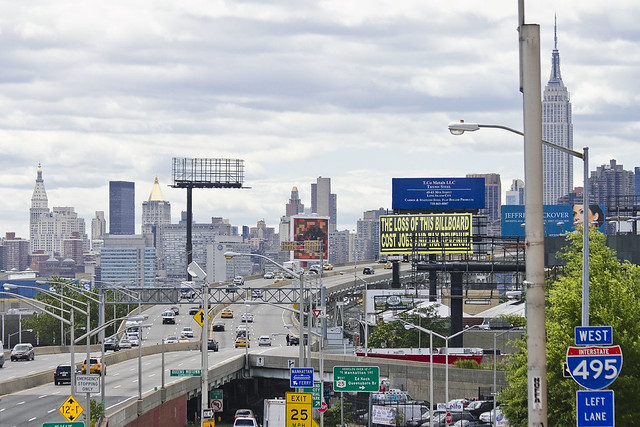
– photo by Mitch Waxman
The blasted heaths of Western Queens, which the art of engineering have conquered fully, must have once been quite lovely. What exists at the dawn of the second millennia, however, represent obeisance to the motor vehicle and “flow”. Gaze in horror upon the Queens Midtown Expressway section of the Long Island Expressway, a 1939 expression of the seeming ennui felt by Robert Moses for the ancient villages and communities of Long Island City.
Your humble narrator is often struck dumb and blind when doing so.
from wikipedia
Symptoms of acute stress reaction
The symptoms show great variation but typically include an initial state of “daze”, with some constriction of the field of consciousness and narrowing of attention, inability to comprehend stimuli, and disorientation.
This state may be quickly followed by either further withdrawal from the surrounding situation (to the extent of a dissociative stupor), or by agitation and overactivity, anxiety, impaired judgement, confusion, detachment, and depression. Autonomic signs of panic anxiety (tachycardia, sweating, flushing) are also commonly present.
The symptoms usually appear within minutes of the impact of the stressful stimulus or event, and disappear within 2–3 days (often within hours). Partial or complete amnesia for the episode may be present.

– photo by Mitch Waxman
At its apex over the Dutch Kills tributary of the languid Newtown Creek, which climbs to some one hundred and six feet over the water, the steel roadway begins a precipitous change in declination which carries vehicular traffic to the subaqueous Queens Midtown Tunnel and into Manhattan. The roadway was elevated to this altitude for no reason other than allow ocean going vessels egress to the turning basin of the Degnon Terminal at the head of Dutch Kills, and the blighting effect it had on Long Island City was quite unintentional. The industrial center became something to be ignored, driven over, forgotten, and quite irrelevant- seemingly by design.
If this is not the case, why are there no entrance or exit ramps between Greenpoint and Vernon Avenues?
from wikipedia
Depersonalization disorder (DPD) is a dissociative disorder (ICD-10 classifies the disorder as an anxiety disorder) in which the sufferer is affected by persistent or recurrent feelings of depersonalization and/or derealization. A diagnosis is made when the dissociation is persistent and interferes with the social and occupational functions necessary for everyday living. Diagnostic criteria include persistent or recurrent experiences of feeling detached from one’s mental processes or body. “Dissociation is defined as a disruption in the usually integrated functions of consciousness, memory, identity and perception, leading to a fragmentation of the coherence, unity and continuity of the sense of self.

– photo by Mitch Waxman
The complicated snare of vehicular access to Manhattan as it all compacts in Long Island City has often caused me to fall into a stupor when contemplated. Subway lines, railroads, passenger and freight vehicles- all form a tight fist gripping the heart of this formerly vital center. Storm water flows freely from exhausts onto local streets, causing temporary lagoons of sooty liquids to agglutinate about garbage choked sewers. Many of these sewers bear the screed “no dumping, drains into waterway” embossed directly on the iron grates.
Perhaps one is entangled in some waking nightmare, and all of what may be observed is merely some fevered ideation?
from wikipedia
Oneirophrenia is a hallucinatory, dream-like state caused by several conditions such as prolonged sleep deprivation, sensory deprivation, or drugs (such as ibogaine). From the Greek words “ὄνειρο” (oneiro, “dream”) and “φρενός” (phrenos, “mind”). It has some of the characteristics of simple schizophrenia, such as a confusional state and clouding of consciousness, but without presenting the dissociative symptoms which are typical of this disorder.
Persons affected by oneirophrenia have a feeling of dream-like unreality which, in its extreme form, may progress to delusions and hallucinations. Therefore, it is considered a schizophrenia-like acute form of psychosis which remits in about 60% of cases within a period of two years. It is estimated that 50% or more of schizophrenic patients present oneirophrenia at least once.
____________________________________________________________________________
Click for details on Mitch Waxman’s
Upcoming boat tours of Newtown Creek
July 22nd, 2012- Working Harbor Committee Newtown Creek Boat Tour

marble and porphyry

– photo by Mitch Waxman
Crazed by heat and a lack of slumber, one nevertheless must continue the never ending walking of the earth and incessant inspection of relict districts, as such activity is nepenthe to one such as myself.
This day, perambulation carried me to the so called “Boulevard of Death”, the Appian Way of Queens- Queens Boulevard itself. Radiant heat rising from the thermally charged pavement, coupled with the blasting emanations streaming down from the thermonuclear eye of god itself, combined to disorient and dehydrate.
Shivering with excitement, one dared to stand still for a moment and record the omnipresent flow of machines, streaming toward the center of the human infestation in Manhattan.
from wikipedia
Ganser syndrome is a rare dissociative disorder previously classified as a factitious disorder. It is characterized by nonsensical or wrong answers to questions or doing things incorrectly, other dissociative symptoms such as fugue, amnesia or conversion disorder, often with visual pseudohallucinations and a decreased state of consciousness. It is also sometimes called nonsense syndrome, balderdash syndrome, syndrome of approximate answers, pseudodementia, hysterical pseudodementia or prison psychosis. This last name, prison psychosis, is sometimes used because the syndrome occurs most frequently in prison inmates, where it may represent an attempt to gain leniency from prison or court officials.

– photo by Mitch Waxman
Long imprisoned by such motivations, your humble narrator’s fever crashed mind began to wander, with every thought resolving into some kind of incomprehensible gibberish.
Were your humble narrator truly alive, instead of some partially animated mass of shambling flesh, standing in this traffic cursed spot would have surely caused his blood to run cold. Unfortunately, the black ichors which carry certain vital gases about within me have long since ceased their proper fluctuation, and some unknown motive force keeps my feet moving. Stubborn purpose is all that causes me to pretend to be one of the living, and it is hard to shake the delusion that current experience is not some hallucination being suffered in a temporally displaced hospital bed.
I’m all ‘effed up.
from wikipedia
The Cotard delusion, Cotard’s syndrome, or Walking Corpse Syndrome is a rare mental disorder in which people hold a delusional belief that they are dead (either figuratively or literally), do not exist, are putrefying, or have lost their blood or internal organs. In rare instances, it can include delusions of immortality.

– photo by Mitch Waxman
Often have I wondered why I’m drawn to locales of morbidity such as this “Boulevard of Death”, whether they be cemeteries or other places of tragedy. Scuttling across the concrete devastations provides all manner of time for introspection, and time to craft cogent fantasies, some of which are shared with others.
Also, on a completely unrelated note, if one walks directly beneath this barrel vaults of the viaduct (which carries the 7 train) pictured above- beginning at 33rd street- a curious effect might be observed. A parking lot exists beneath the structure, and the high arches above are shaped in such a manor that sound waves travel through the spot in a bizarre manner, forming an echo chamber. Stand in the center of the parking lot at 34th street, and shout or sing, and it will reflect back to you.
One has tried this with the chorus from Queen’s Bohemian Rhapsody, and the effects are startling.
from wikipedia
Folie à deux (English pronunciation: /fɒˈli ə ˈduː/, from the French for “a madness shared by two”) (or shared psychosis) is a psychiatric syndrome in which symptoms of a delusional belief are transmitted from one individual to another. The same syndrome shared by more than two people may be called folie à trois, folie à quatre, folie en famille or even folie à plusieurs (“madness of many”). Recent psychiatric classifications refer to the syndrome as shared psychotic disorder (DSM-IV) (297.3) and induced delusional disorder (F.24) in the ICD-10, although the research literature largely uses the original name.
____________________________________________________________________________
Click for details on Mitch Waxman’s
Upcoming boat tours of Newtown Creek
July 22nd, 2012- Working Harbor Committee Newtown Creek Boat Tour
vaguely articulate

– photo by Mitch Waxman
Passing through the tangle of racing traffic, sky flung steel, and electrical equipment in Queens Plaza the other day, a humble narrator felt incredibly vulnerable. Part of my anxiety was generated by the absolutely stellar idea of siting bike paths on the sidewalk, formerly the only safe place and haven for the pedestrian in this place. The remainder was generated by the sheer sensory overload offered by this intermodal transportation center with its never ending traffic flow.
That is, until I was nearly struck by a bicyclist who was rolling down the sidewalk at a minimum of fifteen miles per hour.
from wikipedia
According to the DSM-IV classification of mental disorders, the injury phobia is a specific phobia of blood/injection/injury type. It is an abnormal, pathological fear of having an injury.
Another name for injury phobia is traumatophobia, from Greek τραῦμα (trauma), “wound, hurt” and φόβος (phobos), “fear”. It is associated with BII (Blood-Injury-Injection) Phobia. Sufferers exhibit irrational or excessive anxiety and a desire to avoid specific feared objects and situations, to the point of avoiding potentially life-saving medical procedures.

– photo by Mitch Waxman
It has been mentioned before at this, your Newtown Pentacle, that in the opinion of this citizen- mixing vehicular traffic and pedestrian traffic is a fairly ill considered idea. Sounds logical, right? Bicycles are, in fact, vehicles. Bicycles are, in fact, being directed into pedestrian lanes- commonly called “sidewalks”.
Let us break that down- “side”, as in side of road, “walk”, as in walking.
Not cycling, nor riding, nor whatever the hell it is that those people call Biking these days.
from wikipedia
Agoraphobia is a condition where the sufferer becomes anxious in environments that are unfamiliar or where he or she perceives that they have little control. Triggers for this anxiety may include wide open spaces, crowds (social anxiety), or traveling (even short distances). Agoraphobia is often, but not always, compounded by a fear of social embarrassment, as the agoraphobic fears the onset of a panic attack and appearing distraught in public.

– photo by Mitch Waxman
Incidentally, before “those people” (who I’ve stood shoulder to shoulder with several times on various issues involving alternative transportation options) leap at my throat, no condemnation of the biking community at large is at work here. It’s not that fellows fault that he was on the sidewalk, although he was operating his vehicle in a reckless manner given the number of pedestrians on the street, as he was following the layout of the bike lane. Which has been set into the sidewalk with no lane demarcation other than a painted lane, and which terminates in a street cut shared with pedestrians.
No solution is offered, the crowded interweaving of traffic in Queens Plaza is surely well studied, but we’ve got a problem here.
from wikipedia
The fear of being touched (also known as aphephobia, haphephobia, haphophobia, hapnophobia, haptophobia, thixophobia) is a rare specific phobia that involves the fear of touching or of being touched. It is an acute exaggeration of the normal tendencies to protect one’s personal space, expressed as a fear of contamination or of the invasion, and extending even to people whom its sufferers know well.
____________________________________________________________________________
Click for details on Mitch Waxman’s
Upcoming boat tours of Newtown Creek
July 22nd, 2012- Working Harbor Committee Newtown Creek Boat Tour


 The Newtown Pentacle