Posts Tagged ‘New York City’
border of
Devastations, concrete and plastic.

– photo by Mitch Waxman
Broken, abused, cast aside. That’s me. Like every other bit of wind blown trash in NYC, I find myself staring into the abyssal darkness which is the Newtown Creek. Poisoned, polluted, and abandoned. That’s me too.
Here in the wasteland, where dissolution and disease can be found, this is where I belong.

– photo by Mitch Waxman
Shouting at bureaucrats, angrily decrying the injustices of municipal apportionment, demonstrating that the sky is indeed falling to those who can stop it. Demanding not justice, but a simple admission of culpability for the collapsing heavens. That’s me too. Doesn’t make me popular with officialdom, but there you are. Somebody has to do it, and as with a lot of other sections of my life – you gotta do whatcha gotta do.
Assailed from all sides, by do gooders who would rather complain than actually do anything to change this catastrophe we live in, by cocktail party scholastics, by the politically correct. That’s me too.

– photo by Mitch Waxman
Periodically, the bile rises in my throat, and rage clouds my eyes. Rhetorical flourish and clever retort gives way to a growling and wild eyed sermon which demands acknowledgment that a dangerous storm is forming in front of the lucky recipient. It is in these moments that I remind people, and myself, that I am – in fact – not a nice guy by nature and especially by nurture.
What would Superman do? That’s what pulls me back from the edge, when I remember what I aspire to, rather than what I am.
In fact, I can be quite an asshole when I don’t hold myself in check, and remind myself about Superman.

– photo by Mitch Waxman
It’s at these times that a humble narrator picks his way over to his beloved Creek, musing on his private fantasies of visiting exquisite vengeance upon those who have angered him. It’s also when he finds himself thinking of himself in the “third person” and decides that it’s time to get a grip. Superman always keeps his grip, lest all those things which he gazes upon, and through (x-ray vision, which would be handy), burst into flame. He lives in a world made of paper, of course, but hey – you can have your Jesus, my ideal being and eidolon has heat vision and can fly. He’s also highly resistant to bullets and temperature extremes, but has an aversion to shiny green rocks.
It’s not so easy, living between my ears, but shiny green rocks bring me back to Newtown Creek.

– photo by Mitch Waxman
What this city needs is a good plague, I’ve always thought. That’s the sort of thing Superman never thinks. Newtown Creek, what it really needs are the direct attentions of Superman, but he’d probably avoid the place because it’s covered in shiny green rocks. Superman could probably solve every little Newtown Creek problem in an afternoon, mainly because there would be no one who could say “no” to him.
All Newtown Creek’s really got is me and a few of my friends, I’m afraid. It’s also likely where that plague mentioned above might come from.
We will have to do, until someone better comes along.
“follow” me on Twitter- @newtownpentacle
flat platform
Trucks, trucks, horses, trucks.

– photo by Mitch Waxman
One spent a pretty decent amount of time wandering about the wastelands for Thanksgiving Weekend.
It was likely a good decision to do so, as my company is aberrant and I can be quite “the downer” around the holidays. My understanding of the origins of the term “downer,” by the way, is that it refers to a cow that was sick when it arrived at the stock yards. Common practice in the factory abattoirs of the 19th century was to move the downers to the front of the slaughter line while distracting the government inspectors. The inspectors were glad to be distracted, but they were already in the pockets of the beef trust anyway.
Cattle which was fed on distillery slop, which produced the “swill milk” which I’ve explained endlessly, were covered in sores and boils and were referred to as “steely.” It was a miserable job slaughtering the steely cattle, according to the historic record, but it’s hard to find any profession in the industrial sectors of the 19th century which wasn’t miserable.

– photo by Mitch Waxman
Horses, mules, and oxen were not supposed to be part of the food ecosystem, nor were goats. Saying that, an enormous amount of horse meat found its way into cans of “tinned beef” back then and it was pretty common for “lamb chops” or “mutton” to have exhibited little verisimilitude to lambs. Goat makes for a good stew, at any rate, but I’ve been to Greece a few times and Hellene cuisine can make almost anything taste good. Supposedly, a significant number of the casualties in both the Civil and Spanish American wars were caused by soldiers consuming the tainted tins of meat in their rations.
By the beginning of the 20th century, NYC was producing something like ten million tons of horse manure a day. Modern people – myself included – bitch and moan about truck traffic but can you imagine the amount of shit that our modern world would produce if pack animals were still roaming the streets?

– photo by Mitch Waxman
It’s hard to imagine that version of NYC, although there are a few people left amongst us who experienced it directly. It was still pretty common up until the 1920’s for Fire Engines in Brooklyn and Queens to be driven by teams of horses. FDNY, after the consolidation of the City of Greater New York in 1898, began to outfit the departmental structures in outlying districts and standardize their equipment around the internal combustion engine but that took a while and as you’d imagine – downtown Manhattan came first.
Until the ubiquity of cheap petroleum became a reality, and the supply chain of an automotive industry existed, the horse was still your best bet for moving people and cargo around.

– photo by Mitch Waxman
There was an entire industrial complex built around the horse and carriage trade, as you’d imagine. Just as we don’t think twice about taking a long drive, secure in the knowledge that should we need to replace an engine part or a tire that there’ll be a Pep Boys or auto mechanic everywhere you choose to go – so too did the carriage trade enjoy a dispersed network of supply and demand based equipment and an abundance of skilled mechanics, stable keepers, and tradesmen in every town and village they’d pass through.
Newtown Creek, on the Queens side in particular, hosted a variety of trade manufacturers who supplied the carriage trade. Atavistic industries produced “carbon black,” a kind of paint manufactured from burning and then crushing up animal bones, which provided Victorian era horse carriages (think any Sherlock Holmes movie or TV show) with their shiny black coatings. Others manufactured “neet oil” and the various bits and bobs which the Teamsters would require to ferry people and commerce around the city at the speed of a trotting horse. Funnily enough, that’s just under the speed at which the current Mayor’s “Vision Zero” traffic initiative requires motor vehicles to operate at.
When the pack animals were spent, and their useful occupation at an end, companies like Van Iderstine’s rendering plant in Blissville or Peter Cooper’s Glue factory in Bushwick awaited their arrival.

– photo by Mitch Waxman
Researching the history of Newtown Creek, as I do, one often encounters early versions of environmentalist sentiment. A particular period in the 1880’s saw Manhattan based reformers complaining in vociferous fashion about the smells, carried on the prevailing north westerly winds which then as now swept across the Creek and East River, which plagued Murray Hill and the east side of Manhattan Island. I’ll be exploring this in some detail next week, but the really interesting part of this narrative from the 1880’s is the push to rid the Creek of the “organics” processors like the rendering plants, glue factories, bone blackers, and “superphosphate” manufacturers in favor of the “scientific manufacturers” like General Chemical (Phelps Dodge) and the petroleum distillers like Standard Oil. As mentioned, more on this one next week.
As a note, check out that truck in the shot above. Not only is it parked in a bus stop, but it’s also blocking a fire hydrant.
“follow” me on Twitter- @newtownpentacle
marine things
R.I.P John Skelson.

– photo by Mitch Waxman
Another member of “Team Bernie” has left us, this time it’s photographer John Skelson. John was a life long Staten Islander who spent a lot of his time on the North Shore along the Kill Van Kull photographing passing ships. Working Harbor Committee alumni, John produced shots for the WHC blog’s Friday feature – Ship Spotting with Skelson. Ship Spotting got John noticed by the NY Times and others, and happily I can report that during his final years he enjoyed a certain notoriety in maritime circles. He’s survived by his wife, Phyllis Featherstone.
That’s John Skelson pictured above, at his office on the Kill Van Kull, just a few months before he died.

– photo by Mitch Waxman
Last week, in his honor, a few of us met up at Skelson’s office to collect a few shots and reminisce. Will Van Dorp from tugster.com showed up onboard the NY Media Boat. Afterwards, we retired to Liedy’s Shore Inn, drank a beer or two, and then headed back to other parts of the archipelago.
You people have no idea how connected all of us are to each other, out there on the edge of the water.

– photo by Mitch Waxman
Team Bernie, as mentioned above, was the collection of harbor rats, rail enthusiasts, and antiquarians whom photographer Bernie Ente included on his adventures. Bernie went first, cancer. John Doswell went next, cancer. Skelson just died, cancer.
And you people wonder why I’m so obsessed with what’s lurking in the water.

– photo by Mitch Waxman
John Skelson was a good and kind man, as were Bernie Ente and John Doswell. He, and they, are dearly missed. The collective knowledge which died with them, which will be lost to time, is irreplaceable. Bernie, also a photographer left behind a wife and daughter, who are doing fine last I heard. Capt. Doswell’s wife Jeanne is still one of the operative and moving gears which allows Working Harbor Committee to continue.
And you people wonder why I blog every day, and kiss Our Lady of the Pentacle every chance I get.

– photo by Mitch Waxman
It’s the worst part of growing older – just at that moment when you’ve got yourself figured out, know what and who you actually are – that’s when it comes. All the wasted time and emotional tumult, all the troubles and tribulations, just at the point when you’ve “figured your shit out” is when it all ends. That’s when all that’s left are clothes, papers and possessions, and someone you love finds themselves alone. There’s some truth to the concept that the person that suffers least is the one who died. Saying that, cancer.
And you people wonder why I’m the guy with the sign boards in Times Square that say “the end is nigh.”

– photo by Mitch Waxman
This is Skelson’s Office. The tracks of the Staten Island Railroad are still there, at the corner of Richmond Terrace and Bard Avenue, between the gas station parking lot and the water. A general call is going out to the maritime community to refer to it as such. For those of you interested in photographing the show along the Kill Van Kull, Skelson’s Office is available for new tenants. Bring a zoom lens, and dress warm. Get there early, stay there late. NY Harbor never disappoints.
And you people wonder why I talk about legacy and “passing it on” so much.
Also, on a completely different note:

– photo by Mitch Waxman
Want to get involved in the future of the Montauk Cutoff? A “visioning meeting” will be taking place tonight (December 2nd) at LIC’s Nomad Cycle (47-10 Austell Pl, Queens, NY 11101), between 6:30 and 8:30 p.m. There will be snacks!
“follow” me on Twitter- @newtownpentacle
strange and roving
Someday, a real rain will come.

– photo by Mitch Waxman
An assertion often offered to Our Lady of the Pentacle is that “NYC never looks so good as it does when it’s wet.”
Long suffering, Our Lady is infinitely patient when confronted with pedantic statements and oft repeated phrases like the one above. One recent storm found a humble narrator hanging out at my local pub, Doyle’s Corner at the Times Square of Astoria, and clicking away while enjoying the shelter offered by an awning.

– photo by Mitch Waxman
The big problem encountered in the pursuit of photographing weather events is obvious. Keeping your lens clean and avoiding the infiltration of water into the internal cavities of the camera. My rig enjoys a certain amount of weather sealing, but a soaking or immersion would be ruinous. It’s always a challenge, and positioning yourself so that the wind is at your back is critical to the operation.

– photo by Mitch Waxman
One of the little tricks I’ve learned over the years is to find “rain shadows.” Manhattan, particularly lower Manhattan, is a good place for this sort of thing. The canyon walls, construction sheds, and narrow streets offer the pedestrian several opportunities for temporary shelter from storms. When I’m walking, my naturally quick pace allows me to walk around the rain drops, but some still inevitably find the camera.

– photo by Mitch Waxman
Umbrellas are an obvious choice, but operating the camera with one hand whilst struggling against wind and rain with the other makes for a dicey proposition. Ponchos are more trouble than they’re worth, and do little to protect the equipment.
A few people over the years have asked me how I achieve the “sharpness” apparent in my photos, and they’re all hoping that I can pass on some sort of technical trick or camera setting they can use when they ask. The simple fact is that I’ve read about and adopted a series of techniques which military snipers employ governing posture and body position. Snipers don’t use umbrellas, or at least they don’t mention them in the army and marine training manuals.

– photo by Mitch Waxman
Snipers and photographers are essentially preparing for their respective tasks in the same manner. You assume a stable position, ready your equipment, look through a view finder, and then push a button.
In the case of photo gathering, you’re collecting light reflecting back from a farway target, whereas snipers are trying to embed a piece of metal in theirs. Regardless, you breathe out before triggering your device to reduce metabolic interference in the process and posture yourself in a manner designed to steady your device.
You’d be surprised at how much you’re actually moving around, even when you believe yourself to be still. On long exposures (anything over 1/60th of a second in my case, although I’ve know individuals who can do hand held 1/30ths) you can actually discern the seismic shocks rippling through the arterial system as caused by the stertorous motion of the heart, necessitating the usage of camera supports such as a tripod.

– photo by Mitch Waxman
Despite the hazards and problems introduced by rain and the lack of light it brings – airborne water droplets, wind, etc. – a humble narrator irregardless stands behind his assertion that “NYC never looks as good as it does when it’s wet.”
Stormy weather adds a dramatic sense of latency to an otherwise pedestrian capture, and should you see some mendicant wandering alongside the road in a filthy and quite saturated black raincoat during a storm somewhere in Western Queens or North Brooklyn – you very well might have spotted me trying to conquer the weather. Maybe the world too, depends on how much coffee I drank that day.
“follow” me on Twitter- @newtownpentacle
these views
Welcome to the Montauk Cutoff, Long Island City.

– photo by Mitch Waxman
Recently, one found himself hitting the tracks just before sunrise. I was there with sanction, accompanied by an MTA employee and entirely “legal.” It should be mentioned, again, that illegal trespass is against a humble narrator’s code, and like a vampire – I need to be invited in to do my thing. You also really, really, don’t want to get caught trespassing up here by the railroad cops, by the way. You also really, really, don’t want to meet the sort of person who camps out along railroad tracks in LIC when you’re all alone in the wee hours.
The Montauk Cutoff in Long Island City was designed to connect the North Shore line with the Montauk Line. The Montauk Line uses the tracks which follow the shoreline of Newtown Creek through Queens, eventually intersecting with the Bushwick Branch and both head for the rail yard at Fresh Pond. The elevated trackway of the Montauk Cutoff crosses Skillman, 49th, 50th, 51st, and Borden Avenues, whereupon it meets a rail bridge called Cabin M which spans Newtown Creek’s tributary Dutch Kills.
The North Shore line used what are approximately the modern LIRR passenger tracks, give or take a few yards, which transverse the Sunnyside Yards and head through Woodside on their way east. The Montauk Cutoff was built for freight, as were the North Shore and Montauk Lines. Passenger service was always a loser for the LIRR. Modern day freight on the LIRR is handled by the New York & Atlantic company.
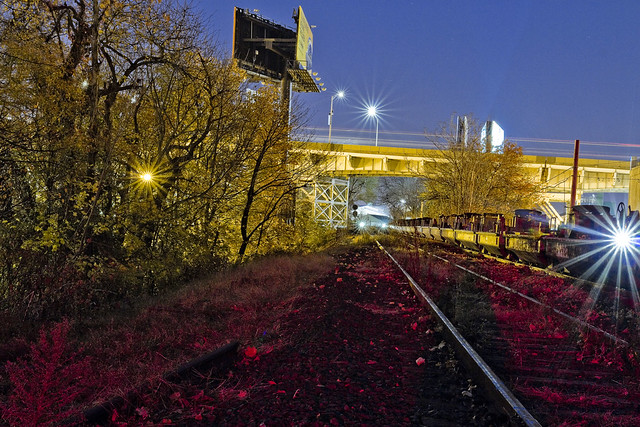
– photo by Mitch Waxman
The first discussion, which I’ve been able to find at least, about building LIC’s Montauk Cutoff was in 1906 – as part of a series of railroad projects either proposed or already under construction at the start of the 20th century by the Pennsylvania Railroad Company – projects which included Penn Station and Sunnyside Yard. Other documents I’ve examined state that the LIRR was paying taxes to New York State as early as 1912 on the Montauk Cutoff, which suggests that it came into service around the same time that the Sunnyside Yards came online. The surrounding Degnon Terminal wasn’t far behind the rail complex, either, with the Loose Wiles factory and other mega factories opening in the 1920’s.
As is always mentioned, old Mitch ain’t no authority on the whole railroad thing. If there’s something wrong in my little summary, please let me know in the comments and corrections or an errata will be incorporated. I can speak pretty intelligently about the maritime/locomotive complex around Newtown Creek, but I’ll admit to having vast gaps on the particular subject of the iron road. That was my pal Bernie Ente’s area of expertise.
For a historic series of shots, maps, and technical descriptions of anything involving the LIRR, you are going to have to visit the fairly excellent trainsarefun.com. Here’s their Montauk Cutoff Page.
Another set of maps and historic shots can be accessed at an equally fantastic site called arrts-arrchives.com. Here’s their Montauk Cutoff page.
I’ve written about the Smiling Hogshead Ranch before, which sits on the interchange between the Degnon Terminal Railway and the Montauk Cutoff, over at my old Brownstoner Queens column.

– photo by Mitch Waxman
The view from up on the Montauk Cutoff is unique. That big parking lot at the bottom of the shot above is a UPS shipping center, the one on 49th avenue. Rearing above and behind it is the Queens Midtown Expressway section of the Long Island Expressway, which arches up and over Dutch Kills some 106 feet from its beginning at the Queens Midtown Tunnel – which is around a half mile away.
My MTA companion and I met up at the Smiling Hogshead Ranch at 5:30 in the morning to get these shots, which gave me a solid hour to work in absolute pitch darkness up on the tracks. The shots in today’s post are obviously tripod shots, and long exposures. Leaving the shutter open for 20-30 seconds at a pop, you can gather a tremendous amount of light and color, but the hot spots of electric street lighting always cause certain problems. Compensation for this is to move the aperture into “hyperfocal” range, f11 and narrower, which is counterintuitive for night shots but nevertheless effective. It also produces those neat little star bursts around the lights.

– photo by Mitch Waxman
So, why was I out on a chilly November morning with an MTA property manger, walking on a century old rail spur in Long Island City?
The MTA has decided to “abandon” this line. Abandon doesn’t mean the same thing in “railroad” as in does in english. It means that the agency has no current plans for the line and wishes to free itself of the duties necessitated in maintaining it as functional track. It means that the MTA will retain ownership of the Montauk Cutoff, and can at any time reactivate the pathway should “future use” require it. Given the speed with which rail projects generally move, however, that means a window of at least a couple of decades of inactivity awaits the property no matter what happens.
Accordingly, MTA has issued a “Request for Expressions of Interest,” or RFEI, regarding the Montauk Cutoff and is seeking potential lessees for the space.

– photo by Mitch Waxman
As defined in the RFEI document, the MTA is seeking out creative uses of the land with an eye towards community improvement. The agency has set down a few ground rules for any potential lessee of the site, many of which are quite expensive – such as insurance, utility service – those sorts of things. The property, as defined in the RFEI, includes the Smiling Hogshead Ranch – who currently lease and pay insurance on the parcel in which the community garden is operated.
Before certain web masters start pointing their fingers and shouting “j’accuse” at me while spinning a conspiratorial tale, Smiling Hogshead is indeed associated with Newtown Creek Alliance, as am I. You can absolutely bet that I’m a fan of SHHR’s operations and programming, and friends with a lot of their members. Long Island City needs every bit of green space it can get, which is how I finally get around to explaining why me and the MTA guy were here on the day before Thanksgiving and just before sunrise.

– photo by Mitch Waxman
A “Request for an Expression of Interest”? You can say that I’m interested. I’m interested in seeing this trackway converted over to green space, in much the same way that the Degnon Spur on Pearson and Skillman – a weedy dumping ground and homeless camp – was turned into a lush garden by a group of dedicated volunteers.
Can you imagine what a group like Smiling Hogshead’s could do up here?
If you want to get in on the conversation, or contribute some time and knowledge to the project – shape the future, as it were – whatcha doing on the 2nd of December? A bunch of us are going to attend a “visioning meeting” at Nomad Cycle (47-10 Austell Pl, Queens, NY 11101) which is set to happen between 6:30 and 8:30 p.m.

– photo by Mitch Waxman
My companion and I had discussed the possibility of getting up here in the pre dawn hours, and a couple of previous appointments had to be cancelled on account of weather. We had met on a walk through of the site which MTA had conducted back in October for parties interested in acquiring the land, an excursion which occurred just before solar noon – which is not the most efficacious time to photograph LIC. I made the case to him that a “proper” set of photos would be needed for this project and quite handy to boot, which my new friend at the agency agreed with. Hence, where we were, when we were, and why we met up in the dark on Skillman Avenue on the day before Thanksgiving.
The wrinkle in this potential project is this – it doesn’t necessarily have to become a green space. Anyone can “express interest” in the Montauk Cutoff, and as long as their proposed project meets the requirements set aside by the MTA, it will be considered a viable option.
I see this as being a frankly huge opportunity to create an enormous acreage of green space in an otherwise completely barren industrial area which can be best described as a “devastation of concrete.” My interest in this thing is simple – this property touches Dutch Kills, where the borders of the “abandoned” section ends, which is “my house.”

– photo by Mitch Waxman
The Montauk Cutoff begins at Sunnyside Yard, and at its southeastern edge connects to the M Cabin truss bridge over Dutch Kills which connects to the Blissville Yard, which in turn feeds the tracks that travel under the Greenpoint and Kosciuszko Bridges to Maspeth, Ridgwood, and all points east. The RFEI states that the M Cabin bridge will be opened, and secured in that position, and that a barrier of some sort will be erected at the edge of the Montauk Cutoff’s lot.
Additionally, I cannot begin to, nor have I ever believed that this is the original bridge on this site. I’ve got some Intel that suggests the early 1940’s for its origins, but nothing solid enough to to stick a pin into. The original early 20th century bridge is long gone at any rate.

– photo by Mitch Waxman
I can tell you with some certainty that the nearby DB Cabin rail bridge is from 1919, and is a swing bridge that hasn’t opened since 2002. My pal Bernie, mentioned above as having been THE authoritative source on all things rail around LIC, told me once or twice that two industrial wreckers are required to tow it from either side to open the bridge. The swing bridges motors are non functional, something that has caused no small amount of grief for the EPA’s Superfund investigators. DB Cabin allows access from the Wheelspur Yard to the Blissville Yard and the Montauk Line.
Like I said, Newtown Creek.

– photo by Mitch Waxman
Looking northwards along Dutch Kills, at a scene familiar and loved by long time readers of this – your Newtown Pentacle. That’s the Borden Avenue Bridge, with the LIE above, spanning Dutch Kills. I’ve been writing about this neighborhood for years, it’s one of my favorite locations in New York City. The Montauk Cutoff leads directly to this spot, which in my mind directly connects it to the environmental problems of the Newtown Creek watershed.
Know how I’ve been rattling on for years about “combined sewer outfalls” and the problems presented to the ancient sewer system during rain events? Montauk Cutoff represents an opportunity to create a nearly four acre long green sponge that can drink up a significant amount of the storm water that carries garbage, grease, and poop into this water.

– photo by Mitch Waxman
The Montauk Cutoff. This is a once in a generation opportunity to do something right for the environment in the ruined biome of Long Island City. Every elected official I’ve spoken to about this idea is “into it” although they haven’t made any public declarations yet (too early in the process to bring them in) and recently – Community Board 2’s environmental committee voted to support the use of these tracks as “green infrastructure.”
Want to get involved in the future of the Montauk Cutoff? As mentioned above, a “visioning meeting” which be taking place at LIC’s Nomad Cycle (47-10 Austell Pl, Queens, NY 11101) on December 2nd, between 6:30 and 8:30 p.m.
“follow” me on Twitter- @newtownpentacle


