Posts Tagged ‘New York City’
drift pleasantly

– photo by Mitch Waxman
As mentioned in the past, my habit is to turn up early for appointments and engagements. Accordingly, before one of the many Working Harbor Committee excursions leaving from South Street Seaport this summer, your humble narrator found himself wandering around lower Manhattan with an hour or so to kill.
– photo by Mitch Waxman
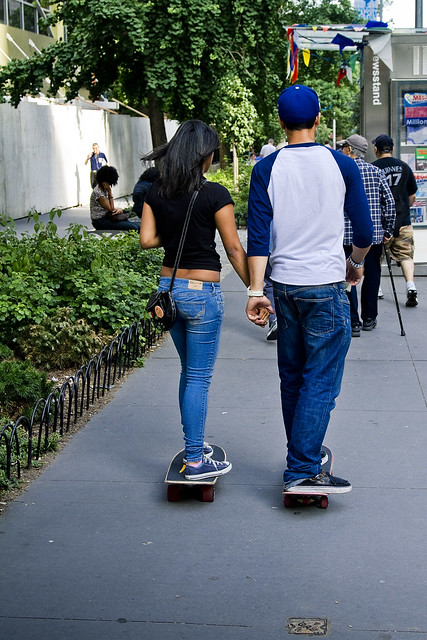
This young couple came rolling past me, texting and skate boarding while holding hands. They were young, at most sixteen. Seemed to be locals, likely from one of the many apartment complexes which neighbor Fulton Street.

– photo by Mitch Waxman
There was just something really sweet about these kids, who seemed to be lost in their own little world. The sight of them made even one as calcified as myself smile.

– photo by Mitch Waxman
Then, as is the case with such cycles of life, the young lovers were forced to separate as their path became blocked by others. The fellow hopped over the curb and headed south while the young lady continued toward some eastern destination.
diurnal prison

– photo by Mitch Waxman
During the colonial era, there were small operators who exploited the route in two masted ships called Periaugers, but it wasn’t until 1817- when a farm boy from Staten Island started a motorized service- that the most popular tourist destination in New York City truly got started. The farm boy bought a steamboat called Nautilus with a loan from his mother, which was captained by his brother in law. Not many people would recognize the name of that Captain- John DeForest- but it’s easy to be overlooked in the historical record when your brother in law was named Cornelius Vanderbilt.

– photo by Mitch Waxman
The consolidated City of New York took possession of the route from the Vanderbilts in 1905, as the family had moved into decidedly less maritime interests like railroads and real estate speculation. It’s run by the NYC DOT today, and is the most reliable of all the mass transit systems in the entire city with a 96% on time rate. The particular ferry boat in these shots is the Guy V Molinari, named for the long sitting and dynastic Borough President of Staten Island.

– photo by Mitch Waxman
An astounding set of statistics accompanies the huge orange boats which trawl back and forth between Staten and Manhattan Islands. The service crosses the archipelago some 35,000 times annually, carrying 60,000 people per day- which resolves to some 20 million riders per year. All free. The Ferry was the origin of the Vanderbilt empire, and when Cornelius Vanderbilt died in 1877- he was worth some 100 million dollars, which would be worth something like two billion today. He was born a pauper in 1794.

– photo by Mitch Waxman
The ferry terminals at both ends of the approximately 30 minute trip have recently been modernized and upgraded. Whitehall terminal in Manhattan allows connection to subway and bus lines, and on the Staten Island “St. George” side- you can catch the bus or Staten Island rail. Hundreds are employed directly by the operation, with a “long tail” of suppliers and contractors supplying various services and employing thousands more. The City recently issued an “RFP” or “Request For Proposal” for new and modernized ferry boats to augment the aging fleet.
often done

– photo by Mitch Waxman
Imagine my surprise. Just the other day, while onboard a Working Harbor Committee Newark Bay trip, along came the Mary H. Another denizen of the Newtown Creek, it was so very odd encountering it somewhere else- sort of like visiting a foreign city and finding a neighbor or coworker is there simultaneously. Maritime Sunday’s are often composed of such “co-inky-dink”. Jung would have called it “synchronicity”.

– photo by Mitch Waxman
Pictured above is Mary H in the place I most often expect to find her, delivering a barge to the Bayside depot on Metropolitan Avenue on the obliteration of rational hope known as the English Kills, some three miles back from the East River in Brooklyn.
sighing uncannily

– photo by Mitch Waxman
A personal theory of mine is that the garden of Eden was actually in midtown Manhattan, specifically the central section of 42nd street. The location where the proverbial tree of good and evil would have been observed in the dim past is the spot where Grand Central Terminal’s information booth will be found today, which is why the clock of the four cardinal directions was placed there. In this rather ridiculous assertion, my theory of what the primordial mother realized when eating the forbidden fruit was not awareness of her nakedness- but rather an awareness of time passing. The Vanderbilts placed the clock there to signify both location and event, I would wager.
from wikipedia
The main information booth is in the center of the concourse. This is a perennial meeting place, and the four-faced clock on top of the information booth is perhaps the most recognizable icon of Grand Central. Each of the four clock faces is made from opal, and both Sotheby’s and Christie’s have estimated the value to be between $10 million and $20 million. Within the marble and brass pagoda lies a “secret” door that conceals a spiral staircase leading to the lower level information booth.

– photo by Mitch Waxman
Time grows short, lords and ladies, an unstoppable river flowing toward oblivion and the embrace of the conqueror worm. Your humble narrator would love to tell you of some epic summer journey this day, a break from the daily grind, but even if I had somewhere to travel to- who would greet me upon arrival? Surely, one such as myself- a shambling and feckless quisling, physical coward, and unreliable lunatic- would be shunned by a sensible and sober local gentry wherever and whenever my shadow is cast.
from wikipedia
The Seth Thomas Clock Company began producing clocks in 1813, and was incorporated as the “Seth Thomas Clock Company” in 1853. The clock at Grand Central Terminal in New York City was manufactured by the company. Seth Thomas Clock Company manufactured longcase clocks as well as mantel, wall, and table-top clocks during this period.

– photo by Mitch Waxman
Exertions of the last few months have worn me down, and left me naught but a reactive shell. A brief surcease of the incessant duties and exhibitions recently performed in obeisance to my beloved Newtown Creek is finally at hand, but as mentioned- I have no where to go. The idea of sitting alongside some vernal water body, or simply communing with an uncorrupted form of the natural world, fills one with dread. Vacations, as they are called, are for others to enjoy- I must remain locked in combat with an eternal and undying human hive and remain consigned to the concrete devastations of a post industrial dystopia.
from nytimes.com
Several times a day, riders troop into the stationmaster’s office in Grand Central Terminal to complain. Even the four faces of the signature brass clock above the information booth in the main concourse, irate riders often point out, are different.
The culprit is not the clocks themselves but something that resembles a giant filing cabinet, tucked away in a closet above one of the Beaux-Arts terminal’s platforms. It is a 15-year-old master clock system, with dials in the middle and two digital displays.
It connects each day at 3 a.m. by shortwave radio signal with the National Institute of Standards and Technology’s atomic clock in Boulder, Colo., and then sends electrical impulses to the terminal’s 20-some historic clocks.
The problem is, the electromechanical devices in the terminal’s master clock system that are sending these signals are becoming increasingly unreliable, making the clocks inaccurate. What’s more, the time displayed on video monitors throughout the terminal is controlled by a different system, not tied to the atomic clock at all.

– photo by Mitch Waxman
Unlike the Vanderbilts, who literally wrote a check when presented with the bill for Grand Central Terminal, my finances continue to be perilous. A disaster as simple as needing a new pair of shoes or a camera repair would sink this Humble Commodore’s fleet, and the frivolity of spending what little cash there is on some diversionary trip is overshadowed by the term “shelter in place”. Better that I just treat those hallucinations which occur when unconsciousness seizes me as my summer getaway.
The plan was expensive. The railroad needed to invest in electrifying its rails, and carve deep into Manhattan’s bedrock (workers would ultimately excavate 2.8 million cubic yards of earth and rock). The solution to the projected $80 million project budget (roughly $2 billion in today?s terms) came from Wilgus as well. Without steam engines, there was no longer a need for an open rail yard. Wilgus proposed that the area from 45th to 49th Streets be paved over and that real estate developers be allowed to erect buildings over the concealed tracks. In exchange for this privilege, developers would pay a premium to the New York Central Railroad for “air rights.” Construction in the years immediately after the completion of Grand Central Terminal would include apartment buildings like the Marguery, the Park Lane, and the Montana, and hotels including the Barclay, the Chatham, the Ambassador, the Roosevelt, and finally the Waldorf-Astoria, completed in 1931. (For many years, hydraulic tanks in the basement of Grand Central Terminal supplied power to these buildings.)

– photo by Mitch Waxman
The odd condition afflicts me on a daily basis (approximately every sixteen to eighteen hours- muscle fatigue and mental confusion begin to manifest, followed by a sudden loss of consciousness and concurrently some six to seven hours are spent caught up in the throws of wild hallucinations. Upon regaining control of my body, odd smells and trails of dried spittle combine with a lack of coordination and a stunted mental capacity. During these periods of involuntary separation from conscious control over my mind and body, oddly, I’ve noticed that my fingernails grow prodigiously), and has since early childhood. it has long been my habit to lock myself away in a protected chamber here at Newtown Pentacle HQ in Queens when the warning signs of this debilitating malady present- far from the dangers of the greater human infestation in a long ago “paradise lost” which is now vulgarly called Manhattan.
from wikipedia
Extending between Sunnyside, Queens, and Grand Central, the project will route the LIRR from its Main Line through new track connections in Sunnyside Yard and through the lower level of the existing 63rd Street Tunnel under the East River. In Manhattan, a new tunnel will begin at the western end of the 63rd Street Tunnel at Second Avenue, curving south under Park Avenue and entering a new LIRR terminal beneath Grand Central.
Current plans call for 24-trains-per-hour service to Grand Central during peak morning hours, with an estimated 162,000 passenger trips to and from Grand Central on an average weekday. Connections to AirTrain JFK at Jamaica Station in Jamaica, Queens, will facilitate travel to John F. Kennedy International Airport from the East Side of Manhattan.
A new LIRR train station in Sunnyside at Queens Boulevard and Skillman Avenue along the Northeast Corridor (which the LIRR uses to get into Pennsylvania Station) will provide one-stop access for area residents to Midtown Manhattan. The station may spur economic development and growth in Long Island City.
something sinister

– photo by Mitch Waxman
Shaken with the potencies of blackest revelation and shattered faith on a July evening, one found himself back at the loquacious Newtown Creek and once again straddling the currently undefended border of Brooklyn and Queens. Slaked with sweat, stricken by those fiery emanations pouring forth from the burning thermonuclear eye of god itself, your humble narrator decided to “lean into it” for the final push back to Astoria after a productive but quite humid summer day spent wandering about the Newtown Pentacle. An alarming lack of awareness of my surroundings overcame me, and I found myself fixated once more upon the sapphire tower.
My feet may have been moving, but my eyes never left the Megalith.
from wikipedia
A fugue state, formally dissociative fugue or psychogenic fugue (DSM-IV Dissociative Disorders 300.13), is a rare psychiatric disorder characterized by reversible amnesia for personal identity, including the memories, personality and other identifying characteristics of individuality. The state is usually short-lived (ranging from hours to days), but can last months or longer. Dissociative fugue usually involves unplanned travel or wandering, and is sometimes accompanied by the establishment of a new identity.
After recovery from fugue, previous memories usually return intact, but there is typically amnesia for the fugue episode. Additionally, an episode of fugue is not characterized as attributable to a psychiatric disorder if it can be related to the ingestion of psychotropic substances, to physical trauma, to a general medical condition, or to psychiatric conditions such as delirium, dementia, bipolar disorder or depression. Fugues are usually precipitated by a stressful episode, and upon recovery there may be amnesia for the original stressor (dissociative amnesia).

– photo by Mitch Waxman
It must have just been the burning thermonuclear eye of god itself glinting off the artless blue glass as it dipped toward the terminal horizon beyond Manhattan, sending crepuscular arcs of refracted red and yellow light along unknown and incalculable parabola. For a moment- your humble narrator thought that that which cannot possibly exist up there was visible.
A quick change of lens on my camera allowed a vain search and fruitless attempt at a second look, but the phantom image was recorded nowhere else beside my own fevered brain.
Dehydration must have been setting in, with too many hours spent while marching involuntarily through the concrete devastations of North Brooklyn and Western Queens in the summer heat- causing hallucination and overt credulity.
from wikipedia
Theories of deindividuation propose that it is a psychological state of decreased self-evaluation and decreased evaluation apprehension causing antinormative and disinhibited behavior. Deindividuation theory seeks to provide an explanation for a variety of antinormative collective behavior, such as violent crowds, lynch mobs, etc. Deindividuation theory has also been applied to genocide and been posited as an explanation for antinormative behavior online and in computer-mediated communications.
Although generally analyzed in the context of negative behaviors, such as mob violence and genocide, deindividuation has also been found to play a role in positive behaviors and experiences. There still exists some variation as to understanding the role of deindividuation in producing anti-normative behaviors, as well as understanding how contextual cues affect the rules of the deindividuation construct.

– photo by Mitch Waxman
Paranoia is omnipresent by default while scuttling about, as certainty states that one is being photographed every moment by automatic security cameras while out in public. Whether there is any single human watching or noticing these recordings is another thing entirely. It occurs that the stream of raw data captured by passive surveillance alone in New York City on any given day- the ATM’s and Deli cameras alone- would take years to catalog, let alone review. Likely, it will be artificial intelligences of the near future that will perform high speed analysis of such tasks.
An articulated and artificial thing which cannot possibly exist at the apex of the Megalith, of course, sees all. No utility can be found in hiding from it, as it casts its three lobed eye about and watches the world of men.
from wikipedia
Sigmund Freud considered that ideas of reference illuminated the concept of the superego: ‘Delusions of being watched present this power in a regressive form, thus revealing its genesis…voices, as well as the undefined multitude, are brought into the foreground again by the [paranoid] disease, and so the evolution of conscience is reproduced regressively’.
In his wake, Otto Fenichel concluded that ‘the projection of the superego is most clearly seen in ideas of reference and of being influenced….Delusions of this kind merely bring to the patient from the outside what his self-observing and self-critical conscience actually tells him’.
Lacan similarly saw ideas of reference as linked to ‘the unbalancing of the relation to the capital Other and the radical anomaly that it involves, qualified, improperly, but not without some approximation to the truth, in old clinical medecine, as partial delusion’ – the ‘big other, that is, the other of language, the Names-of-the-Father, signifiers or words’, in short, the realm of the superego.


