Posts Tagged ‘ny harbor’
burst open

– photo by Mitch Waxman
Recent business, if you must ask, is the reason I found myself visiting …Staten Island… Kevin Walsh of forgotten-ny.com wanted, sensibly enough given the sylvan landscaping and thoughtful architecture of the place, to offer a walking tour of St. George as part of his ambitious schedule of “2nd Saturday” walking tours. As an accomplice in his fiendish revelations, I was forced to return to this place by land.
It is one thing to motor past …Staten Island… on a ship or highway, and another thing entirely to touch it with your feet. This is when you are helpless, a pedestrian lost in a land of motor vehicles and steep hills, and movement noticed behind dark curtains might said to be an implied rather than suggested hint of an occluded occupant.
from silive.com
For the past two days, visitors to a park in Staten Island’s Fort Wadsworth section have stumbled upon a gory mystery — a mutilated animal, possibly a dog or a goat, wrapped in a white sheet.
Parkgoers found two such animals in Von Briesen Park yesterday and this morning, city Parks Department officials confirmed.
The discovery has sparked speculation of ritual sacrifice and cult activity, and has led one Port Richmond woman to douse part of the ground where one animal was found with holy water, in an attempt to ward off what she believes is an evil presence.
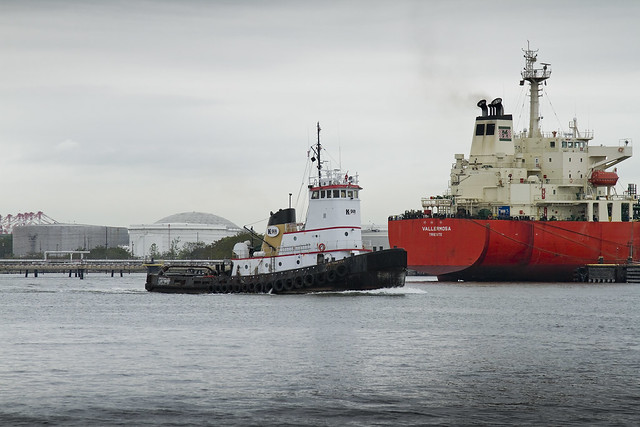
– photo by Mitch Waxman
Overly sensitive to sleights, always ready to interpret malicious intent in an innocent gesture, your humble narrator nevertheless prides himself on what Brooklyn kids might call “spidey sense”. When certain instincts and triggers begin to fire off, the imperative to “get out of dodge” becomes overwhelming and flight ensues, if I am clever enough to acknowledge this “tingle”.
Every time I’m on the island which Richmond County squats upon, I start to tingle.
from silive.com
Staten Island ranks second in the overall suicide rate out of all five boroughs, behind only Manhattan, according to the most recent state Department of Health statistics.
In 2005, the most recent year available, there were 6.9 suicides on the Island per 100,000 people. Manhattan was the only borough that had more, with 7.6 suicides per 100,000; rates for the Bronx, Brooklyn and Queens were 4.8, 4.6 and 5.4, respectively.
Sudden changes in behavior or personality; feelings of desperation, helplessness, hopelessness, aloneness, loss and depression; previous suicide attempt; and most importantly, suicide statements expressing a desire or intention to die are all some of the warning signs that sometimes go overlooked, experts say.

– photo by Mitch Waxman
Over the years paying attention to this “tingle”, sometimes felt by Our Lady of the Pentacle instead of me, has aided me in avoiding multiple encounters with the Constabulatory, allowed me to escape a burning building twice, and facilitated in sidestepping some of the dire consequences of a degenerate youth. Additionally, I seem to know which days it would be fortuitous to call in sick to work, intuitively avoid traffic jams and transit logjams, and when some baser denizen of the NY streets sets their sights on me- I know it.
It has long been my belief that physical cowardice is a genetic inheritance, a gift from timorousness ancestors who managed to run away before the Vikings or Mongols found them.
from wikipedia
Snug Harbor was founded by the 1801 bequest of New York tycoon Captain Robert Richard Randall for whom the nearby neighborhood of Randall Manor is named. Randall left his country estate, Manhattan property bounded by Fifth Avenue and Broadway and Eighth and 10th Streets, to build an institution to care for “aged, decrepit and worn-out” seamen. The opening of the sailor’s home was delayed by extended contests of the will by Randall’s disappointed heirs. When Sailors’ Snug Harbor opened in 1833, it was the first home for retired merchant seamen in the history of the United States. It began with a single building, now the centerpiece in the row of five Greek Revival temple-like buildings on the New Brighton waterfront.
Captain Thomas Melville, a retired sea captain and brother of Moby-Dick author Herman Melville, was governor of Snug Harbor from 1867 to 1884.
In 1890, Captain Gustavus Trask, the governor of Snug Harbor, built a Renaissance Revival church, the Randall Memorial Chapel and, next to it, a music hall, both designed by Robert W. Gibson.
Approximately 1,000 retired sailors lived at Snug Harbor at its peak in the late 19th century, when it was among the wealthiest charities in New York. Its Washington Square area properties yielded a surplus exceeding the retirement home’s costs by $100,000 a year.

– photo by Mitch Waxman
There are places which terrify, and intimidate. …Staten Island… with it’s hoary past and terrifying implications of Old World conspiracy- accomplishes both for me. I prefer to focus on what floats past the place, observing from the safety of running water, rather than delve too deeply into the rumors of those things which have been witnessed in the trees near Willowbrook.
from artsjournal.com
All “aged decrepit and warn-out sailors” were accepted. Even some blacks. Eventually the Harbor also allowed steamboat sailors and inland sailors from lakes and rivers too, but they were no doubt frowned upon as not being adventurous enough. Once, while trying to affix a sculpture to one of the walls, we found a sealed-off compartment containing a book of photographs of hundreds of inmates (as the retired seamen were called). Here and there were some dark faces. All races and nationalities were welcomed. Only “habitual alcoholics and those with contagious disease or immoral character were banned.”
tentacled starers

– photo by Mitch Waxman
The courthouse in Staten Island, found in St. George near the Borough Hall, has always filled me with some nameless dread- an unknowable and substantive certainty that behind it’s gabled window sashes, there exists a brain blasting horror and existential truth which would shatter my sanity were the curtains to shift and reveal what lurks within.
Since childhood, when school trips or camp outings would bring me to this jutting littoral outcrop from my homeland of infinite Brooklyn, I’ve always maintained that there is just something wrong about the place.
If you think about it, the decline of New York City as an industrial and cultural leader began when the Verrazano Narrows Bridge was completed.
from nyc.gov
Borough Hall was designed by Carrere & Hastings, one of the most influential firms in this country in the early twentieth century. John Carrere (1858-1911) and Thomas Hastings (1860-1929) both attended the Ecole des Beaux Arts in Paris and worked at the firm of McKim, Mead & White. They started their firm in 1885. Carrere, a resident of Staten Island, helped select the dramatic hilltop site of Borough Hall, and was involved with the plan and development of the Civic Center. The firm designed the Richmond County Courthouse next door, the Ferry Terminal (burned) and the St. George Branch Library.

– photo by Mitch Waxman
It must be admitted that …Staten Island… is actually quite lovely in spots and that the prejudice I bear the place is entirely between my own ears. Another perfectly lovely community in the United States- Boulder, Colorado- also receives an unreasoning enmity from your humble narrator. No reasonable explanation can be offered except that both make me itchy and uncomfortable, representative of a way of life unattractive to my personality and tastes. Funny thing is, half of my old neighborhood from Brooklyn moved out here, including my own parents.
If you’re from …Staten Island… and reading this, just chalk it up to inter borough antagonism, and allow me to just rattle on…
from wikipedia
McKim, Mead & White was a prominent American architectural firm at the turn of the twentieth century. The firm’s founding partners were Charles Follen McKim (1847–1909), William Rutherford Mead (1846–1928) and Stanford White (1853–1906). The firm was a major training ground for many other prominent architects -partners, associates, designers and draftsmen.
McKim and Mead joined forces in 1872 and were joined in 1879 by White who, like McKim, had worked for architect Henry Hobson Richardson. Their work applied the principles of Beaux-Arts architecture, the adoption of the classical Greek and Roman stylistic vocabulary as filtered through the Parisian Ecole des Beaux-Arts, and the related City Beautiful movement after 1893 or so, which aimed to clean up the visual confusion of American cities and imbue them with a sense of order and noble formality.
Mead was the last of the firm’s founding partners to die in 1928, after McKim (1909), and White (1906). The firm retained its name after the death of Mead, until partner James Kellum Smith’s death in 1961. The firm – primarily Smith – designed the prominent National Museum of American History in Washington DC, one of the firm’s last works, opening in 1964. McKim, Mead & White was also involved with an urban renewal project at Pratt Institute in Brooklyn in the 1950s and designed three buildings as part of the project: DeKalb Hall, ISC Building and North Hall.
In 1961, McKim, Mead & White was succeeded by the firm Steinman, Cain, and White, which by 1971 had become Walker O. Cain and Associates.

– photo by Mitch Waxman
Perhaps it’s just a psychic charge which the place has carried since the maritime days, when old sailors who had capsized into Snug Harbor would dialogue with the locals in area taverns, exchanging wild stories of the south seas for a shot of whiskey or a glass of beer. Squid like monstrosities worshipped like heathen gods, or a 50 foot shark which bit the prow from a boat, Fijian mermaids, and even stranger reports entered the folkloric gene pool here and mixed in with the hybrid pestilence of both English and Dutch superstitions. Isolation too, held special horrors for …Staten Island…
from wikipedia
Stanford White (November 9, 1853 – June 25, 1906) was an American architect and partner in the architectural firm of McKim, Mead & White, the frontrunner among Beaux-Arts firms. He designed a long series of houses for the rich and the very rich, and various public, institutional, and religious buildings, some of which can be found to this day in places like Sea Gate, Brooklyn. His design principles embodied the “American Renaissance”.
In 1906, White was murdered by millionaire Harry Kendall Thaw over White’s affair with Thaw’s wife, actress Evelyn Nesbit, leading to a trial which was dubbed at the time “The Trial of the Century”

– photo by Mitch Waxman
Rumors abound as to the mission of a certain Catholic Lay organization, based in a dormitory skyscraper on 34th street and Madison in Manhattan- and why certain members of that group (who believe even the Knights of Loyola to have lost their way) seem to spend quite so much of their time on …Staten Island…
One theory which has gained my attention suggests that the Masonic Treasures of Garibaldi still lie extant and occluded in the vast acreage of the place, and that the Holy See wishes to see these relics returned to Roman hands. However, one cannot trust in conspiracy, although… Garibaldi did conspire to overthrow the papal states here, and later succeeded in doing so… But that doesn’t prove anything!
from wikipedia
Thaw was born on February 12, 1871 to Pittsburgh coal and railroad baron William Thaw. Violent and paranoid from a very young age (his mother claimed his problems had started in the womb), he spent his childhood bouncing from private school to private school in Pittsburgh, never doing well and described by teachers as unintelligent and a troublemaker. Still, as the son of William Thaw, he was granted admission to the University of Pittsburgh, where he was to study law, though he apparently did little studying. After a few years he used his name and social status to transfer to Harvard University.
Thaw later bragged that he had studied poker at Harvard. He also went on long drinking binges, attended cockfights, and spent much of his time romancing young women. He was expelled after being picked up for chasing a cab driver through the streets of Cambridge with a shotgun, though he claimed it was unloaded.
Thaw has been credited with the invention of the speedball, an injected combination of morphine and/or heroin along with cocaine sometime between 1896 and 1906. He was also reported by newspapers at the time of his trial to have once consumed an entire bottle of laudanum in a single sitting and carry a special silver case full of syringes and other parts of a large “outfit” of injecting equipment.

– photo by Mitch Waxman
The woodlands of …Staten Island… betray it’s nature to visitors who observe the glacial erratics and kettle ponds which would be recognizable to the antediluvian dwellers of the place some 14,000 years ago. The predatory bipeds referred to as the “Clovis Culture” left behind evidence of their presence, and then dropped off the map entirely. The next direct evidence of occupancy, this time of recognizable humans, was some 5,000 years ago. What happened during the nine millennia between 3,000 and 12,000 B.C.? How does it relate to the stories told by the old mariners at Snug Harbor?
from wikipedia
The towns and villages of Staten Island were dissolved in 1898 with the consolidation of the City of Greater New York, with Richmond as one of its five boroughs.
The construction of the Verrazano Bridge, along with the other three major Staten Island bridges, created a new way for commuters and tourists to travel from New Jersey to Brooklyn, Manhattan, and areas farther east on Long Island. The network of highways running between the bridges has effectively carved up many of the borough’s old neighborhoods.
The Verrazano had another effect, opening up many areas of the borough to residential and commercial development, especially in the central and southern parts of the borough, which had previously been largely undeveloped. Staten Island’s population doubled between from about 221,000 in 1960 to about 443,000 in 2000.
Throughout the 1980s, a movement to secede from the city steadily grew in popularity, reaching its peak during the mayoral term of David Dinkins. In a 1993 referendum, 65% voted to secede, but implementation was blocked in the State Assembly.
growing ferocity

– photo by Mitch Waxman
Witness the most technologically advanced fire fighting vessel on earth, the FDNY’s newest, known to commoner and king alike as the “Three Forty Three”. An enigmatic and photogenic craft, it’s still shaking out it’s bugs in the harbor of New York, and is regularly observed by a humble narrator. This ship (which is a pregnant point which will be discussed in a paragraph below) and it’s capabilities as reported exist on the edge of what would have been called science fiction 10 years ago, and exhibits the kind of cutting edge technology which the modern FDNY’s mission calls for.
Click here to witness the initial launch of the craft at the Marine 1 homepage.

– photo by Mitch Waxman
The question of whether a vessel is considered a boat or a ship is a bit contentious. Technical descriptions by maritime experts always use the mantra that a ship can carry and launch a boat, which defines what a “ship” is and what a “boat” isn’t. My buddy John Doswell of the Working Harbor Committee however, asks “have you ever heard of a fireship?”, and given his insider status regarding the retired John J. Harvey Fireboat and general maritime expertise one must lend certain shrift to his assertion.
Although, to me, the 343 is a $27 million vessel which can launch another craft as part of it’s onboard arsenal and design, so I have some difficulty referring to it as a boat.
from wikipedia
140-foot, 500-ton, $27 million dollar boat will be the country’s largest fireboat with a maximum speed of 18 knots. The Three Forty Three will provide the FDNY with the latest technology available for Marine vessels, including the capability of pumping 50,000 gallons of water per minute; nearly 30,000 gallons more than its predecessor. The need for this increased pumping capacity was graphically displayed as FDNY’s existing fireboats supplied the only water available for many days after the September 11, 2001 attack on the World Trade Center. However, the technological advances of these new boats do not end there. The boat’s original design by Robert Allan Ltd. of Vancouver, B.C. will catapult FDNY’s Marine Division into the 21st century and beyond.
Because of the very real threat of additional terrorist attacks after 9/11, the boats will also be capable of protecting firefighters from Chemical, Biological, Radiological, Nuclear agents (CBRN). While performing in any of these hostile environments, the crew will be protected in a pressurized area that will also have its air supply filtered by special charcoal and HEPA filters. Assistance on the design of the CBRN system was provided by engineers from the U.S. military’s Joint Program Executive Office for Chemical and Biological Defense and Naval Sea Systems Command. United States Navy.

– photo by Mitch Waxman
A sister vessel, the Firefighter 2, follows the same design principals as 343 although I haven’t managed to get any shots of it yet. Both will allow fire commanders to place as many as 50,000 gallons of water a minute in a gps guided arc onto a conflagration in Manhattan or on the harbor. Veiled references to parabolic calculations of the reach of this torrent have suggested to your humble narrator that it can be expected to reach further inland than any Fireboat in memory. Additionally, a forward ballast tank allows these ships to match the deck level of other vessels, allowing egress to the Staten Island Ferry amongst other civilian watercraft during emergencies.
from nycfireboat.com
- Length, overall = 140′-0″ (excluding fenders)
- Length, waterline = 130’–0″
- Beam, moulded = 36’–0″
- Depth, moulded = 16’–0″ (midship, deck edge)
- Draft (maximum) = 9’–0″
- Air draft design loaded waterline to highest point = 39’–0″ (maximum)
- Main Engines = MTU 4×2000 HP- total = 8,000 HP
- Propellers and Reduction Gears = Hundested 4 X Variable Pitch Propellers
- Fuel oil = 6,850 US gallons (trial condition), = 9,350 US gallons (maximum capacity)
- Fresh water capacity = 1,000 US gallons
- Foam concentrate = 3,600 US gallons (total)
- Sewage holding tank = 100 US gallons
- Oily water = 120 US gallons
- Sludge = 60 US gallons
- Decon wastewater tank = 100 US gallons
- Calm water trial speed – 20 mph at fully loaded condition operating at 100% vessel power rating (8,000 hp) and 15% sea margin.
- Design seastate – 6′ significant wave height
- Pumping capacity – 20,000 gpm on two engines as fire-fighting ship and 50,000 gpm on four engines as pumping station
- Monitor throw – 700′ from midships
- Operating crew – seven (7)
- Fire-fighters – 27 in transit
feeble horns
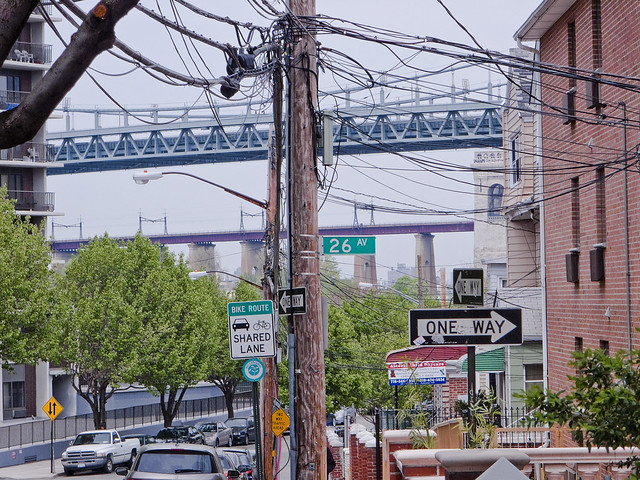
Hell Gate and Triborough bridges from Old Astoria – photo by Mitch Waxman
Loathsome memories of recent setbacks- and also of certain rebuffs- plague your humble narrator during these gloomy and sunless days, and always only solace can offer nepenthe. Thus, during a recent stroll by the pacific maelstrom of Hell Gate, nestled between two steel structures whose unearthly vibrations and omnipresent vocalizations form the aural environment- this series of shots were captured.

curiously scattered bones on sidewalk in Astoria – photo by Mitch Waxman
Vengeance and malice, indeed all of the seven deadly transgressions, populate the infernal dream world which has plagued me since childhood. Of late, a vivid character has typified these somnambulist hallucinations, and at least once during the night I’ll awaken in cold sweat grasping at the void of a curtain draped chamber. Surely, these negative humors are manifestations of another failing displayed by your humble narrator and least of all men, the inability to not bear grudges well beyond all sensible intervals.

sinister seeming bird at Hells Gate – photo by Mitch Waxman
Having grown up in a lonely and isolated existence, in dusty rooms of sculptured green carpeting and vinyl covered couches with odd knick knacks that betrayed basic tenets of adherence to the Hebrew faith, family members carried a charge of eastern European distrust for outsiders. Don’t trust anyone, my mother used to tell me while still in the cradle. As such, your humble narrator has grown into a hostile and suspicious man, contemptuous of authority even when such authority is necessary to govern over and control chaos and anarchy.

Amtrak at Hellegat Hell Gate Bridge – photo by Mitch Waxman
Often I stand on a point of principle, in a combative and tenacious- and vastly unpopular- stand over small matters such as allowing a police officer the right to inspect my belongings on demand. Of course I realize the age we are living in is fraught with the consequences of living in a global military empire the likes of which even the Romans or Turks would gasp and genuflect at, and that to most “standard of living” trumps “individual rights” but the constables have to follow the rules too. That’s what our modern Metropolis operates on, and as the saying in Brooklyn used to go “if I gots to stands in lines, youse gotta stands in da line”.

Psychiatric Hospitals at Hell Gate – photo by Mitch Waxman
Often, I fear that someday my darker impulses will take control of me, and I’ll spin off and become some comic book villain like parody of myself, the defeated antihero of a cosmic parable. Perhaps I will be remembered as a cautionary tale, your humble narrative of the man who looked under too many rocks. The Rumpelstiltskin of Newtown Creek, or perhaps just some old man in a shack who talks only to a collection of bottles?

Wards Island from Hell Gate – photo by Mitch Waxman
Preoccupations with such bizarre concerns has led me to believe in and visualize conspiracy lurking behind every corner. The attentions of certain malign elements, teenage adherents to some form of the Hip Hop cult, have been noted milling about around headquarters of late. Additionally, strange vehicles not usually parked in the neighborhood have been observed, adorned with mysterious antennae and blacked out windows- even on the windshield, which is unusual in itself due to municipal regulation.
Such bizarre notions, undoubtedly the product of lonely studies and a massive workload, were what led me to seek the solace of Astoria Park. I had hoped (futilely as turns out) to photograph passing Tugboats, but instead grew focused on certain uluations which seemed to be emerging from the impossibly distant Psychiatric hospitals at Wards Island…

The President of the United States on Marine 1 over Hell Gate – photo by Mitch Waxman
And that’s when the President of the United States flew by in Marine One on his way to the World Trade Center site to commemorate the death of his arch enemy.
In short, I’m all ‘effed up, and this post hits six points out of seven of the ICD-10 for paranoid personality type.
And the Newtown Pentacle is back in session.
longings and welcome

– photo by Mitch Waxman
The first bit of business today is about our departed friend Bernie Ente, and a memorial moment we have planned for the Newtown Creek Cruise tomorrow.
As many of you know, Bernie was and remains an inspiration to those of us involved in the story of Newtown Creek, in many ways he was “the King of the Creek”. He was the founder and institutor of this annual exploration of the troubled waterway, and there won’t be anyone connected with the organization and execution of this trip who won’t acutely feel his absence.
Accordingly, there is going to be a memorial moment performed for our fallen King, and several people have contacted me saying they wish to be present, but cannot afford the price of the boat trip. I have been instructing all who wish to attend to gather at the Maspeth Avenue street end (click here for google maps location and pictured above) and be there by 11:30. You’ll see a gigantic boat coming up the Creek, that’ll be us. The whole shebang will be short and sweet, as Bernie would be embarrassed by such honorifics and would chide me to focus in on what’s truly important- the revelation of Newtown Creek’s often occluded past, and the stunning possibilities for our communities offered by it’s revitalization and renewal.
Erik Baard will be paddling up the Creek with Richard Melnick of the Greater Astoria Historic Society, should any of you wish to attend on the water, although I stress that this is not an official Long Island City Boathouse event. Erik can be contacted via this facebook link if you wish to join them.
(afterwards, you can then cross the Grand Avenue Bridge and head over to Rust Street, where a rally to save the St. Saviour’s site and turn it into a City Park is meant to be happening at 1pm, but you’ll have to hit Google for specifics on that- I’ve been too busy with my own business to pay much attention to this effort in the last month- but there’s meant to be quite a gathering of elected officials and the folks from COMET and other Maspeth based community groups)

– photo by Mitch Waxman
Secondly, when our vessel returns to South Street Seaport at 1pm, those of you onboard who wish to discuss what you’ve just seen with Working Harbor personnel and or your humble narrator should plan on joining us for our customary post game. We will be proceeding to a local cafe bar where the camaraderie and libation will flow, and a relaxed conversation will be offered. Your tab, of course, is your own. This is not a part of the tour, and is not offered as part of the ticket price, but if you buy old Mitch a drink or two- he might tell you about some of the unknowable things he’s seen dancing around in the Creek during thunderstorms or share the story of the “Blissville Banshee” with you.
Nothing loosens Mitch’s tongue like a flask of cheap hip pocket liquor.

– photo by Mitch Waxman
Lastly, and I promise- this is the last time you’ll see this string of text, there are still a few ticketed seats available but I can’t promise they’ll be there when you leave work tonight. If you’ve been prevaricating about whether or not to come, now is the time to “drop the hammer”.
And… did I mention we’ve got a speaker from Riverkeeper scheduled to be onboard?
Lastly:
It is critical for you to purchase tickets for the Newtown Creek Cruise soon. We’re filling up rapidly and seating is limited. Your humble narrator is acting as chairman for this journey, and spectacular guest speakers are enlisted to be onboard. Click here to order tickets. Something I can promise you, given the heavy rain we’re having at the beginning of this week, is that the Newtown Creek will be especially photogenic on Saturday. Current forecasts call for “Partly sunny. A slight chance of showers in the morning. Highs in the mid 70s. North winds around 5 mph. Chance of rain 20 percent” (we leave the dock at 10- late morning)! Photographers in Greenpoint, Long Island City, and beyond- this is going to be hyperfocal MAGIC.
From workingharbor.com
he May 21st, Newtown Creek Cruise:
Explore Newtown Creek by Boat
Saturday, 21 May, 2011
Pier 17, South Street Seaport.
Departs 10 am sharp
Returns 1 pm
Price: $60
Join us for a special water tour with expert narration from historical and environmental guest speakers.
There are limited tickets available on the MV American Princess for a very rare tour of Newtown Creek. Guest narrators will cover points of industrial and historical interest as well as environmental and conservation issues during your three-hour exploration. New York’s forgotten history will be revealed – as well as bright plans for the creeks future.
MV American Princess is a large, comfortable vessel with indoor and outdoor seating. Complimentary soft drinks and a tour brochure are included.
Cruise runs rain or shine
Queries? Contact Tour Chairman Mitch Waxman: waxmanstudio@gmail.com
Hosted by Hidden Harbor Tours ® in association with the Newtown Creek Alliance.


 The Newtown Pentacle