Posts Tagged ‘photowalk’
slow decadence

– photo by Mitch Waxman
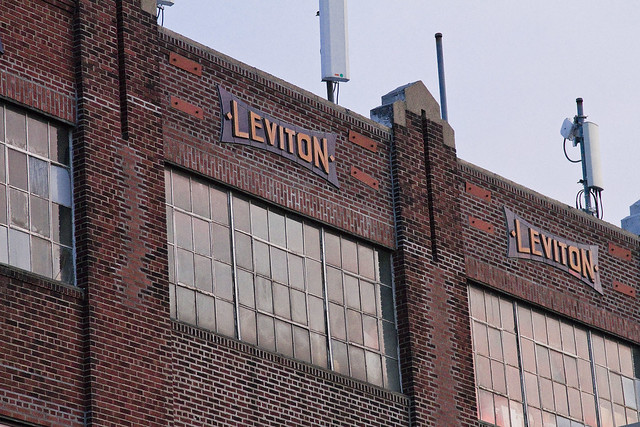
I seem to walk past this structure at least once a week, have done so for several years now, and until recently was completely ignorant about one of the largest employers of 20th century Greenpoint. The Leviton family built this commercial empire by the sweat of their brows- stories of part time employees encountering old Isidor working on the factory floor are rampant in Greenpoint, verging on Pop culture amongst garden spotters of a certain age.
from wikipedia
Leviton Manufacturing Company, Inc. is a manufacturer of electrical wiring devices, data center connectivity apparatus and lighting energy management systems. The company was founded in 1906 by Evser and his son Isidor Leviton. They began by manufacturing brass mantle tips for the natural gas lighting infrastructure in Manhattan. They sold their mantle tips on a pushcart on the Bowery on the Lower East side of Manhattan. Isidor Leviton designed a screw in lampholder for Thomas Edison’s Electric Lamp in 1910 and within ten years the lampholders were being used in every apartment in New York. In 1936 Leviton built a two square block 4 story factory and warehouse in Greenpoint, Brooklyn which still stands today. Leviton products include over 25,000 devices and systems, used in homes and businesses.

– photo by Mitch Waxman
Another bit of reputation that the family gathered unto itself was a certain liberalism regarding class, religion, and creed in their hiring practices- eschewing the segregation and selective hiring practiced by other corporations- particularly those in the electronics sector. The father of a close friend once told me that, in the years following the second world war, he was denied an opportunity to use his ivy league engineering degree because of a last name that sounded “too Italian”. Not an issue at Leviton, I am told.
from heresgreenpoint.com
By 1910 Leviton was designing and manufacturing pull-chain lamp holders for Thomas Edison’s newly developed light bulb, and in 1922 the company was moved to Greenpoint to better facilitate its rapid ascention. The massive factory took up two city blocks between Newel and Jewel Streets and produced over 600 electrical items, from fuses to socket covers to outlets and switches. Leviton would remain in Greenpoint until 1975, when the company again relocated, this time to Little Neck, NY.
– photo by Mitch Waxman
Newspaper reports describe the company as resistant to unionization, and even Eleanor Roosevelt found herself standing in solidarity with a picket line on Greenpoint Avenue in the 1940’s. In August of 1940, a large group of laborers “went out”, despite Leviton paying “benefits”- a rare and coveted perk of employment in that era. “Benefits” are what health insurance and a retirement plan were once known as, and were not an automatic or legislated requirement before the 1970’s- for those of you reading this under the age of 30, understand that these “insurance benefits” were something won by the labor movement of the early 20th century.
This was the scene of a long and contentious labor strike in 1940,
as detailed in this preview of the George Ruffini book– “Harry Van Arsdale, Jr: Labor’s Champion”, courtesy google books.

– photo by Mitch Waxman
Today, the structure is called the “Greenpoint Industrial Center” and seems to host a series of industrial, artisanal, and warehousing operations who make use of its cavernous interior spaces. The Leviton company left Greenpoint in the 1970’s, migrating to literal greener pastures in eastern Queens and ultimately Melville, Long Island.
from nationmaster.com
The Leviton Manufacturing Company was founded in New York by Isidor Leviton, at the dawn of the electrical era in 1906. Originally engaged in the fabrication of mantle tips for gas lighting, the Company soon afterwards in 1910, converted to production of a single electrical product — a pull-chain lampholder (designed for Edison’s new light bulbs).
- 1922: Leviton relocated to Greenpoint, Brooklyn after acquiring the TECCO plant, and now offered 568 products.
- 1929: Acquires Meteor Electric Company, a leading manufacturer of wiring devices.
- 1932: Leviton devices are used in the Empire State Building.
- 1937: Acquires American Insulated Wire and becomes the industry leader in wire, cable and cord products.
- 1939: Leviton devices featured at World’s Fair.
- 1950: Purchases the Deal Electric Company.
- 1953: Acquires Hale Brothers Companies, now known as Leviton Canada.
- 1960: Leviton is among the first manufactures to institute an employee pension plan.
- 1961: Leviton devices are installed in the White House.
- 1965: Harold Leviton becomes President and CEO.
- 1972: Introduces the first GFCI, the first touch dimmer, and a selection of home automation powerline carrier components.
- 1973: Introduces Decora® designer-style devices.
- 1975: Moves corporate headquarters to current location in Little Neck, NY.
_______________________________________________________________
August 5th, 2012- Newtown Creek Alliance Walking Tour- The Insalubrious Valley- This Sunday

– photo by Mitch Waxman
Newtown Creek Alliance historian Mitch Waxman will be leading a walk through the industrial heartlands of New York City, exploring the insalubrious valley of the Newtown Creek.
The currently undefended border of Brooklyn and Queens, and the place where the Industrial Revolution actually happened, provides a dramatic and picturesque setting for this exploration. We’ll be visiting two movable bridges, the still standing remains of an early 19th century highway, and a forgotten tributary of the larger waterway. As we walk along the Newtown Creek and explore the “wrong side of the tracks” – you’ll hear tales of the early chemical industry, “Dead Animal and Night Soil Wharfs”, colonial era heretics and witches and the coming of the railroad. The tour concludes at the famed Clinton Diner in Maspeth- where scenes from the Martin Scorcese movie “Goodfellas” were shot.
Lunch at Clinton Diner is included with the ticket.
Details/special instructions.
Meetup at the corner of Grand Street and Morgan Avenue in Brooklyn at 11 a.m. on August 5, 2012. The L train serves a station at Bushwick Avenue and Grand Street, and the Q54 and Q59 bus lines stop nearby as well. Check MTA.info as ongoing weekend construction often causes delays and interruptions. Drivers, it would be wise to leave your vehicle in the vicinity of the Clinton Diner in Maspeth, Queens or near the start of the walk at Grand St. and Morgan Avenue (you can pick up the bus to Brooklyn nearby the Clinton Diner).
Be prepared: We’ll be encountering broken pavement, sometimes heavy truck traffic as we move through a virtual urban desert. Dress and pack appropriately for hiking, closed-toe shoes are highly recommended.
Clinton Diner Menu:
- Cheese burger deluxe
- Grilled chicken over garden salad
- Turkey BLT triple decker sandwich with fries
- Spaghetti with tomato sauce or butter
- Greek salad medium
- Greek Salad wrap with French fries
- Can of soda or 16oz bottle of Poland Spring
for August 5th tickets, click here for the Newtown Creek Alliance ticketing page
deserted midnight

– photo by Mitch Waxman
A friend recently published an excellent book (Eat the City) and your humble narrator was invited to the reception party her publisher was sponsoring on the Lower East Side of Manhattan. On the way to the event, deep in Alphabet City, this church building at 345 East 4th street between Avenues B and C caught my eye.
Built in 1895 as a Russian church, it currently houses the congregation of “San Isidro y San Leandro of the Western Orthodox Catholic Church of the Hispanic Mozarabic Rite”.
from wikipedia
Western Rite Orthodoxy or Western Orthodoxy or Orthodox Western Rite are terms used to describe congregations and groups which are in communion with Eastern Orthodox Churches or Oriental Orthodox Churches using traditional Western liturgies rather than adopting Eastern liturgies such as the Divine Liturgy of St. John Chrysostom. While there are some ancient examples of Western Rite churches in areas predominantly using the Byzantine Rite (the Monastery of Saint Mary of the Latins, often referred to as Amalfi, is a common example), the history of the movement is often considered to begin in the nineteenth century with the life and work of Julius Joseph Overbeck. Less commonly, Western Orthodoxy refers to the Western Church before the Great Schism.

– photo by Mitch Waxman
The history of this structure is somewhat hazy, but it was purpose built as a church. Originally a catholic church serving the St. Elizabeth of Hungary parish, ownership was transferred to the “Russian-Greek Orthodox Chapel of the Holy Trinity” and then the “Russian Orthodox Church of St. Nicholas”. I’ve been unable to tie down exactly when the current congregants took possession of the structure.
from wikipedia
The Mozarabic Rite is the second-best attested liturgy in the Latin Church in terms of preserved documentation. The Mozarabic Rite was considered authoritative for the clarification of a Sacramentary received by Charlemagne from Pope Adrian I (d. 795). The first is, of course, the Roman Rite, which, to encourage unity of faith and worship, generally replaced the Mozarabic in Iberia from about 1080.
In the year 870, Charles the Bald, wishing to see what the ancient Gallican Rite had been like, had priests sent from Spain to celebrate the Mozarabic Rite before him.
In the latter part of the eighth century, the Rite had fallen under some suspicion owing to quotations cited by Elipandus of Toledo in support of his Adoptianist theories, and the Council of Frankfurt 794 spoke somewhat disparagingly of possible Islamic influence on it. It was due to these suspicions that in 924, John X sent a Papal Legate named Zanello to investigate the Rite. Zanello spoke favourably of the Rite, and the Pope gave a new approbation to it, requiring only to change the words of consecration to that of the Roman one. Spanish clergy gradually started to use the Roman words of institution (though there is no evidence whether or not it was done consistently).
When King Alfonso VI of Castile conquered Toledo in 1085, it was being disputed as to which rite Iberian Christians should follow: the Roman rite or Mozarabic Rite. After other ordeals, it was submitted to the trial by fire: One book for each rite was thrown into a fire. The Toledan book was little damaged whilst the Roman one was consumed. Henry Jenner comments in the Catholic Encyclopedia: “No one who has seen a Mozarabic manuscript with its extraordinarily solid vellum, will adopt any hypothesis of Divine Interposition here.” The king allowed six parishes in the city to continue to use the Mozarabic rite.

– photo by Mitch Waxman
Baroque, and literally gothic in its decoration and design elements, the church reminds one that the monolithic Roman Catholic Church of modernity was once rent asunder by schisms. The Church was once caught between two dying and one growing empires (Latin Rome, Greek Rome, and the Arab Rum) which caused isolated pockets of Christian adherents to stray from Vatican orthodoxy. Often, it was the endless sea of politics which created these schisms, but as often as not it was merely regional variation in belief.
from wikipedia
Saint Isidore of Seville (Spanish: San Isidro or San Isidoro de Sevilla, Latin: Isidorus Hispalensis) (c. 560 – 4 April 636) served as Archbishop of Seville for more than three decades and is considered, as the historian Montalembert put it in an oft-quoted phrase, “le dernier savant du monde ancien” (“the last scholar of the ancient world”). Indeed, all the later medieval history-writing of Hispania (modern Spain and Portugal) was based on his histories.
At a time of disintegration of classical culture, and aristocratic violence and illiteracy, he was involved in the conversion of the royal Visigothic Arians to Catholicism, both assisting his brother Leander of Seville, and continuing after his brother’s death. He was influential in the inner circle of Sisebut, Visigothic king of Hispania. Like Leander, he played a prominent role in the Councils of Toledo and Seville. The Visigothic legislation which resulted from these councils is regarded by modern historians as exercising an important influence on the beginnings of representative government.

– photo by Mitch Waxman
The world of a thousand years ago, while bearing strange similarity to our own, saw one of the great wheels of history grinding to a halt. The process that began with Alexander the Great and continued through Rome’s unified empire, then the Western and Eastern Roman imperiums, and the fall of the West and subsequent reign of the barbarous men of the North- spawned several Catholic variants which few have ever heard of. The Copts, Mozarabs, and Syriacs come to mind, of course- as do the Arians, Monophysites, and Nestorians.
from wikipedia
Leander and Isidore and their siblings (all sainted) belonged to an elite family of Hispano-Roman stock of Carthago Nova. Their father Severianus is claimed to be according to their hagiographers a dux or governor of Cartagena, though this seems more of a fanciful interpretation since Isidore simply states that he was a citizen. The family moved to Seville around 554. The children’s subsequent public careers reflect their distinguished origin: Leander and Isidore both became bishops of Seville, and their sister Saint Florentina was an abbess who directed forty convents and one thousand nuns. Even the third brother, Fulgentius, appointed Bishop of Écija at the first triumph of Catholicism over Arianism, but of whom little is known, has been canonised as a saint. The family as a matter of course were staunch Catholics, as were the great majority of the Romanized population, from top to bottom; only the Visigothic nobles and the kings were Arians. It should be stated that there was less Visigothic persecution of Catholics than legend and hagiography have painted. From a modern standpoint, the dangers of Catholic Christianity were more political. The Catholic hierarchy were in collusion with the representatives of the Byzantine emperor, who had maintained a considerable territory in the far south of Hispania ever since his predecessor had been invited to the peninsula by the former Visigothic king several decades before. In the north, Liuvigild struggled to maintain his possessions on the far side of the Pyrenees, where his Merovingian cousins and in-laws cast envious eyes on them and had demonstrated that they would stop at nothing with the murder of Liuvigild’s sister.

– photo by Mitch Waxman
An interesting series of clips, detailing the choral aspects of the Mozarabic rite, can be accessed here. Always fascinated by the prismatic flavors of faith, your humble narrator is glad to have stumbled across this enigmatic little church. Should any congregants of the institution have anything to add or correct, please use the comments link to share your knowledge.
from wikipedia
The Mozarabs (Spanish: mozárabes [moˈθaɾaβes]; Portuguese: moçárabes [muˈsaɾɐβɨʃ]; Catalan: mossàrabs [muˈsaɾəps]; Arabic: مستعرب trans. musta’rab, “Arabized”) were Iberian Christians who lived under Arab Islamic rule in Al-Andalus. Their descendants remained unconverted to Islam, but did however adopt elements of Arabic language and culture. They were mostly Roman Catholics of the Visigothic or Mozarabic Rite.
Most of the Mozarabs were descendants of Hispano–Gothic Christians and were primarily speakers of the Mozarabic language under Islamic rule. Many were also what the arabist Mikel de Epalza calls “Neo-Mozarabs”, that is Northern Europeans who had come to the Iberian Peninsula and picked up Arabic, thereby entering the Mozarabic community.
A few were Arab and Berber Christians coupled with Muslim converts to Christianity who, as Arabic speakers, naturally were at home among the original Mozarabs. A prominent example of Muslims who became Mozarabs by embracing Christianity is the Andalusian rebel and Anti-Umayyad military leader, Umar ibn Hafsun. The Mozarabs of Muslim origin were descendants of those Muslims who converted to Christianity, following the conquest of Toledo and perhaps also, following the expeditions of king Alfonso I of Aragon. These Mozarabs of Muslim origin, who converted en masse at the end of the 11th century, many of them Muladi (ethnic Iberians previously converted to Islam), are totally distinct from the Mudéjars and Moriscos who converted gradually to Christianity between the 12th and 17th centuries. Some Mozarabs were even Converso Sephardi Jews who likewise became part of the Mozarabic milieu.
Separate Mozarab enclaves were located in the large Muslim cities, especially Toledo, Córdoba, Zaragoza, and Seville.
_______________________________________________________________
August 5th, 2012- Newtown Creek Alliance Walking Tour- The Insalubrious Valley- This Sunday
– photo by Mitch Waxman
Newtown Creek Alliance historian Mitch Waxman will be leading a walk through the industrial heartlands of New York City, exploring the insalubrious valley of the Newtown Creek.
The currently undefended border of Brooklyn and Queens, and the place where the Industrial Revolution actually happened, provides a dramatic and picturesque setting for this exploration. We’ll be visiting two movable bridges, the still standing remains of an early 19th century highway, and a forgotten tributary of the larger waterway. As we walk along the Newtown Creek and explore the “wrong side of the tracks” – you’ll hear tales of the early chemical industry, “Dead Animal and Night Soil Wharfs”, colonial era heretics and witches and the coming of the railroad. The tour concludes at the famed Clinton Diner in Maspeth- where scenes from the Martin Scorcese movie “Goodfellas” were shot.
Lunch at Clinton Diner is included with the ticket.
Details/special instructions.
Meetup at the corner of Grand Street and Morgan Avenue in Brooklyn at 11 a.m. on August 5, 2012. The L train serves a station at Bushwick Avenue and Grand Street, and the Q54 and Q59 bus lines stop nearby as well. Check MTA.info as ongoing weekend construction often causes delays and interruptions. Drivers, it would be wise to leave your vehicle in the vicinity of the Clinton Diner in Maspeth, Queens or near the start of the walk at Grand St. and Morgan Avenue (you can pick up the bus to Brooklyn nearby the Clinton Diner).
Be prepared: We’ll be encountering broken pavement, sometimes heavy truck traffic as we move through a virtual urban desert. Dress and pack appropriately for hiking, closed-toe shoes are highly recommended.
Clinton Diner Menu:
- Cheese burger deluxe
- Grilled chicken over garden salad
- Turkey BLT triple decker sandwich with fries
- Spaghetti with tomato sauce or butter
- Greek salad medium
- Greek Salad wrap with French fries
- Can of soda or 16oz bottle of Poland Spring
for August 5th tickets, click here for the Newtown Creek Alliance ticketing page
lower edge

– photo by Mitch Waxman
While walking down Greenpoint Avenue recently, specifically that section of the ancient lane which overpasses the massive Long Island Expressway, this “Ghost Bike” caught my attention. Reckless, the political calculations which have caused the Manhattan elites to embrace and encourage cycling as an alternative form of transportation has created several spots where high speed traffic interacts directly with human powered vehicles, and tragedy has ensued. Cycling enthusiasts place these white painted bicycles at the spot where someone has died, as a memorial and a reminder to passerby.
It’s kind of a somber thing, these white bikes.
This is an “unnamed” ghost bike, according to ghostbikes.org
A livery cab driver struck and killed a cyclist in Long Island City early this morning, as first reported by DNAinfo. The motorist was not charged with any crime, said an NYPD spokesperson.
According to police, the cyclist, a man in his 30s, was riding south on Greenpoint Avenue at the time of the crash, while the livery driver, 25, was heading east on Borden Avenue, along the side of the Long Island Expressway.

– photo by Mitch Waxman
This post won’t be debating the efficacy of such alternative transportation, the wisdom of allowing vehicles to operate on the streets of New York City (motorized or human powered) without insurance or tags or operator training or licensing, or comment on the tremendous amount of traffic focused on and through Western Queens.
Instead, my attention was drawn to the slip of notepaper which was inserted into the spokes.
from wikipedia
A ghost bike or ghostcycle is a bicycle set up as a roadside memorial in a place where a cyclist has been killed or severely injured (usually by a motor vehicle) Apart from being a memorial, it is usually intended as a reminder to passing motorists to share the road. Ghost bikes are usually junk bicycles painted white, sometimes with a placard attached, and locked to a suitable object close to the scene of the accident.

– photo by Mitch Waxman
“You have a beautiful bike. Have a nice day- homeless Cassie” is what it reads. Hipster “twee” notwithstanding, this is simply in bad taste, and the writer might as well have left a note of the gates of nearby Calvary saying “nice landscaping.”
Seriously?
_______________________________________________________________
August 5th, 2012- Newtown Creek Alliance Walking Tour- The Insalubrious Valley
– photo by Mitch Waxman
Newtown Creek Alliance historian Mitch Waxman will be leading a walk through the industrial heartlands of New York City, exploring the insalubrious valley of the Newtown Creek.
The currently undefended border of Brooklyn and Queens, and the place where the Industrial Revolution actually happened, provides a dramatic and picturesque setting for this exploration. We’ll be visiting two movable bridges, the still standing remains of an early 19th century highway, and a forgotten tributary of the larger waterway. As we walk along the Newtown Creek and explore the “wrong side of the tracks” – you’ll hear tales of the early chemical industry, “Dead Animal and Night Soil Wharfs”, colonial era heretics and witches and the coming of the railroad. The tour concludes at the famed Clinton Diner in Maspeth- where scenes from the Martin Scorcese movie “Goodfellas” were shot.
Lunch at Clinton Diner is included with the ticket.
Details/special instructions.
Meetup at the corner of Grand Street and Morgan Avenue in Brooklyn at 11 a.m. on August 5, 2012. The L train serves a station at Bushwick Avenue and Grand Street, and the Q54 and Q59 bus lines stop nearby as well. Check MTA.info as ongoing weekend construction often causes delays and interruptions. Drivers, it would be wise to leave your vehicle in the vicinity of the Clinton Diner in Maspeth, Queens or near the start of the walk at Grand St. and Morgan Avenue (you can pick up the bus to Brooklyn nearby the Clinton Diner).
Be prepared: We’ll be encountering broken pavement, sometimes heavy truck traffic as we move through a virtual urban desert. Dress and pack appropriately for hiking, closed-toe shoes are highly recommended.
Clinton Diner Menu:
- Cheese burger deluxe
- Grilled chicken over garden salad
- Turkey BLT triple decker sandwich with fries
- Spaghetti with tomato sauce or butter
- Greek salad medium
- Greek Salad wrap with French fries
- Can of soda or 16oz bottle of Poland Spring
for August 5th tickets, click here for the Newtown Creek Alliance ticketing page
vast reaches

– photo by Mitch Waxman
Pictured today are the operations of A.R.C. scrap metal division of a corporation called Alloco found at 540 Kingsland avenue in the Greenpoint section of Brooklyn, pictured from a vantage point on the loquacious Newtown Creek.
Another former Standard Oil property converted over to modern usage, A.R.C. scrap metal is involved in the recycling trade.

– photo by Mitch Waxman
I’ve had the privilege of meeting some of the folks who work here, and you couldn’t ask to encounter a nicer bunch of guys. Their yard always displays a frenzy of activity, with heavy equipment sorting through the flow of waste materials and what seems like dozens of safety vested and hard hatted workers laboring away.

– photo by Mitch Waxman
You may have seen one of these shots before, and apologies are offered for repetition. One is still sorting out problems and playing catch up after the interruption to work flow offered by the lightning strike which disabled much of my equipment.
It has been a very, very busy period of time with many unexpected and unscheduled obstacles.
_______________________________________________________________
August 5th, 2012- Newtown Creek Alliance Walking Tour- The Insalubrious Valley
– photo by Mitch Waxman
Newtown Creek Alliance historian Mitch Waxman will be leading a walk through the industrial heartlands of New York City, exploring the insalubrious valley of the Newtown Creek.
The currently undefended border of Brooklyn and Queens, and the place where the Industrial Revolution actually happened, provides a dramatic and picturesque setting for this exploration. We’ll be visiting two movable bridges, the still standing remains of an early 19th century highway, and a forgotten tributary of the larger waterway. As we walk along the Newtown Creek and explore the “wrong side of the tracks” – you’ll hear tales of the early chemical industry, “Dead Animal and Night Soil Wharfs”, colonial era heretics and witches and the coming of the railroad. The tour concludes at the famed Clinton Diner in Maspeth- where scenes from the Martin Scorcese movie “Goodfellas” were shot.
Lunch at Clinton Diner is included with the ticket.
Details/special instructions.
Meetup at the corner of Grand Street and Morgan Avenue in Brooklyn at 11 a.m. on August 5, 2012. The L train serves a station at Bushwick Avenue and Grand Street, and the Q54 and Q59 bus lines stop nearby as well. Check MTA.info as ongoing weekend construction often causes delays and interruptions. Drivers, it would be wise to leave your vehicle in the vicinity of the Clinton Diner in Maspeth, Queens or near the start of the walk at Grand St. and Morgan Avenue (you can pick up the bus to Brooklyn nearby the Clinton Diner).
Be prepared: We’ll be encountering broken pavement, sometimes heavy truck traffic as we move through a virtual urban desert. Dress and pack appropriately for hiking, closed-toe shoes are highly recommended.
Clinton Diner Menu:
- Cheese burger deluxe
- Grilled chicken over garden salad
- Turkey BLT triple decker sandwich with fries
- Spaghetti with tomato sauce or butter
- Greek salad medium
- Greek Salad wrap with French fries
- Can of soda or 16oz bottle of Poland Spring
for August 5th tickets, click here for the Newtown Creek Alliance ticketing page
glassy or metallic

– photo by Mitch Waxman
Coming home from the Working Harbor Committee Walking tour of the Kill Van Kull yesterday, while onboard the Staten Island Ferry, one of the tour goers pointed out a gargantuan ship passing by and asked me about it. While neither of the ships pictured above and below are that exact vessel, they are of the same class and function. Automobile carriers, they are known to the maritime trade as “Ro-Ro” or “Roll on Roll off” cargo ships, which we’ll be taking a look at this “Maritime Sunday”.
from wikipedia
Since 1970 the market for exporting and importing cars has increased dramatically and the number and type of RO/ROs has increased also. In 1973, Japan’s K Line built European Highway, the first pure car carrier (PCC), which carried 4,200 automobiles. Today’s pure car carriers and their close cousins, the pure car/truck carrier (PCTC) are distinctive ships with a box-like superstructure running the entire length and breadth of the hull, fully enclosing the cargo. They typically have a stern ramp and a side ramp for dual loading of thousands of vehicles (as cars trucks, heavy machineries, tracked units, Mafi trailers, loose statics), and extensive automatic fire control systems.
The PCTC has liftable decks to increase vertical clearance as well as heavier decks for “high and heavy” cargo. A 6500 unit car ship with 12 decks can have three decks which can take cargo up to 150 short tons (136 t; 134 long tons) with liftable panels to increase clearance from 1.7 to 6.7 m (5 ft 7 in to 21 ft 10 in) on some decks. Lifting decks to accommodate higher cargo reduces the total capacity.

– photo by Mitch Waxman
One often spots these gargantua moving slowly about the harbor, most often escorted by at least two tugs. Despite their ungainly appearance, the ships are a great deal more stable than they would appear, or so I am told. Researching this post, tales of Ro Ro ships listing as much as 80 degrees in heavy seas without capsizing have emerged. The economic advantages offered by these vessels, however, far outweigh their risks.
from eukor.com
EUKOR operates a large and modern fleet of specialized Pure Car and Truck Carriers (PCTC), embracing some of the largest vessels in the world – annually transporting around 3 million cars worldwide, utilizing a global network of offices and agents.
Through continuous expansion of our route network, minimization of transit times, utmost attention to cargo-handling quality and a strong dedication to cost savings for our customers, we strive towards delivering total customer satisfaction. Ultimately, we aim to achieve our vision of becoming the best shipping company for the global automotive industry.
We combine the best of what Korea and Europe have to offer. Having Hyundai Motor and Kia Motors as shareholders (20%) gives us a unique growth platform within the industry. Add to that the shareholdings of Norwegian shipping company Wilh.Wilhelmsen (40%) with shipping experience dating back to 1861 and leading Swedish shipping group Wallenius Lines (40%)- founded in 1934 and pioneers in car carrier operations since the 1950′s -and we have created a company of world class competencies.

– photo by Mitch Waxman
The Ro Ro’s, it seems, allow vehicles to be driven onto the ship and then back off at their port of destination. This creates a series of efficiencies when delivering automobiles. Time spent at dock is anathema to shipping companies, and the name of the game is to discharge and acquire new cargo in as efficient and expedient fashion as possible. Expediting such matters, and finding solutions to the never ending flow of goods through the port, is what has made New York the 2nd largest port in the United States (although the secondary ranking is something which officials at the Port Authority will argue against, claiming factual rather than statistical primacy over the currently ranked #1 in California).
This is less of a link than a crib from emails which have been passed around recently by members of the Working Harbor Committee. The source of the information is undoubtedly “official” but I can’t tell you it’s origin.
What actually transpires at The Port of New York/New Jersey:
- Total estimated value of cargo-$176 Billion (2011)
- 6.752 deep draft commercial ship arrivals (over 18/day)
- 1st in nation for petroleum product movement
- 1st in nation for domestic/foreign imports combined
- 3rd largest U.S. port for containerized cargo
- 3rd largest Passenger Ferry service in the world
- 3rd largest Cruise Ship port in the U.S.
In 2011, transported:
- 85 million tons of general and bulk cargo
- 5.5 million twenty-foot equivalent units of containerized cargo (15,058 containers per day)
- 561,965 vehicles
- Distributed to 89-90 million consumers in a 10- contiguous state area (35% of U.S. population


