Posts Tagged ‘Tugboat’
oily river

– photo by Mitch Waxman
Recently witnessed, the Reinauer Towing tugboat Matthew Tibbets maneuvering a fuel barge through the languid expanse of the legend choked Newtown Creek.
Just a short one today, still playing catch up from a recent bout with some unknown and untrammeled organism, which is best thought of as some mere virus.
many candles

– photo by Mitch Waxman
Another one of NY Harbor’s towing companies whose craft are a delight to behold is DonJon Marine.
They operate a fleet of sky blue tugs whose capabilities range from canal and river tugs all the way up to a gargantuan oceanic tug which is called Atlantic Salvor.
Today, the focus is on DonJon’s Cheyenne, which is one of their smaller tugs. That’s her, moving past Wards Island and passing beneath the Hells Gate Bridge.
from donjon.com
Founded in 1964 by Mr. J. Arnold Witte, Donjon’s President and Chief Executive Officer, Donjon Marine’s principal business activities were marine salvage, marine transportation, and related services. Today Donjon Marine is a true provider of multifaceted marine services. Donjon’s controlled expansion into related businesses such as dredging, ferrous and non-ferrous recycling and heavy lift services are a natural progression, paralleling our record of solid technical and cost-effective performance.
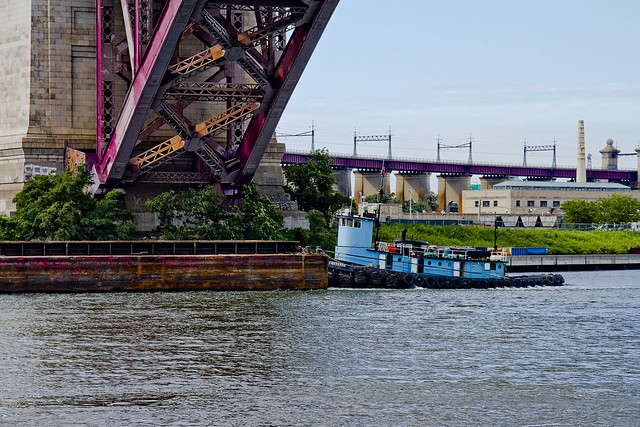
– photo by Mitch Waxman
Cheyenne is older than I am, yet manages to get to work every day, unlike me.
DonJon serves as one of the integral components of New York Harbor’s system for moving recyclable commodities from curb to customer, and can often be spotted moving barges of metallic waste between DSNY collection points.
I first became aware of the company’s role in the process after spotting them at the SimsMetal Newtown Creek docks a few years ago.
Built in 1965, by Ira S. Bushey and Sons of Brooklyn, New York (hull #628) as the tug Glenwood for Red Star Towing.
In 1970, she was acquired by Spentonbush Towing where she was renamed as the Cheyenne
The tug was later acquired by Amerada Hess where she retained her name.
She was then acquired by Empire Harbor Marine where the tug retained her name. The company would later be renamed as Port Albany Ventures.
In 2009, Port Albany Ventures was acquired by the DonJon Marine Company of Hillside, New Jersey.

– photo by Mitch Waxman
A dirty and necessary industry, recycling is nothing like you would imagine it to be. University professors, environmentalists, and politicians present an image of something akin to Santa’s Elves in crisp white uniforms working in an antiseptic factory isolated from population centers. The reality is that it is performed by oil streaked and smoke belching heavy machinery, consumes far more fuel than you would imagine, and that it is quite a dangerous occupation (also, the concentration and processing of these metals carries dark implications for groundwater and air quality in the localities which it takes place in).
Green jobs of the future indeed.
from wikipedia
The scrap industry contributed $65 billion in 2006 and is one of the few contributing positively to the U.S. balance of trade, exporting $15.7 billion in scrap commodities in 2006. This imbalance of trade has resulted in rising scrap prices during 2007 and 2008 within the United States. Scrap recycling also helps reduce greenhouse gas emissions and conserves energy and natural resources. For example, scrap recycling diverts 145,000,000 short tons (129,464,286 long tons; 131,541,787 t) of materials away from landfills. Recycled scrap is a raw material feedstock for 2 out of 3 pounds of steel made in the U.S., for 60% of the metals and alloys produced in the U.S., for more than 50% of the U.S. paper industry’s needs, and for 33% of U.S. aluminum. Recycled scrap helps keep air and water cleaner by removing potentially hazardous materials and keeping them out of landfills.

– photo by Mitch Waxman
Not meaning to sound negative on this otherwise essential service, it’s just that as certain highly placed municipal employees have advised me in the past- “Be careful which laws you ask for, as some things may come only at too great a cost”.
If it costs ten gallons of fuel to recycle and reuse something which it would have cost five gallons of fuel to pull out of the ground… what are we actually saving?
from wikipedia
The tugboat is one symbol of New York. Along with its more famous icons of Lady Liberty, the Empire State Building, and the Brooklyn Bridge, the sturdy little tugs, once all steam powered, working quietly in the harbor became a sight in the city.
The first hull was the paddler tug Rufus W. King of 1828.
New York Harbor at the confluence of the East River, Hudson River, and Atlantic Ocean is among the world’s largest natural harbors and was chosen in the 17th century as the site of New Amsterdam for its potential as a port. The completion of the Erie Canal in 1825 to the upper Hudson River ensured that New York would be the center of trade for the Eastern Seaboard, and as a result, the city boomed. At the port’s peak in the period of 1900-1950, ships moved millions of tons of freight, immigrants, millionaires, and GI service men serving in wars.
Sheparding the traffic around the harbor were hundreds of tugs–over 700 steam tugs worked the harbor in 1929. Firms such as McAllister, and Moran Tugs came into the business. Cornelius Vanderbilt started his empire with a sailboat and went on to greatness with the New York Central Railroad, incidentally owning many tugs.
crooked boughs

– photo by Mitch Waxman
This Tug, the Gramma Lee T. Moran, was mentioned in a Newtown Pentacle posting of November 26- “loose and displaced“. As it’s one of my favorite tugs in New York Harbor to shoot, I felt a little bad that the starring role in that posting had gone to a cargo ship- and that Gramma Lee T. Moran had to share the second banana position with another Moran Tug- the estimable Marion Moran.
Can’t tell you why I like the esthetics of this ship so much, nor can I say why exactly it always reminds me of the Millennium Falcon (from the Star Wars movies) as it slides along the Kill Van Kull.
from wikipedia
The Kill Van Kull is a tidal strait approximately 3 miles (4.8 km) long and 1,000 feet (305 m) wide separating Staten Island and Bayonne, New Jersey, USA. The name kill comes from the Middle Dutch word kille, meaning “riverbed” or “water channel.”
Kill Van Kull connects Newark Bay with Upper New York Bay. The Robbins Reef Light marks the eastern end. Historically it has been one of the most important channels for the commerce of the region, providing a passage for marine traffic between Manhattan and the industrial towns of New Jersey. Since the final third of the 20th century, it has provided the principal access for ocean-going container ships to Port Newark-Elizabeth Marine Terminal, the busiest port facility in the eastern United States and the principal marine terminal for New York Harbor.

– photo by Mitch Waxman
These two shots are from just a few months ago, captured in the fall of 2011. It’s always odd seeing a tugboat operating without a barge, or tending a larger vessel which can be hundreds of times larger than itself. The majesty of these ships, and their crews, come alive when they are tasked with bearing such sisyphean burdens.
Can you imagine what it must be like guiding a fuel tanker into the narrow Kill Van Kull or down the East River? It must take nerves of steel to muster the confidence needed to Captain such tasks.
from tugboatenthusiastsociety.org
Tugs are “displacement” hull vessels, the hull is designed so water flows around it, there is no consideration for having the vessel “plane”. Because of this the hull form is limited to a maximum speed when running “free” that is about 1.5 times the square root of the waterline length. As the tug approaches this speed when running “free” it is perched between the bow wave and the stern wave. Since the hull cannot plane, application of additional power when approaching maximum hull speed only results in a larger bow wave, with the tug “squatting” further into the trough.

– photo by Mitch Waxman
The shot above, and the one below are from earlier in 2011- April to be exact.
Moran is a well established company which operates tugs all over North America. A century and a half old, the company’s fleet can be found on the USA’s Pacific and Atlantic coasts and within the Great Lakes, both along the west coast of- and in the Gulf of- Mexico, and within the inland waters of the eastern United States. They’ve been known to operate periodically as far away as the Caribbean Sea and South American waters.
from morantug.com
The LEE T. MORAN is an expression of brute power and utility that belies the refinements of technical engineering below her waterline. There, twin ports are cut into the steel hull to make room for the tug’s Z-drive units. On the floor of the shop they look like the lower units of giant outboard engines. Made by Ulstein, a subsidiary of Rolls-Royce, the Z-drive functions much like an outboard. Imagine two outboards extending straight down through the hull, each having the ability to rotate 360 degrees. That makes even a heavy, 92-foot tug with a 450-ton displacement very maneuverable. “It can turn on a dime,” says Doughty. “The hull bottom is slightly flatter to adjust to the two drive units. By turning each drive out 90 degrees, the captain can go from full-ahead (14 knots) to a dead stop in no time.”

– photo by Mitch Waxman
Perhaps it’s the low slung aspect of the wheelhouse, or the gentle curves observed in its hull… I can’t say, but there is just something pleasing about the design of this boat. A big toot goes out from this, your Newtown Pentacle, to one of my favorite citizens of the NY Harbor- the Gramma Lee T. Moran.
Moran Towing began operations in 1860 when founder Michael Moran opened a towing brokerage, Moran Towing and Transportation Company, in New York Harbor. In 1863, the company was transformed from a brokerage into an owner-operator of tugboats when it purchased a one-half interest in the tugboat Ida Miller for $2,700. Over time Moran acquires a fleet of tugboats. It was Michael Moran who painted the first white “M” on a Moran tugboat stack, in 1880.
loose and displaced

– photo by Mitch Waxman
Recent activities had carried your humble narrator to… Staten Island… A friend’s photography was included in a gallery exhibit at the venerable Snug Harbor, and wishing to both show support for another photographer and to witness his work in print form- I began the long journey from Astoria in Queens to the outermost of boroughs. After exiting the ferry, I was titillated by the sudden appearance of the gargantuan “Hanjin Lisbon” being guided toward the Kill Van Kull by two Moran tugs.
from marinetraffic.com
- Hanjin Lisbon Vessel’s Details
- Ship Type: Cargo
- Year Built: 2003
- Length x Breadth: 278 m X 40 m
- DeadWeight: 67979 t
- Speed recorded (Max / Average): 21 / 20.6 knots (20.6 knots = 23.7060566 mph)

– photo by Mitch Waxman
Like all the ocean going vessels of its type, the Lisbon is a lumbering monster of a ship. Nearly 1,000 feet in length, the cargo ship was most likely headed to the Port facilities at Newark Bay, and requires the use of tender boats to navigate the relatively narrow and hazard fraught coastal leg of its journey to New York harbor from some impossibly foreign port. It’s titan engines and onboard electronics can propel the ship through open ocean with great accuracy, of course, but the giant cargo ship can’t exactly “stop on a dime”.
from marinetraffic.com
MARION MORAN Vessel’s Details
- Ship Type: Tug
- Year Built: 1982
- Length x Breadth: 39 m X 12 m
- DeadWeight: 10 t
- Speed recorded (Max / Average): 14.5 / 8.9 knots
- Flag: USA [US]
- Call Sign: WRS2924
- IMO: 8121812, MMSI: 366941020

– photo by Mitch Waxman
Tugboat and towing services of the modern era, like Moran towing, are inheritors of centuried wisdom passed down from generations of mariners. The complex currents, mores, and eddies of the harbor are well known to the crews of these vessels and their job includes guiding such massive visitors to the port into safe harborage. Two tugs were observed at work, the Marion Moran and the Gramma Lee T. Moran.
Moran Towing began operations in 1860 when founder Michael Moran opened a towing brokerage, Moran Towing and Transportation Company, in New York Harbor. In 1863, the company was transformed from a brokerage into an owner-operator of tugboats when it purchased a one-half interest in the tugboat Ida Miller for $2,700. Over time Moran acquires a fleet of tugboats. It was Michael Moran who painted the first white “M” on a Moran tugboat stack, in 1880.

– photo by Mitch Waxman
Iconic, Moran tugs are distinguished their large white “M” logo and the white and maroon “color way” which allows them to be identified at great distances across the harbor. Like all tugs, they are built with highly reinforced steel superstructures and powerful engines that allow them to pursue an occupation which requires the ability to precisely handle tonnages which are clumsy and thousands of times their own weight.
from morantug.com
The LEE T. MORAN is an expression of brute power and utility that belies the refinements of technical engineering below her waterline. There, twin ports are cut into the steel hull to make room for the tug’s Z-drive units. On the floor of the shop they look like the lower units of giant outboard engines. Made by Ulstein, a subsidiary of Rolls-Royce, the Z-drive functions much like an outboard. Imagine two outboards extending straight down through the hull, each having the ability to rotate 360 degrees. That makes even a heavy, 92-foot tug with a 450-ton displacement very maneuverable. “It can turn on a dime,” says Doughty. “The hull bottom is slightly flatter to adjust to the two drive units. By turning each drive out 90 degrees, the captain can go from full-ahead (14 knots) to a dead stop in no time.”

– photo by Mitch Waxman
Containerized shipping is what makes the modern world tick, of course, and has enabled the business model of “just in time delivery” to take hold. The steel boxes which adorn the Lisbon’s decks will be unloaded by Gantry Crane at the dock and will find their way onto either rail or truck for delivery to the final consignee. What isn’t commonly known about these cargo ships is that ordinary people can book passage onboard, finding accommodation in a variety of staterooms, and cruise the world on a proverbial “slow boat to china”.
from hanjin.com
Hanjin Shipping (http://www.hanjin.com President& CEO Young Min Kim) is Korea’s largest and one of the world’s top ten container carriers that operates some 60 liner and tramper services around the globe transporting over 100 million tons of cargo annually. Its fleet consists of some 200 containerships, bulk and LNG carriers.

– photo by Mitch Waxman
The mind reels at such suggestions, and your humble narrator is both titillated at the notion of meeting and interacting with the sailors onboard (undoubtedly Koreans, Tagalog, and Chinese- citizens from all over the manufacturing hubs of the Pacific) and terrified by the lore and knowledge they must carry with them about the true nature of the world. Often these cargo ships will encounter pirates, terrorists, and other malingering forces on both the open sea and in coastal waters. Perhaps they have other experiences, of the sort which sailors do not discuss with outsiders, which only a hip pocket flask of raw whiskey might pry out of them.
from wikipedia
The Port Authority of New York and New Jersey was formed in 1921 and the Newark Bay Channels were authorized by the Rivers and Harbors Acts in 1922. Shipping operations languished after the war, and in 1927, the City of Newark started construction of Newark Airport (now known as Newark Liberty International Airport) on the northwest quadrant of the wetlands which lay between Port Newark and the edge of the developed city. Port Authority took over the operations of Port Newark and Newark Airport in 1948 and began modernizing and expanding both facilities southward. In 1958, the Port Authority dredged another shipping channel which straightened the course of Bound Brook, the tidal inlet forming the boundary between Newark and Elizabeth. Dredged materials was used to create new upland south of the new Elizabeth Channel, where the Port Authority constructed the Elizabeth Marine Terminal. The first shipping facility to open upon the Elizabeth Channel was the new 90-acre (36 ha) Sea-Land Container Terminal, which was the prototype for virtually every other container terminal constructed thereafter.
The building of the port facility antiquated most of the traditional waterfront port facilities in New York Harbor, leading to a steep decline in such areas as Manhattan, Hoboken, and Brooklyn. The automated nature of the facility requires far fewer workers and does not require the opening of containers before onward shipping.
crowned with withers

– photo by Mitch Waxman
Apologies for the paucity of communique offered this week, as catching up with sundry and mundane details of both personal and professional incarnation has been all consuming. The Creek tours of last month, in addition to psychologically exhausting a humble narrator famous for his delicate constitution and frail health, caused a surfeit of t’s to miss their crosses and undotted i’s proliferate. For the next few days, expect a few pretty pictures but nothing too hardcore until I’ve caught up. Thanks to all who have written inquiring as to my status, everything is fine.


 The Newtown Pentacle