Posts Tagged ‘Working Harbor Committee’
with an atomic, or molecular, motion

– photo by Mitch Waxman
Another interesting event set to occur on May 21st, which has been scheduled against my Newtown Creek Cruise- I would add, seems to be the apocalypse.
On my way to a meeting at Greater Astoria Historical Society on Sunday, the purpose of which was to discuss the upcoming Forgotten-NY tour of Staten Island’s Livingston neighborhood, I came across this pamphleteer who was proselytizing passers by to prepare for the coming tribulation and offering advice for making it through the end times which are meant to begin on a specific date not far in the future.
from wikipedia
The 2011 end times prediction is a prediction made by Christian preacher Harold Camping that the Rapture (in Christian belief, the taking up into heaven of God’s elect people) will take place on May 21, 2011 and that the end of the world as we know it will take place five months later on October 21, 2011. These predictions were made by Camping, president of the Family Radio Christian network, who claims the Bible as his source. Believers claim that around 200 million people (approximately 3% of the world’s population) will be raptured.

– photo by Mitch Waxman
This sort of millennialist doom saying is nothing new, remember the UFO people in California, the Branch Davidians in Texas, and the Solar Temple cult in Switzerland, just to refresh somewhat recent memories.
At the turn of the last century, one needed to have looked no further than the so called Millerites to find the originators of this sort of proclamation.
from wikipedia
The Great Disappointment was a major event in the history of the Millerite movement, a 19th century American Christian sect that formed out of the Second Great Awakening. William Miller, a Baptist preacher, proposed based on his interpretations of the prophecies in the book of Daniel (Chapters 8 and 9, especially Dan. 8:14 “Unto two thousand and three hundred days; then shall the sanctuary be cleansed”), that Jesus Christ would return to the earth during the year 1844. A more specific date, that of October 22, 1844, was preached by Samuel S. Snow. Although thousands of followers, some of whom had given away all of their possessions, waited expectantly, Jesus did not appear as expected on the appointed day and as a result October 22, 1844, became known as the Great Disappointment.

– photo by Mitch Waxman
Your humble narrator would hope that if the world does indeed end on the 21st of May, that you can enjoy the view of Manhattan disintegrating from those vantage points which the scenic waters of Newtown Creek offer with me. Destruction not withstanding, there is still a heck of a lot to see.
Assuming that some multi headed dragoness isn’t raining brimstone down upon us by then, I would also remind you of a Magic Lantern Show on the subject of Newtown Creek I’ll be presenting at the aforementioned Greater Astoria Historical Society on June 6th ($5- cheep).
May 21st

– photo by Mitch Waxman
The show must go on, as they say, yet your humble narrator is of heavy heart in announcing the Newtown Creek tour of May 21st, 2011- which is offered for your consideration by the Working Harbor Committee.
It is not the task of course, which tempers the normal ebullience experienced when an opportunity to share the wonders of the Newtown Creek with a group of enthusiasts from the comfort and safety of a modern vessel like the MV American Princess (which is outfitted with all the amenities one would expect to find during a harbor trip in a tourist Mecca such as New York City), crosses my path.
It is not that unnatural and uncontrollable timorousness which plagues me when I am asked to speak before “this group of pale enthusiasts” or “that gang of antiquarians”. Revealing and sharing the history of this amazing place is one the things I revel in, and brings me close to understanding what joy must be like.
from workingharbor.com
Visit Beautiful Newtown Creek Saturday, May 21, 2011
On MV American Princess, Boat departs from Pier 17, South Street Seaport, Manhattan NYC, 10am – 1pm
Souvenir Tour Brochure with historical information and vintage maps. Narration by experienced historical and environmental guest speakers. Complimentary soft drinks will be served. Come aboard for an intense Newtown Creek exploration! Our comfortable charter boat will travel the length of Newtown Creek. The tour will pause at many interesting locations for narration and discussion. Guest narrators will cover historical, environmental, and conservation issues. Large comfortable vessel with indoor & outdoor seating. Cruise runs rain or shine. Price: $60
To purchase tickets click here
or contact Tour Chairman Mitch Waxman: waxmanstudio(AT)gmail.com

– photo by Mitch Waxman
This is where the Industrial Revolution happened, and this trip will transverse and offer certain observations about the Newtown Creek’s present form and usage, and reveal a potentially bright future which this neglected ribbon of water- which provides the currently undefended border of Brooklyn and Queens- were it to be revitalized and renewed, might offer the future.
After boarding at South Street seaport, Working Harbor’s maritime experts will discuss the waterfront of Brooklyn as we pass beneath the Brooklyn Bridge and Manhattan Bridge, and finally passing under the Willamsburg Bridge. Our vessel will smoothly move past the neighborhoods of Dumbo, Williamsburg, and Greenpoint in Brooklyn, and offer spectacular views of Manhattan. This entire trip will be a photographer’s delight, incidentally, offering spectacular and unreal urban panoramas.

– photo by Mitch Waxman
At Long Island City, your humble narrator will presume to expose you to a short history of the Newtown Creek, and offer an identity to some of the enigmatic structures arrayed around the troubled industrial waterway.
Luckily for all concerned, there are other speakers who will relieve the crowd from my droning prattle, maritime experts and environmentalists included. Around Newtown Creek Alliance headquarters, there is some buzz amongst the staff about which one of the heavyweight orators will be onboard.
Soft drinks, one to a customer, will be complimentary as well.

– photo by Mitch Waxman
The American Princess will proceed past the titan Newtown Creek Waste Water Treatment Plant, the malign Dutch Kills, the cyclopean SimsMetal dock, the brutal symmetry of the Greenpoint Avenue Bridge, through the agglutinated heart of the Greenpoint Oil Spill, past the severed Penny Bridge at Meeker Avenue, and beyond the emerald devastations of Calvary Cemetery.
Then, we’re going to take a moment to remember our fallen friend… for just a moment.
I’m hesitant to mention this… as this is not what this trip is meant to be about, this is not a memorial event… but Bernie Ente is and will be so profoundly missed by many of us who will be conducting this tour, of which he is the originator and founder of… it would be in bad taste if a moment of silence to remember him, in this place which he expended so much of his attentions revealing and teaching and guiding about, were not offered. More on this in a later posting, but as the initial line says “the show must go on”, and that is exactly what Bernie would have us do.

– photo by Mitch Waxman
The course will continue, past the middle point of the Newtown Creek, and will plunge past the Maspeth Plank road, past the Phelps Dodge site and the Kosciusko Bridge. At the branching of the Newtown Creek which exists at the confluence of the East Branch and English Kills, we will witness the remains of the Maspeth Plank Road and approach the wicked end of the navigable section of the Newtown Creek itself and approach one the hydra like tributaries which spread languishing tendrils of rotting bulkheads and unused yet prime industrial waterfront locations all across Brooklyn and Queens.
This is not the world you know.

– photo by Mitch Waxman
Witness the startling elegance of the Grand Street Bridge, a century old swing bridge connecting Brooklyn and Queens, which signals the entrance to English Kills has been reached. Industrial heartland, this is a grossly contaminated section of the waterway which has- of course- been designated as a Federal Superfund site. Seeing the Newtown Creek in this state, this bizarre half life which is neither tick nor tock- industrial nor residential, is a fairly short term proposition.
Vast changes are coming which will literally alter the very landscape.

– photo by Mitch Waxman
The Kosciusko Bridge replacement, and the enormous new populations and residential conversion in progress and expected in Hunters Point South and Greenpoint, and the EPA conducting the initial stages of Superfund remediation (which will involve dredging and vast public works projects conducted by hundreds of contractors) will all be happening in roughly the same timeframe. Ten years from now, it will hard to recognize the place, and twenty more will render it a stranger to those who know it today.
In the English Kills, you will become transfixed by a waterfront frozen in some other century, and witness the extant vitality of those economies of heavy industry which build, and drain, and recycle, and dispose of. You don’t get Manhattan without a Newtown Creek, after all.

– photo by Mitch Waxman
We will proceed into the depths of English Kills near the Third Ward in East Williamsburg, Brooklyn. Our journey will cross the navigable sections of the Newtown Creek and begin it’s return journey to the Shining City of Manhattan and the South Street Seaport, leaving Greenpoint and Long Island City behind.
The plan for the return narration includes a full description and explanation of the Superfund situation by representatives of the Newtown Creek Alliance, and a return to Manhattan’s South Street Seaport. Personally, I’ll be at the bow during this part of the trip, as the photographic possibilities of moving languidly along the Creek with the sun behind us and illuminating both the creek lands and the Shining City as we smoothly speed across the East River beyond will be awe inspiring.
You haven’t experienced the Newtown Creek until you’ve sailed down it, and such a trip will disabuse you of viewing it with anything but wonder afterward. Simply, what is offered is a new perspective on the City of New York, one that less than 10% of New Yorkers have ever even heard of.

– photo by Mitch Waxman
Once again…
from workingharbor.com
Visit Beautiful Newtown Creek Saturday, May 21, 2011
On MV American Princess, Boat departs from Pier 17, South Street Seaport, Manhattan NYC, 10am – 1pm
Souvenir Tour Brochure with historical information and vintage maps. Narration by experienced historical and environmental guest speakers. Complimentary soft drinks will be served. Come aboard for an intense Newtown Creek exploration! Our comfortable charter boat will travel the length of Newtown Creek. The tour will pause at many interesting locations for narration and discussion. Guest narrators will cover historical, environmental, and conservation issues. Large comfortable vessel with indoor & outdoor seating. Cruise runs rain or shine. Price: $60
To purchase tickets click here
or contact Tour Chairman Mitch Waxman: waxmanstudio(AT)gmail.com
with palpitant heart

– photo by Mitch Waxman
Startlingly interesting is the only way to describe the experiences of the preceding year. Attempts have been made to cogently describe and colorfully illustrate the encounters your humble narrator has enjoyed in this 10th year of the millennium. For those of you who have just recently started to read this, your Newtown Pentacle, this is your chance to check out some of the highlights of 2010 (according to me), and for the veteran Lords and Ladies of the Pentacle an opportunity to review.
If you’ll indulge me…
January, 2010- The Abbot

The sort of posting which satisfies me deeply, “The Abbot” monument found at Calvary focused my attentions on certain realities of 19th century New York, and proved my theory that Calvary Cemetery is the single greatest historical resource in Queens. Obviation of my satisfaction with the posting is provided by the admission that I had noticed the stone peripherally, found it interesting, and started shooting it with no idea at all about its meaning. Only at home, when reviewing the photos did the whole story come together. Al Smith is buried at Calvary as well (he’s the fellow who built the skyscraper seen in the night shot at the head of this post) but this paragraph is about January 2010 and Governor Smith’s story was told in 2009.
January, 2010- The Great Machine

Also in January, a pet ideation was advanced, one not of theory but of perception. The notion of the megalopolis figures heavily in my thinking- a concept that sees the eastern seaboard of the United States not as a series of cities, but rather one vast urban zone of varying densities with New York City at the titular center of a web of industry, transport, and agricultural systems. The center of the web has a center itself, which is Manhattan- specifically where it connects to “the Great Machine” of the Queensboro bridge and it’s corollaries.

– photo by Mitch Waxman
February 2010– Affordable Housing Development on Borden Avenue

This post, “Affordable Housing Development on Borden Avenue“, is included in the year end wrap up simply because it ended up being one of the more widely read and commented upon endeavors presented in 2010. Most likely, it was the linking shout out from Queenscrap that made it so, rather than any subjective quality or incisive observation. Homeless camps abound in the Newtown Pentacle, hidden away on seldom trodden lanes and along backwater pathways- in this case it’s alongside the oft delayed construction project at the Borden Avenue Bridge which spans Dutch Kills.
February 2010– horrible and unearthly ululations…

A lot of time was spent in 2010 trying to wrap my head fully around the story of the Newtown Creek (which culminated ultimately in the late October release of the first Newtown Pentacle book- Newtown Creek for the vulgarly curious) and “horrible and unearthly ululations…” was the first of several posts which attempted to boil complicated and obscure snippets of historical lore into a cohesive and accessible form. So much is made of the Greenpoint Oil Spill and the Meeker Avenue Plumes by the legal community, whose hungry jowls slaver and shake at the financial possibilities offered by the EPA’s superfund designation and various court decisions, that the true and terrible wonder of the Newtown Creek is often overlooked. This post and several others of its ilk attempt to present a fuller version of things, and act as reminders that what was may once again be.

– photo by Mitch Waxman
March 2010– The Shadow over Sunnyside

The St. Pat’s Day for All parade in Sunnyside is a yearly event which draws in a citywide coterie of political entities, all desperate for attention and attribution as being friendly to the GLTG members of the electorate. The parades origins are a reaction against the banning of outwardly gay marchers in the RC church’s own St. Patricks day parade in Manhattan. Despite its politically contentious birthing, the Sunnyside parade is actually a fun and light hearted event, and signals the coming of springtime in the Newtown Pentacle. While there principally to get shots of the political master race which rules over us, amongst the crowd I noticed small clots of dire intent armed with ugly signage. Research into this group, which was clearly coordinated and queerly ominous, revealed them to be adherents to a bastardized form of Catholic fundamentalism which has been outlawed and defined as a dangerous cult by several Nation-states. A shadow over Sunnyside indeed.
March 2010– Exhausted
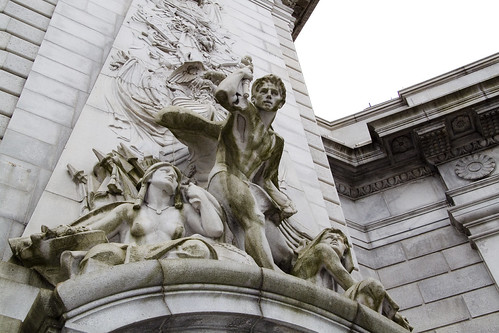
A brighter experience for your humble narrator was the Manhattan Bridge Centennial Time Capsule event, on March 5. Interactions and conversations were enjoyed by the least of men with certain powers and potentates of the City of Greater New York and entry to the interior space of the Manhattan Bridge was obtained. One of the high points of my year, “Exhausted” detailed the embedding of a time capsule in the East River Bridge #2- aka the Manhattan Bridge. Remarkable self control was exercised when I met the DOT Commissioner, Jeanette Sadik-Khan. My sincerest desire was to bend her ear with my alleged wisdom about bike lanes and bridge safety- but self control was ascendent that day and only congratulations were offered to both her and the other staffers at DOT.

– photo by Mitch Waxman
April 2010– City of Marble and Beryl
Odd shenanigans were observed at St. Michael’s Cemetery here in Astoria, which were of a decidedly magickal nature. A ritual site that your humble narrator stumbled across was examined and evidentiary examination suggested that certain third world cults were extant here in the old village of Astoria, conducting midnight bacchanals concurrent with the lunar cycle. “City of Marble and Beryl” was but the first of many moons which witnessed a working of will amongst the desolations of our kind.
April 2010– Searching for Gilman

A good part of 2010 was spent “Searching for Gilman” at First Calvary Cemetery, which I am doing as you are reading this, assuming it’s the start of 2011 whenever you do. Gilman is the source of no small amount of pain and financial hardship around these parts, as your humble narrator has become dangerously obsessive and paranoid around the subject. A psychotic need to find Gilman’s grave torments me, coloring my days and painting my dreams a dull yellow.

– photo by Mitch Waxman
May 2010– the king in yellow, brick
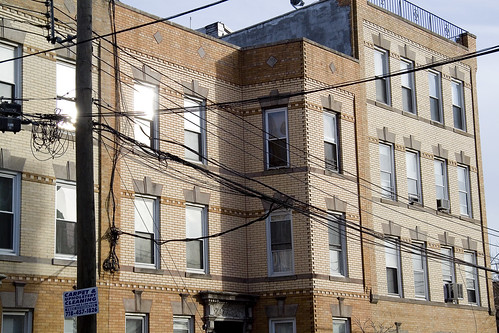
Remiss would be apparent were I to not mention the “Madison Avenue Bridge Centennial” but “the king in yellow, brick” advanced another of my pet theories and served up a fascinating (to me at least) sequence of events and relationships which attempts to explain why those yellow Kreischer bricks are all over the older sections of Queens.
May 2010– after cycles incalculable

“After cycles incalculable” is another one of those perfect posts, from a personal perspective. Wandering around with a friend, which is a disturbing trend which developed over the course of 2010, at Skillman Avenue’s start we observed the Lemuria hatching in concordance with the anniversary of the Roman festival of Lemuralia in Long Island City.

– photo by Mitch Waxman
June 2010– from Hells Gate, loosed upon the world

When I set out on my little walks, there is seldom a destination in mind. Literally wandering, obscure symbols and pseudo occultism guide my steps- I’ll follow a black cat, or merely adopt a roughly heliotropic path using my own shadow as compass. At the very end of May, my feet carried me toward Astoria Park and the notorious section of the East River known as Hells Gate. The odd craft, an “unidentified floating object” if you would, which sped past my lens required more than a small bit of detective work to identify- which was detailed in “from Hells Gate, loosed upon the world“.
June 2010– Gods Gift to Pain

English Kills, which is the logical and modern end of Newtown Creek, is a heavily industrialized and largely anaerobic tributary of the larger waterway and is seldom visited (by me, at least) at its extant. One fine day, while hanging out with another Creek enthusiast (you should not go to this place alone), we decided to enter the largely hidden urban foyer which leads here- despite the fact that we were most likely trespassing- which violates Newtown Pentacle policy. The title of the post- “Gods Gift to Pain” was lifted from an enigmatic and appropriate bit of graffiti observed in this forgotten pace of dissolution and poison.

– photo by Mitch Waxman
The reason for Brooklyn, and Queens- why it was a viable alternative to living in Manhattan in the 19th century was defined by the horrors of tenement life. The grand old buildings with their high ceilings, thick plastered walls, convenient dumbwaiters, and incredibly ornate lobbies- the structures which distinguished and made life desirable in the incalculably distant boroughs, were built as an alternative to the crowded and dangerous tenements of “The City”- especially the warren which was known as the “Five Points“. Additionally, Calvary Cemetery (of particular interest to me, and perhaps, to you) was founded by the parishioners of Old St. Patrick’s Cathedral which is smack dab in the middle of this ancient labyrinth of poverty, crime, and squalor. It was decided that to fully understand what one observes in the remains of the supposed “answer to the problem”, exploration of “the problem” itself is required.
July 2010– Bandits Roost, 2010

Ideal source material for the textural and societal milieu of the Five Points is the admittedly biased “How the Other Half Lives” by 19th century do-gooder Jacob Riis. Speaking the truth that power wants to hear is always a sound move if one considers fiscal realities and historical reputation. Attempts were made to find the modern locale in which Riis shot some of his more famous shots, such as this visit to “Bandits Roost 2010“.
July 2010– The house of Dagger John

Another critical visitation for me, as part of my larger education and study of the early development of the City of Greater New York was occasioned on the day when I went to “The house of Dagger John“. Old St. Patrick’s Cathedral satisfies both my continuing fascination with the counterpoint of sacred and profane in the story of the Megalopolis, and figures largely in the predictions of certain obscure lore which governs the schedule of my researches.

– photo by Mitch Waxman
August 2010– not to harsh anyone’s buzz… but…

August of 2010 brought a posting which garnered a lot of attention, due to curbed.com noticing and linking to it. Simply noticing that a growing proliferation of small boats were berthing illegally at the Vernon Avenue street end, it would be irresponsible of me- given everything that I know about the location not to point out the mortal and existential danger that the operators of these boats were placing themselves in. It’s not even the water, really, its the high pressure natural gas line- the enormous CSO which drains LIC- the omnipresent heavy industrial maritime traffic- which makes the spot so hazardous. Mortal threats were received via email (which I’ve kept private), and the comments thread displayed an angry and accusatory tone. As is the case with all such critique, these comments were presented verbatim- here’s a taste: “i have red your article in which you show a great deal of unger towards me and my friends . i believe that you base your article on many misconceptions that are rooted in a lack of communication”, “Blogger or not, the prudent journalist would make an effort to uncover basic facts before publishing a story full of assumptions”, “are you just the type of little man that tells teacher when the cool kids make you feel inferior. The water is public domain! And according to maritime law it is not illegal to moor a boat as long as it safe and looked after.”, “They are not bothering anyone. And get sick from the canal, come on. They are not living down there as far as I know. Parking your boat in the canal is not going to get them sick! Stop over doing it.” Check out “not to harsh anyone’s buzz… but…“.
August 2010– lively antics

One of the greatest joys of living in Queens are the chance encounters you’ll have with people who hail from the furthest points of the compass, such as this Bouzouki player during another visit to Hells Gate. His “lively antics” added splendor to a brightly lit walk around Astoria.

– photo by Mitch Waxman
September 2010– Lucky Shot

Although veteran photographers caution me against use of this term, I call the photo above my “shot of the year”. The steel structure attached to the bottom of the Brooklyn Bridge was installed as part of a bridge painting and maintenance project, and I was luckily along on a Working Harbor trip just as the sun was setting. Right place, right time, it was a “Lucky Shot“.
September 2010– stronger than fear

The dynamic new Safeboats utilized by NYPD and other entities around the harbor were a frequent subject over several of the Working Harbor expeditions I was lucky enough to attend. The many shapes, colorways, and missions of these quick little patrol boats are a delight to observe- and to those who would work maritime malice upon the metropolis- they are the head of the spear. Check out “stronger than fear“.

– photo by Mitch Waxman
A high of the year was the Newtown Creek Cruise which I had the honor of co-narrating with Bernard Ente on October 24th, of course, but the main topic of conversation amongst the antiquarian and environmental communities of the Newtown Pentacle in October revolved around the EPA’s superfund announcement about Newtown Creek at the very end of September. October is spooky time around these parts, and I spent a little time digging around the area for thrills and chills as well.
October 2010– blurred outlines

As part of series of postings detailing what might be seen in the Brooklyn neighborhood of Greenpoint, “blurred outlines” discusses the alleged appearance of a pyrokinetic at 84 Guernsey Street in January of 1895.
October 2010– scenes familiar, and loved

One of my frequent walks through Calvary Cemetery took me to the curiously empty chapel which enjoys the paramount of Laurel Hill. I will admit that I came here this day seeking two things- one was a likely entrance to a vast subterranean structure which underlies the area- the other was a vain hope that the grave of Gilman might present itself in a section which was, at the time, not terribly familiar to me as I normally stay close to the fringes of the place where the whipporwills wail. I very well might have captured what mass media paranormal media sources describe as a ghost orb in “scenes familiar, and loved“.

– photo by Mitch Waxman
November 2010– peace rests nevermore

One of the goals of this, your Newtown Pentacle, is to provide some sort of documentation about this terrible and wonderful place called the Newtown Creek- and I’m happy to say that I was there when the then Attorney General and Governor Elect Andrew Cuomo announced the settlement of a lawsuit brought by his office on behalf of New York State against Exxon-Mobil which involved the Greenpoint Oil Spill. “Peace rests nevermore” indeed.
November 2010– shocking coruscations

Entertaining maritime folklore from past centuries was offered in “shocking coruscations“, which is told against a series of twilight photos from good old Hells Gate between the two great bridges.

– photo by Mitch Waxman
During the cold, when inclement clime restricts my movements and the black dog nips at my heels, I tend toward shorter postings- and in December of 2010 there were two “Then and Now” postings that really took my fancy. These posts are difficult because of the scarce source material available in the public domain, but fun nevertheless. In my usual fashion “dumb idiot” fashion, I had shot the modern views completely unaware of the original photo. Our friends at the Greater Astoria Historic Society have recently released a book of similar historical views, which is worthy of consideration.
December 2010– Bowery Savings Bank 2010 and 1903

As the title states, this is the iconic shell of a once essential and awesomely powerful institution called the Bowery Savings Bank in Manhattan, with a 1903 photo from a similar perspective.
December 2010– Hunters Point Avenue Bridge Centennial

If you told me a year ago that I’d end up doing a press conference with a United States Congresswoman, I’d have hit you. That’s how I ended up at the Degnon Terminal’s own Sunshine Biscuits (LaGuardia Community College) building though, and by an odd coincidence- found myself standing in nearly the same spot as some unknown photographer did in 1921. This posting was built around the announcement of the “Hunters Point Avenue Bridge Centennial” event.

– photo by Mitch Waxman
Overall, a positive and exciting year, despite the deaths of several members of my family.
For a while, I enjoyed a spot on the board of the nascent Newtown Historical Society as a trustee, which is a position that I’ve had to resign for a variety of personal reasons- but I’d like to thank fellow board members Kevin Walsh, Christina Wilkinson, Steve Garza, and Bob Singleton for an interesting and educational experience. Kevin Walsh of forgotten-ny gets a personal call out, as his support, knowledge, and encouragement has been invaluable. Special thanks also are extended toward Capt. John Doswell and Meg Black of the Working Harbor Committee, all the guys and gals aboard the John J. Harvey fireboat, and everybody else who allowed a piss poor specimen such as myself to come along on adventures. Bernard Ente of the Newtown Creek Alliance, Working Harbor, and others also receives a heartfelt gratitude and shout out from this humble mendicant. Standing on the shoulders of giants is difficult if you suffer from altitude related nosebleeds.
What’s next?
Tell you what, feel like taking a walk?
Meet me at the border of Brooklyn and Queens – bring a camera… and ID… I’ll show you something cool…
narcotic flowers

– photo by Mitch Waxman
One of the many things which both torment and delight my imaginings is the notion of some foreign plague or hostile bacterium hitching a ride into New York Harbor onboard a ship.
In 1863, the city fathers enacted the “General Quarantine Act” due to similar fears. Political upheavals in Europe and Asia resulted in a lot of people seeking a more peaceful and profitable future and heading to North America. Many of these peasant pilgrims were weakened or crippled by ordeal and famine, and sometimes from an infectious disease. It was feared that if just one plague carrier became lost in the crowded tenements of Manhattan, something “biblical” would ensue, something which anointing the door with lamb’s blood couldn’t help you out with.
If the New Yorkers of 1863 were afraid of something… well, the City’s immune system ain’t what it used to be, y’know…
from tlcarchive.org
In 1864, the commercial avenues of the area were paved with cobblestones which, in turn, provided deep cracks in which refuse collected and rotted. But the streets were “very filthy” with accumulations of manure from the horses that traversed the area, dead dogs, cats and rats, household and vegetable refuse that in winter accumulated to depths of three feet or more. “Garbage boxes,” rarely emptied, overflowed with offal, animal carcasses, and household waste. “Pools” of stagnant water collected in the carcasses of dead animals, and over sewer drains that were generally clogged. “Filth of every kind [were] thrown into the streets, covering their surface, filling the gutters, obstructing the sewer culverts, and sending forth perennial emanations which must generate pestiferous diseases,” reported William Thomas, the Sanitary Inspector for the district. “Drainage is generally imperfect, the courtyards being … below the level of the streets” and “everything is thrown into the street and gutters at all times of the day.” While poorly designed sewers had been installed throughout the region, most of the population depended upon the outdoor “water closets” and privies in the courtyards of the tenement buildings, close to wells used for drinking.

– photo by Mitch Waxman
As early as 1755, the redoubtable stewards of New York Harbor were working on this issue, when an ordinance was passed demanding that all ships seeking entrance to the harbor must first be inspected by physicians and that all ships bearing contagion be quarantined at Bedloe’s Island. Bedloe’s, of course, is known as Liberty Island to modernity. 1795 is the beginning of the paper trail which eventually transmogrifies into the The New York City Department of Public Health and Mental Hygiene, when the first death records are filed for the 718 Yellow Fever victims that died that year. It wasn’t until 1866 that a Metropolitan Board of Health was formed, which was the same year that a Cholera outbreak was controlled by the “Disinfectant Corps” of Dr. Stephen S. Smith.
Tuberculosis, however, accounted for nearly 20% of all deaths in New York City.
from wikipedia
An infectious disease is a clinically evident illness resulting from the presence of pathogenic microbial agents, including pathogenic viruses, pathogenic bacteria, fungi, protozoa, multicellular parasites, and aberrant proteins known as prions. These pathogens are able to cause disease in animals and/or plants. Infectious pathologies are also called communicable diseases or transmissible diseases due to their potential of transmission from one person or species to another by a replicating agent (as opposed to a toxin).
Transmission of an infectious disease may occur through one or more of diverse pathways including physical contact with infected individuals. These infecting agents may also be transmitted through liquids, food, body fluids, contaminated objects, airborne inhalation, or through vector-borne spread. Transmissible diseases which occur through contact with an ill person or their secretions, or objects touched by them, are especially infective, and are sometimes referred to as contagious diseases. Infectious (communicable) diseases which usually require a more specialized route of infection, such as vector transmission, blood or needle transmission, or sexual transmission, are usually not regarded as contagious, and thus are not as amenable to medical quarantine of victims.

– photo by Mitch Waxman
Outbreaks of Cholera in New York City during the 19th century carried staggering death tolls, equivalent statistics for the modern population of 8 million calculate that 100,000 people would be snuffed out by a modern outbreak of the bacterial illness. Modern antibiotics and medical techniques have put reigns on Cholera, but it still ravages the populations of the developing world where such luxuries as sanitary waste water disposal, clean drinking water, and private privy rooms are beyond the reach of most. The class of diseases that keep me up at night though are the hemorrhagic fevers, caused by seemingly demonic entities like the Arenaviridae, Filoviridae, Bunyaviridae, and Flaviviridae families of virii.
from wikipedia
- The Arenaviridae include the viruses responsible for Lassa fever and Argentine, Bolivian, Brazilian and Venezuelan hemorrhagic fevers.
- The Bunyaviridae include the members of the Hantavirus genus that cause hemorrhagic fever with renal syndrome (HFRS), the Crimean-Congo hemorrhagic fever (CCHF) virus from the Nairovirus genus, and the Rift Valley fever (RVF) virus from the Phlebovirus genus.
- The Filoviridae include Ebola and Marburg viruses.
- Finally, the Flaviviridae include dengue, yellow fever, and two viruses in the tick-borne encephalitis group that cause VHF: Omsk hemorrhagic fever virus and Kyasanur Forest disease virus.
- The most recently recognized virus capable of causing hemorrhagic fever is Lujo virus, a new member of the arenaviruses described in 2009 and found in South Africa.

– photo by Mitch Waxman
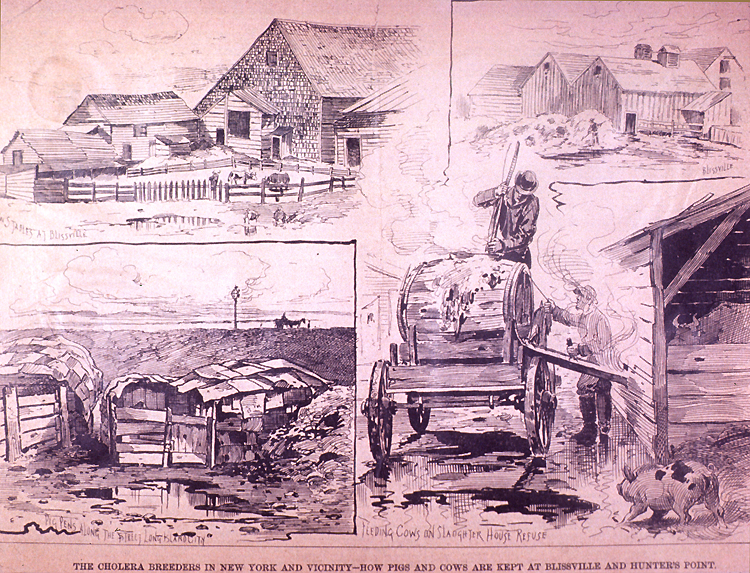
In 1879, conditions around the Hunters Point and Blissville sections of the Newtown Creek were infamous. The distilleries which lined the Queens banks produced a series of waste products, known collectively to the locals as “swill”, which was fed to a sickly group of cows and pigs imprisoned in overcrowded and hellish stables. Pneumonia and open sores were reported by state inspectors, and they intimated that animal waste was observed as mingling with the water in great abundances. The “swill milk” produced by these cattle was, of course, cheaper than more wholesome substitutes and meant for the children of the poor. The situation drew much attention at the time, and there is even an illustrated view of the conditions available at the National Institutes for Health, presented below (click image for full size).
The caption reads “The cholera breeders in New York and vicinity, how pigs and cows are kept at Blissville and Hunter’s Point.”
Who can guess, all there is, that might be buried down there… and what might be waiting to escape from a centuries long quarantine… in the deep sediments of the Newtown Creek?
from epa.gov
EPA conducted an Expanded Site Investigation (ESI) of Newtown Creek in 2009 as part of the Hazard Ranking System scoring process for NPL listing under Superfund. Based on the ESI, which was focused on Newtown Creek itself and not its tributaries, EPA concluded that metals, volatile organic compounds, and semi-volatile organic compounds (including polycyclic aromatic hydrocarbons and polychlorinated biphenyls) were present in Creek sediments at elevated concentrations. The variety and distribution of the detected contaminants suggests that they originated from a variety of sources. Previous environmental investigations of Newtown Creek, or specific portions of the Creek, also disclosed that sediments in Newtown Creek are contaminated by a wide variety of hazardous substances. Environmental investigations of upland parcels adjacent to or nearby the Creek have disclosed contamination of those parcels by hazardous substances similar to hazardous substances found in sediments in Newtown Creek.
Hudson River, October 17th, 2010
Hudson River, October 17th, 2010 – photos by Mitch Waxman
A trip from Cold Spring to Manhattan, aboard the John J. Harvey Fireboat.


 The Newtown Pentacle