Archive for February 2011
glassy flatness

– photo by Mitch Waxman
Odd and solitary even as a child, amongst my few friends in public school was a fellow named Brian. Despite the occasional beatings he would administer to me, which long experience has taught me to expect when interacting with others, he was an amiable kid. Brian was wont to propagate an urban legend which once permeated Brooklyn, a story which goes like this (phonetically spelled, as Brooklyn patois is critical to the telling):
“So, yooz knows about de Verryzanno Bridgde, rights? When deys wuz bilding its, and pourinz de cement- workers who fell intadee cements would just sinks rights down, and dheres nuttin that could get dones to saves ’em, so’s da bahdeez are still in da bridge. My grandfather’s brudda died dat way, my Uncle Mike…”
translation:
So, you know about the Verrazano Bridge, right? When they were building it, and pouring the cement- workers who fell into the cement would just sink in, and there was nothing that could be done to save them, so the bodies are still in the Bridge… As far as the Grandfather’s brother, versions of the story told by others involved every possible male acquaintance or familial description possible.
from nycroads.com
The foundations, which support the 264,000-ton weight of both the towers and the suspended deck, as well as a design live load of 16,000 tons on the deck, were dug 105 feet below the water on the Staten Island side, and 170 feet below the water on the Brooklyn side. Conventional foundation design called for sand islands that kept water, as well as provided working and storage space. However, because the currents were swift and the ground was unstable in the area, sand islands were not constructed. Instead, “cofferdams,” or vertically interlocking steel sheet pilings, were driven below the surface to protect the caissons. Above each 13-foot-high caisson base, muck and sand were dredged out of 66 vertical concrete shafts. When the caissons reached their predetermined depth, the shafts were filled with water, and caisson tops and bottoms were sealed with concrete. The two tower piers, which contain a combined 196,500 cubic yards of concrete, were completed in less than two years at a cost of $16.5 million.
Two anchorages were then constructed at either end of the Narrows. Each anchorage stands 130 feet high, 160 feet wide and 300 feet long. However, because of the differences below ground, the Brooklyn anchorage contains 207,000 cubic yards of concrete, while the Staten Island anchorage contains only 171,000 cubic yards of concrete. On their inshore ends, they support the two decks of bridge approaches. On their outshore ends, they carry four massive, roller-mounted saddles that support, and move with, the four cables as they change length, either because of temperature changes or because of load changes. The hand-polished concrete exteriors have diagonal patterns that continue the path of the suspension cables. Inside the anchorages, forces from the suspension are transferred at two points: the front of the anchorage (where the compacted cables bend around saddles that rest on inclined steel posts), and near the heel of the anchorage (where eyebars transfer force to inclined girders buried within the concrete). The anchorages cost $18 million to construct.

– photo by Mitch Waxman
This urban legend- and yes, it is– was once omnipresent in the land of Egg Creams and really good Pizza.
So much so that it actually made it to the movies, as you’ll observe in the clip from “Saturday Night Fever” presented below, courtesy of youtube. For a great first person description of the building of the bridge, and the remembered effects of building the Brooklyn pierage in Bay Ridge- check out the inestimable Forgotten-NY’s “Bridge in the Back Yard” posting from 2003 here.
I can tell you that the old guys in Canarsie and Flatbush who worked on the thing always “beamed” a little bit when driving down the Belt Parkway toward the City and seeing it rear up.
from youtube

– photo by Mitch Waxman
Officially, there were three deaths associated with the building of the Verrazano, and the bodies were all recovered. Brooklyn legends notwithstanding, that is actually an incredible number given the size and scope of the project.
But what else would you expect from the maestro, Othmar Amman, on his final project?
from wikipedia
The bridge is owned by New York City and operated by the Triborough Bridge and Tunnel Authority, an affiliate agency of the Metropolitan Transportation Authority. Interstate 278 passes over the bridge, connecting the Staten Island Expressway with the Gowanus Expressway and the Belt Parkway. The Verrazano, along with the other three major Staten Island bridges, created a new way for commuters and travelers to reach Brooklyn, Long Island, and Manhattan by car from New Jersey.
The bridge was the last great public works project in New York City overseen by Robert Moses, the New York State Parks Commissioner and head of the Triborough Bridge and Tunnel Authority, who had long desired the bridge as a means of completing the expressway system which was itself largely the result of his efforts. The bridge was also the last project designed by Chief Engineer Othmar Ammann, who had also designed most of the other major crossings of New York City, including the George Washington Bridge, the Bayonne Bridge, the Bronx Whitestone Bridge, the Robert F. Kennedy Bridge, and the Throgs Neck Bridge. The plans to build the bridge caused considerable controversy in the neighborhood of Bay Ridge, because many families had settled in homes in the area where the bridge now stands and were forced to relocate.
of stout body
Ok, just one more frozen Calvary post… and apologies for the sparse presentations this week, a dear friend of the Pentacle has been hospitalized and I’ve been spending a good amount of time visiting with and attempting to take some of the load off of the immediate family. Such is the price of true fealty and companionship, this duty to “be there” when the good times stop. I’m no “good time charlie”, after all.

– photo by Mitch Waxman
These shots are from the same walk through the ice at Calvary Cemetery discussed during a couple of last week’s transmissions . On the lookout for animal tracks (I’ll find that damned Coyote), I discovered these curious prints etching back and forth through the crusty ice and deep snow.
from wikipedia
In 1847, faced with cholera epidemics and a shortage of burial grounds in Manhattan, the New York State Legislature passed the Rural Cemetery Act authorizing nonprofit corporations to operate commercial cemeteries. Old St. Patrick’s Cathedral trustees had purchased land in Maspeth in 1846, and this land was used to develop Calvary Cemetery. The first burial in Calvary Cemetery was in 1848 and by 1852 there were 50 burials a day, half of them the Irish poor under seven years of age.
The original division of the cemetery, now known as First Calvary or Old Calvary, was filled by 1867. The Archdiocese of New York expanded the area of the cemetery, adding more sections, and by the 1990s there were nearly 3 million burials in Calvary Cemetery.

– photo by Mitch Waxman
Childhood fantasy blossomed in my thoughts, and despite the obviousness of these being bird tracks, I entertained certain vague memories of Spring Heel Jack and other Dickensian bogeymen. Imagine if there were some monopodal mystery hopping about the place, thought an idiot in a filthy black raincoat while standing in knee deep frozen precipitants at an ancient cemetery in Queens.
from wikipedia
Spring Heeled Jack (also Springheel Jack, Spring-heel Jack, etc.) is a character from English folklore said to have existed during the Victorian era and able to jump extraordinarily high. The first claimed sighting of Spring Heeled Jack that is known occurred in 1837. Later alleged sightings were reported all over England, from London up to Sheffield and Liverpool, but they were especially prevalent in suburban London and later in the Midlands and Scotland.
Many theories have been proposed to ascertain the nature and identity of Spring Heeled Jack. The urban legend of Spring Heeled Jack gained immense popularity in its time due to the tales of his bizarre appearance and ability to make extraordinary leaps, to the point where he became the topic of several works of fiction.
Spring Heeled Jack was described by people claiming to have seen him as having a terrifying and frightful appearance, with diabolical physiognomy, clawed hands, and eyes that “resembled red balls of fire”. One report claimed that, beneath a black cloak, he wore a helmet and a tight-fitting white garment like an “oilskin”. Many stories also mention a “Devil-like” aspect. Spring Heeled Jack was said to be tall and thin, with the appearance of a gentleman, and capable of making great leaps. Several reports mention that he could breathe out blue and white flames and that he wore sharp metallic claws at his fingertips. At least two people claimed that he was able to speak comprehensible English.

– photo by Mitch Waxman
Inexpert, I clumsily followed the tracks, moving in my typically arthritic, lurching, and uneven winter scuttle. By this point, the specie which had left its mark behind was clearly avian, and quite obviously a water bird of some sort.
from wikipedia
Anatidae is the biological family that includes ducks, geese and swans. The family has a cosmopolitan distribution, occurring on all the world’s continents except Antarctica and on most of the world’s islands and island groups. These are birds that are adapted through evolution for swimming, floating on the water surface, and in some cases diving in at least shallow water. (The Magpie Goose is no longer considered to be part of the Anatidae, but is placed in its own family Anseranatidae.) The family contains around 146 species in 40 genera. They are generally herbivorous, and are monogamous breeders. A number of species undertake annual migrations. A few species have been domesticated for agriculture, and many others are hunted for food and recreation. Five species have become extinct since 1600, and many more are threatened with extinction.

– photo by Mitch Waxman
Three toes and webbed at that, this was no Spring Heeled entity… I recognized what shared my walk through Calvary that cold day… And then they appeared…
from wikipedia
6-8 living species of black geese are known. In addition, one species has been described from subfossil remains found in the Hawaiian Islands, where it became extinct in prehistoric times. Another undescribed prehistoric species from the Big Island of Hawai‘i was extremely large and flightless; it is tentatively assigned to this genus due to being very peculiar. It is fairly certain that at least another species of this genus awaits discovery on the Big Island, judging from the facts that at least one species of Branta was found on every major Hawaiian island, and that remains of such birds have not been intentionally searched for on the Big Island.

– photo by Mitch Waxman
Several Canada Geese appeared at the top of a hill, quietly picking at the ice. Copious deposits of their feces were observed as well- but not pictured as to insure against the delicate sensibilities of the Lords and Ladies of the Newtown Pentacle being offended.
from wikipedia
This species is native to North America. It breeds in Canada and the northern United States in a variety of habitats. Its nest is usually located in an elevated area near water such as streams, lakes, ponds and sometimes on a beaver lodge. Its eggs are laid in a shallow depression lined with plant material and down. The Great Lakes region maintains a very large population of Canada Geese.
By the early 20th century, over-hunting and loss of habitat in the late 19th century and early 20th century had resulted in a serious decline in the numbers of this bird in its native range. The Giant Canada Goose subspecies was believed to be extinct in the 1950s until, in 1962, a small flock was discovered wintering in Rochester, Minnesota, by Harold Hanson of the Illinois Natural History Survey. With improved game laws and habitat recreation and preservation programs, their populations have recovered in most of their range, although some local populations, especially of the subspecies occidentalis, may still be declining.
In recent years, Canada Geese populations in some areas have grown substantially, so much so that many consider them pests (for their droppings, the bacteria in their droppings, noise and confrontational behavior). This problem is partially due to the removal of natural predators and an abundance of safe, man-made bodies of water (such as on golf courses, public parks and beaches, and in planned communities).

– photo by Mitch Waxman
Often are such Geese observed here at First Calvary, even during the summer. It’s odd, alongside the maligned Newtown Creek and within the walls of New york’s ancient burying ground, that there exists a sort of nature preserve amongst the tomb legions.
from a 2009 nytimes.com report:
All commercial airplane engines are required to pass a “bird strike” test before they can be certified for use. Engine manufacturers, including CFM International, which produced the engines on the US Airways Airbus A320 involved in Thursday’s sudden landing, test the engines physically and through computer simulation.
In the physical tests, the engines are revved to full power inside a test facility and absorb various kinds of birds, from those the size of sparrows to those the size of herons, one at a time. (The birds are already dead.) The engines also ingest multiple birds meant to simulate a collision with a flock, said Matthew Perra, a spokesman for the engine manufacturer Pratt & Whitney.
To pass the test, engines must keep operating after the collision, maintaining enough power to take off, fly around the airport and land the plane safely, he said. That is because a jet with two engines has to be able to take off on 50 percent power
Newtown Creek Waste Water Plant Time Capsule
I received this email a couple of weeks ago- how could I resist going?
New York City Environmental Protection Commissioner Cas Holloway Invites you to join him for the Newtown Creek Time Capsule Ceremony.
Friday, February 11, 2011
The Visitor Center at Newtown Creek, 329 Greenpoint Avenue, Brooklyn
As is usually the case with such events, local political figures and high officials of the municipality can be expected to turn up. DEP Commissioner Cas Holloway, Assemblyman Joe Lentol, and City Council Member Stephen Levin were in attendance, as were several prominent citizens and business leaders of the Greenpoint community were there as well.
The kids in the shots were Class 5-313 of the Samuel P. Dumont P.S. 31 Magnet School for the Arts and Humanities, who placed drawings in a time capsule not to be opened some in 50 years. Other items placed in the capsule included the latest infrastructure and strategic plans of the DEP, periodicals, and other City documents concerning the water system of New York City.
a ghastly plot
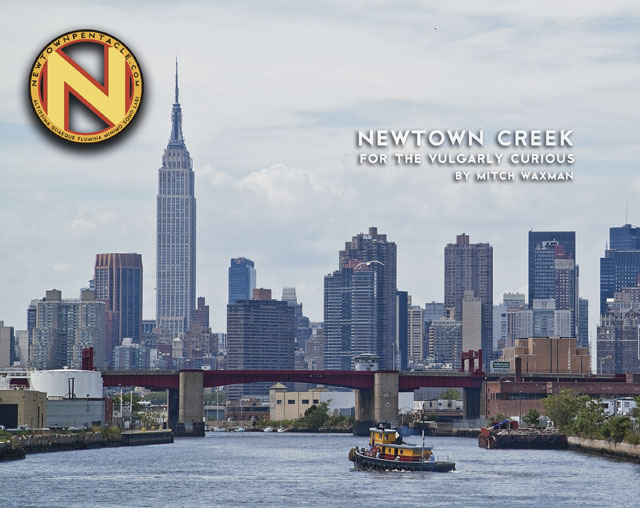
“Newtown Creek for the Vulgarly Curious” is a fully annotated 68 page, full-color journey from the mouth of Newtown Creek at the East River all the way back to the heart of darkness at English Kills, with photos and text by Mitch Waxman.
Check out the preview of the book at lulu.com, which is handling printing and order fulfillment, by clicking here.
Every book sold contributes directly to the material support and continuance of this, your Newtown Pentacle.
Project Firebox 21

– photo by Mitch Waxman
The stout forearms and colorful urban patois which once identified and distinguished those who emanate from storied Greenpoint no longer betray the origins of all its residents, due to the caste of bohemians and esthetes who have lately made the ancient village their home. Observe the ironic wit, sardonic smile, and postmodern vacuity of this long suffering alarm box at the terminus of Greenpoint Avenue where it collides with the East River.


 The Newtown Pentacle