Archive for August 2012
belching aperture

– photo by Mitch Waxman
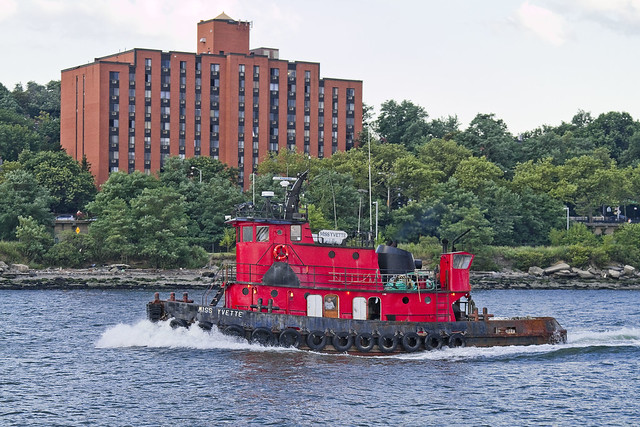
This Maritime Sunday, a psychologically overwhelmed and physically exhausted narrator presents to you the little Miss Yvette tug, as it motors down the Kill Van Kull. That’s… Staten Island… in the background, and the red, black, and blue tarp witnessed back there is part of a road salt operation called “Atlantic Salt”.

– photo by Mitch Waxman
Call sign WDE7815, Miss Yvette is not a terribly large or fast tug- with a maximum recorded speed of 7.8 knots (9mph) and a length of some 22 meters (roughly 72 feet). She is owned and operated by the Sterling Equipment company, and was built in 1975. An “inland tug”, Miss Yvette boasts a 1200 HP twin screw drive, and is 106 gross tons.
– photo by Mitch Waxman
She used to be blue and white, having spent some of her career with Hallan Marine, but is a proud scarlet these days. These shots were captured while onboard a Working Harbor Committee trip to the Port of Newark Elizabeth, just a few weeks ago.
Long Island Zen (reblog)
Reblogged from June of 2009,
Know this spot?

Long Island City -photo by Mitch Waxman
It’s a backroad, by LIC standards.
It’s 51st Avenue and what would be 21st street, and it smells heavily from the garbage bins of a commercial fish butcher just up the block on the corner of 23rd street. During the festering heat of the late summer in New York, crossing the street- if not avoiding the block all together- is advisable. Across the street are fallow lots of illegally dumped industrial garbage and the Crows picking it over.
Crows are metal collectors, usually immigrants who have a tradition of “ship-breaking” or “shanty towns” in their country of origin. They see value in what others see as trash.
Metal buyers in Long Island City and especially Greenpoint and East Williamsburg pay, by the pound, for the collected materials. If copper wire is found, the collector is expected to burn off the insulation, despite the toxicity of doing so. Its not the buyers problem, he just wants the commodity. Want to see it in action- hang out on the corner of Greenpoint avenue and Moultrie St. in Greenpoint, Brooklyn. This is recycling.

Pretty darn close to 51st Avenue and what would be 21st street- It’s the Circus Train!!! -photo by Mitch Waxman
In 1908, a fire at the nearby Blanchard Building- which housed the works of J.F. Blanchard, makers of fireproof doors and shutters- was started by an inferno at the Pratt & Lambert varnish works next door. The fire soon began to spread and a great crowd watched as groups of firemen tried to battle the out of control blaze. The great fear was that the nearby Columbia Paper Bag company would be set alight, which would provide ample fuel for an inferno that might spread beyond Borden Avenue and to the shores of the Newtown Creek.
There is a Blanchard Building on the site today, and it does seem quite fireproof, although Blanchard is long gone. J.F. Blanchard eventually merged with the John W. Rapp company and became the United States Metal Products Company.
View the Blanchard Building in a google map, clicking streetview- from the LIE- its the large structure with the two billboards.
Blanchard manufactured hollow, sheet-metal, fireproof doors. Their Type A and Type B were endorsed by the National Board of Fire Underwriters in Chicago. Installation of thee doors would reduce fire insurance costs by a significant margin. A major influence on the bottom line here in the dense agglutination of industry here on the Newtown Creek.

Down under the Long Island Expressway- DULIE -photo by Mitch Waxman
51st avenue dead ends at the Long Island Railroad tracks, and what would be 21st street is a pedestrian rail bridge (which Forgotten-Ny once christened “the 21st street Bridge“) that goes over the train tracks and under the Highway, which channels the constant stream of vehicular traffic (some 83,900 cars and trucks a day) flowing east out of the toll plaza at the Midtown Tunnel to the highways threading out through Queens and ultimately to Long Island.
note- this bridge has a lamppost which was one of the ones tagged with “occult” grafiti, as discussed in an earlier post.

LIRR crosses Borden Avenue -photo by Mitch Waxman
Nearby, the 800 pound gorilla crosses Borden Avenue at grade (street level). One of the few places in New York City that the Long Island Rail Road still does so.
These tracks lead between the Hunters Point Avenue station and the Long Island City station, and up until the 1950′s such grade crossings were a constant nuisance and mortal threat to the citizens of Long Island City- here in the Newtown Pentacle.
chiseled likeness

– photo by Mitch Waxman
Recently observed patrolling the languid expanses of the Newtown Creek, the NYPD Harbor Unit’s “Lt. Federico Narvaez”. The coppers name their boats after fallen comrades. There is also a playground in Brooklyn named after the departed officer.
from nycgovparks.org
Police Lieutenant Federico Narvaez (1956-1996), who was born in Brooklyn and died in the vicinity of this Flatbush playground. Following his graduation from high school in Williamsburg, Narvaez studied business at Baruch College, where he met his wife, Marilyn. The two married in 1980 and had one child, Katrina. Appointed to the Police Department in 1979, Narvaez served at the 25th, 34th and 23rd Precincts before his promotion to Lieutenant in 1993. In addition, Narvaez had tours of duty with the Narcotics Division, the Warrant Division and the Civilian Complaint Review Board.

– photo by Mitch Waxman
The story of the fallen officer is told at the “NYPD Angels” site, linked to below. This is a message board frequented by the members of the force, and often displays a “pulls no punches” manner- so be warned if you click through. Launch 3 is technically a ship, not a boat. It’s a ship because it can launch a boat, which is one of those little bits of maritime knowledge you pick up hanging around sailors. There are enormous vessels out there- Tugs come to mind- which cannot launch a boat. It’s one of those minor points…
from nypdangels.com
Lieutenant Narvaez was shot and killed after being flagged down by a female pedestrian. The pedestrian told him that she was being stalked and Lieutenant Narvaez approached the man after calling for backup. The man turned and fired, striking Lieutenant Narvaez in the face. The man ran down a street but was stopped by other responding units. He was told to drop his gun but fired at the units and was shot and killed.
Lieutenant Narvaez had been on the job for 17 years.

– photo by Mitch Waxman
This Police ship, not boat, is actually pretty large. Most of the NYPD vessels you see are actually rather small, built for speed rather than capacity. On the day which these shots were captured, I was waiting for a group to arrive (who were running late) and whatever the Cops were doing on the Creek, they were back there for a good hour or more before I saw them heading back out to the East River.
from wikipedia
Commanding Officer of Harbor Unit – Deputy Inspector David Driscoll
On March 15, 1858, five members of the New York City Police Department rowed out into New York Harbor to combat piracy aboard merchant ships lying at anchor. The NYPD Harbor Unit has existed ever since, protecting life and property. With hundreds of miles of inland waterways to cover, the unit operates 27 boats from three bases.
For underwater work, the department used to contract with private diving companies when weapons or other evidence had to be recovered from the bottom of New York’s many rivers and waterways. In the early 1970s, however, the Harbor Unit formed a specialized scuba team that today numbers around 30 officers. Unlike many police dive units, whose members dive only part-time, NYPD divers are assigned to the unit full-time. (The exception are some scuba-trained officers in regular patrol units who are detailed to the team temporarily during the busy summer months.) In addition to the normal duties of evidence recovery, the Scuba Team’s mission has expanded since 9/11 to include a counter-terrorism role. For air-sea rescue work, the Harbor Unit keeps two divers assigned to the Aviation Unit 24 hours a day, seven days per week, all year round. These divers will work with their counterparts in the FDNY, who arrive at incidents by fireboat or rescue company.

- image from wikipedia
———————————————————————————————
Upcoming Walking Tour- The Poison Cauldron, with Atlas Obscura


– photo by Mitch Waxman
Meetup at the corner of Kingsland and Norman Avenues in Greenpoint at 11 on Saturday, August 25th.
We will be exploring the petroleum and waste transfer districts of the Newtown Creek watershed in North Brooklyn. Heavily industrialized, the area we will be walking through is the heart of the Greenpoint Oil Spill and home to scores of waste transfer stations and other heavy industries. We will be heading for the thrice damned Kosciuszko Bridge, which is scheduled for a demolition and replacement project which will be starting in 2013. Photographers, in particular, will find this an interesting walk through a little known and quite obscure section of New York City.
Be prepared: We’ll be encountering broken pavement, sometimes heavy truck traffic, and experiencing a virtual urban desert as we move through the concrete devastations of North Brooklyn. Dress and pack appropriately for hiking, closed toe shoes are highly recommended- as are a hat or parasol to shield you from the sun.
Bathroom opportunities will be found only at the start of the walk, which will be around three hours long and cover approximately three miles of ground. Drivers, it would be wise to leave your cars in the vicinity of McGolrick Park in Greenpoint.
Click here for tickets, and as always- a limited number of walk ups will be welcomed- but for safety reasons we need to limit the group to a manageable size. Contact me at this email if you desire further details.
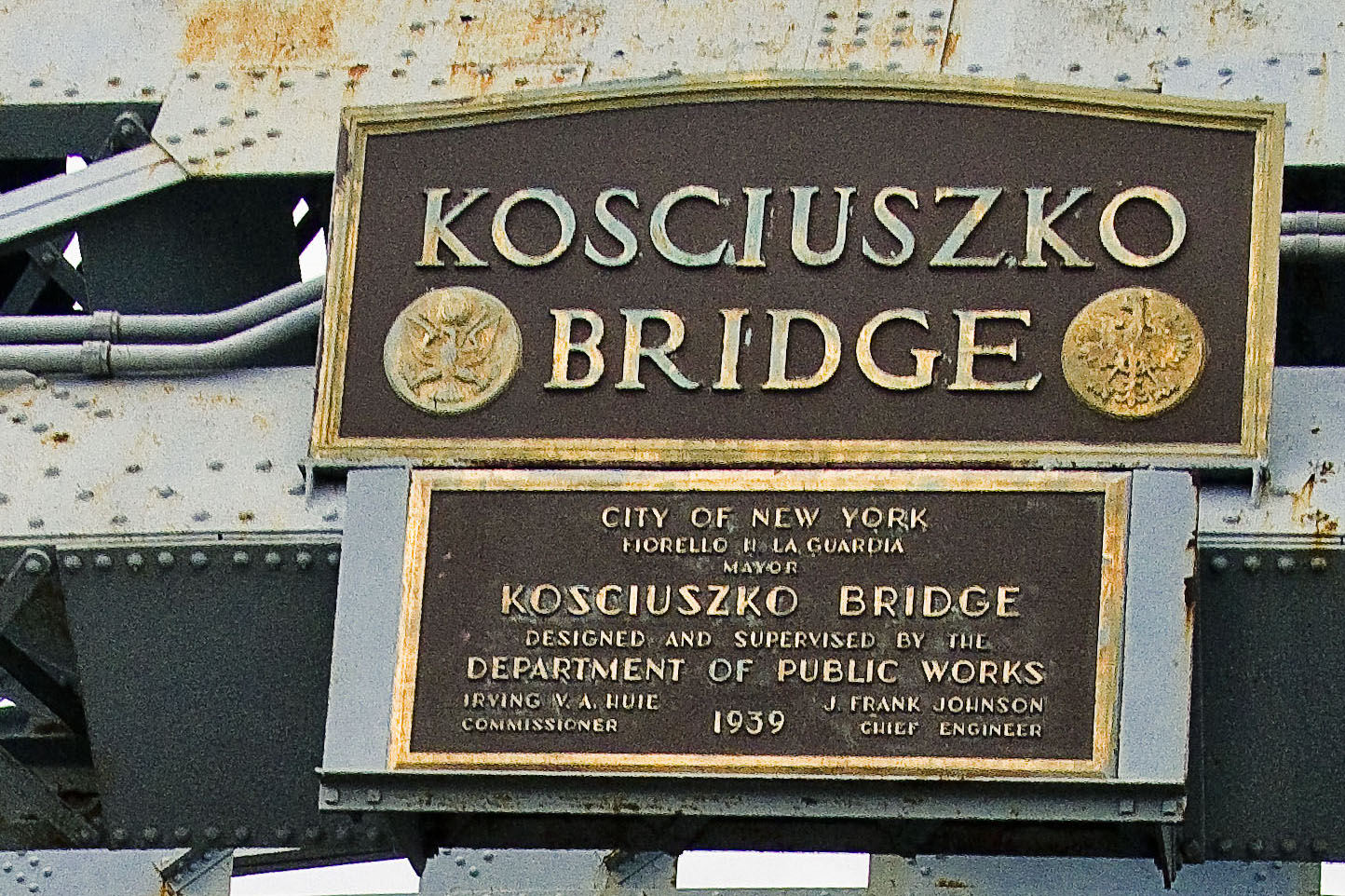
the last birthday of the Kosciuszko Bridge
– photo by Mitch Waxman
Oh, the old gray mare, she ain’t what she used to be,
Ain’t what she used to be, ain’t what she used to be.
The old gray mare, she ain’t what she used to be, Many long years ago.
Seventy Three years ago today, the Little Flower cut the ribbon and officially opened the “New Meeker Avenue Bridge” to traffic. The following April in 1940, it was renamed as the Kosciuszko Bridge.
It’s the Night of the Living Dead, by the way. Also, it’s Vulcanalia…
August 23, 1939, image New York City Municipal Archives at nycma.lunaimaging.com

– photo by Arthur J. Foley
According to the Long Island City Star-Journal of August 24th, 1939– the lineup of folks in the shot and action above are described as:
Mayor LaGuardia snips the ribbon which admitted the first autos lo use the lofty new Meeker Avenue Bridge over Newtown Creek in Laurel Hill, at the dedication held yesterday at Laurel Hill Plaza. To the right of the mayor is Acting Borough President John J. Halloran of Queens. To his left is Borough President Raymond V. Ingersoll of Brooklyn. Left of Ingersoll is Frederick J. H. Kracke, who was commissioner of Plant and Structures when that department originated plans for the bridge.

– photo by Mitch Waxman
American Bridge Company and Bethlehem Steel worked on her, along with dozens of other contractors. The Big K was part of what was known as “the Regional Plan”, which also provied the pretext for the erection of the Triborough, Whitestone, Marine Parkway and a slew of other bridges across the archipelago.
July 14, 1939, image New York City Municipal Archives at nycma.lunaimaging.com,

– photo by Arthur J. Foley

– photo by Mitch Waxman
Odds are very good that this is her last birthday, as the “Fast Track” program announced by the Governor will be kick starting the construction of a “Newer Meeker Avenue Bridge”- or perhaps the “Kosciuszko Two”- by the late spring of 2013. She will be gone by 2017, if one were to believe the schedule currently touted by State officials.
June 29, 1939, image New York City Municipal Archives at nycma.lunaimaging.com,

– photo by Joseph Shelderfer

– photo by Mitch Waxman
The historic shots included in this post all link out to the New York City Municipal Archives site, which has famously begun releasing thousands of historic images of the City online. One of the tricks to using the system, I’ve discovered, is knowing what things used to be called. It’s a “streetcar” versus “trolley” kind of thing. We call the former light rail system by the latter name, while those who dwelled in the past used the former.
June 29, 1939, image New York City Municipal Archives at nycma.lunaimaging.com,

– photo by Joseph Shelderfer

– photo by Mitch Waxman
Very little information is available about the construction and planning of the Kosciuszko, but there’s plenty about the New Meeker Avenue Bridge. The Big K was built for two official reasons- first, to provide a link between the multitudes of infinite Brooklyn and the World Fair Grounds in Flushing (Flushing Meadow Corona Park), and secondly to replace the aging swing bridge that spanned Newtown Creek between Meeker Avenue in Brooklyn and Laurel Hill Blvd. in Queens. Unofficially, Robert Moses really wanted to get the Brooklyn Queens Expressway built and this was as good a place as any to start.
August 14, 1939, image New York City Municipal Archives at nycma.lunaimaging.com,

– photo by Arthur J. Foley

– photo by Mitch Waxman
One does look forward to that day in the latter half of this decade, which I seriously doubt will be anything even close to 2017, when the pedestrian lane of the new bridge will be open for inspection. One of the most frustrating parts of the current bridge is that it once sported such a lane for perambulation, but it has long been closed off- thwarting photographic exploitation of the surreal vantage point that it offers.
How I would love to set up a tripod on the Kosciuszko Bridge…
from nydailynews.com
style=”padding-left:30px;”>Construction on a new bridge is now expected to begin in spring 2013 — a year ahead of schedule, thanks to $460 million made available for the job by Gov. Cuomo’s New York Work initiative.
The 73-year-old bridge, which carries the Brooklyn-Queens Expressway over the Newtown Creek, qualified for the money in part because it is on the state’s “deficient bridge” list.
The initial phase of construction will build an eastbound lane next to the existing bridge, according to the state Department of Transportation, the agency overseeing the project. The 1.1-mile bridge is expected to be done in 2017 and will cost about $800 million.
When completed, two new spans with a total of nine vehicle lanes and paths for pedestrians and bikes will replace the original structure.
Here’s a rare historic shot- in color- of the mighty span, from the year it was opened, also courtesy New York Municipal Archives

– photo by New York City Municipal Archives

– photo by Mitch Waxman
And just as a remider, in the name of public good and an abundance of caution- don’t forget about the whole Night of the Living Dead thing- this could be trouble.
from youtube– I’d suggest skipping forward to the 1 hour 13 minute marker, btw, unless you’ve got time to watch the whole flick via the Crackle Youtube page.
rythmical promise

– photo by Mitch Waxman
In April of 2011, your humble narrator attended a lecture conducted by an FDNY Harbor Unit commander- Chief James Dalton of the Marine 6 unit. The Chief described several of the fascinating boats his unit was in the process of rolling out for duty in the Harbor of New York, one of which is the Fireboat pictured above- The Bravest.

– photo by Mitch Waxman
Part of the Marine 6 unit, which is housed at the Brooklyn Navy Yard, The Bravest is one of the ships responsible for protecting an enormous area which encompasses an aggregate coastline of several hundred miles. This coast- which includes petroleum depots, several airports, and cargo terminals as well as residential and recreational docks- wraps around “terrorist target number one” and is the responsibility of only four FDNY chiefs and just over one hundred and twenty firefighters.

– photo by Mitch Waxman
Like many of the modern “service boats”, Bravest is based around a Coast Guard model- the “Response Boat Medium” (which has been discussed in earlier postings at this, your Newtown Pentacle). Sixty five feet long, the vessel is incredibly fast (45 knots), and is powered by a jet drive which supplies three 1,000 HP engines with motive force. The jet drive scheme enhances crew safety, and allows for shallow draft operation.

– photo by Mitch Waxman
Bravest’s two main monitors (water cannons) can pump an astounding six thousand gallons per minute. the Fireboat also carries a “miraculous” substance known as “purple K”. A foam extinguisher designed for fighting petrochemical fires, “purple K” and other exotic chemicals are kept onboard in case of an emergency at the Kill Van Kull or Newtown Creek. On the subject of the Creek, “The Bravest” is the likely first responder should an emergency occur involving one of the many oil industry installations found along it.

– photo by Mitch Waxman
Bravest also carries a full suite of modern communications equipment, including “blue force tracking”, satellite uplinks, and classified radiological detection sensors. Onboard, one will also find a first aid area which comes very close to being considered a mobile field hospital. Larger than needed alternators supply excess voltage to power all of this equipment.
———————————————————————————————
Upcoming Walking Tour- The Poison Cauldron, with Atlas Obscura
– photo by Mitch Waxman
Meetup at the corner of Kingsland and Norman Avenues in Greenpoint at 11 on Saturday, August 25th.
We will be exploring the petroleum and waste transfer districts of the Newtown Creek watershed in North Brooklyn. Heavily industrialized, the area we will be walking through is the heart of the Greenpoint Oil Spill and home to scores of waste transfer stations and other heavy industries. We will be heading for the thrice damned Kosciuszko Bridge, which is scheduled for a demolition and replacement project which will be starting in 2013. Photographers, in particular, will find this an interesting walk through a little known and quite obscure section of New York City.
Be prepared: We’ll be encountering broken pavement, sometimes heavy truck traffic, and experiencing a virtual urban desert as we move through the concrete devastations of North Brooklyn. Dress and pack appropriately for hiking, closed toe shoes are highly recommended- as are a hat or parasol to shield you from the sun.
Bathroom opportunities will be found only at the start of the walk, which will be around three hours long and cover approximately three miles of ground. Drivers, it would be wise to leave your cars in the vicinity of McGolrick Park in Greenpoint.
Click here for tickets, and as always- a limited number of walk ups will be welcomed- but for safety reasons we need to limit the group to a manageable size. Contact me at this email if you desire further details.


 The Newtown Pentacle