Archive for the ‘Dutch Kills’ Category
colossal portrait
“follow” me on Twitter at @newtownpentacle

– photo by Mitch Waxman
A constant desire for your narrator is the betterment of his palette wherein the esthetic appreciation of high culture is concerned. Accordingly, a recent perambulation brought me to the galleria of the native art form of the Borough of Queens, which is illegal dumping.
This salon is found on 29th street, adjoining that loquacious tributary of the Newtown Creek which men have referred to as Dutch Kills for better than three centuries.

– photo by Mitch Waxman
The rotating displays offered here are many, and varied. Currently installed is an anonymous work comprised of empty vessels which formerly held liquor. Wry, such commentary on the human condition does not escape one as highly cultured and trained in the arts as myself.

– photo by Mitch Waxman
Neither is the sly repetition and utilization of manufactured items, nor their seemingly random pattern, unnoticed. Random takes a lot of effort to get right. So does the solemnity of a suggested narrative.

– photo by Mitch Waxman
The entire piece speaks to one on a visceral level, intoning mental images of some lonely bacchanal besottingly acted out- over and over during the course of weeks- happening in the same spot. Kudos are awarded the designer, for the subject matter and overall composition.
Well done, sir or madam, lord or lady.
Also:
Remember that event in the fall which got cancelled due to Hurricane Sandy?
The “Up the Creek” Magic Lantern Show presented by the Obscura Society NYC is back on at Observatory.
Click here or the image below for more information and tickets.

“The Street” by H.P. Lovecraft
“follow” me on Twitter at @newtownpentacle

– photo by Mitch Waxman
All text in today’s post from “The Street” by H.P. Lovecraft, courtesy wikisource
There be those who say that things and places have souls, and there be those who say they have not; I dare not say, myself, but I will tell of the Street.
Men of strength and honour fashioned that Street: good valiant men of our blood who had come from the Blessed Isles across the sea. At first it was but a path trodden by bearers of water from the woodland spring to the cluster of houses by the beach. Then, as more men came to the growing cluster of houses and looked about for places to dwell, they built cabins along the north side, cabins of stout oaken logs with masonry on the side toward the forest, for many Indians lurked there with fire-arrows. And in a few years more, men built cabins on the south side of the Street.
Up and down the Street walked grave men in conical hats, who most of the time carried muskets or fowling pieces. And there were also their bonneted wives and sober children. In the evening these men with their wives and children would sit about gigantic hearths and read and speak. Very simple were the things of which they read and spoke, yet things which gave them courage and goodness and helped them by day to subdue the forest and till the fields. And the children would listen and learn of the laws and deeds of old, and of that dear England which they had never seen or could not remember.

– photo by Mitch Waxman
There was war, and thereafter no more Indians troubled the Street. The men, busy with labour, waxed prosperous and as happy as they knew how to be. And the children grew up comfortable, and more families came from the Mother Land to dwell on the Street. And the children’s children, and the newcomers’ children, grew up. The town was now a city, and one by one the cabins gave place to houses—simple, beautiful houses of brick and wood, with stone steps and iron railings and fanlights over the doors. No flimsy creations were these houses, for they were made to serve many a generation. Within there were carven mantels and graceful stairs, and sensible, pleasing furniture, china, and silver, brought from the Mother Land.
So the Street drank in the dreams of a young people and rejoiced as its dwellers became more graceful and happy. Where once had been only strength and honour, taste and learning now abode as well. Books and paintings and music came to the houses, and the young men went to the university which rose above the plain to the north. In the place of conical hats and small-swords, of lace and snowy periwigs, there were cobblestones over which clattered many a blooded horse and rumbled many a gilded coach; and brick sidewalks with horse blocks and hitching-posts.
There were in that Street many trees: elms and oaks and maples of dignity; so that in the summer, the scene was all soft verdure and twittering bird-song. And behind the houses were walled rose-gardens with hedged paths and sundials, where at evening the moon and stars would shine bewitchingly while fragrant blossoms glistened with dew.

– photo by Mitch Waxman
So the Street dreamed on, past wars, calamities, and change. Once, most of the young men went away, and some never came back. That was when they furled the old flag and put up a new banner of stripes and stars. But though men talked of great changes, the Street felt them not, for its folk were still the same, speaking of the old familiar things in the old familiar accounts. And the trees still sheltered singing birds, and at evening the moon and stars looked down upon dewy blossoms in the walled rose-gardens.
In time there were no more swords, three-cornered hats, or periwigs in the Street. How strange seemed the inhabitants with their walking-sticks, tall beavers, and cropped heads! New sounds came from the distance—first strange puffings and shrieks from the river a mile away, and then, many years later, strange puffings and shrieks and rumblings from other directions. The air was not quite so pure as before, but the spirit of the place had not changed. The blood and soul of their ancestors had fashioned the Street. Nor did the spirit change when they tore open the earth to lay down strange pipes, or when they set up tall posts bearing weird wires. There was so much ancient lore in that Street, that the past could not easily be forgotten.
Then came days of evil, when many who had known the Street of old knew it no more, and many knew it who had not known it before, and went away, for their accents were coarse and strident, and their mien and faces unpleasing. Their thoughts, too, fought with the wise, just spirit of the Street, so that the Street pined silently as its houses fell into decay, and its trees died one by one, and its rose-gardens grew rank with weeds and waste. But it felt a stir of pride one day when again marched forth young men, some of whom never came back. These young men were clad in blue.

– photo by Mitch Waxman
With the years, worse fortune came to the Street. Its trees were all gone now, and its rose-gardens were displaced by the backs of cheap, ugly new buildings on parallel streets. Yet the houses remained, despite the ravages of the years and the storms and worms, for they had been made to serve many a generation. New kinds of faces appeared in the Street, swarthy, sinister faces with furtive eyes and odd features, whose owners spoke unfamiliar words and placed signs in known and unknown characters upon most of the musty houses. Push-carts crowded the gutters. A sordid, undefinable stench settled over the place, and the ancient spirit slept.
Great excitement once came to the Street. War and revolution were raging across the seas; a dynasty had collapsed, and its degenerate subjects were flocking with dubious intent to the Western Land. Many of these took lodgings in the battered houses that had once known the songs of birds and the scent of roses. Then the Western Land itself awoke and joined the Mother Land in her titanic struggle for civilization. Over the cities once more floated the old flag, companioned by the new flag, and by a plainer, yet glorious tricolour. But not many flags floated over the Street, for therein brooded only fear and hatred and ignorance. Again young men went forth, but not quite as did the young men of those other days. Something was lacking. And the sons of those young men of other days, who did indeed go forth in olive-drab with the true spirit of their ancestors, went from distant places and knew not the Street and its ancient spirit.
Over the seas there was a great victory, and in triumph most of the young men returned. Those who had lacked something lacked it no longer, yet did fear and hatred and ignorance still brood over the Street; for many had stayed behind, and many strangers had come from distance places to the ancient houses. And the young men who had returned dwelt there no longer. Swarthy and sinister were most of the strangers, yet among them one might find a few faces like those who fashioned the Street and moulded its spirit. Like and yet unlike, for there was in the eyes of all a weird, unhealthy glitter as of greed, ambition, vindictiveness, or misguided zeal. Unrest and treason were abroad amongst an evil few who plotted to strike the Western Land its death blow, that they might mount to power over its ruins, even as assassins had mounted in that unhappy, frozen land from whence most of them had come. And the heart of that plotting was in the Street, whose crumbling houses teemed with alien makers of discord and echoed with the plans and speeches of those who yearned for the appointed day of blood, flame and crime.

– photo by Mitch Waxman
Of the various odd assemblages in the Street, the Law said much but could prove little. With great diligence did men of hidden badges linger and listen about such places as Petrovitch’s Bakery, the squalid Rifkin School of Modern Economics, the Circle Social Club, and the Liberty Cafe. There congregated sinister men in great numbers, yet always was their speech guarded or in a foreign tongue. And still the old houses stood, with their forgotten lore of nobler, departed centuries; of sturdy Colonial tenants and dewy rose-gardens in the moonlight. Sometimes a lone poet or traveler would come to view them, and would try to picture them in their vanished glory; yet of such travelers and poets there were not many.
The rumour now spread widely that these houses contained the leaders of a vast band of terrorists, who on a designated day were to launch an orgy of slaughter for the extermination of America and of all the fine old traditions which the Street had loved. Handbills and papers fluttered about filthy gutters; handbills and papers printed in many tongues and in many characters, yet all bearing messages of crime and rebellion. In these writings the people were urged to tear down the laws and virtues that our fathers had exalted, to stamp out the soul of the old America—the soul that was bequeathed through a thousand and a half years of Anglo-Saxon freedom, justice, and moderation. It was said that the swart men who dwelt in the Street and congregated in its rotting edifices were the brains of a hideous revolution, that at their word of command many millions of brainless, besotted beasts would stretch forth their noisome talons from the slums of a thousand cities, burning, slaying, and destroying till the land of our fathers should be no more. All this was said and repeated, and many looked forward in dread to the fourth day of July, about which the strange writings hinted much; yet could nothing be found to place the guilt. None could tell just whose arrest might cut off the damnable plotting at its source. Many times came bands of blue-coated police to search the shaky houses, though at last they ceased to come; for they too had grown tired of law and order, and had abandoned all the city to its fate. Then men in olive-drab came, bearing muskets, till it seemed as if in its sad sleep the Street must have some haunting dreams of those other days, when musketbearing men in conical hats walked along it from the woodland spring to the cluster of houses by the beach. Yet could no act be performed to check the impending cataclysm, for the swart, sinister men were old in cunning.

– photo by Mitch Waxman
So the Street slept uneasily on, till one night there gathered in Petrovitch’s Bakery, and the Rifkin School of Modern Economics, and the Circle Social Club, and Liberty Cafe, and in other places as well, vast hordes of men whose eyes were big with horrible triumph and expectation. Over hidden wires strange messages traveled, and much was said of still stranger messages yet to travel; but most of this was not guessed till afterward, when the Western Land was safe from the peril. The men in olive-drab could not tell what was happening, or what they ought to do; for the swart, sinister men were skilled in subtlety and concealment.
And yet the men in olive-drab will always remember that night, and will speak of the Street as they tell of it to their grandchildren; for many of them were sent there toward morning on a mission unlike that which they had expected. It was known that this nest of anarchy was old, and that the houses were tottering from the ravages of the years and the storms and worms; yet was the happening of that summer night a surprise because of its very queer uniformity. It was, indeed, an exceedingly singular happening, though after all, a simple one. For without warning, in one of the small hours beyond midnight, all the ravages of the years and the storms and the worms came to a tremendous climax; and after the crash there was nothing left standing in the Street save two ancient chimneys and part of a stout brick wall. Nor did anything that had been alive come alive from the ruins. A poet and a traveler, who came with the mighty crowd that sought the scene, tell odd stories. The poet says that all through the hours before dawn he beheld sordid ruins indistinctly in the glare of the arc-lights; that there loomed above the wreckage another picture wherein he could describe moonlight and fair houses and elms and oaks and maples of dignity. And the traveler declares that instead of the place’s wonted stench there lingered a delicate fragrance as of roses in full bloom. But are not the dreams of poets and the tales of travelers notoriously false?
There be those who say that things and places have souls, and there be those who say they have not; I dare not say, myself, but I have told you of the Street.
perils exhorted
“follow” me on Twitter at @newtownpentacle

– photo by Mitch Waxman
It has been discussed so often here that it is depressing to actually bring it up again, but your humble narrator absolutely detests this time of the year. Miserable vulnerabilities to cold wreak havoc upon an already weakened constitution, and the diminished availability of light emanating from the burning thermonuclear eye of god itself during these months cause me nothing but misery and consternation. In short, I hate the winter, and it sort of figures that the world will cease to be on precisely the date when the winter solstice occurs and the days begin to grow longer.
Mayan Apocalypse Countdown: just 10 days left until the 13th b’ak’tun ends, initiating the Mayan Apocalypse on December 21st. Tick, tock.

– photo by Mitch Waxman
Wandering about in the wastelands surrounding the Newtown Creek and its tributaries normally bring me a sort of solace, but of late, not so much. It is painful to know so much about a subject that you actually have no one to chat with about it. More and more, I think about my friend Bernie Ente, and his loss grows ever more profound. He is dearly missed.

– photo by Mitch Waxman
The good news is that the excess time I am cursed with is being put to some use. A schedule of 2013 tours and events is being hammered out and negotiated as you read this, and there are quite a few interesting things on the horizon. There will be two completely new Newtown Creek walking tours, as well as an updated “Magic Lantern” lecture and slideshow. Additionally, discussions about new opportunities out on the harbor are starting as well. Just have to make it through to the spring in one piece…
madness born
“follow” me on Twitter at @newtownpentacle

– photo by Mitch Waxman
It might be a bit of an oxymoron to say this, but there has been a lot of oil floating in the Dutch Kills tributary of the Newtown Creek since Hurricane Sandy. Realize who this statement is coming from, of course, and the unhealthy familiarity with this waterway which I enjoy. Dutch Kills is one of the forgotten parts of the creek, mainly because it is in Queens.
Mayan Apocalypse Countdown: just 11 days left until the 13th b’ak’tun ends, initiating the Mayan Apocalypse on December 21st. Tick, tock.

– photo by Mitch Waxman
One is often faced with a quandary regarding the Newtown Creek’s northern bank. The Brooklyn, or southern side is well monitored by an army of concerned observers, whereas it often seems that the Queens side only has me. Relying on one such as myself is a terrible idea, given my onerous personality and irksome inability to fulfill even simple responsibilities like doing the laundry.

– photo by Mitch Waxman
Photographic records which I have been building for several years of this canal also reveal that the water has never been observed with this particular coloration before, which is obsidian. Something has changed here, possibly of a chemical nature. Perhaps the Bowery Bay sewer plant, whose out falls are found along this stretch, was impacted deeply by the storm? I have no answers to offer.
I guess it doesn’t matter, who cares about Queens anyway?
indefinable odors
“follow” me on Twitter at @newtownpentacle
This is a reblog of the post “indefinable odors“, which focused in on the little commented Hunters Point Avenue Bridge. Sorry for the repeat, fresh and new stuff is in the pipes.

– photo by Mitch Waxman
Down by Dutch Kills, one must persevere to maintain some inkling of hope for the future of mankind.
Saying that, however, in its own way Dutch Kills is actually quite a lovely place- as storied industrial centers which have seen better days typically are. A canalized waterway, Dutch Kills is a tributary of that languid cautionary tale known as the Newtown Creek, and has been isolated for several seasons from its principate source by emergency bridge construction and a changing industrial landscape. I’m down here a lot of course, most recently in the “from some point in space” posting of November 3rd, which includes an intriguing set of high elevation shots of the area which I recently managed to capture.
from nyc.gov
Hunters Point Avenue is a two-lane local City street in Queens. Hunters Point Avenue is oriented east-west and extends from 21st Street to the Long Island Expressway/Brooklyn Queens Expressway interchange in Queens. The avenue is parallel to and approximately one block south of the Long Island Expressway. The Hunters Point Bridge over Dutch Kills is situated between 27th Street and 30th Street in the Long Island City section of Queens, and is four blocks upstream of the Borden Avenue Bridge. It is a bascule bridge with a span of 21.8m. The general appearance of the bridge has been significantly changed since it was first opened in 1910. The bridge provides a channel with a horizontal clearance of 18.3m and a vertical clearance, in the closed position, of 2.4m at MHW and 4.0m at MLW. The bridge structure carries a two-lane, two-way vehicular roadway with sidewalks on either side. The roadway width is 11.0m, while the sidewalks are 1.8m wide. The width of the approach roadways vary from the width of the bridge roadway. The west approach and east approach roadways are 13.4m and 9.1m, respectively.
The first bridge at this site, a wooden structure, was replaced by an iron bridge in 1874. That bridge was permanently closed in 1907 due to movement of the west abutment, which prevented the draw from closing. It was replaced in 1910 by a double-leaf bascule bridge, designed by the Scherzer Rolling Lift Bridge Company. The bridge was rebuilt in the early 1980′s as a single-leaf bascule, incorporating the foundations of the previous bridge.

– photo by Mitch Waxman
Seldom commented, the Hunters Point Avenue Bridge segments Dutch Kills neatly, and has done so for nigh on a century now. The marshes and streams which once typified the area before the advance of railroad and vast agglutination of industrial installation are long gone, relegated to subterranean sewers and masonry clad spillways, but a century ago- the Hunters Point Avenue Bridge (and its predecessors) allowed egress between the terrestrial isolation of the Long Island City center and the rest of western Queens.
The NY Times, in 1908, commented that Long Island City might someday be known as “A city of bridges” due to the many crossings over the tributaries of the Newtown Creek and the presence of mighty Queensboro at its center.
from federalregister.gov
The Hunters Point Avenue Bridge, at mile 1.4, over the Dutch Kills has vertical clearances of 8 feet at mean high water and 13 feet at mean low water. The existing regulations for the Hunters Point Avenue Bridge in 33 CFR 117.801(d) require the draw to open on signal if at least a one-hour advance notice is given to the drawtender at the Grand Street/Avenue Bridge, the NYCDOT Radio Hotline, or NYCDOT Bridge Operations Office. In the event the drawtender is at the Roosevelt Island Bridge or the Borden Avenue Bridge, up to an additional half-hour delay may occur.
The bridge owner, the New York City Department of Transportation (NYCDOT), submitted bridge opening log data to the Coast Guard for review. The bridge owner plans to operate these bridges with multiple crews of drawtenders. The two-hour advance notice should allow sufficient time for the crews to operate these bridges due to the close proximity of the bridges to each other. Recent yearly openings have been relatively low which will allow the bridge owner to utilize the roving crew concept and still meet the needs of navigation.

– photo by Mitch Waxman
The Hunters Point Avenue Bridge (the 1910 version) was configured differently than the modern structure when first built, although the original was constructed for some $95,214 from plans by the Scherzer Rolling Lift Bridge Company with the dirty work performed by the Duseath Engineering Company of 114 Liberty St. NY. As you’d imagine, there is a certain logic behind the esoterica presented about this obscure little bridge found in a literal “industrial backwater” in Queens.
But… I can’t tell you what is is yet… (it was a Bridge centennial parade)
from nysdot.gov
About 1900, most of the Newtown Creek was bulkheaded and occupied by about fifty industrial properties. Undeveloped or less developed sections without bulkheads included Dutch Kills, about 2,000 feet of shoreline in Queens just above Dutch Kills with two LIRR lighterage piers, about 1,000 feet of shoreline in Queens near the Penny Bridge, and about 3,500 feet of shoreline downstream of Maspeth Avenue in Brooklyn.15 Dutch Kills, and the Queens side of Newtown Creek, just upstream of Dutch Kills, were developed circa 1905-1912, largely through the efforts of the Degnon Terminal & Realty Company. The Degnon firm created an industrial park with rail and marine access around Dutch Kills between about Hunters Point and 47th Avenue, Dutch Kills subsequently was included within USACE dredging projects. Without federal assistance, Degnon created a 150-foot-wide channel with 2,400 feet of bulkhead, including a turning basin. To create rail links to the development, Degnon helped the LIRR build a new 1,000-acre freight terminal circa 1907 along Newtown Creek east of Dutch Kills on property bought from Calvary Cemetery, including several short piers intended to handle heavy freight such as brick, coal, lumber, and ice. From this terminal, a private Degnon Terminal Railroad was created, largely through local streets. On newly filled marshy margins of Dutch Kills, Degnon Terminal & Realty promoted industrial development both on and away from the water. One iron works and several large building materials firms occupied the Degnon waterfront by the early 1920s. Reconstruction of the two movable bridges over Dutch Kills circa 1908-10 contributed to these developments. On other Degnon lots, large firms included the American Eveready Company and the American Chiclet Company, respective makers of batteries and candy.16 Facilitating this growth was the construction of the Queensboro Bridge (1909) and the start of the operation of the IRT subway line in 1917.

– photo by Mitch Waxman
Unfortunately, I can’t announce the news yet… Let’s just say that it would be a good idea to leave the 11th of December open, and that Long Island City is terrible in its grandeur during the winter months.
More on this will be forthcoming by the end of the week.
from wikipedia
Edward Byrne began his civil engineering career in 1886 with the New York City Aqueduct Commission on the construction of the Croton Water Supply System. It is of interest that on this project he met Robert Ridgway, who also was destined to become a distinguished engineer and an outstanding civil servant.
From 1889 to the close of 1897, Byrne worked on highways and bridges for the old Department of Public Works of New York City.
On January 1, 1898, he joined the Department of Bridges and began a striking and noteworthy service which ended in November, 1933, with his resignation from the position of Chief Engineer of the Department of Plant and Structures (the successor of the Bridge Department), in order to assume the duties of Chief Engineer of the Triborough Bridge. His thirty-six years of service in the Department of Bridges, and its successor, the Department of Plant and Structures, may be divided into two periods.
Borden Avenue Bridge
During this period, he was in charge of bridge construction and maintenance, supervising the construction of the Willis Avenue Bridge over the Harlem River, the Vernon Avenue Bridge, the Borden Avenue and Hunters Point Bridges over Dutch Kills, and the old bridge over Flushing River.

– photo by Mitch Waxman
Also, as a note:
I get asked all the time what these signs mean, what they indicate, and how seriously they should be regarded. The powers that be don’t make it easy to find out, for despite the “for more information” attribution, the City doesn’t go into much detail at nyc.gov/dep about them. Partly, this is due to the vogue followed by municipal authorities in recent years which allows private contractors to perform public work. The contractor is under no obligation to release their work into the public domain, as government workers are, and many important details about our metropolis ends up hidden behind corporate firewalls.
Here’s a little of the Batman type detection required to penetrate a purposely obtuse subject, which is a skill I’ve been developing over the lifetime of this, your Newtown Pentacle.
Quoting from hydroqual.com
The Bowery Bay WPCP is permitted by the NYSDEC under SPDES permit number NY-0026158. The facility is located at 43-01 Berrian Blvd., Astoria, NY, 11105 in the Astoria section of Queens, on a 34.6 acre site adjacent to the Rikers Island Channel, leading into the Upper East River, bounded by Berrian Blvd. and Steinway Street. The Bowery Bay WPCP serves an area of approximately 16,105 acres in the Northwest section of Queens, including the communities of KewGarden Hills, Rego Park, Forest Hills, Forest Hills Gardens, North Corona, South Corona, Lefrak City, Elmhurst, East Elmhurst, Jackson Heights, Maspeth, Woodside, Sunnyside Gardens, Sunnyside, Hunters Point, Long Island City, Astoria, Astoria Heights, Steinway, Ravenswood, and Roosevelt Island.
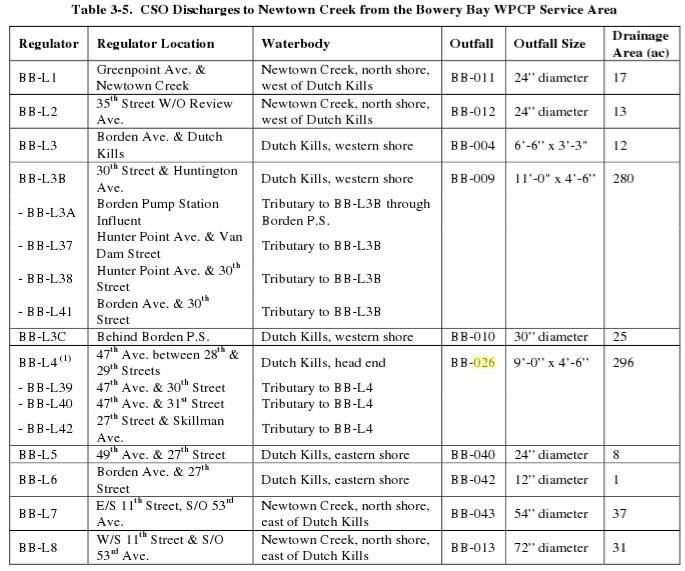
and from the same document this text and chart
The Low Level service area contains 46 regulators, of which 19 interconnected regulators discharge to the Newtown Creek during wet weather through the 13 CSOs. Of these 13 CSOs, 6 discharge to the tributary Dutch Kills (BB-004, 009, 010, 026, 040, and 042), and 6 discharge to Newtown Creek(BB-011, 012, 013, 014, 015, and 043). An additional 2-feet, 8-inches x 4-foot outfall, BB-049, is listed in the Bowery Bay WPCP SPDES permit as discharging to Dutch Kills near 21st Street, but no further information is available such as which regulator it is connected to.


 The Newtown Pentacle