Archive for the ‘Dutch Kills’ Category
pillars and niches

– photo by Mitch Waxman
You might recall, Lords and Ladies of Newtown, that back on December 11th of 2010 the 100th anniversary of the Hunters Point Avenue Bridge was commemorated by the New York City Bridge Centennial Commission and that I was one of the two Parade Marshalls for the celebration.
There were a few postings about the bridge found here, at your Newtown Pentacle, which detailed the storied history of the structure and it’s environs. Additionally, more than once has the Degnon Terminal been mentioned in prior posts, and appropriately so.

– photo by Mitch Waxman
Also mentioned in prior postings (parts one and two), the Newtown Creek Alliance had tasked a small group of it’s members (myself included) with attempting a photographic catalogue of the bulkheads of Newtown Creek and it’s smaller tributaries. Noble in it’s aspirations and massive in capability and resources, Riverkeeper sent a vessel and captain from it’s vast fleet to shepherd us through these very murky waters. These shots were captured from a small launch boat capable of crossing both low ceilings and containment booms which was little more than rowboat with an outboard motor.

– photo by Mitch Waxman
Beneath the Hunters Point Avenue Bridge, the waters of the long neglected industrial canal called Dutch Kills have been silting up with the worst sort of filth for decades, knowing not the presence of dredging or channel depth engineering. Here, the sediments pile up and erupt from the water.
The only flow of water here comes from rain and sewage, this is a stagnant and forbidding place.

– photo by Mitch Waxman
There is only a trickle of dry weather discharge dripping from this combined sewer outfall hidden away beneath the bridge. It hadn’t rained for a couple of days, but still, there was some flow. Though minor, this sort of discharge can add up to hundreds of gallons a day, carrying- for instance- the mop water that a Chinese restaurant on Broadway in Astoria might dump into the corner sewer drain nightly (yup, actual thing, observable every single day).
The reason I mention Astoria is that most of the drains on the Queens side resolve back to the Bowery Bay Wastewater Treatment Plant.

– photo by Mitch Waxman
In this posting, which led up to the Hunters Point Avenue bridge event mentioned above, some logic is offered as to how to decode the DEP “SPDES” signs which are required to be displayed above CSO discharge points. Like all things government, a bizarre nomenclature and specific system of numbering applies to the CSO’s.
It took your humble narrator a little bit to dope it out, so it is offered to save you from having to do so.

– photo by Mitch Waxman
Vehicle traffic was rattling by overhead on Hunters Point Avenue, and we observed the surprisingly good condition of the bridge anchorages. Notice the extreme high tide line of encrusted sediment lining the structural elements of the bridge. It would interesting to know what sort of organisms exist in that slime and residue, and what they could tell us about the true nature of the water here.

– photo by Mitch Waxman
The bubbles of mephitic gas which had been been popping all around the boat since we entered Dutch Kills began to subside at this point, perhaps it is the permanent shadows beneath the LIE and the two rail bridges which allow the methane producers in the sediment to thrive. The Hunters Point Avenue Bridge’s roadway is a grate which allows quite a lot of light to filter down to the surface.

– photo by Mitch Waxman
It must be admitted that long have I desired to see what might be hiding down here, and observe the understructure of this bridge. As it might be guessed, your humble narrator is a bit of an infrastructure geek, and the lesser bridges of New York City often surprise the observer.
This used to be a double leaf bascule, you see, whose mechanism was replaced in relative modernity.

– photo by Mitch Waxman
This shot is from the December 11th Centennial event and shows the other more easterly orientated shoreline, where the bascule hinge and bridge house are located, showing the Hunters Point Avenue Bridge in an open position. The spot I shot it from was the abutment seen in the prior shot.

– photo by Mitch Waxman
The head of Dutch Kills is a straightaway and engineered canal with a widened terminus, and the term for it is a “turning basin”. Overall, it’s shaped like a giant letter “T”. Heavy industrial concerns all around Dutch Kills built and maintained docks with which they could transfer materials which came to them by barge to rail (and truck, but rail was the key), and then to factory floor for processing. The manufactured product of these industries not destined for the local market would also then be shipped out via these docks.
Today, nothing much happens on the waters of Dutch Kills, and nearly all of the rail infrastructure is relict and abandoned- or purposed solely for passenger service to and from Manhattan.

– photo by Mitch Waxman
The benefits, costs, and upkeep of an intermodal transportation hub like this are massive. Unfortunately, most of the modern business in the area is oriented toward an automobile and truck culture rather than to the locomotive or maritime city, and thse docks are abandoned and rotted away. The once mighty rail lines are interrupted or orphaned, and the great factories which they once supplied are either empty, used for warehousing, or carved up into a hundred smaller spaces.
Where titans once thrived, ants now scratch by.

– photo by Mitch Waxman
Tomorrow, the Dutch Kills turning basin at this… Your Newtown Pentacle.
ethereal character

– photo by Mitch Waxman
The launch we were in had been referred to as the “tin boat” by the Riverkeeper folks, but it was more a smallish rowboat with an outboard engine than anything else. This is the second post of this adventure, click here for the first one.
We had just passed beneath the two rail bridges which vouchsafe and isolate Dutch Kills from the main body of the Newtown Creek, and were heading in the general direction of Queens Plaza when we approached the Borden Avenue Bridge.

– photo by Mitch Waxman
Of course, this century old structure has recently undergone a radical schedule of repairs when it was discovered that one of its abutments had begun to shift, and no small amount of complaint arose at the inconvenience from the legions of truckers and ordinary drivers who mourned its unavailability.
Down on the water however, things were pretty intense, from a purely existential point of view.

– photo by Mitch Waxman
Those bubbles of gas mentioned in yesterday’s post, which were erupting even when the water was unmolested by our passing, delivered a slightly petrochemical smell when they burst. Another member of the Newtown Creek Alliance who was sitting next to me in the boat began muttering “Oh my god” over and over at this point in time.
It wasn’t fear in his eyes, it was disbelief.

– photo by Mitch Waxman
My companion was no virgin or first time visitor to the Creek, of course, in fact his experience of the place is broad and far reaching. When all of your senses get involved with the atmosphere of ruination here, however, one tends to become a bit overwhelmed as your brain attempts to interpret and process the impossible data it is presented with.
The canalized bulkheads of Dutch Kills also tower over you from the water level, creating a sense of forced perspective and inevitability.

– photo by Mitch Waxman
The first thing you see when passing the Borden Avenue Bridge is an archaic sewer outfall, and were the brush not at it’s mid summer height, one would observe the shanty home of the Blue Crow above.
For those of you not familiar with this term, Crow is a name assigned in my little section of Astoria to the myriad metal and refuse collectors known to haunt the neighborhood on “Bulk Pickup Day”. Leave something shiny on the sidewalk, a crow will sweep in and grab it.
Metals are collected and sold by the pound in the scrap and recycling markets of Greenpoint and Long Island City, and these guys make their living from hunting and gathering. I assign them color names based on vehicle, or clothing choices.
There’s also a red crow out there.

– photo by Mitch Waxman
Here is a winter shot from road grade level which shows the sewer and the ever expanding hut of this particular crow. There is a photo of him to be in this Newtown Pentacle posting from February of 2010. Don’t be mistaken, I am not insulting either his industriousness or tenacity, if I were in a similar situation things would go far worse for your humble narrator. This man has been surviving in what has to one of the world’s most extreme environments for years now, and rent free.

– photo by Mitch Waxman
Looking back toward the Borden Avenue Bridge, the ominous humming which echoed along the bulkheads and emanated from above signaled that we had passed under another of the bridges of Dutch Kills. This bridge was built high, and called an expressway by Robert Moses himself.

– photo by Mitch Waxman
Some 106 feet over road grade, the high flying Queens Midtown Expressway leg of the larger Long Island Expressway feeds into the yawning mouth of the Queens Midtown Tunnel less than a mile from here. I call this part of Dutch Kills DULIE, or Down Under the Long Island Expressway.
One of the common complaints heard by eastern bound commuters in the early days of the 20th century was about the horrible smells they encountered when crossing through Long Island City. Moses built his auto bridge as high as engineering and budgetary considerations allowed in response to the plume of industrial outgassing which distinguished a trip through the area in his time.

– photo by Mitch Waxman
Dutch Kills is a particularly important tributary of the Newtown Creek, from an industrial history point of view. What is today a relict of brown fields, industrial spills, and toxic leave behinds was once the economic and manufacturing heartland of New York City. The heavy infrastructure here is no accident, and the waterway was a critical feature that drew one of the great (and largely forgotten) men of Queens to the Waste Meadows at the start of the early 20th century.

– photo by Mitch Waxman
At the end of the 19th century, none of this was here. Sure, there was a muddy road made of creosoted wood blocks and riprap bulkheads called Hunters Point Avenue which ran between isolated industrial sites, and a slightly more modern causeway called Borden Avenue which hosted a few large operations, but this was a swampy and pestilential bog. Brackish creeks wound along knolls of marsh grass and the stubby trees held together mud islands.
The place was lousy with all the junk floating down from Blissville and the sewers in Brooklyn and only Mosquitos and ticks found the place hospitable.
Dutch Kills needed to be fixed.
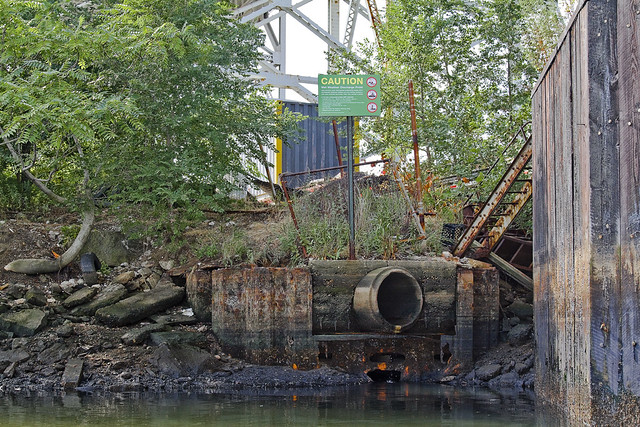
– photo by Mitch Waxman
Another sewer outfall is found directly after passing the LIE’s massive footing, which is the sort of improvement that benefited somewhere else rather than Dutch Kills. It was decided by the city fathers in the first years of the 20th century that something had to be done with these swampy wetlands, so close to Manhattan and the gold coast of the Newtown Creek.
Something was needed- a plan with vision, executed by someone who understood the byzantine politics of Tammany Hall and the recently consolidated City of Greater New York. Additionally, it would have to someone with proven “know how” who could “get it done”.

– photo by Mitch Waxman
From the mid 1930’s on, that person would have been Robert Moses. The ultimate political fixer, Moses employed the greatest engineering minds of a generation to shape and design our modern City. While Moses was still in diapers, however, no shortage of great men existed in the City. A plan was presented, and approved, and in both Albany and Washington- strings were pulled by the Tammany men and budgets were approved.
The Army Corps of Engineers were assigned here to canalize, deepen, straighten and erect industrial bulkheads at Dutch Kills in 1914. Land was reclaimed by dumping the fill and spoils produced by the digging of the Belmont Subway Tunnels (leading to to Manhattan) amongst wooden pilings driven deeply into the mud.
The modern shoreline of Queens began to assume it’s current shape.
– photo by Mitch Waxman
It is apparent what happened here, when you see the Hunters Point Avenue Bridge appear before you.
Progress had arrived in Queens, and his name was Michael Degnon.
ponderous and forbidding

– photo by Mitch Waxman
As mentioned in a post the other day, an opportunity arose for me to accompany a representative of Riverkeeper on a survey mission to Newtown Creek recently.
Demanded by the top leadership of the Newtown Creek Alliance itself, this was an expedition whose agenda would require the photographic documentation of bulkheads and shoreline conditions all along the Creek. Of special interest to those involved in the renewal and resuscitation of brownfield sites, the mission as put forward was to get a shot of everything possible. This survey would include observation of the lesser known tributaries of the Creek- Dutch and English Kills, as well as Maspeth Creek, and the East and West Branches which lie beyond the Grand Street Bridge.

– photo by Mitch Waxman
The barriers which guard the secrets of Dutch Kills, which branches from the main body of Newtown Creek just .8 of a mile from it’s locus point with the East River, are two rail bridges. As mentioned in the past, I am no expert on the intricacies of the trackways which snake around the Queens side of the Creek. The expert on this subject was Bernard Ente, who recently passed away, and I wouldn’t offend his memory by pretending to know more than the following:
Neither Bridge (both are moveable) has opened for some time, and it is my understanding that they are part of the “Montauk Cutoff”.

– photo by Mitch Waxman
The survey team was small, as we were in a tiny craft. Hardly more than a rowboat with an outboard motor, three of us sat less than a few inches above the water. There was a mist hanging in the air, as it was early morning, which was quite invisible to the eye but will occasionally become visible in these shots (when I fired off the flash).
Our plan was to take advantage of high and low tides to gain access to the various sections which we were mandated to record, and the low ceiling of the swing bridge at Dutch Kills demanded we make our attempt at ebb tide and exit the tributary before it again flooded.

– photo by Mitch Waxman
I will admit to prayer that a train might pass overhead, for this would be a prize photo for your humble narrator, but alas- no such luck. I don’t know very much about the rails, but I do like taking pictures of trains from odd angles. There was a ghastly sensation afoot in me as well, as I knew that the very air which we were breathing was a hideous miasma of vapor emissions rising from the poison sediments which line the bed of Dutch Kills.
Everywhere, there were tiny bubbles erupting to the surface of the water, and as we disturbed them- mephitic smells swirled about and enveloped the boat.

– photo by Mitch Waxman
Many times have I been down Newtown Creek on the water, but it has always been in nothing smaller than a NY Water Taxi. Additionally, Dutch Kills is “mine”, a branch of the Creek that has received extensive study and historical analysis here at Newtown Pentacle as well as having been thoroughly catalogued photographically. No surprises in store here thought I, English Kills is a bit more “unknown territory” and would likely yield something to hang my hat on.
That is what I thought at the start of this trip.

– photo by Mitch Waxman
To start, the first rail bridge seems to be in a deep state of corrosion, which would make sense given its century long existence. I am no engineer, of course, but this thing hasn’t seen a paint brush in a very long time.
Witnessing the rust and metal fatigue on this bridge actually made me glad that a train wasn’t passing by overhead. The works and motors which power this bridge’s swing action have been burnt out for some time I am told.

– photo by Mitch Waxman
I have never seen it happen (as you would have seen a photo of it here by now) but word is that if the bridge needed to be opened, rail workers would utilize the sort of tow trucks known as “wreckers”, situated at both banks, to winch the thing open.
Sounds bizarre, but the aforementioned Bernard Ente told me that one, and “Bernie was always right” about this sort of thing. Can’t tell you how many crazy stories he would tell me about the history and lore of this place, which my own research would prove him to have been purposely understating.

– photo by Mitch Waxman
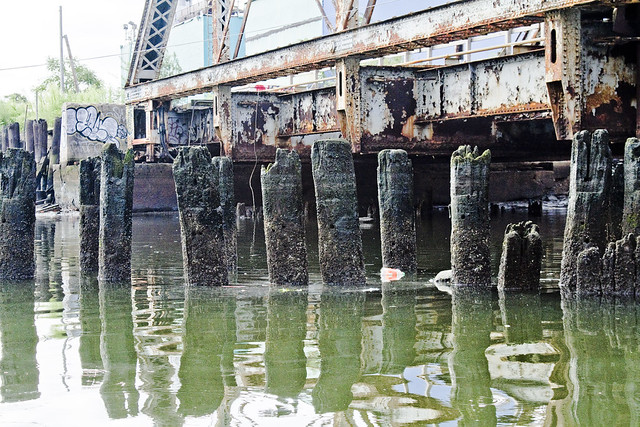
All across Dutch Kills, everything bore that unmistakable colour which typifies the lament and sickness of the Newtown Creek watershed. Iridescent, it is neither black nor white nor any normal color, rather it’s is like something alien coating everything in rotten decay. Metal corrodes, wood molders, stone and cement simply crumble away.
The swampy wetlands which existed here in aboriginal times were known as the Waste Meadows in the 19th century, and perhaps this is still the appropriate terminology for them.
– photo by Mitch Waxman
Pilings and structural elements squamously protrude from the water, whose surface seems thicker than expectation would predict. Normal fluid dynamics apply of course, but the turgid waves behaved in the manner of a broth or syrup as opposed to the more wholesome (but still polluted) water found on the nearby East River.
Additionally, high tide was not marked by invertebrate communities of barnacles or mussels here, but rather by tree ring like deposits of sediment.

– photo by Mitch Waxman
Looking back toward the swing bridge, in the direction of infinite Brooklyn, a long walkway is attached to the pier which the bridge is anchored into.
One thing which I can categorically show in these “bulkhead survey” shots of the Newtown Creek, is that much of the so called land along the Queens bank of the Creek (and large parts of English Kills in Brooklyn) is actually an engineered surface of pilings intermixed with fill and capped with a cement slab- reclaimed land.
One of the scarier ramifications of this, and again– not an engineer- is witnessed in the deleterious condition of these century old wood pilings visible from the water’s edge.

– photo by Mitch Waxman
Next up on this trip is the truss rail bridge, which is built quite a bit higher in elevation than the initial structure and is found at the other side of the pier and walkway which connects to the Swing Bridge. It’s a drawbridge, and the elevated height must have been part of a plan to reduce the need to open the span for water traffic on the once busy Dutch Kills.

– photo by Mitch Waxman
Apologies are offered for vagueness, lords and ladies, as I fear that I’ve spoiled you over the last several years with vulgar displays of “info-porn”. Normally, you’d be reading stats and figures, hearing the name of engineers and learning of long forgotten disasters. Unfortunately, as these two bridges are not publicly accessible, and to study them in any real detail would mean trespassing and demand mandatory jail time… these are the bridge structures which I can describe in the least detail anywhere along Newtown Creek.
Railfans of NYC, anonymous LIRR employees, please leave a comment below and share the wisdom.
As mentioned in the past- I never trespass- like a Vampire your humble narrator needs to be invited inside to do his best work and in the age of terror- no one is invited to look too closely at railroad infrastructure.

– photo by Mitch Waxman
Others, however, are not as constrained as I.
A garish banner caught my eye as we passed beneath the truss bridge. My mind concocted that I was seeing just another windblown tarp or plastic container bag at first, but then as we approached… I realized that it was some kind of painting.

– photo by Mitch Waxman
Hung at a level which allows it to interact with the high tide level, this painting seems to depict- to my eye- a middle eastern city withering in flame beneath the burning thermonuclear eye of god.
What’s more, for once, I can brag to Ms. Heather, over at ny-shitty.com, that I finally got something before she did.
Note: as always, clicking the photo will open a new window at Flickr. Clicking the view all sizes option under the “actions” tab will take you to ever larger incarnations of the shot for closer examination. If anyone knows who the artist is, or what this situation is about, I’d love to hear about it.

– photo by Mitch Waxman
It would seem that someone has set up camp under here, or perhaps it is just a studio space. The undocumented men and women who live in both these “Waste Meadows” -and the Newtown Creek watershed as a whole- are too numerous to count. Many are exactly where they belong, while others are trapped by circumstance and ill omen.
All need to be coaxed away from this place, before the Creek does to them what it has to so many others in Greenpoint and Long Island City.

– photo by Mitch Waxman
No human being should be living in this place, except as part of a penal sentence for an especially heinous offense. Trolls live under bridges, not Americans. Additionally, in the age of terror, how exactly does this go unnoticed by the gendarme?
I cannot stress how often I ask this question as I wander across the Creeklands.

– photo by Mitch Waxman
Despite the fearful atmospherics and forbidding appearance of the water, we pressed on. Our steward from Riverkeeper kept a steady hand on the outboard motor and the tiny boat slid forward across Dutch Kills. This shot is looking back at the two rail bridges of the Montauk Cutoff which we had just passed beneath.
Still no trains.

– photo by Mitch Waxman
Dead ahead was the Borden Avenue Bridge and the high flying Long Island Expressway, the experiencing of which which will be discussed tomorrow at this- your Newtown Pentacle.
the dark moor

– photo by Mitch Waxman
Lucid and unwholesome, witness this sky flung perspective of the backbone of New York City- vantaged from several hundred feet above the Newtown Creek and it’s little known tributary- Whale Creek, and high atop the digester eggs of the Newtown Creek Wastewater Treatment Plant.
Gaze in wonder at the majesty of western Queens.
Additionally, click here to see this view reversed, and witness the parallel horizon of infinite Brooklyn.

– photo by Mitch Waxman
That’s the Thomas D. Witte tugboat maneuvering a barge into position at the SimsMetal dock, and the rusty crossing in the background is the non functioning swing bridge which spans the larger Queens side tributary of Newtown Creek called Dutch Kills.

– photo by Mitch Waxman
That’s the LIRR moving along the ancient rail tracks which have blessed the industries and cursed the residents of this area since the early 19th century. The general area that the locomotive track is passing through, employed to this very day by petrochemical interests, is the former Queens location of Standard Oil at Newtown Creek.

– photo by Mitch Waxman
In the distance, from left is Lindenthal’s magnificent Queensboro, the Big Allis power plant, the omnipresent Sapphire megalith, the high flying Long Island Expressway, and a substantial portion of the vast industrial quarters of Long Island City which I call “The Empty Corridor“.
noble and familiar

– photo by Mitch Waxman
Wandering aimlessly through the section of Long Island City which forms the hazed border of Dutch Kills and Ravenswood recently, your humble narrator was taken aback by the fortress like appearance of the local domiciles and businesses. Perhaps this unremarked series of blocks in western Queens harbors and shelters itself- in secret- against some unbound curse or horror unknown to neighboring communities, an invisible and omnipresent dread requiring stout gates and heavy iron clasps to vouchsafe life and limb?
I’ve never observed it in daylight, whatever this lurking fear might be, it must only come out at night.
from wikipedia
The land was acquired in 1814 by Col. George Gibbs, a businessman from New York City who developed it. Gibbs died in 1833, and the land was divided into nine parcels by three developers. From 1848, there were several mansions built on this land, but the high class housing did not survive. The spring of 1853 brought the opening of a post office of its own and country store “run by Messrs. Moore & Luyster, and Mr. Samuel H. Moore of that firm received the appointment of postmaster, handling the mails in a corner of the store.”
Ravenswood, unlike Astoria, Queens, never became a village; there was no disposition at any time to become independent as there was insufficient population or commercial activity to justify such a move. Ravenswood remained an exclusive hamlet within the Town of Newtown until its absorption with the Village of Astoria, and the hamlets of Hunters Point, Blissville, Sunnyside, Dutch Kills, Steinway, Bowery Bay and Middleton in Newtown Township into Long Island City in 1870. “Ravenswood enthusiastically accepted incorporation into Long Island City in 1870 and this absorption of the quiet village into the mainstream of commerce and industry spelled the end of the old era.”

– photo by Mitch Waxman
Freakish thoughts arise often during these long walks about the Newtown Pentacle, arising perhaps from the sheer oddness of what one might encounter on these perambulations- or from other strange energies encountered in the environment. When transversing the area around Big Allis and it’s various transformer farms, odd cracklings and resonances emerge from my headphones which I cannot be certain are merely electromagnetic anomalies caused by the titan powerplant. Certain evidences are consciously sought, of course, but long ago the universe was granted sway over my steps as I scuttle about the earth, and if New York City wants me to see something- she takes me there.
It is best not to disobey the City.
from wikipedia
Big Allis, formally known as Ravenswood No. 3, is a giant electric power generator originally commissioned by Consolidated Edison Company (ConEd) and built by the Allis-Chalmers Corporation in 1965. Currently owned by Transcanada Corp., it is located on 36th Avenue and Vernon Boulevard in western Queens, New York.
During 1963, Allis-Chalmers announced that ConEd had ordered the “world’s first MILLION-KILOWATT unit…big enough to serve 3,000,000 people.” This sheer scale helped the plant become popularly known as “Big Allis”.
At the time of its installation, it was the world’s largest steam energy generating facility. It is located on the Ravenswood site, consisting of Units 1, 2, 3 and 4, as well as several small Gas Turbines (GTs), and an oil depot. The site overall produces about 2,500 MW, or approximately 20% of New York City’s current energy needs. The current installed capacity of Big Allis is around 980 MW.

– photo by Mitch Waxman
A certain commandment is “to see”. Bombarded with visual stimuli, the extraordinary nature of New York City becomes commonplace and quite ordinary in daily observance, and difficulty is found in filtering. This statuary on 9th street in Ravenswood… I don’t want to research its possible meanings or significance… find out who is represented or what tradition presents itself in style or execution…
Alright, I’m pretty sure it’s a Maronite Cross. The Maronites are a group of Lebanese Christians who revere St. Maron of Chrysostom, a city near Antioch in his time which was around 16 centuries ago. They are part of what is known as “Eastern Catholic Churches“, which may follow atavist theurgical or theological paths which differ from the “Roman Catholic” faction, yet are nevertheless in full communion with the Bishop of Rome.
from wikipedia
Saint Maroun (also Maron or Maro; Syriac: ܡܪܝ ܡܪܘܢ, Mār(y) Mārōn; Arabic: مار مارون) was a 5th century Syriac Christian monk who after his death was followed by a religious movement that became known as the Maronites. The Church that grew from this movement is the Maronite Church. St. Maroun was known for his missionary work, healing and miracles, and teachings of a monastic devotion to God. He was a priest that later became a hermit. His holiness and miracles attracted many followers and drew attention throughout the empire.

– photo by Mitch Waxman
As mentioned in the past, a simple 5 point methodology for discovering the hidden ecstasies of this ancient place has evolved around wholesale surrender to the directionless cosmos:
- Keep, the sun on your back.
- Turn, left only.
- Follow, a cat- if encountered.
- Move, in an alert fashion.
- Interact, with the humans only when necessary.
For some reason, around Ravenswood, I always find myself heading for Big Allis. Mayhap it’s some electromagnetoception sort of thing…
from wikipedia
In bees, it has been observed that magnetite is embedded across the cellular membrane of a small group of neurons; it is thought that when the magnetite aligns with the Earth’s magnetic field, induction causes a current to cross the membrane which depolarizes the cell.
Crocodiles are believed to have magnetoception, which allows them to find their native area even after being moved hundreds of miles away. Some have been strapped with magnets to disorient them and keep them out of residential areas.
In 2008, a research team led by Hynek Burda using Google Earth accidentally discovered that magnetic fields affect the body orientation of cows and deer during grazing or resting. In a followup study in 2009, Burda and Sabine Begall observed that magnetic fields generated by power lines disrupted the orientation of cows from the Earth’s magnetic field.
Certain types of bacteria (magnetotactic bacteria) and fungi are also known to sense the magnetic flux direction; they have organelles known as magnetosomes containing magnetic crystals for this purpose.


 The Newtown Pentacle