Archive for the ‘Long Island City’ Category
ultimate blackness
It’s Al Capone, Betty White, and Andy Kaufman’s birthday.

– photo by Mitch Waxman
Over in LIC’s Blissville neighborhood, you’ll find the principal burying grounds of the Roman Catholic Church in 19th and early 20th century NYC, called First Calvary Cemetery. It’s called “First” Calvary, as there are three other properties found to the east in Woodside that the church refers to as “Second,” “Third,” and “Fourth.” First, or Old, Calvary has been in use since 1848. Calvary Cemetery is on a hill overlooking the Newtown Creek and is surrounded by the industrial zones of Long Island City and West Maspeth.
The majority of burials in First Calvary occurred between its founding and the Second World War, which means that the monuments found within its fence lines have endured the effects of the endemic atmospheric pollution typical of industrial America prior to the passing of the 1972 Federal Clean Air Act. Acid rain wasn’t a term used prior to that legislation.

– photo by Mitch Waxman
Granite seems to be the best choice for a monument able to weather the atmospherics hereabouts.
Marble rots away, obscuring the legend, iconography, and screed carven into the memorial stones. If you were to run your fingers across the surface of the stone pictured above, a sandy grit would transfer from it to your skin. To be fair, though, there used to be an acid factory right across the street from Calvary Cemetery.
That factory was opened in 1866, and was first known as “General Chemical,” then as “Nichols Chemical,” and then as “Phelps Dodge.” Phelps Dodge, of course, is one of the named “potentially responsible parties” or “PRP’s” in the ongoing Federal Superfund situation on Newtown Creek being investigated by the Environmental Protection Agency.

– photo by Mitch Waxman
Phelps Dodge vacated its property long ago. Back in 1901, when the corporate entity was still called the Nichols Chemical Company, community complaints and a law suit by the cemetery forced them to build what was – at the time – the largest chimney in the United States to release their acidic waste gases high above the ground. It was supported by wooden piles driven into the landfilled Newtown Creek marshlands their factory was built on. These piles supported a 25 foot deep concrete foundation, which in turn provided a stable enough base for a 22,000 ton, 367 feet tall chimney.
Roughly translating that to modern day “building stories,” this was a 36-37 story tall chimney.

– photo by Mitch Waxman
For comparison, the sapphire megalith of Long Island City is 53 stories in height, but three of those stories are below the ground. The Nichols/Phelps complex employed close to 1,500 people back in 1901. The acid factory was merely part of their production line, and the high grade sulfuric acid they were known for as a mere co-product for their true profit center.
The main focus of their business was the refining of copper. The company was producing some 517,000 tons of the stuff, annually, back in 1901 when that chimney went up. Most of the landfill that the company had used to build out the marshy shoreline of Newtown Creek, and upon which they built their factories, was material harvested from the refining processes – specifically slag from their redoubts and furnaces. The original shoreline of Newtown Creek was anywhere from 500-1,000 feet back from the modern shoreline, more or less where the Long Island Railroad’s Lower Montauk Branch tracks are found today.
“follow” me on Twitter- @newtownpentacle
sheerly perpindicular
It’s Friday the 13th…

– photo by Mitch Waxman
Tapophile? Ghoul? Trespasser? I’ve been called all of these things because of my devotion to studying the history of First Calvary Cemetery in the Blissville neighborhood of Long Island City. Calvary Cemetery, for the uninitiates amongst you, was founded by the Roman Catholic Church in 1848 to comply with New York City’s “Rural Cemetery Act” which proscribed the continuing interment of cadavers in Manhattan due to fears of contagious disease. Prior to this, it was common for churches to have graveyards, and far more common was the usage of the dirt floor basements of tenements as ad hoc burial spots for the poor. The law commanded all the major religious denominations to acquire and maintain cemeteries in “rural areas” to house their congregants – which at the time – was a description that included the south eastern corner of Blissville near its border with the Berlin section of Maspeth. The cemetery was consecrated by Archbishop “Dagger” John Hughes in 1848, and there are literally millions buried in this – the original property – and in the nearby Second, Third, and Fourth Calvary Cemeteries. The law also requires the disinterment of buried bodies, which was a ghastly process that occurred in the dead of night, and vast numbers of human remains were removed from their Manhattan graves and barged across the river for reinterment in the new rural cemeteries. There are so many cemeteries in the surrounding neighborhoods of Brooklyn and Queens that the term “cemetery belt” is commonly used to describe the vast acreages of graves. All of these are not Roman Catholic ones, of course. There’s a cemetery for everyone.
For Catholics, however, all roads lead to Calvary.
Calvary Cemetery was founded, and continues to be maintained, by the Roman Catholic Church – specifically by the Trustees of Old St. Patrick’s Cathedral in Manhattan, and it is a very special place. The Trustees consider the cemetery to be an extension of the altar at the Cathedral. To one such as myself, Calvary is a history book, left sitting wide open and found along the Queens shoreline of the noisome Newtown Creek.

– photo by Mitch Waxman
Your best bet is to wander in here, roam around a bit and see what you can see. If you come here looking for something specific, it’s going to be quite frustrating. Let the place talk to you, and it’ll show you exactly what you need to see – just like Queens itself. Don’t force it. Look up, down, all around. Notice things. If you take a hard look at these things, you might be offered a lost or occluded slice of the history of New York City.
That’s the grave of the Malone family – Father Sylvester Malone, his brother Edward and his sister in law Annie. Slice.

– photo by Mitch Waxman
Father Malone… wow… it’s actually amazing to me that he’s not still spoken of in North Brooklyn. Beloved in life, Sylvester Malone was born in Ireland’s County Meath. Malone was recruited to the priesthood by Reverend Andrew Byrne in 1838, and came to America with him. In NYC, Malone fell into the circle of priests surrounding Archbishop John Hughes, and was ordained at Old St. Patrick’s Cathedral in 1844. Malone was shortly assigned to Old St. Mary’s church in Williamsburg. Malone worked a Parish circuit that included the East River side of Newtown (including Astoria’s Hallets Cove) and the former Boswijck – or Bushwick – Colony, including Greenpoint, Williamsburg, and Bushwick. Malone formed a friendship with architect Patrick Keely (who also designed St. Anthony’s in Greenpoint and more than 200 other new gothic churches in the northeastern United States) and the two oversaw the construction of Sts. Peter and Paul church in Williamsburg, which Malone was permanently assigned to in 1852.
The inscription on his memorial reads:
Sylvester Malone. Pastor of St. Peter and Paul’s Church for fifty five years. Regent of the University of the State of New York. Live in Charity with all of your fellow citizens. A curse on prejudice and ignorance. Bane of the human family. As long as you have existence, there can be but little peace and charity.

– photo by Mitch Waxman
Malone was known for his open acceptance of people of other faiths, regularly attending the Jewish community’s Purim Ball, visiting the Masonic Hall, was an outspoken abolitionist, and encouraged his flock to perceive other faiths and cultures as neighbors rather than adversaries. Famously, he was one of the first Catholic priests to embrace the African Americans in his community, presenting honors to the Civil War’s Black Veterans Association. He happily interacted with Protestant denominations as well. While researching this post, some of the earliest usages of the term “tolerance” jumped out at me. You don’t hear much about the modern political concept of “tolerance” in the 19th century, and almost never from the pen of an Irish born Catholic priest based in industrial Brooklyn.
Malone was also a regent of the State University of New York, and remained at Sts. Peter and Paul Church until his death in 1899. Unfortunately, the original building housing his church was demolished in 1957, so I can’t show you that. A modern church building sits on the old site, but the influential gothic design of the original is lost to modernity except for a few blurry old photos.

– photo by Mitch Waxman
There were three Malone Brothers, with Sylvester being the senior. Brother Patrick was the middle son and a Civil Engineer by trade, and Edward was the youngest. Edward fought in the Civil War, was a physician and surgeon of some renown, and died at the age of 52. Patrick and Edward actually died within a few months of each other in 1890. There was a sister too, but I can’t tell you anything about her, and I’m not sure if she ever left Europe or not.
Dr. Edward Malone was born Aug. 5, 1832, and died June 16, 1890. His wife, Annie Loyola Malone, died July 13, 1916.

– photo by Mitch Waxman
You never know what, or who, you’re going to find in LIC’s Calvary Cemetery.

“follow” me on Twitter- @newtownpentacle
unused tool
It’s National Cheese Fondue Day, here in these United States.

– photo by Mitch Waxman
As described in yesterday’s post – one left Point A (A is for Astoria) for a walk around LIC’s construction zone, ate an egg sandwich, and swiped his Metrocard to vouchsafe a journey to Manhattan’s Hells Kitchen in pursuance of attending a holiday gathering. While awaiting the arrival of the 7 line subway, the hair on the back of my neck went up, and it occurred to me that the thing – which does not breathe or think or live – that persists in the cupola of the Sapphire Megalith – had fixed its three lobed burning eye in my direction. Brrr.
Luckily, I didn’t have to wait long, and that inhuman intelligence didn’t have time to send any members of its army of acolytes to investigate, proscribe, or accuse. This will likely surprise regular riders of the 7 – the “not waiting long” part. Nobody will be surprised about the thing which cannot be that exists in the cupola of the Sapphire Megalith of Long Island City.

– photo by Mitch Waxman
Arguably, the 7 is the most photogenic of NYC’s subways. There’s a lot to be said about various examples of the lettered lines – notably the G and F entering and leaving Smith 9th street in Red Hook – but to me, the 7 is the visual champ.

– photo by Mitch Waxman
Even if I’m on the train, I keep flipping the shutter, which causes no end of concern for my fellow riders. It always seems as if my fellow New Yorkers experience difficulty in distinguishing the difference between an assault weapon and a camera, based on the masked expression of apprehension they assume upon spying the thing. Mind you, they’ve all got their smart phones deployed – which sport cameras directly connected to the web – but nobody seems at all concerned about that. Old weird guy in a filthy black raincoat with a DSLR? Clearly terror related, so cancel all National Cheese Fondue Day events just in case. .
Of course, I’m the nervous type, so I’m terrified of everybody else. What’s wrong with you people? Eeek!

– photo by Mitch Waxman
The 7 continued along its well worn path, entering the subterrene and the dilapidated Vernon Jackson stop. If you feel like googling “Hunters Point South FEIS,” it’ll take you to a document prepared by NYC’s Dept. of City Planning which discusses the need for the platforms at this stop to be widened and the station to be thoroughly rebuilt in order to handle the burgeoning population of LIC, btw.
NYC City planning ain’t perfect, but you have to be a real dummy not to listen to their advice and shoring up the transportation infrastructure of an area that you intend on adding thousands of people to.

– photo by Mitch Waxman
My destination was in Hells Kitchen, over in Manhattan. Given that I was a couple of hours early to attend the Holiday party I was invited to – and I really can’t imagine why ANYONE would want to spend time with one such as myself, as a note – the 7 was ridden all the way to its western terminal stop at the brand spanking new Hudson Yards station.

– photo by Mitch Waxman
Hudson Yards is the first of the “new style” subway stops which sports a mezzanine that’s one flight of steps up from the tracks. It’s pretty airy in here, but this mezzanine represents a not insignificant investment at the Hudson Yards station. Wonder how much it cost to create a cavern here.

– photo by Mitch Waxman
Hudson Yards is DEEP, and there’s a couple of sets of industrial meat grinders escalators which carry you up to the surface. The leading lines of the tunnels which the escalators carry you through are fairly vertigo inducing, in my experience.

– photo by Mitch Waxman
It’s actually a bit nauseating.

– photo by Mitch Waxman
Speaking of nauseating, on the Manhattan side of the 7, the western mirror of LIC’s mega projects is underway – the Hudson Yards development project. Funny, how it often seems that the 7 line – from Flushing all the way to LIC in Queens and all the way down 42nd and then to 34th in Manhattan – seems to be the singular focus of the Real Estate people.
“follow” me on Twitter- @newtownpentacle
unrelieved insanity
It’s National Chocolate Covered Cherry Day, here in these United States.

– photo by Mitch Waxman
One fine day at the end of December, my calendar informed that a holiday party was on my schedule at seven p.m. in Manhattan’s Hells Kitchen neighborhood. Having few things holding me at home, and desirous of an end to my “bouncing off the four walls” that typifies my response to the Christmas season, I decided to make a day of it. I packed up the camera bag and left Astoria at around two in the afternoon. My path first carried me down the Carridor, or Northern Blvd. if you must, and at the undefended border of the neighborhoods of Astoria and Dutch Kills (31st street) one encountered a gargantua construction project whose goal – I believe – is to deliver yet another badly needed hotel to the Dutch Kills neighborhood.
There’s only about twenty or so of them there now, and god knows we need more, as at least one of them has been converted over to a homeless shelter by the administrative geniuses employed by our beloved Mayor – the Dope from Park Slope, Bill de Blasio.

– photo by Mitch Waxman
Construction projects have stolen the sky in Long Island City in recent years. Long shadows are cast, and bizarrely reflected sunlight glares from the mirror box surfaces of the new towers. The glare sometimes illuminates a long shadowed factory block, burning away the mold and nitre of the early 20th century Industrial Age of Queens. The towers eradicate these ancient factories and warehouses which still hosted hundreds of blue collar and industrial jobs, replacing them with residences. It’s all done in the name of providing jobs, I’m told, although after the 24-36 months of construction work is done those jobs move on.
Luckily there’s still a handful of jobs for servile labor – doormen, porters, building superintendents. There would be delivery boys too, if the designers and funders of these towers had remembered that a neighborhood is more than just a collection of apartment buildings, and that you need doctors offices, laundromats, and supermarkets too.

– photo by Mitch Waxman
Queens Plaza seems to be quite the focus point for construction activity at the moment, answering the clarion call that all New Yorkers have been singing for generations demanding the opportunity to live here. As mentioned earlier, the only good part of these new structures to me is that they act as sun reflectors during the late afternoon and illuminate the transportation hub that serves as the de facto focusing point for nearly all the Midtown Manhattan bound vehicular traffic of Long Island and the locus point for the screeching steel wheels of the elevated N, W, and 7 Subway lines.
I do wish that the orange construction netting was a permanent feature, of course, as it provided for a nice color contrast with the stolen sky.

– photo by Mitch Waxman
I’ve always been fascinated by the elevated Subway architecture hereabouts, which forms – technically speaking -“Queensborough Plaza.” The underground Subway complex, where you’ll find the E, R, and M lines, is called “Queens Plaza.” One of the things that has long puzzled me, however is why there isn’t a free transfer between upstairs and downstairs. If I get off a train at either complex, there are free transfers to the NYCTA Bus lines which Queens Plaza is lousy with, via some sort of magical Metrocard alchemy.
Conversely, MTA doesn’t allow a free transfer from… say, the N line to the R. Instead, you’re told to transfer to the 7 from the N, go to the Court Square stop, and transfer there instead. Not too big a deal, but why?

– photo by Mitch Waxman
Crossing under the elevated tracks, and towards the Citi building megalith, one encounters another construction zone. These buildings are further along, many have been open and renting for a while now. I know a couple who live in the “Linc LIC” building at the right of the shot above, and they proclaim great satisfaction with their new home.
Of course, as I’m ever a black spider crawling across clean white linen, one had to inform them of their proximity to half a dozen State Superfund sites, and to the Dutch Kills tributary of the noisome Newtown Creek Federal Superfund site. It seems that the realtors of NYC are under no obligation to inform buyers and renters of these new properties about environmental issues present in their new neighborhood. The realtors would be obliged to disclose if the property was known to be haunted by a ghost, conversely, in accordance with NYS jurisprudence.

– photo by Mitch Waxman
Regardless of opinion, sense, or a web of infrastructure capable of maintaining this new population – construction continues. Hospital beds – Who needs ’em? Sewer plant upgrades – nobody cares about that. 7 train at capacity already, according to the MTA – haven’t you got something else to worry about, Mitch? Clouds of toxic dust mixing into the air column from construction sites – pfahhh, have you tried the new muffins at Coffeed?
Well you get the idea, and it is National Chocolate Covered Cherry Day after all, so why aren’t you out shopping for some? What are ya? Some kind of commie? Go buy something. Maybe an apartment in Queens Plaza.

– photo by Mitch Waxman
Swinging around onto 23rd street, under the elevated tracks of the 7 line, in an area which I’ve always referred to as “the fedora district” since it’s the sort of place you can picture working guys wearing old school hats – I encountered some politically expressive vandalism on the plywood fencing of what promises to be yet another construction site.
The same writer installed the screed “Trump is your fault” around the corner. Politics and vandalism versus expression notwithstanding, one realized that he had left the house without eating breakfast. After counting out how many pennies I had in my pocket – I went to the ever reliable Court Square diner and ordered a sandwich which I call a “cholesterol bun” – 2 scrambled eggs, with ham and swiss cheese, on a roll.

– photo by Mitch Waxman
Whilst quaffing my cholesterol bun and sitting on the sidewalk of Jackson Avenue, the construction site occurring on the site of the former 5Ptz caught my eye. This is the one that burns me, incidentally. Maybe people do want to live in Queens Plaza. Maybe I’m just a recalcitrant preservationist and my knowledge of the intricacies of LIC’s environmental woes and infrastructure deficiencies prejudices the way I perceive all of this construction activity which the avarice of the politically connected Real Estate Shit Flies have created.
Thing is, a significant number of people who are moving in to LIC have been sold on its “vibrant art scene” which doesn’t actually exist. There WAS a vibrant art scene at 5Ptz, but nobody in power raised a finger to save the one thing which drew crowds of “artsy fartsy lookie-loos” to LIC. It’s a a crime what happened to 5ptz, from the literal whitewashing of its walls onwards. What’s rising are two more bland towers overlooking an elevated, busy and quite noisy, subway track.

– photo by Mitch Waxman
Disgusted by all the short sightedness, and abundant entropy of LIC – and after the consumption of my yummy cholesterol bun – one entered the MTA “system” and paid my fare for a ride on the most photogenic of NYC’s subway lines. As mentioned at the top of the post, I had a social obligation to keep in Hells Kitchen, and it was time to head into town. LIC will shortly resemble a Hells Kitchen anyway – surviving tenements converted to one family “pied a terre” and surrounded by outré scale luxury towers that host the minimum number of low income housing allowable by law, and suffused by staggering levels of congested vehicular traffic.
My plan was to take the 7 to the western end of the line, in… Manhattan. More on that tomorrow, at this, your Newtown Pentacle.
“follow” me on Twitter- @newtownpentacle
guttural accent
Old acquaintance be forgot, all that jazz, in today’s post.

– photo by Mitch Waxman
Last post of 2016 right here, lords and ladies, coming to you from the Empty Corridor of LIC. As y’all know, my favorite part of the concrete devastations for many years has been the splendid isolation it offered, which is getting all screwed up by real estate development. There’s so many more people around these parts than there were ten years ago… where’s a humble narrator got to go to find some solitude and listen to his HP Lovecraft audiobooks? I suppose there’s always Calvary Cemetery, but…
The Empty Corridor, I would mention, is a term of my own invention. It’s the zone of LIC found down under the Long Island Expresway – or DULIE. You’ve got to stay ahead of the real estate people, I always say.

– photo by Mitch Waxman
There’s an MTA owned railroad access road which isn’t exactly a NYC DOT street, despite it having a “29th street” sign hanging on it. It adjoins the Dutch Kills tributary of Newtown Creek, connecting Hunters Point Avenue and 47th avenue. If you send mail to one of the businesses found on this street, you can write the address as “One Dutch Kills” rather than “29th street” and it will be delivered. That’s something I learned in 2016.
– photo by Mitch Waxman
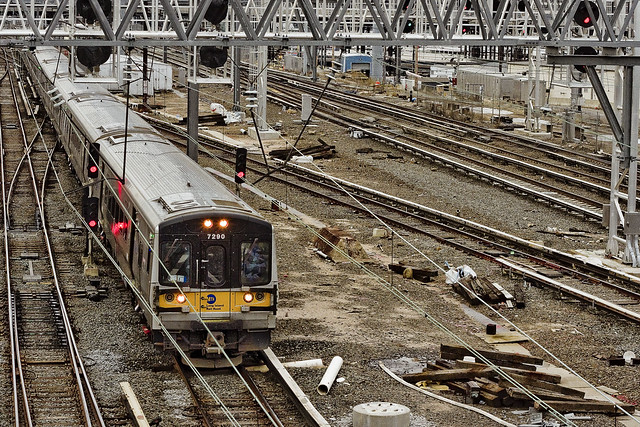
On the subject of looking forward to 2017, the battle of Queens looms large. The Mayor of NYC announced, a while ago now, that he intends to deck over the titan Sunnyside Yards and build what promises to be a disastrous number of housing units there without a concurrent buildout of infrastructure. Bill de Blasio; the big little mayor, the dope from park slope, the vainglorious ideologue – he’s got another thing coming if he thinks he’s going to wreck Western Queens.
A sleeping activist giant has awoken in this borough, thanks to his homeless hotels, disingenuous neoliberalism masquerading as progressive policy, and his crass Tammany style corruption.
“follow” me on Twitter- @newtownpentacle


