Archive for the ‘Long Island Rail Road’ Category
harnessed shadows

– photo by Mitch Waxman
To begin with, you will be hard pressed to find someone who is a bigger supporter of the efforts of the NYPD than your humble narrator. Vast physical inadequacies and a timorous constitution render one a “victim waiting to happen” and the presence and oversight of the gendarme is the only reason that you haven’t heard about finding my corpse lying in the street somewhere, as we live in a community cursed with predators and a criminal element which threatens all. Saying that, I recently attended a meeting of the 114th pct. community council here in Astoria, and one of the speakers was a representative of the “Anti Terror” squad. I have long been a proponent of the single truth of a “Terror War” which is that the side which most scares the shit out of the other is the one who wins. Apparently, the other guys have the upper hand at the moment, as we continue to be a reactionary and terrified opponent given to wild flights of fancy about the capabilities enjoyed by the enemy- including the deadly martial art of photography.

– photo by Mitch Waxman
This unit is tasked with subverting and detecting terrorist plots, gathering intelligence on “bad actors”, and performing a role few would ask for. The representative who spoke at this meeting, however, informed the community that should they witness- for example, someone taking photographs of bridges or other “odd” things- that they should call the police and report it as suspicious behavior. After his statement was concluded, the Lieutenant was suddenly faced with an odd mendicant named Mitch who confronted him on this. I asked “Did you actually just tell the room that photography is a precursor to terrorism”?

– photo by Mitch Waxman
I let the Lieutenant know that I ran a blog, and was speaking to him in the manner of a journalist. “Other than the fact that there is no documented evidence of this, and that google maps would actually be a far more effective tool to scout a potential target than sending out an operative with a dslr, there are specific orders curtailing the harassment of photographers issued by Chief Kelly” I continued. Then, I asked him about the glaring lack of security and holes in the fences around the Sunnyside Yard and the energy infrastructure around Newtown Creek. I asked about the boats tied off to the Buckeye pipeline at Vernon Blvd. street end, the ferry boat on English Kills, and several other choice spots for undocumented and uncommented deviltry to occur. Additionally, did he know that there are websites which claim that anyone can find a free berth on Newtown Creek and that boats regularly show up there these days from unknown points carrying who knows what? I had to remind him where Newtown Creek and the largest rail yard in New York City was, as he seemed rather focused on Manhattan.
Also- Upcoming Newtown Creek tours and events:

for an expanded description of the October 20th Newtown Creek tour, please click here
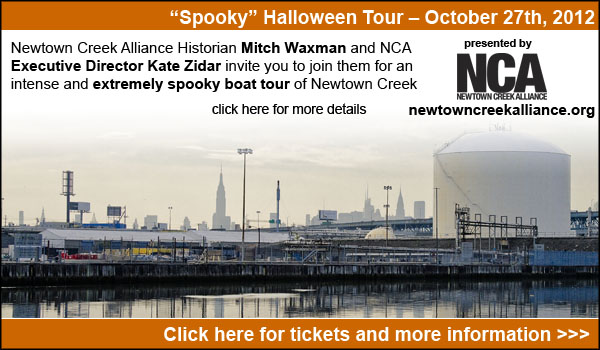
for more information on the October 27th Newtown Creek Boat Tour, click here

for more information on the November 9th Newtown Creek Magic Lantern Show, click here

for an expanded description of the November 11th Newtown Creek tour, please click here
Long Island Zen (reblog)
Reblogged from June of 2009,
Know this spot?

Long Island City -photo by Mitch Waxman
It’s a backroad, by LIC standards.
It’s 51st Avenue and what would be 21st street, and it smells heavily from the garbage bins of a commercial fish butcher just up the block on the corner of 23rd street. During the festering heat of the late summer in New York, crossing the street- if not avoiding the block all together- is advisable. Across the street are fallow lots of illegally dumped industrial garbage and the Crows picking it over.
Crows are metal collectors, usually immigrants who have a tradition of “ship-breaking” or “shanty towns” in their country of origin. They see value in what others see as trash.
Metal buyers in Long Island City and especially Greenpoint and East Williamsburg pay, by the pound, for the collected materials. If copper wire is found, the collector is expected to burn off the insulation, despite the toxicity of doing so. Its not the buyers problem, he just wants the commodity. Want to see it in action- hang out on the corner of Greenpoint avenue and Moultrie St. in Greenpoint, Brooklyn. This is recycling.

Pretty darn close to 51st Avenue and what would be 21st street- It’s the Circus Train!!! -photo by Mitch Waxman
In 1908, a fire at the nearby Blanchard Building- which housed the works of J.F. Blanchard, makers of fireproof doors and shutters- was started by an inferno at the Pratt & Lambert varnish works next door. The fire soon began to spread and a great crowd watched as groups of firemen tried to battle the out of control blaze. The great fear was that the nearby Columbia Paper Bag company would be set alight, which would provide ample fuel for an inferno that might spread beyond Borden Avenue and to the shores of the Newtown Creek.
There is a Blanchard Building on the site today, and it does seem quite fireproof, although Blanchard is long gone. J.F. Blanchard eventually merged with the John W. Rapp company and became the United States Metal Products Company.
View the Blanchard Building in a google map, clicking streetview- from the LIE- its the large structure with the two billboards.
Blanchard manufactured hollow, sheet-metal, fireproof doors. Their Type A and Type B were endorsed by the National Board of Fire Underwriters in Chicago. Installation of thee doors would reduce fire insurance costs by a significant margin. A major influence on the bottom line here in the dense agglutination of industry here on the Newtown Creek.

Down under the Long Island Expressway- DULIE -photo by Mitch Waxman
51st avenue dead ends at the Long Island Railroad tracks, and what would be 21st street is a pedestrian rail bridge (which Forgotten-Ny once christened “the 21st street Bridge“) that goes over the train tracks and under the Highway, which channels the constant stream of vehicular traffic (some 83,900 cars and trucks a day) flowing east out of the toll plaza at the Midtown Tunnel to the highways threading out through Queens and ultimately to Long Island.
note- this bridge has a lamppost which was one of the ones tagged with “occult” grafiti, as discussed in an earlier post.

LIRR crosses Borden Avenue -photo by Mitch Waxman
Nearby, the 800 pound gorilla crosses Borden Avenue at grade (street level). One of the few places in New York City that the Long Island Rail Road still does so.
These tracks lead between the Hunters Point Avenue station and the Long Island City station, and up until the 1950′s such grade crossings were a constant nuisance and mortal threat to the citizens of Long Island City- here in the Newtown Pentacle.
morning bright

– photo by Mitch Waxman
For once, the smell at the corner of 49th street and 56th road/Laurel Hill Blvd./Rust street isn’t being caused by the infamously aromatic Maspeth Creek tributary of the larger Newtown Creek.
It’s the three headless chickens which are rotting away on the train tracks.

– photo by Mitch Waxman
These bird corpses turned up at this crossroad shortly after the last full moon, without their heads, and have been left to moulder away. My personal theory, which has been enhanced by a recent addition on the other track of dinnerware adorned with coins and candles, is that this is some sort of “Santeria” thing- however- there are other logical possibilities…

– photo by Mitch Waxman
It is entirely possible that this trio “made a break for it” from a nearby “pollo vivo” establishment, were walking down the tracks, and were struck by a passing train which decapitated them. Often has this, your Newtown Pentacle, adjured against walking these active and street grade trackways- proclaiming the existential and mortal dangers of such activity to urban explorers and other photographers. Here is tangible evidence of what might happen to you.

– photo by Mitch Waxman
There might also be some sort of bird mafia at work around West Maspeth, and these three chickens might have been left out in public view as a lesson to those who might snitch to the authorities about their illicit activities. “Dese boids mights beze Canaries takins a doit nap”. You don’t screw around with the Goodfeathers around Maspeth.

– photo by Mitch Waxman
Jocularity notwithstanding, it is likely a religious thing we are looking at here. The number three is significant, as is the positioning of the bodies at the crossroads of a north/south and east/west path. As stated in the past, your humble narrator is not overly familiar with the syncretic religions of the Caribbean or Central American cultures, but can spot “magick” at a hundred paces.
final destinations
This is tomorrow, as in Sunday the 22nd. Seriously- you can count the number of seats left with one hand. If you haven’t got your tickets yet, today is probably your last chance.
 |
 |
Many people know about the environmental issues facing Newtown Creek, but did you know that the Creek was once the busiest waterway in North America, carrying more industrial tonnage than the entire Mississippi River?
You’ll learn much more when Working Harbor Committee’s maritime historians and harbor experts
put it all in context during a Hidden Harbor Tours: Newtown Creek Exploration.
The heart of industrial New York, Newtown Creek was home port to hundreds of tugboats (one of which is the historic WO Decker). It was also an international destination for oceangoing ships and a vast intermodal shipping and manufacturing hub that employed hundreds of thousands of people. Forming the border of Brooklyn and Queens for nearly three miles, five great cities grew rich along the Newtown Creek’s bulkheads — Greenpoint, Willamsburg, Bushwick, Long Island City and Manhattan itself. The waterway is still a vital part of the harbor and the Working Harbor Committee (WHC) is proud to present this tour as part of the celebration of their tenth anniversary year.
Mitch Waxman, a member of WHC’s steering committee and the group’s official photographer, also serves with the Newtown Creek Alliance as its group Historian. In addition to working on WHC’s boat tours of the Creek, Mitch offers a regular lineup of popular walking tours, and presents a series of well-attended slideshows for political, governmental, antiquarian, historical and school groups. His website – newtownpentacle.com – chronicles his adventures along the Newtown Creek and in the greater Working Harbor.
He was recently profiled in the NY Times Metro section, check out the article here.
Upcoming tour: Hidden Harbor Tours: Newtown Creek Exploration.
On July 22nd, Mitch shares his unique point of view and deep understanding of the past, present and future conditions of the Newtown Creek as the narrator and expedition leader for this years Hidden Harbor Tours: Newtown Creek exploration.
Our NY Water Taxi leaves from South Street Seaport at 11 a.m. (sharp) on a three hour tour of the Newtown Creek. From the East River we’ll move into the Newtown Creek where we’ll explore explore vast amounts of maritime infrastructure, see many movable bridges and discover the very heart of the Hidden Harbor.
Limited seating available, get your tickets today.
 |
|||||||||||||||
|
|||||||||||||||


nature transmutes

– photo by Mitch Waxman
A humble narrator just can’t get enough of the Long Island Railroad yard in Long Island City.
Back in January of this year, while “wondering uneasily“, we established that the LIRR station in Long Island City accomplishes tasks which it would take some 30,000 horses to accomplish on a daily basis. Last year, in October- these very tracks were visited in “Deeply Hidden“.
Simply put, I’m kind of drawn to this spot.
from wikipedia
This station has 13 tracks, two concrete high-level island platforms, and one wooden high-level island platform. All platforms are two cars long and accessible from Borden Avenue just west of Fifth Street. The northernmost one, adjacent to tracks 2 and 3, is the only one used for passenger service. The other concrete platform adjacent to tracks 6 and 7 and the wooden one adjacent to tracks 8 and 9 are used for employees only. All tracks without platforms are used for train storage. The southernmost four tracks are powered by third rail while the remaining tracks are used only by diesel-powered trains.

– photo by Mitch Waxman
Once upon a time, street grade rail crossings were pretty common in Western Queens, but these days there are only a few that I know about. As always, never will I claim to be an expert on this subject, as there’s too many alphanumeric terms involved for me to remember. As mentioned in the past, mathematics isn’t my strong suit, and I’ve always been cursed by a sort of numbers based dyslexia. I’m all ‘effed up.
from wikipedia
The Long Island Rail Road owns an electric fleet of 836 M7 and 170 M3 electric multiple unit cars, and 134 C3 bilevel rail cars powered by 23 DE30AC diesel-electric locomotives and 22 DM30AC dual-mode locomotives.
In 1997 and 1998, the LIRR received 134 double-decker passenger cars from Kawasaki, including 23 cab control cars, and 46 General Motors Electro-Motive Division diesel-electric locomotives (23 diesel DE30ACs and 23 dual-mode DM30ACs) to pull them, allowing trains from non-electric territory to access Penn Station for the first time in many years, due to the prohibition on diesel operation in the East River Tunnels leading to Penn Station.

– photo by Mitch Waxman
Arithmetic challenged, in a Jewish family, this marks one as worse than an idiot. The stereotype which opines that Jews are possessed of a certain aptitude for mathematics is fairly accurate (or at least it generally is in my family), and black sheep status was assigned me as early as second grade when they rolled out long division. Consistently low scores on the math section of standardized testing always betrayed my inadequacies to scholastic authorities, and was a great cause of concern to my parents. Reports from teachers fed their dire suspicions that I would someday end up “a bum on da bowery” or “shovelin shit on da street”.
from wikipedia
The DE30AC and DM30AC locomotives replaced aging GP38s, Alco FA1/FA2s, F7As and F9As, and MP15AC and SW1001 locomotives, with GP38s used to push and pull diesel trains and other locomotives used to provide HEP for the trains. The bodies of the DE30AC and the DM30AC are similar; the difference is the ability of the DM30AC to use electric third rail while the diesel engine is off, enabling the locomotive to use the East River Tunnels into New York Penn Station. DM30ACs have third rail contact shoes, permitting direct service from non-electrified lines in eastern Long Island via the western electrified main lines all the way to Penn Station. A few such trains a day run on the Port Jefferson, Oyster Bay, and Montauk Branches. The engines’ naming scheme: DM = Dual Mode, DE = Diesel Engine, 30 = 3000 hp, AC = Alternating Current traction motors.

– photo by Mitch Waxman
I’m told that people suffering from several different cognitive disorders spend their time memorizing train schedules and details about the rail system, and that they find some solace in the purely numerical language which governs the subject. Me, I just wander around aimlessly, and get the giggles when I’m lucky enough to randomly come across a train passing so close by. My major malfunction is taking too many pictures of trains and boats, it would seem.
from 1877′s “Long Island and where to go!!: A descriptive work compiled for the Long R.R. Co.“, courtesy google books:
Long Island City is the concentrating point upon the East river, of all the main avenues of travel from the back districts of Long Island to the city of New York. The great arteries of travel leading from New York are Thomson avenue, macadamized, 100 feet wide, leading directly to Newtown, Jamaica and the middle and southern roads on Long Island, and Jackson avenue, also 100 feet wide, and leading directly to Flushing, Whitestone and the northerly roads.
Long Island City is also the concentrating point upon the East river, of the railway system of Long Island.
The railways, upon reaching the city, pass under the main avenues of travel and traffic, and not upon or across their surface.


 The Newtown Pentacle